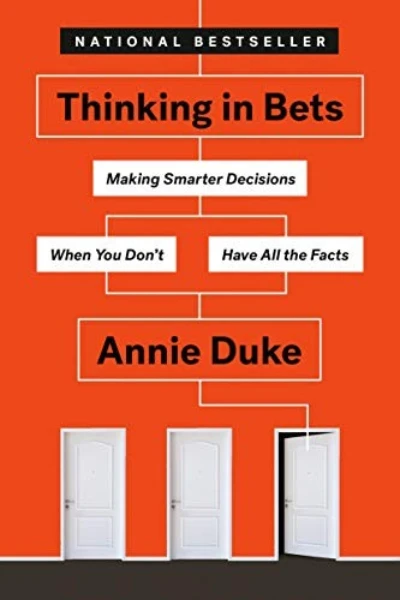
Thinking in Bets
Thinking in Bets — “Yeah, but what have you done for me lately?”
impact. Our decision-making becomes reactive, focused on off-loading negative emotions or sustaining positive emotions from the latest change in the status quo. We can see how this can result in self-serving bias: fielding outcomes to off-load the negative emotions we feel in the moment from a bad outcome by blaming them on luck and sustaining the positive emotions from good outcomes by taking credit for them. The decisions driven by the emotions of the moment can become a self-fulfilling prophecy, degrading the quality of the bets we make, increasing the chances of bad outcomes, and making things worse.
“Yeah, but what have you done for me lately?”
Watching the ticker doesn’t just magnify what has happened in the very recent past. It distorts our view of it as well. To understand the additional element of distortion, the casino is a great place to look.
Imagine that you go to a casino for an evening of blackjack with your friends. In the first half hour, you go on a winning streak and are ahead $1,000. You keep playing because you and your friends are having such a good time. For the next hour and a half, it seems like you never win a hand.
You lose back the $1,000 and break even for the night. How are you feeling about that?
Now imagine that you lose $1,000 in the first half hour and stick around playing with your friends because they are having a great time. In the next hour and a half you go on a winning streak that erases the early loss, and you end up breaking even for the night. How are you feeling about that?
I’m guessing you are pretty sad and morose about starting off with the big win, only to break even. In the second example, you’re probably so happy that the drinks are on you. While you took a different path to get there, in both cases you didn’t win or lose a dime at the end of the two hours. But in one case you are really sad about the result and the other really happy.
As they say in the infomercial world, “But, wait! There’s more!”
Imagine you go up that same $1,000 in the first half hour but now, over the next hour and a half, you can’t seem to win a hand and lose $900 back, ending the night with a $100 win. How does that feel? Now imagine that you lost that same $1,000 in the first half hour but then went on a winning streak to end the night down only $100. How does that feel? Most likely, you’re pretty glum about the $100 win but still buying drinks for everyone after recovering from that terrible start to only lose $100. So you’re sad that you won $100 and happy that you lost $100.
The way we field outcomes is path dependent. It doesn’t so much matter where we end up as how we got there. What has happened in the recent past drives our emotional response much more than how we are doing overall. That’s how we can win $100 and be sad, and lose $100 and be happy. The zoom lens doesn’t just magnify, it distorts. This is true whether we are in a casino, making investment decisions, in a relationship, or on the side of the road with a flat tire. If we got a big promotion last week and have a flat tire right now, we are cursing our lives, complaining about how unlucky we are. Our feelings are not a reaction to the average of how things are going. We feel sad if we are breaking even (or winning) on an investment that used to be valued much higher. In relationships, even small disagreements seem big in the midst of the disagreement. The problem in all these situations (and countless others) is that our in-the- moment emotions affect the quality of the decisions we make in those moments, and we are very willing to make decisions when we are not emotionally fit to do so.
Now imagine if you had gone for that night of blackjack a year ago.
When you think about the outcomes as having happened in the distant past, it is likely your preference for the results reverses, landing in a more rational place. You are now happier about the $100 win than about the $100 loss. Once we pull ourselves out of the moment through time-traveling exercises, we can see these things in proportion to their size, free of the distortion caused by whether the ticker just moved up or down.
This is a constant challenge in poker. While the moving scoreboard has the upside of reminding players that all their decisions have consequences, there is also a downside. The scoreboard, like a stock ticker, reflects the most recent changes, creating a risk that players get caught up in ticker