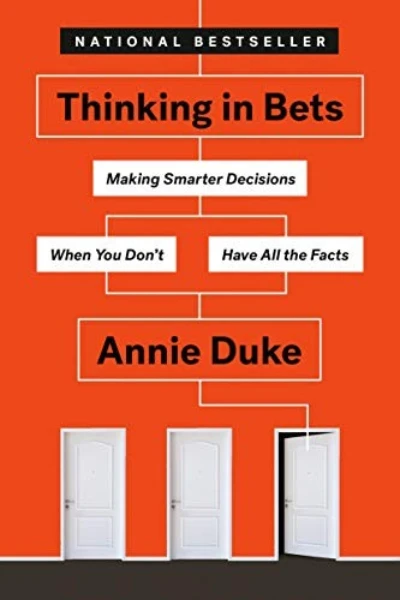
Thinking in Bets
Thinking in Bets — “If it weren’t for luck, I’d win every one”
next try. When you withdraw the reward from those rats, the lever-pressing behavior extinguishes only after a very long time of fruitless lever pushing, sometimes thousands of tries.
We might imagine the rats thinking, “I bet the next lever press will get me a pellet. . . . I’ve just been getting unlucky . . . I’m due.” Actually, we don’t even have to imagine this. We can hear it if we listen to what people say while they play slot machines. Slot machines operate on a variable- payoff system. It’s no wonder that, despite those machines being among the worst bets in the casino, the banks of slots in a casino are packed. In the end, our rat brains dominate.
If this all doesn’t seem difficult enough, outcomes are rarely all skill or all luck. Even when we make the most egregious mistakes and get appropriately negative outcomes, luck plays a role. For every drunk driver who swerves into a ditch and flips his car, there are several who swerve harmlessly across multilane highways. It might feel like the drunk driver in the ditch deserved that outcome, but the luck of the road conditions and presence or absence of other drivers also played a role. When we do everything right, like drive through a green light perfectly sober and live to tell the tale, there is also an element of luck. No one else simultaneously ran a red light and hit us. There wasn’t a patch of ice on the road to make us lose control of our vehicle. We didn’t run over a piece of debris and blow a tire.
When we field our outcomes as the future unfolds, we always run into this problem: the way things turn out could be the result of our decisions, luck, or some combination of the two. Just as we are almost never 100% wrong or right, outcomes are almost never 100% due to luck or skill.
Learning from experience doesn’t offer us the orderliness of chess or, for that matter, folding and sorting laundry. Getting insight into the way uncertainty trips us up, whether the errors we make are patterned (hint: they are) and what motivates those errors, should give us clues for figuring out achievable strategies to calibrate the bets we make on our outcomes.
“If it weren’t for luck, I’d win every one”
Just as with motivated reasoning, our fielding errors aren’t random. They are, borrowing from psychologist and behavioral economist Dan Ariely,* “predictably irrational.” The way we field outcomes is predictably patterned: we take credit for the good stuff and blame the bad stuff on luck so it won’t be our fault. The result is that we don’t learn from experience well.
“Self-serving bias” is the term for this pattern of fielding outcomes.
Psychologist Fritz Heider was a pioneer in studying how people make luck and skill attributions about the results of their behavior. He said we study our outcomes like scientists, but like “naïve scientists.” When we figure out why something happened, we look for a plausible reason, but one that also fits our wishes. Heider said, “It is usually a reason that flatters us, puts us in a good light, and it is imbued with an added potency by the attribution.”
Our capacity for self-deception has few boundaries. Look at the reasons people give for their accidents on actual auto insurance forms: “I collided with a stationary truck coming the other way.” “A pedestrian hit me and went under my car.” “The guy was all over the road. I had to swerve a number of times before I hit him.” “An invisible car came out of nowhere, struck my car, and vanished.” “The pedestrian had no idea which direction to run, so I ran over him.” “The telephone pole was approaching. I was attempting to swerve out of its way when it struck my car.”* Stanford law professor and social psychologist Robert MacCoun studied accounts of auto accidents and found that in 75% of accounts, the victims blamed someone else for their injuries. In multiple-vehicle accidents, 91% of drivers blamed someone else. Most remarkably, MacCoun found that in single-vehicle accidents, 37% of drivers still found a way to pin the blame on someone else.
We can’t write this off to lack of self-knowledge by a few bad drivers.
John von Neumann, considered a terror on the roads of Princeton, New Jersey, once offered this explanation after smashing his car: “I was proceeding down the road. The trees on the right were passing me in orderly fashion at 60 MPH. Suddenly, one of them stepped out in my path.
Boom!” Et tu, JvN? Et tu?
This predictable fielding error is probably the single most significant problem for poker players. I watched it firsthand with Nick the Greek at the Crystal Lounge. When he lost with seven-deuce, it was because he got
unlucky that time. When he won playing those cards, it was because his plan of “surprise attack” was so brilliant. Off-loading the losses to luck and onboarding the wins to skill meant he persisted in overestimating the likelihood of winning with seven-deuce. He kept betting on a losing future.
And this is not confined to Nick the Greeks of the small-time Billings variety. Phil Hellmuth, the biggest winner in World Series of Poker history (fourteen championship bracelets and counting), famously fell prey to this fielding error. After getting eliminated from a televised poker tournament, Hellmuth said on camera to ESPN, “If it weren’t for luck, I’d win every one.” This line has become legend in the poker world. (It was even the basis for a song, “I’d Win Everytime [If It Wasn’t for Luck]” in All In: The Poker Musical, a show based on Phil’s life.) When the ESPN episode aired, there was a collective gasp in the poker community. After all, Phil is saying that if the luck element were eliminated from poker—if he were playing chess— his poker skills are so superior that he would win every tournament he entered. So, clearly, any negative outcomes are due to luck, and any positive outcomes are the result of his superior skill.
Poker players may have gasped, but the only difference between Phil and everyone else is that he said this out loud and on television. Most of us just have the sense to keep the sentiment to ourselves, especially when the cameras and mics are on. But, trust me, we are all vulnerable to the exact same thinking.
I, certainly, am not exempt. When I was playing poker, I did my share of taking credit for winning and complaining about bad luck when I lost.
It’s a fundamental urge. I’ve been conscious of that tendency in all areas of my life. Remember, we can know it’s a visual illusion, but that doesn’t keep us from still seeing it.
Self-serving bias has immediate and obvious consequences for our ability to learn from experience.* Blaming the bulk of our bad outcomes on luck means we miss opportunities to examine our decisions to see where we can do better. Taking credit for the good stuff means we will often reinforce decisions that shouldn’t be reinforced and miss opportunities to see where we could have done better. To be sure, some of the bad stuff that happens is mainly due to luck. And some of the good stuff that happens is mainly due to skill. I just know that’s not true all the time. 100% of our bad outcomes aren’t because we got unlucky and 100% of our good outcomes aren’t
because we are so awesome. Yet that is how we process the future as it unfolds.
The predictable pattern of blaming the bad stuff on the world and taking credit for the good stuff is by no means limited to poker or car accidents. It’s everywhere.
When Chris Christie participated in a debate before the Republican presidential primary in Iowa in early 2016, he played the part of behavioral psychologist in his attack on Hillary Clinton’s response to the tragic outcome in Benghazi: “She refuses to be held accountable for anything that goes wrong. If it had gone right, believe me, she would have been running around to be able to take credit for it.” Whether or not the accusation is correct, Christie certainly got the human tendency right: we take credit for good things and deflect blame for bad things. Ironically, only minutes earlier, he offered a pretty competitive example of the bias in himself.
When asked by the moderator if the GOP should take a chance on nominating him in light of Bridgegate, he answered, “Sure, because there’s been three different investigations that have proven that I knew nothing.”
Then he added, “And let me tell you something else. I inherited a state in New Jersey that was downtrodden and beaten by liberal Democratic policies, high taxes, high regulation. And this year, in 2015, New Jersey had the best year of job growth that our state has ever had in the last fifteen years. That’s because we’ve put conservative policies in place.”
That’s a pretty fast pivot from “that bad outcome isn’t my fault” to “and let me tell you the good outcome I can take credit for.”
I described this pattern during an address at a meeting of the International Academy of Trial Lawyers (IATL). One lawyer in the audience rushed to tell me after the speech about a senior partner he trained under when he was first out of law school. “You won’t believe how on- point this is, Annie. I assisted this partner at several trials and at the end of each day, he would analyze the witness testimony the same way. If the witness helped our case, he would say, ‘You see how well I prepared that witness? When you know how to prepare a witness, you get the results you want.’ If the witness hurt our case, he would tell me, ‘That guy refused to listen to me.’ It never varied.”
I’m betting any parent of a school-aged child knows this. On occasions when my kids have done poorly on a test, it seems to have never been