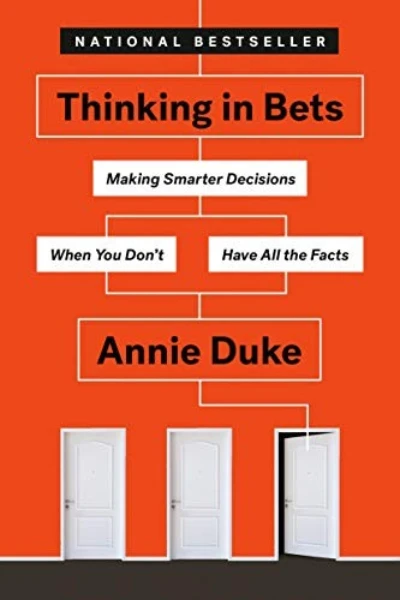
Thinking in Bets
Thinking in Bets — A lethal battle of wits
Incomplete information poses a challenge not just for split-second decision-making, but also for learning from past decisions. Imagine my difficulty as a poker player in trying to figure out if I played a hand correctly when my opponents’ cards were never revealed. If the hand concluded after I made a bet and my opponents folded, all I know is that I won the chips. Did I play poorly and get lucky? Or did I play well?
If we want to improve in any game—as well as in any aspect of our lives—we have to learn from the results of our decisions. The quality of our lives is the sum of decision quality plus luck. In chess, luck is limited in its influence, so it’s easier to read the results as a signal of decision quality.
That more tightly tethers chess players to rationality. Make a mistake and your opponent’s play points it out, or it is capable of analysis afterward.
There is always a theoretically right answer out there. If you lose, there is little room to off-load losing to any other explanation than your inferior decision-making. You’ll almost never hear a chess player say, “I was robbed in that game!” or, “I played perfectly and caught some terrible breaks.” (Walk the hallways during a break in a poker tournament and you’ll hear a lot of that.) That’s chess, but life doesn’t look like that. It looks more like poker, where all that uncertainty gives us the room to deceive ourselves and misinterpret the data. Poker gives us the leeway to make mistakes that we never spot because we win the hand anyway and so don’t go looking for them, or the leeway to do everything right, still lose, and treat the losing result as proof that we made a mistake. Resulting, assuming that our decision-making is good or bad based on a small set of outcomes, is a pretty reasonable strategy for learning in chess. But not in poker—or life.
Von Neumann and Morgenstern understood that the world doesn’t easily reveal the objective truth. That’s why they based game theory on poker. Making better decisions starts with understanding this: uncertainty can work a lot of mischief.
A lethal battle of wits
In one of the more famous scenes in The Princess Bride, the Dread Pirate Roberts (the love-besotted Westley) catches up to Vizzini, the mastermind who kidnapped Princess Buttercup. Having vanquished Fezzik the Giant in a battle of strength and having outdueled swordsman Inigo Montoya, the Dread Pirate Roberts proposes he and Vizzini compete in a lethal battle of wits, which provides a great demonstration of the peril of making decisions with incomplete information. The pirate produces a packet of deadly iocane powder and, hiding two goblets of wine from view, he empties the packet, and puts one goblet in front of himself and the other in front of Vizzini.
Once Vizzini chooses a goblet, they will both drink “and find out who is right and who is dead.”
“It’s all so simple,” Vizzini scoffs. “All I have to do is deduce, from what I know of you, the way your mind works. Are you the kind of man who would put the poison into his own glass, or into the glass of his enemy?” He provides a dizzying series of reasons why the poison can’t (or must) be in one cup, and then in the other. His rant accounts for cleverness, anticipating cleverness, iocane’s origin (the criminal land of Australia), untrustworthiness, anticipating untrustworthiness, and dueling presumptions related to Westley defeating the giant and the swordsman.
While explaining all this, Vizzini diverts Westley’s attention, switches the goblets, and declares that they should drink from the goblets in front of them. Vizzini pauses for a moment and, when he sees Westley drink from his own goblet, confidently drinks from the other.
Vizzini roars with laughter. “You fell victim to one of the classic blunders. The most famous is ‘Never get involved in a land war in Asia,’ but only slightly less well known is this: ‘Never go in against a Sicilian when death is on the line.’”
In the midst of laughing, Vizzini falls over, dead. Buttercup says, “To think, all that time it was your cup that was poisoned.”
Westley tells her, “They were both poisoned. I’ve spent the last two years building up immunity to iocane powder.”
Like all of us, Vizzini didn’t have all the facts. He considered himself a genius without equal: “Let me put it this way. Have you ever heard of Plato, Aristotle, Socrates? Morons.” But, also like all of us, he underestimated the amount and effect of what he didn’t know.
Suppose someone says, “I flipped a coin and it landed heads four times in a row. How likely is that to occur?”
It feels like that should be a pretty easy question to answer. Once we do the math on the probability of heads on four consecutive 50-50 flips, we can determine that would happen 6.25% of the time (.50 × .50 × .50 × .50).
That’s making the same mistake as Vizzini. The problem is that we came to this answer without knowing anything about the coin or the person flipping it. Is it a two-sided coin or three-sided or four? If it is two-sided, is it a two-headed coin? Even if the coin is two-sided (heads and tails), is the coin weighted to land on heads more often than tails (but maybe not always)? Is the flipper a magician who is capable of influencing how the coin lands? This information is all incomplete, yet we answered the question as if we had examined the coin and knew everything about it. We never considered that both goblets might be poisoned. (“Inconceivable” would have been Vizzini’s term, had he been able to comment on his own death.) Now if that person flipped the coin 10,000 times, giving us a sufficiently large sample size, we could figure out, with some certainty, whether the coin is fair. Four flips simply isn’t enough to determine much about the coin.
We make this same mistake when we look for lessons in life’s results.
Our lives are too short to collect enough data from our own experience to make it easy to dig down into decision quality from the small set of results we experience. If we buy a house, fix it up a little, and sell it three years later for 50% more than we paid, does that mean we are smart at buying and selling property, or at fixing up houses? It could, but it could also mean there was a big upward trend in the market and buying almost any piece of property would have made just as much money. Or maybe buying that same house and not fixing it up at all might have resulted in the same (or even better) profit. A lot of previously successful house flippers had to face that real possibility between 2007 and 2009.
When someone asks you about a coin they flipped four times, there is a correct answer: “I’m not sure.”