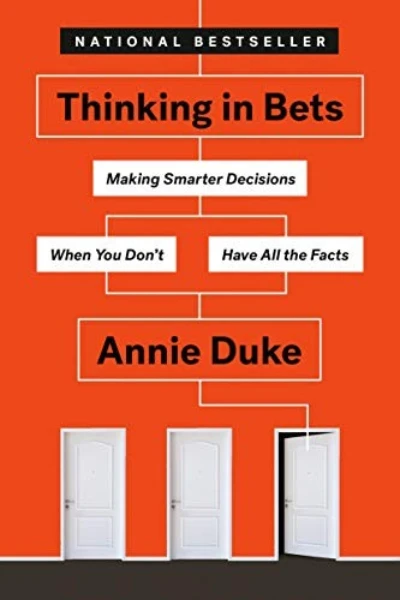
Thinking in Bets
Thinking in Bets — People watching
experience is difficult—and sometimes impossible—with this kind of biased, broad-brush thinking. Outcomes are rarely the result of our decision quality alone or chance alone, and outcome quality is not a perfect indicator of the influence of luck or skill. When it comes to self-serving bias, we act as if our good outcomes are perfectly correlated to good skill and our bad outcomes are perfectly correlated to bad luck.* Whether it is a poker hand, an auto accident, a football call, a trial outcome, or a business success, there are elements of luck and skill in virtually any outcome.
That the motivation to update our self-image in a positive way underlies self-serving bias gives us an idea of where we might look for solutions to overcome the bias. Maybe we could stop clinging to ego, giving up on that need to have a positive narrative of our lives. Maybe we could still drive a positive narrative but, instead of updating through credit and blame, we could get off on striving to be more objective and open- minded in assessing the influence of luck and skill on our outcomes. Maybe we could put in the time and hard work to retrain the way we process results, moving toward getting our positive self-image updates from accurate fielding, from truthseeking.
Or maybe we could detour around the obstacles altogether by finding a work-around that doesn’t require us to address self-serving bias at all.
People watching
One could conceivably argue that maybe self-serving bias isn’t such a big deal because we can learn from other people’s experience. Maybe the solution that has evolved is to compensate for the obstacles in learning from our own experience by watching other people do stuff. There are more than seven billion other people on the planet who do stuff all the time. As Yogi Berra said, “You can observe a lot by watching.”
Watching is an established learning method. There is an entire industry devoted to collecting other people’s outcomes. When you read the Harvard Business Review or any kind of business or management case study, you’re trying to learn from others. An important element of medical education is watching doctors perform medical procedures or other caregivers do their
jobs up close. They watch, then they assist . . . and then, hopefully, they’ve learned. Who would want a surgeon who says, “This will be the first time I’ve seen inside a live human body”? It’s possible we could follow that example, going to school on the experiences of the people around us.
In poker, the bulk of what goes on is watching. An experienced player will choose to play only about 20% of the hands they are dealt, forfeiting the other 80% of the hands before even getting past the first round of betting. That means about 80% of the time is spent just watching other people play. Even if a poker player doesn’t learn all that efficiently from the outcomes of the hands they play themselves, there is still a whole lot to be learned from watching what happens to the other players in the game. After all, there is four times as much watching everyone else as there is playing a hand yourself.
Not only are all those other people’s outcomes plentiful, they are also free (aside from any ante). When a poker player chooses to play a hand, they are putting their own money at risk. When a poker player is just watching the game, they get to sit back while other people put money at risk. That’s an opportunity to learn at no extra cost.
When any of us makes decisions in life away from the poker table, we always have something at risk: money, time, health, happiness, etc. When it’s someone else’s decision, we don’t have to pay to learn. They do. There’s a lot of free information out there.
Unfortunately, learning from watching others is just as fraught with bias. Just as there is a pattern in the way we field our own outcomes, we field the outcomes of our peers predictably. We use the same black-and- white thinking as with our own outcomes, but now we flip the script. Where we blame our own bad outcomes on bad luck, when it comes to our peers, bad outcomes are clearly their fault. While our own good outcomes are due to our awesome decision-making, when it comes to other people, good outcomes are because they got lucky. As artist and writer Jean Cocteau said, “We must believe in luck. For how else can we explain the success of those we don’t like?”
When it comes to watching the bad outcomes of other people, we load the blame on them, quickly and heavily. One of the most famous moments in baseball history, in which 40,000 people at a baseball stadium and tens of millions around the world instantly blamed an otherwise typical fan for
keeping the Chicago Cubs out of the World Series, demonstrates this. The incident is known as the Bartman play.
In 2003, the Chicago Cubs were one game from reaching their first World Series since 1945. They led three games to two in the series against the Florida Marlins, and led Game Six with one out in the top of the eighth inning. A Marlins hitter lifted a foul fly toward the left-field stands. At the base of the sloping wall separating spectators from the field, Cubs left fielder Moises Alou reached his glove over his head for the ball as several spectators on the other side of the wall also reached for it. One of the 40,000 spectators at Wrigley Field, Steve Bartman, deflected the ball, which then bounced off the railing, landing at the feet of another spectator. Alou stormed away, expressing anger at the fan who kept him from attempting to catch the ball.
The Cubs had a 3–0 lead at the time Bartman, those folks near him, and Moises Alou reached for the foul ball. Had Alou caught it, the Cubs would have been four outs from reaching the World Series. Here’s how the future unfolded after Bartman touched the ball: The Cubs lost the game, and Game Seven too, failing again to reach the World Series. Bartman got the blame, first from the 40,000 people present (who pointed and chanted “A**hole!,” threw beer and garbage at him, and yelled death threats), then from the millions of Cubs fans, not just on sports and news shows replaying the incident at the time but for more than a decade. One person who actually assaulted Bartman while he was surrounded by stadium security said, “I wanted to expose him for ruining what could have been a once-in-a-lifetime experience.”
Steve Bartman had a bad outcome. He reached for the ball, and the Cubs eventually lost. Was that due to his bad decision-making or bad luck?
To be sure, he made the decision to reach for the ball, so there was some skill in that. He also, however, had an overwhelming amount of bad luck.
Almost uniformly, people discounted that bad luck, blaming Bartman for the loss of that game and the series itself.
Alex Gibney’s ESPN documentary on the Bartman play, Catching Hell, displays the double standard, showing the replay from numerous angles and interviewing spectators and members of the media from the scene. Gibney noted (and the footage clearly showed), “There are a lot of people who went for that ball.” One fan, who lunged right next to Bartman for the ball,
couldn’t deny that he had reached for the ball, the same as Bartman. “I went for the ball. There’s no way . . . I obviously went for the ball.” Yet, he tried to claim that, unlike Bartman, he never would have interfered with the play: “Once I saw [Moises Alou’s] glove, I had no interest in the ball.” That fan, at once, took credit for his good outcome in not having touched the ball and placed blame squarely on Bartman’s decision-making rather than bad luck.
While everybody in the vicinity behaved the same way, Bartman was the unlucky one who touched the baseball. But the fans didn’t see it as bad luck. They saw it as his fault. Worse yet, none of the subsequent things that happened in the game—all clearly outside Bartman’s control—mitigated his responsibility. Remember that after that ball landed in the stands, the Cubs were in the same position they were in before the Bartman play. They still had the Marlins down to their last five outs, with a 3–0 lead in the game, their ace pitcher hurling a shutout, and a 3–2 lead in a best-of-seven series.
That batter who hit the foul ball was still at the plate, with a 3–2 count. The Marlins went on to score eight runs in the inning, seven of them after (two batters later) the Cubs shortstop, Alex Gonzalez, bobbled an inning-ending double-play ball for an error.
Bartman had a lot of bad luck to end up with that result, much of which had to do with the play of the team, over which Bartman clearly had no control. The fans, nevertheless, laid all the blame on Bartman rather than on, say, Gonzalez. Nearby fans yelled, “Rot in hell! Everyone in Chicago hates you! You suck!” As he walked through the concourse, people yelled, “We’re gonna kill you! Go to prison!” “Put a twelve-gauge in his mouth and pull the trigger!”
It would be nice if a story line developed that gave Steve Bartman credit for the Cubs winning the World Series in 2016. After all, Steve Bartman was a key player in the chain of events responsible for a moribund franchise hiring baseball-turnaround specialist Theo Epstein as president of baseball operations and Joe Maddon as manager. Not surprisingly, that narrative hasn’t gotten any traction.* We see this pattern of blaming others for bad outcomes and failing to give them credit for good ones all over the place. When someone else at work gets a promotion instead of us, do we admit they worked harder than and deserved it more than we did? No, it was because they schmoozed the boss. If someone does better on a test at school, it was because the teacher
likes them more. If someone explains the circumstances of a car accident and how it wasn’t their fault, we roll our eyes. We assume the cause was their bad driving.
When I started in poker, I followed the same pattern (and still fight the urge in every area of my life to this day). Even though I was quick to take credit for my own successes and blame bad luck for my losses, I flipped this when evaluating other players. I didn’t give other players enough credit for winning (or, viewed another way, give other players credit for my losing) and I was quick to blame their losses on their poor play.
When I first started, my brother gave me a list of cards that were good to play, written on a napkin while we were eating in a coffee shop at Binion’s Horseshoe Casino. I clutched this napkin like I was Moses clutching the Ten Commandments. When I saw people win with hands that were not on my brother’s list, I dismissed it as good luck since they clearly did not know how to play. I was so closed-minded to the thought that they might deserve credit for winning that I didn’t even bother to describe these hands to my brother to ask him if there might be a good reason they would play a hand off the list.
As my understanding of the game grew over time, I realized the hands on that list weren’t the only hands you could ever play. For one thing, only playing hands on the list meant you would never bluff. My brother gave me that list to keep me, a total novice, out of trouble. He gave me that list because the hands he was telling me to play would limit the mistakes a total beginner might make. I didn’t know that, depending on all sorts of factors, sometimes there are hands that wouldn’t be on the list that would be perfectly okay to play.
Even though I had access to the list writer, I never asked my brother why these guys were playing these off-list cards. My biased assessment of why they were winning slowed my learning down considerably. I missed out on a lot of opportunities to make money because I dismissed other players as lucky when I might have been learning from watching them. To be sure, some of those people shouldn’t have been playing those hands and were actually playing poorly. But, as I figured out almost a year into playing, not all of them.
The systematic errors in the way we field the outcomes of our peers comes at a real cost. It doesn’t just come at the cost of reaching our goals