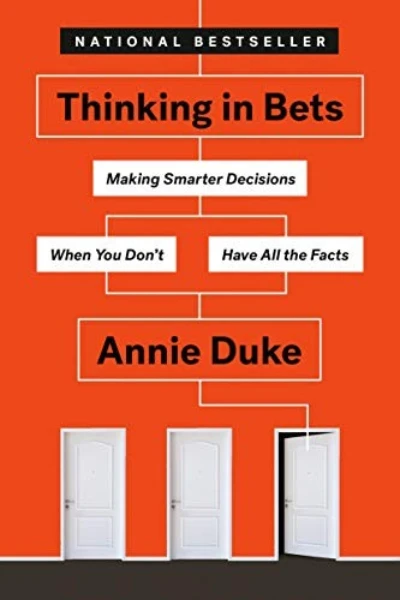
Thinking in Bets
Thinking in Bets — Decision swear jar
In all these instances, the precommitment or predecision doesn’t completely bind our hands to the mast. An emotional, reactive, irrational decision is still physically possible (though, to various degrees, more difficult). The precommitments, however, provide a stop-and-think moment before acting, triggering the potential for deliberative thought. Will that prevent an emotional, irrational decision every time? No. Will we sometimes still decide in a reflexive or mindless way? Of course. But it will happen less often.
Decision swear jar
We all know about the concept of a swear jar: if someone swears, they put a dollar in the jar. The idea behind it is that it will make people mindful about swearing and reduce how much they do it. A “decision swear jar” is a simple kind of precommitment contract that we can apply to many of the key concepts of this book. For the decision swear jar, we identify the language and thinking patterns that signal we are veering from our goal of truthseeking. When we find ourselves using certain words or succumbing to the thinking patterns we are trying to avoid because we know they are signs of irrationality, a stop-and-think moment can be can be created. You can think about this as a way to implement accountability.
We have discussed several patterns of irrationality in the way we lodge beliefs and field outcomes. From these, we can commit to vigilance around words, phrases, and thoughts that signal that we might be not be our most rational selves. Your list of those warning signs will be specific to you (or your family, friends, or enterprise), but here is a sample of the kinds of things that might trigger a decision-interrupt.
Signs of the illusion of certainty: “I know,” “I’m sure,” “I knew it,”
“It always happens this way,” “I’m certain of it,” “you’re 100% wrong,” “You have no idea what you’re talking about,” “There’s no way that’s true,” “0%” or “100%” or their equivalents, and other terms signaling that we’re presuming things are more certain than we
know they are. This also includes stating things as absolutes, like “best” or “worst” and “always” or “never.”
Overconfidence: similar terms to the illusion of certainty.
Irrational outcome fielding: “I can’t believe how unlucky I got,” or the reverse, if we have some default phrase for credit taking, like “I’m at the absolute top of my game” or “I planned it perfectly.” This includes conclusions of luck, skill, blame, or credit. It includes equivalent terms for irrationally fielding the outcomes of others, like, “They totally had that coming,” “They brought it on themselves,” and “Why do they always get so lucky?”
Any kind of moaning or complaining about bad luck just to off-load it, with no real point to the story other than to get sympathy. (An exception would be when we’re in a truthseeking group and we make explicit that we’re taking a momentary break to vent.) Generalized characterizations of people meant to dismiss their ideas: insulting, pejorative characterizations of others, like “idiot” or, in poker, “donkey.” Or any phrase that starts by characterizing someone as “another typical ________.” (Like David Letterman said to Lauren Conrad, he dismissed everyone around him as an idiot, until he pulled himself into deliberative mind one day and asked, “What are the odds that everyone is an idiot?”) Other violations of the Mertonian norm of universalism, shooting the message because we don’t think much of the messenger. Any sweeping term about someone, particularly when we equate our assessment of an idea with a sweeping personality or intellectual assessment of the person delivering the idea, such as “gun nut,”
“bleeding heart,” “East Coast,” “Bible belter,” “California values”— political or social issues. Also be on guard for the reverse: accepting a message because of the messenger or praising a source immediately after finding out it confirms your thinking.
Signals that we have zoomed in on a moment, out of proportion with the scope of time: “worst day ever,” “the day from hell.”
Expressions that explicitly signal motivated reasoning, accepting or rejecting information without much evidence, like “conventional wisdom” or “if you ask anybody” or “Can you prove that it’s not
true?” Similarly, look for expressions that you’re participating in an echo chamber, like “everyone agrees with me.”
The word “wrong,” which deserves its own swear jar. The Mertonian norm of organized skepticism allows little place in exploratory discussion for the word “wrong.” “Wrong” is a conclusion, not a rationale. And it’s not a particularly accurate conclusion since, as we know, nearly nothing is 100% or 0%. Any words or thoughts denying the existence of uncertainty should be a signal that we are heading toward a poorly calibrated decision.
Lack of self-compassion: if we’re going to be self-critical, the focus should be on the lesson and how to calibrate future decisions. “I have the worst judgment on relationships” or “I should have known” or “How could I be so stupid?”
Signals we’re being overly generous editors when we share a story.
Especially in our truthseeking group, are we straying from sharing the facts to emphasize our version? Even outside our group, unless we’re sharing a story purely for entertainment value, are we assuring that our listener will agree with us? In general, are we violating the Mertonian norm of communism?
Infecting our listeners with a conflict of interest, including our own conclusion or belief when asking for advice or informing the listener of the outcome before getting their input.
Terms that discourage engagement of others and their opinions, including expressions of certainty and also initial phrasing inconsistent with that great lesson from improvisation—“yes, and . . .” That includes getting opinions or information from others and starting with “no” or “but . . .”
This is by no means a complete list, but it provides a flavor of the kinds of statements and thinking that should trigger vigilance on our part.
Once we recognize that we should watch out for particular words, phrases, and thoughts, when we find ourselves saying or thinking those things, we are breaking a contract, a commitment to truthseeking. These terms are signals that we’re succumbing to bias. Because if we are cutting the binding when we catch ourselves saying or thinking these things, it can