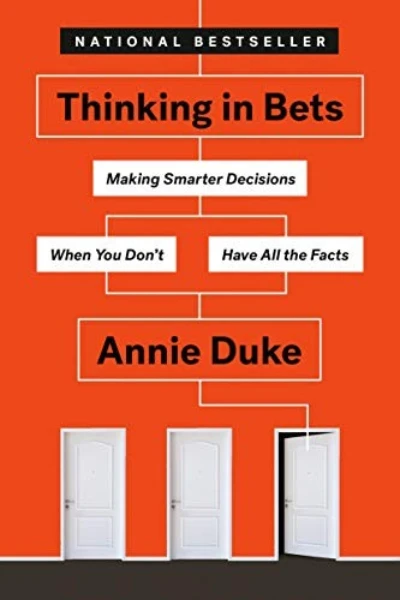
Thinking in Bets
Thinking in Bets — Moving regret in front of our decisions
We’re not perfectly rational when we ponder the past or the future and engage deliberative mind, but we are more likely to make choices consistent with our long-term goals when we can get out of the moment and engage our past- and future-selves. We want Night Jerry and Morning Jerry colliding on the decision of when to get some sleep. We want all those Marty McFlys to get the additional perspective of all the other Marty McFlys. And we want our aged, wrinkly self colliding with us when we decide between spending more money now on something like a nicer car versus saving more money for retirement.
Moving regret in front of our decisions
Philosophers agree that regret is one of the most intense emotions we feel, but they have argued about whether it is productive or useful. Nietzsche said that remorse was “adding to the first act of stupidity a second.”
Thoreau, on the other hand, praised the power of regret: “Make the most of your regrets; never smother your sorrow, but tend and cherish it till it comes to have a separate and integral interest. To regret deeply is to live afresh.”
The problem isn’t so much whether regret is an unproductive emotion.
It’s that regret occurs after the fact, instead of before. As Nietzsche points out, regret can do nothing to change what has already happened. We just wallow in remorse about something over which we no longer have any control. But if regret occurred before a decision instead of after, the experience of regret might get us to change a choice likely to result in a bad outcome. Then we could embrace Thoreau’s view and harness the power of regret because it would serve a valuable purpose. It would be helpful, then, if we could get regret to do some time traveling of its own, moving before our decisions instead of after them. That way, regret might be able to keep us from making a bad bet. In addition, it wouldn’t, as Nietzsche implied, rear its head later by causing us to make a remorse-fueled second mistake.
Morning Jerry regretted Night Jerry’s decision to stay up late, but it was too late for him to do anything about it. When we see the retirement- savings shortfall in this country, there is no doubt that many of the future, retired versions of us are going to regret the financial allocation decisions
that younger-us made, after it is too late to fix it. The age-progression imaging works to address this issue of regret occurring when it’s already too late. By giving us a look at the retirement-aged version of ourselves, it gives us a chance to experience some regret that we didn’t plan adequately for retirement before we’ve made inadequate plans. That was one of the purposes of my loss limit in poker. Because of the loss-limit agreement I had made with myself and my group, I ran the conversation in my head that I’d be forced to have when I explained why I kept playing beyond my limit.
It gave me a chance to regret the decision before I bought more chips.
One of our time-travel goals is to create moments like that, where we can interrupt an in-the-moment decision and take some time to consider the decision from the perspective of our past and future. We can then create a habit routine around these decision interrupts to encourage this perspective taking, asking ourselves a set of simple questions at the moment of the decision designed to get future-us and past-us involved. We can do this by imagining how future-us is likely to feel about the decision or by imagining how we might feel about the decision today if past-us had made it. The approaches are complementary; whether you choose to travel to the past or travel to the future depends solely on what approach you find most effective.
Business journalist and author Suzy Welch developed a popular tool known as 10-10-10 that has the effect of bringing future-us into more of our in-the-moment decisions. “Every 10-10-10 process starts with a question. . . . [W]hat are the consequences of each of my options in ten minutes? In ten months? In ten years?” This set of questions triggers mental time travel that cues that accountability conversation (also encouraged by a truthseeking decision group). We can build on Welch’s tool by asking the questions through the frame of the past: “How would I feel today if I had made this decision ten minutes ago? Ten months ago? Ten years ago?”
Whichever frame we choose, we draw on our past experiences (including similar decisions we may have regretted) in answering the questions, recruiting into the decision those less-reactive brain pathways that control executive functioning.
In poker, because the decisions are all made in the moment and the consequences are big and immediate, routines like 10-10-10 are a survival skill. I recognized in poker that in the same way that I was not the best