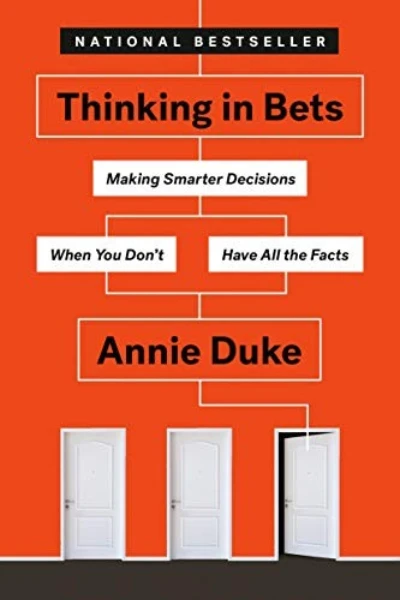
Thinking in Bets
Thinking in Bets — The red pill or the blue pill?
adhere to the norm of being a sympathetic ear for a hard-luck story. When I attempted to delve into the details, I violated this implied contract. I Lettermanned him.
Such interactions are reminders that not all situations are appropriate for truthseeking, nor are all people interested in the pursuit. That being said, any of us who wants to get better at thinking in bets would benefit from having more David Lettermans in our lives. As the “original” Letterman learned from the awkward exchange with Lauren Conrad, Lettermanning needs agreement by both parties to be effective.
The red pill or the blue pill?
In the classic science-fiction film The Matrix, when Neo (played by Keanu Reeves) meets Morpheus (the hero-hacker played by Laurence Fishburne), Neo asks Morpheus to tell him what “the matrix” is. Morpheus offers to show Neo, giving him the choice between taking a blue pill and a red pill.
“You take the blue pill, the story ends. You wake up in your bed and believe whatever you want to believe. You take the red pill, you stay in Wonderland and I show you how deep the rabbit hole goes.”
As Neo reaches toward a pill, Morpheus reminds him, “Remember, all I am offering is the truth. Nothing more.”
Neo chooses to see the world as it really is. He takes the red pill and is pounded with a series of devastating truths. His comfortable world is a dream created by machines to enslave him as an energy source. His job and lifestyle, his clothes, his appearance, and the entire fabric of his life are an illusion implanted in his brain. In the actual world, taking the red pill causes his body to be unplugged from his feeding pod, flushed into a sewer, and picked up by Morpheus’s pirate ship, the Nebuchadnezzar. As rebels against the machines, Morpheus and his crew (and now Neo, due to his choice) live in cramped quarters, sleep in uncomfortable cells, eat gruel, and wear rags. Machines are out to destroy them.
The trade-off is that Neo sees the world as it actually is and, in the end, gets to defeat the machines that have enslaved humanity.
In the movie, the matrix was built to be a more comfortable version of the world. Our brains, likewise, have evolved to make our version of the world more comfortable: our beliefs are nearly always correct; favorable outcomes are the result of our skill; there are plausible reasons why unfavorable outcomes are beyond our control; and we compare favorably with our peers. We deny or at least dilute the most painful parts of the message.
Giving that up is not the easiest choice. Living in the matrix is comfortable. So is the natural way we process information to protect our self-image in the moment. By choosing to exit the matrix, we are asserting that striving for a more objective representation of the world, even if it is uncomfortable at times, will make us happier and more successful in the long run.
But it’s a trade-off that isn’t for everyone; it must be freely chosen to be productive and sustainable. Morpheus (unlike Letterman) didn’t just go around ripping people out of the matrix against their will. He asked Neo to make the choice and exit the matrix with him.
If you have gotten this far in this book, I’m guessing that you are choosing the red pill over the blue pill.
When I started playing poker, I chose truthseeking. Like Neo, I did it reluctantly and wasn’t sure what I was getting into. My brother took a blunt approach with me. My instinct was to complain about my bad luck and to marvel at how poorly others played, decrying the injustice of any hand I might have lost. He wanted to talk about where I had questions about my strategic decisions, where I felt I might have made mistakes, and where I was confused on what to do in a hand. I recognized he was passing along the approach he learned with his friends, a group of smart, analytical East Coast players, many of whom, like Erik Seidel,* were on their way to establishing themselves as legends at the game. In addition to introducing me to this approach, he also encouraged these phenomenal professionals to treat me as a peer when discussing poker.
I was lucky to have access at such an early stage in my career to this group of world-class players who became my learning pod in poker. And I was also lucky that if I wanted to engage that group about poker, I had to ask about my strategic decisions. I had to resist my urge to moan about my bad luck and focus instead on where I felt I might have made mistakes and
where I was confused on what to do in a hand. Because I agreed to the group’s rules of engagement, I had to learn to focus on the things I could control (my own decisions), let go of the things I couldn’t (luck), and work to be able to accurately tell the difference between the two.
I learned from this experience that thinking in bets was easier if I had other people to help me. (Even Neo needed help to defeat the machines.) Remember the buddy system from school field trips or camp? Teachers or counselors would pair everybody up with a buddy. Our buddy was supposed to keep us from wandering off or getting into water too deep, and we did the same for our buddy. A good decision group is a grown-up version of the buddy system. To be sure, even with help, none of us will ever be able to perfectly overcome our natural biases in the way we process information; I certainly never have. But if we can find a few people to choose to form a truthseeking pod with us and help us do the hard work connected with it, it will move the needle—just a little bit, but with improvements that accumulate and compound over time. We will be more successful in fighting bias, seeing the world more objectively, and, as a result, we will make better decisions. Doing it on our own is just harder.
Members of our decision pod could be our friends, or members of our family, or an informal pod of coworkers, or an enterprise strategy group, or a professional organization where members can talk about their decision- making. Forming or joining a group where the focus is on thinking in bets means modifying the usual social contract. It means agreeing to be open- minded to those who disagree with us, giving credit where it’s due, and taking responsibility where it’s appropriate, even (and especially) when it makes us uncomfortable. That’s why, when we do it with others, we need to make it clear the social contract is being modified, or feelings will get hurt, defensiveness will rear its ugly head, and, just like Lauren Conrad, your audience won’t want to hear what you have to say. So, while we find some people to think in bets with us, with the rest of the world, it is generally better to observe the prevailing social contract and not go around saying, “Wanna bet?” willy-nilly. (That doesn’t mean we can’t ever engage in truthseeking outside of our group. Our approach just needs to be less head- on, less Letterman-like. More on that later, after we explore communications within the group.)
Out in the world, groups form all over the place because people recognize how others can help us; the concept of working together on our individual challenges is a familiar one. Having the help of others provides many decision-making benefits, but one of the most obvious is that other people can spot our errors better than we can. We can help others in our pod overcome their blind-spot bias and they can help us overcome the same.
Whatever the obstacles to recruiting people into a decision group (and this chapter points out several, along with strategies for overcoming them), it is worth it to get a buddy to watch your back—or your blind spot. The fortunate thing is that we need to find only a handful of people willing to do the exploratory thinking necessary for truthseeking. In fact, as long as there are three people in the group (two to disagree and one to referee*), the truthseeking group can be stable and productive.
It’s also helpful to recognize that people serve different purposes in our lives. Even if we place a high value on truthseeking, that doesn’t mean everyone in our lives has to adopt that or communicate with us in that way.
Truthseeking isn’t a cult; we don’t have to cut off people who don’t share that commitment. Our Pilates friends or our football friends or any of our friends shouldn’t have to take the red pill to remain our friends. Different friends fill different needs and not all of them need to be cut from the same cloth. Those different groups can also provide much-needed balance in our lives. After all, it takes effort to acknowledge and explore our mistakes without feeling bad about ourselves, to forgo credit for a great result, and to realize, with an open mind, that not all our beliefs are true. Truthseeking flies in the face of a lot of comfortable behaviors; it’s hard work and we need breaks to replenish our willpower.
In fact, in my poker strategy group, we understood the need to occasionally opt out and off-load intense emotions before engaging in the work of accurately fielding an outcome. If, for example, one of us just got eliminated from a tournament, it was acceptable, every once in a while, to say, “For right now, I just need to moan about my bad luck.” The key was that when we did that, we recognized it was a temporary exception from the hard work we were doing together and to which we would return when the emotional rawness of the moment passed.
We know our decision-making can improve if we find other people to join us in truthseeking. And we know we need an agreement. What’s in that