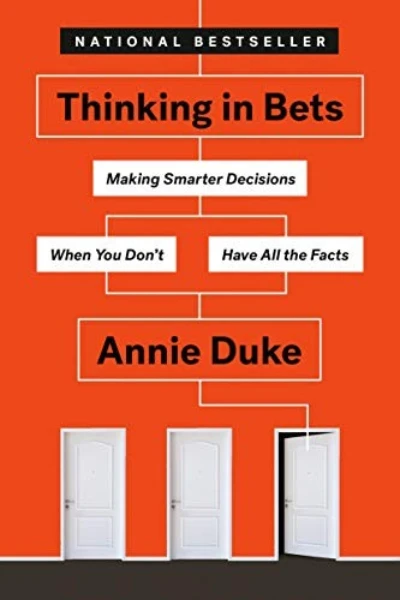
Thinking in Bets
Thinking in Bets — Dr. Strangelove
In addition, once the game is over, poker players must learn from that jumbled mass of decisions and outcomes, separating the luck from the skill, the signal from the noise, and guarding against resulting. That’s the only way to improve, especially when those same under-pressure situations will recur in a variety of forms.
Solving the problem of how to execute is even more important than innate talent to succeed in poker. All the talent in the world won’t matter if a player can’t execute; avoiding common decision traps, learning from results in a rational way, and keeping emotions out of the process as much as possible. Players with awe-inspiring talent clean up on their best nights but go broke plenty of other nights if they haven’t confronted this challenge. The poker players who stand the test of time have a variety of talents, but what they share is the ability to execute in the face of these limitations.
We all struggle to execute our best intentions. Poker players have the same struggle, with the added challenges of time pressure, in-your-face uncertainty, and immediate financial consequences. That makes poker a great place to find innovative approaches to overcoming this struggle. And the value of poker in understanding decision-making has been recognized in academics for a long time.
Dr. Strangelove
It’s hard for a scientist to become a household name. So it shouldn’t be surprising that for most people the name John von Neumann doesn’t ring a bell.
That’s a shame because von Neumann is a hero of mine, and should be to anyone committed to making better decisions. His contributions to the science of decision-making were immense, and yet they were just a footnote in the short life of one of the greatest minds in the history of scientific thought. (And, not coincidentally, he was a poker player.) After a twenty-year period in which he contributed to practically every branch of mathematics, this is what he did in the last ten years of his life: played a key role on the Manhattan Project, pioneered the physics behind
the hydrogen bomb, developed the first computers, figured out the optimal way to route bombers and choose targets at the end of World War II, and created the concept of mutually assured destruction (MAD), the governing geopolitical principle of survival throughout the Cold War. Even after being diagnosed with cancer in 1955 at the age of fifty-two, he served in the first civilian agency overseeing atomic research and development, attending meetings, though in great pain, in a wheelchair for as long as he was physically able.
Despite all he accomplished in science, somehow von Neumann’s legacy in popular culture is as one of the models for the title character in Stanley Kubrick’s apocalyptic comedy, Dr. Strangelove: a heavily accented, crumpled, wheelchair-bound genius whose strategy of relying on mutually assured destruction goes awry when an insane general sends a single bomber on an unauthorized mission that could trigger the automated firing of all American and Soviet nuclear weapons.
In addition to everything else he accomplished, John von Neumann is also the father of game theory. After finishing his day job on the Manhattan Project, he collaborated with Oskar Morgenstern to publish Theory of Games and Economic Behavior in 1944. The Boston Public Library’s list of the “100 Most Influential Books of the Century” includes Theory of Games.
William Poundstone, author of a widely read book on game theory, Prisoner’s Dilemma, called it “one of the most influential and least-read books of the twentieth century.” The introduction to the sixtieth-anniversary edition pointed out how the book was instantly recognized as a classic.
Initial reviews in the most prestigious academic journals heaped it with praise, like “one of the major scientific achievements of the first half of the twentieth century” and “ten more such books and the progress of economics is assured.”
Game theory revolutionized economics, evidenced by at least eleven economics Nobel laureates connected with game theory and its decision- making implications, including John Nash (a student of von Neumann’s), whose life story was chronicled in the Oscar-winning film A Beautiful Mind. Game theory has broad applications outside economics, informing the behavioral sciences (including psychology and sociology) as well as political science, biomedical research, business, and numerous other fields.