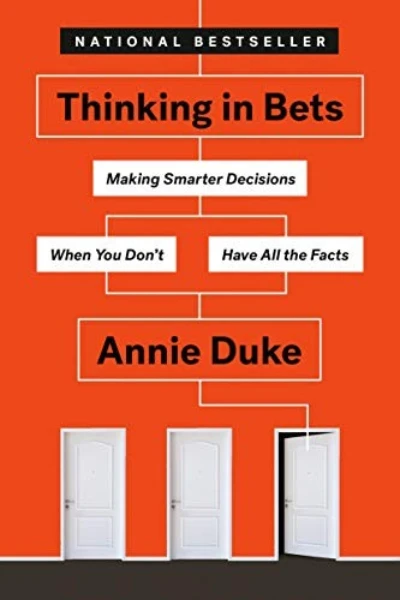
Thinking in Bets
Thinking in Bets — A flat tire, the ticker, and a zoom lens
judge of how I was playing after losing a certain amount of money, I was also not the best judge of the quality of my poker after about six to eight hours of play. Just as we can convince ourselves we are sober enough to drive, it is easy for poker players to convince themselves that they are alert enough to keep playing after many hours of intense, intellectually taxing work. In my more rational moments, away from the tables, I knew I would be better off if I played just six to eight hours per session. When I reached that point in a session and considered continuing past that time limit, I could use a 10-10-10-like strategy to recruit my past- and future-self: How have I felt when I kept playing in the past? How has it generally worked out? When I look back, do I feel I was playing my best? This routine of asking myself these questions helped mitigate the in-the-moment risk that, as I was losing my mental edge, I might try to convince myself that the game was so great that I had to keep playing.
Moving regret in front of a decision has numerous benefits. First, obviously, it can influence us to make a better decision. Second, it helps us treat ourselves (regardless of the actual decision) more compassionately after the fact. We can anticipate and prepare for negative outcomes. By planning ahead, we can devise a plan to respond to a negative outcome instead of just reacting to it. We can also familiarize ourselves with the likelihood of a negative outcome and how it will feel. Coming to peace with a bad outcome in advance will feel better than refusing to acknowledge it, facing it only after it has happened.
After-the-fact regret can consume us. Like all emotions, regret initially feels intense but gets better with time. Time-travel strategies can help us remember that the intensity of what we feel now will subside over time.
And that helps reduce the emotion we feel in the moment, making it less likely that we will prove Nietzsche right and add a second act of stupidity to the first.
A flat tire, the ticker, and a zoom lens
Imagine you are standing on a narrow strip of concrete on the shoulder of the highway. Behind you is your car, hazard lights flashing. The rear tire on
the driver’s side is shredded. It is fully dark and the drizzle has turned into a cold, heavy downpour. You’ve called roadside assistance, twice, and both times (after long hold times) spoken with operators who’ve told you someone will arrive “as soon as they get there after responding to your call.” You decide to change the tire yourself, only to discover you have no jack. You’re soaked to the skin and cold.
How does it feel? It likely feels like the worst moment of your life. You are likely bemoaning how unlucky you are, wondering why these things always happen to you. You are miserable and you can’t imagine feeling any other way.* That’s how it feels in the moment. But if the flat tire had happened a year ago, do you think it would have an effect on your happiness today, or your overall happiness over the past year? Not likely. It likely wouldn’t cause your overall happiness to tick up or down. It would probably have faded to a funny story (or a story you try to make sound funny) told at cocktail parties.
In our decision-making lives, we aren’t that good at taking this kind of perspective—at accessing the past and future to get a better view of how any given moment might fit into the scope of time. It just feels how it feels in the moment and we react to it. We want to create opportunities to take the broader perspective prior to making decisions driven by the magnified feelings we have in the moment. A 10-10-10 strategy does that, getting us to imagine the decision or outcome in the perspective of the past and the future.
The flat tire isn’t as awful as it seems in the moment. This kind of time- travel strategy calms down the in-the-moment emotions we have about an event, so we can get back to using the more rational part of our brain.
Recruiting past-us and future-us in this way activates the neural pathways that engage the prefrontal cortex, inhibiting emotional mind and keeping events in more rational perspective. This discourages us from magnifying the present moment, blowing it out of proportion and overreacting to it.
This overestimation of the impact of any individual moment on our overall happiness is the emotional equivalent of watching the ticker in the financial world. We make a long-term stock investment because we want it to appreciate over years or decades. Yet there we are, watching a downward tick over a few minutes, consumed by imagining the worst. What’s the
volume? Is it heavier than usual? Better check the news stories. Better check the message boards to find out what rumors are circulating.
A stock like Berkshire Hathaway reveals why ticker watching isn’t a particularly productive endeavor when you are investing for the long run.
Look at this chart of Berkshire’s performance since 1964:
Now zoom in on a random day in late January 2017. The upticks and downticks look large and potentially frightening. You can imagine sitting at the low point around 11:30, feeling like your losses are spiraling.
If you zoomed in on the performance of Berkshire Hathaway stock during the banking crisis, September 2008 to March 2009, you would feel terrible most days:
Yet we know from the first chart, the big picture, that all those minute- to-minute and even day-to-day changes had little effect on the investment’s general upward trajectory.
Our problem is that we’re ticker watchers of our own lives. Happiness (however we individually define it) is not best measured by looking at the ticker, zooming in and magnifying moment-by-moment or day-by-day movements. We would be better off thinking about our happiness as a long- term stock holding. We would do well to view our happiness through a wide-angle lens, striving for a long, sustaining upward trend in our happiness stock, so it resembles the first Berkshire Hathaway chart.
Mental time travel makes that kind of perspective possible. We can use our past- and future-selves to pull us out of the moment and remind us when we’re watching the ticker, looking at our lives through that lens on extreme zoom.
When we view these upticks and downticks under the magnification of that in-the-moment zoom lens, our emotional responses are, similarly, amplified. Like the flat tire in the rain, we are capable of treating things that will have little effect on our long-term happiness as having significant