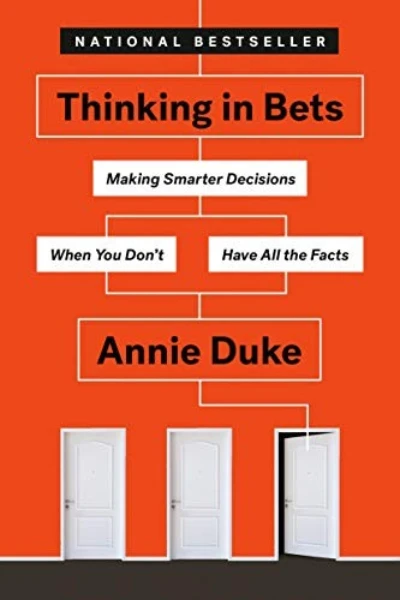
Thinking in Bets
Thinking in Bets — All decisions are bets
because when you are betting, you have to back up your belief by putting a price on it. You have to put your money where your mouth is. To me, the ironic thing about a story that seems so crazy is how the underlying analysis was actually very logical: a difference of opinion about alternatives, consequences, and probabilities.
By treating decisions as bets, poker players explicitly recognize that they are deciding on alternative futures, each with benefits and risks. They also recognize there are no simple answers. Some things are unknown or unknowable. The promise of this book is that if we follow the example of poker players by making explicit that our decisions are bets, we can make better decisions and anticipate (and take protective measures) when irrationality is likely to keep us from acting in our best interest.
All decisions are bets
Our traditional view of betting is very narrow: casinos, sporting events, lottery tickets, wagering against someone else on the chance of a favorable outcome of some event. The definition of “bet” is much broader. Merriam- Webster’s Online Dictionary defines “bet” as “a choice made by thinking about what will probably happen,” “to risk losing (something) when you try to do or achieve something” and “to make decisions that are based on the belief that something will happen or is true.” I have emphasized the broader, often overlooked, aspects of betting: choice, probability, risk, decision, belief. We can also see from this definition that betting doesn’t have to take place in a casino or against somebody else.
No matter how far we get from the familiarity of betting at a poker table or in a casino, our decisions are always bets. We routinely decide among alternatives, put resources at risk, assess the likelihood of different outcomes, and consider what it is that we value. Every decision commits us to some course of action that, by definition, eliminates acting on other alternatives. Not placing a bet on something is, itself, a bet. Choosing to go to the movies means that we are choosing to not do all the other things with our time that we might do during that two hours. If we accept a job offer, we are also choosing to foreclose all other alternatives: we aren’t sticking