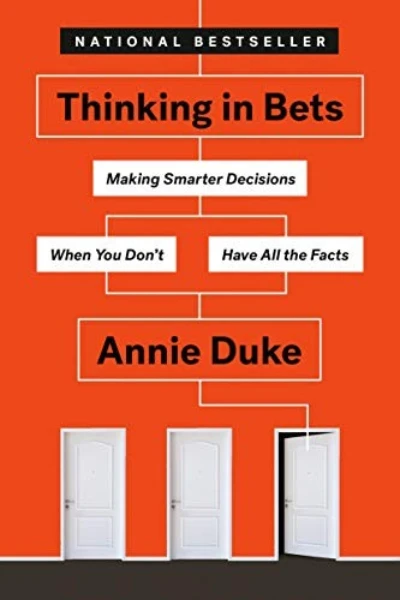
Thinking in Bets
Thinking in Bets — All-or-nothing thinking rears its head again
because they didn’t study. “The teacher doesn’t like me. Everybody did poorly. The teacher put material on the test we didn’t cover in class. You can ask anyone!”
Self-serving bias is a deeply embedded and robust thinking pattern.
Understanding why this pattern emerges is the first step to developing practical strategies to improve our ability to learn from experience. These strategies encourage us to be more rational in the way we field outcomes, fostering open-mindedness in considering all the possible causes of an outcome, not just the ones that flatter us.
All-or-nothing thinking rears its head again
Black-and-white thinking, uncolored by the reality of uncertainty, is a driver of both motivated reasoning and self-serving bias. If our only options are being 100% right or 100% wrong, with nothing in between, then information that potentially contradicts a belief requires a total downgrade, from right all the way to wrong. There is no “somewhat less sure” option in an all-or-nothing world, so we ignore or discredit the information to hold steadfast in our belief.
Both of these biases cause us to see our outcomes through the equivalent of a funhouse mirror. The reflection distorts reality, maximizing the appearance of our skill in good outcomes. For bad outcomes, it makes skill all but disappear, while luck looms giant.
Just as with motivated reasoning, self-serving bias arises from our drive to create a positive self-narrative. In that narrative, taking credit for something good is the same as saying we made the right decision. And being right feels good. Likewise, thinking that something bad was our fault means we made a wrong decision, and being wrong feels bad. When our self-image is at stake, we treat our fielding decisions as 100% or 0%: right versus wrong, skill versus luck, our responsibility versus outside our control. There are no shades of grey.
Fielding outcomes with the goal of promoting our self-narrative and doing it in an all-or-nothing fashion alters our ability to make smart bets about why the future unfolded in a particular way. Learning from