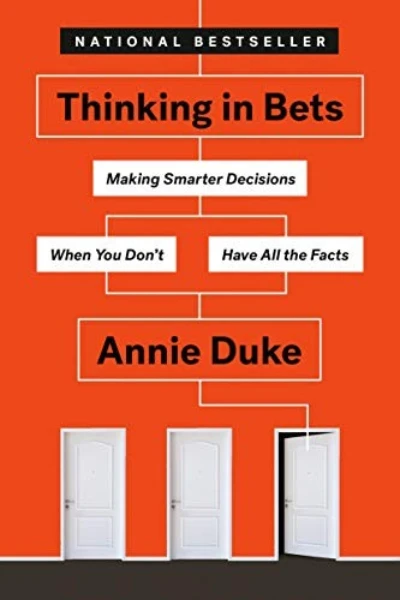
Thinking in Bets
Thinking in Bets — Backcasting: working backward from a positive future
Backcasting: working backward from a positive
future
All methods of imagining the future are not created equal. You know that Chinese proverb, “A journey of a thousand miles starts with a single step”?
Turns out, if we were contemplating a thousand-mile walk, we’d be better off imagining ourselves looking back from the destination and figuring how we got there. When it comes to advance thinking, standing at the end and looking backward is much more effective than looking forward from the beginning.
The distorted view we get when we look into the future from the present is similar to the stereotypical view of the world by Manhattan residents, poked fun at by the famous New Yorker cover. The cover was a drawing of a map from the perspective of a person from New York. In that view, half the map covers a few blocks of the city. While you can see all the buildings on Ninth Avenue and even vehicles and people, the Hudson River and New Jersey are just horizontal strips. The entire United States occupies the same amount of space as the distances between Ninth and Tenth avenues. Beyond a strip of the Pacific Ocean are three tiny lumps, labeled “China,” “Japan,” and “Russia.”
When we forecast the future, we run the risk of a similar distortion.
From where we stand, the present and the immediate future loom large.
Anything beyond that loses focus.
Imagining the future recruits the same brain pathways as remembering the past. And it turns out that remembering the future is a better way to plan for it. From the vantage point of the present, it’s hard to see past the next step. We end up over-planning for addressing problems we have right now.
Implicit in that approach is the assumption that conditions will remain the same, facts won’t change, and the paradigm will remain stable. The world changes too fast to assume that approach is generally valid. Samuel Arbesman’s The Half-Life of Facts makes a book-length case for the hazards of assuming the future is going to be like the present.
Just as great poker players and chess players (and experts in any field) excel by planning further into the future than others, our decision-making improves when we can more vividly imagine the future, free of the
distortions of the present. By working backward from the goal, we plan our decision tree in more depth, because we start at the end.
When we identify the goal and work backward from there to “remember” how we got there, the research shows that we do better. In a Harvard Business Review article, decision scientist Gary Klein summarized the results of a 1989 experiment by Deborah Mitchell, J. Edward Russo, and Nancy Pennington. They “found that prospective hindsight—imagining that an event has already occurred—increases the ability to correctly identify reasons for future outcomes by 30%.”
A huge urban planning project requires enormous amounts of money, materials, commitment—and the vision to work backward from a distant future goal. When Frederick Law Olmsted designed Central Park, for example, he recognized that a lot of the charm of the park, and a lot of enjoyment that people would get from it, would take decades, as the landscape changed and matured. People walking through Central Park when it opened to the public in 1858 would have seen a lot of barren land. Even in 1873, when construction was substantially completed, there was a lot of undergrown foliage. The trees, shrubs, and plants were clearly recent transplants. None of those visitors would recognize Central Park today. But Olmstead would because he was starting from what it would develop into.
The most common form of working backward from our goal to map out the future is known as backcasting. In backcasting, we imagine we’ve already achieved a positive outcome, holding up a newspaper with the headline “We Achieved Our Goal!” Then we think about how we got there.
Let’s say an enterprise wants to develop a three-year strategic plan to double market share, from 5% to 10%. Each person engaged in the planning imagines holding up a newspaper whose headline reads “Company X Has Doubled Its Market Share over the Past Three Years.” The team leader now asks them to identify the reasons they got there, what events occurred, what decisions were made, what went their way to get the enterprise to capture that market share. This enables the company to better identify strategies, tactics, and actions that need to be implemented to get to the goal. It also allows it to identify when the goal needs to be tweaked. Backcasting makes it possible to identify when there are low-probability events that must occur to reach the goal. That could lead to developing strategies to increase the chances those events occur or to recognizing the goal is too ambitious. The