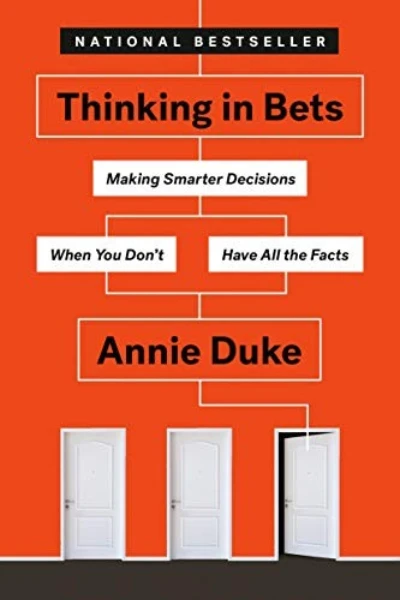
Thinking in Bets
Thinking in Bets — Night Jerry
In business, if a leader ignores the ideas of an intern because “What does an intern possibly know?” it could take years for that intern to become a successful competitor before that mistake becomes obvious. If the trajectory of that business suffers because of the poverty of new ideas, the owner of the business might never realize the effect of that attitude.
The best poker players develop practical ways to incorporate their long- term strategic goals into their in-the-moment decisions. The rest of this chapter is devoted to many of these strategies designed to recruit past- and future-us to help with all the execution decisions we have to make to reach our long-term goals. As with all the strategies in this book, we must recognize that no strategy can turn us into perfectly rational actors. In addition, we can make the best possible decisions and still not get the result we want. Improving decision quality is about increasing our chances of good outcomes, not guaranteeing them. Even when that effort makes a small difference—more rational thinking and fewer emotional decisions, translated into an increased probability of better outcomes—it can have a significant impact on how our lives turn out. Good results compound. Good processes become habits, and make possible future calibration and improvement.
Those methods involve a lot of mental time travel, and those poker players could teach Marty McFly and Doc Brown a thing or two.
Night Jerry
For all the scientific research on the battle between our immediate desires and long-term goals, a particularly succinct explanation comes from Jerry Seinfeld, on why he doesn’t get enough sleep: “I stay up late at night because I’m Night Guy. Night Guy wants to stay up late. ‘What about getting up after five hours of sleep?’ ‘That’s Morning Guy’s problem.
That’s not my problem. I’m Night Guy. I stay up as late as I want.’ So you get up in the morning: you’re exhausted, you’re groggy. ‘Oooh, I hate that Night Guy.’ See, Night Guy always screws Morning Guy.”
That’s a good example of how we struggle in the present to take care of our future-self. Night Jerry is always going to want to stay up late and, if
Morning Jerry has no say in the decision, Night Jerry will get his way regardless of what’s in Jerry’s longer-term best interest. When we make in- the-moment decisions (and don’t ponder the past or future), we are more likely to be irrational and impulsive.* This tendency we all have to favor our present-self at the expense of our future-self is called temporal discounting.* We are willing to take an irrationally large discount to get a reward now instead of waiting for a bigger reward later. An example of temporal discounting among adults includes a study from the military drawdown in the 1990s that led tens of thousands of military employees to choose lump-sum retirement payments at drastically discounted rates instead of guaranteed annuity payments. The men and women of the U.S. military took lump-sum payments worth $2.5 billion, a 40% discount compared to the present value of the annuity payments they would have received. (For additional sources on temporal discounting, see the Selected Bibliography and Recommendations for Further Reading.) When Night Jerry stays up late, it’s because it benefits him now; he discounts the benefits that come later from going to bed. Saving for retirement is a temporal discounting problem: the gratification of spending discretionary income is immediate. Putting it away for retirement means we have to wait decades to get enjoyment from that money. We are built for temporal discounting, for using the resources that are available to us now as opposed to saving them for a future version of us that we aren’t particularly in touch with in the moment of the decision. Time traveling can get us in touch with that future version of us. It can get future-us to remind present- us, “Hey, don’t discount!” Or at least, “Don’t discount so much!”
When we think about the past and the future, we engage deliberative mind, improving our ability to make a more rational decision. When we imagine the future, we don’t just make it up out of whole cloth, inventing a future based on nothing that we have ever seen or experienced. Our vision of the future, rather, is rooted in our memories of the past. The future we imagine is a novel reassembling of our past experiences. Given that, it shouldn’t be surprising that the same neural network is engaged when we imagine the future as when we remember the past. Thinking about the future is remembering the future, putting memories together in a creative way to imagine a possible way things might turn out. Those brain pathways
include the hippocampus (a key structure for memory) and the prefrontal cortex, which controls System 2, deliberative decision-making. It is our cognitive control center.* By engaging those pathways, Night Jerry can access memories like oversleeping and missing appointments or dozing off during morning meetings that he can use to imagine how tired Morning Jerry will be or what’s going to happen to Morning Jerry’s schedule when he doesn’t want to get up or how his day will go when he can’t pay attention.
Wouldn’t it be great if Morning Jerry could travel back in time and tap Night Jerry on the shoulder to tell him to go to bed? As it turns out, there’s an app for that.
From advancements in photo techniques and virtual reality, there is software that can show you a prediction of what you will look like decades into the future. If you feel, like most adults, bad about seeing your parents age, these images of future-you can be unsettling, like looking into a sadist- designed funhouse mirror. Fortunately, they’ve found ways to put this age- progression technology to more productive uses than just making us stare into the void of our own mortality.
Saving for retirement is a Night Jerry–versus–Morning Jerry problem.
If Night Jerry isn’t even thinking ahead to tomorrow morning, he’s certainly not thinking ahead several decades to retirement. Retirement planning involves a series of decisions in which our present-self can act to the detriment or benefit of our future-self. When we set retirement goals, we are necessarily thinking about our future-self’s goals—how much we need to save for that older version of us to live comfortably. Our spending decisions, however, don’t seem to be particularly focused on what’s best for our seventy-year-old-self. In fact, a quick Google search on the topic quickly reveals that our retirement savings are dangerously low. According to one study by the Center for Retirement Research at Boston College, “roughly half of today’s working households will not be able to maintain their standard of living in retirement.” Depending on which estimate you read, the shortfall could be $6.8 to $14 trillion.
Several organizations and companies with an interest in encouraging retirement planning have resources that allow clients to “meet” their future- selves as they make retirement decisions. In the simplest versions of these tools, clients plug in their age, income, savings practices, and retirement
goals. The apps then show the client the financial situation and lifestyle their future-self can expect, compared with the present.
Prudential Retirement, AARP, and others have versions of these apps that emphasize the consequences of retirement planning by visually introducing us to our future-self. Bank of America Merrill Lynch in 2012 (for web-access computing) and 2014 (for mobile devices) introduced Merrill Edge, which includes a tool called “Face Retirement.” Customers upload a picture of themselves and get to see, according to the press release, “a life-like 3D animation of their future self, enabling them to envision every wrinkle they could encounter at retirement age—and beyond.” Night Jerry gets a glimpse of what Morning Jerry looks like without enough sleep to function.
This idea that seeing our aged future-self could help us make better allocation decisions is based, in part, on research by Jeremy Bailenson and Laura Carstensen of Stanford University’s Freeman Spogli Institute for International Studies. They used immersive virtual-reality technology in a lab setting to demonstrate how a visit from Morning Jerry will help Night Jerry make better decisions. Subjects entered a virtual-reality environment, after which they were asked to allocate $1,000 among accounts for various purposes, one of which was a hypothetical retirement account. Subjects seeing a digital representation of their present-self in the mirror allocated on average $73.90 to the retirement account. Other subjects looking in that mirror saw an age-progressed version of themselves. This latter group of subjects, on average, allocated $178.10 to the retirement account. This is a startling example of how future-us can act as an effective decision buddy for present-us.
Bringing our future-self into the decision gets us started thinking about the future consequences of those in-the-moment decisions. Fundamentally, Morning Jerry and Night Jerry are living the same life, and getting Morning Jerry into Night Jerry’s face will remind him of that. Seeing our aged-self in the mirror, along with a spreadsheet showing us how future-us has to struggle to get by, is a persuasive reminder to put aside some discretionary spending money for retirement. It’s that tap on the shoulder from our future- self. “Hey, don’t forget about me. I’m going to exist and I’d like you to please take that into account.”