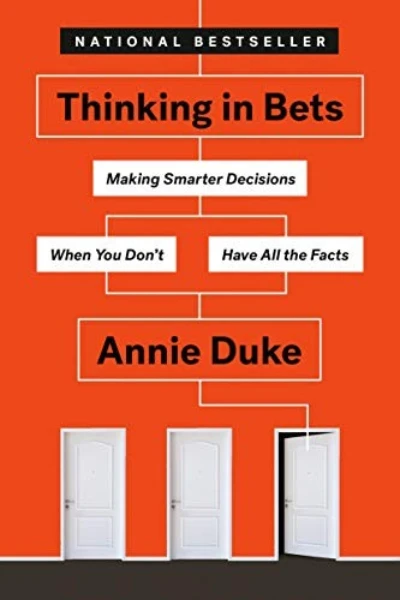
Thinking in Bets
Thinking in Bets — Reshaping habit
that it couldn’t buy today was the opportunity to soar above most everyone else. We’d rather lap the field in 1900 with an average life expectancy of only forty-seven years than sit in the middle of the pack now with an average life expectancy of over seventy-six years (and a computer in our palm).
A lot of the way we feel about ourselves comes from how we think we compare with others. This robust and pervasive habit of mind impedes learning. Luckily, habits can be changed, whether the habit is biting your nails or decrying your terrible luck when you lose. By shifting what it is that makes us feel good about ourselves, we can move toward a more rational fielding of outcomes and a more compassionate view of others. We can learn better and be more open-minded if we work toward a positive narrative driven by engagement in truthseeking and striving toward accuracy and objectivity: giving others credit when it’s due, admitting when our decisions could have been better, and acknowledging that almost nothing is black and white.
Reshaping habit
Phil Ivey is one of those guys who can easily admit when he could have done better. Ivey is one of the world’s best poker players, a player almost universally admired by other professional poker players for his exceptional skill and confidence in his game. Starting in his early twenties, he built a reputation as a top cash-game player, a top tournament player, a top heads- up player, a top mixed-game player—a top player in every form and format of poker. In a profession where, as I’ve explained, most people are awash in self-serving bias, Phil Ivey is an exception.
In 2004, my brother provided televised final-table commentary for a tournament in which Phil Ivey smoked a star-studded final table. After his win, the two of them went to a restaurant for dinner, during which Ivey deconstructed every potential playing error he thought he might have made on the way to victory, asking my brother’s opinion about each strategic decision. A more run-of-the-mill player might have spent the time talking about how great they played, relishing the victory. Not Ivey. For him, the
opportunity to learn from his mistakes was much more important than treating that dinner as a self-satisfying celebration. He earned a half-million dollars and won a lengthy poker tournament over world-class competition, but all he wanted to do was discuss with a fellow pro where he might have made better decisions.
I heard an identical story secondhand about Ivey at another otherwise celebratory dinner following one of his now ten World Series of Poker victories. Again, from what I understand, he spent the evening discussing in intricate detail with some other pros the points in hands where he could have made better decisions. Phil Ivey, clearly, has different habits than most poker players—and most people in any endeavor—in how he fields his outcomes.
Habits operate in a neurological loop consisting of three parts: the cue, the routine, and the reward. A habit could involve eating cookies: the cue might be hunger, the routine going to the pantry and grabbing a cookie, and the reward a sugar high. Or, in poker, the cue might be winning a hand, the routine taking credit for it, the reward a boost to our ego. Charles Duhigg, in The Power of Habit, offers the golden rule of habit change—that the best way to deal with a habit is to respect the habit loop: “To change a habit, you must keep the old cue, and deliver the old reward, but insert a new routine.”
When we have a good outcome, it cues the routine of crediting the result to our awesome decision-making, delivering the reward of a positive update to our self-narrative. A bad outcome cues the routine of off-loading responsibility for the result, delivering the reward of avoiding a negative self-narrative update. With the same cues, we flip the routine for the outcomes of peers, but the reward is the same—feeling good about ourselves.
The good news is that we can work to change this habit of mind by substituting what makes us feel good. The golden rule of habit change says we don’t have to give up the reward of a positive update to our narrative, nor should we. Duhigg recognizes that respecting the habit loop means respecting the way our brain is built.
Our brain is built to seek positive self-image updates. It is also built to view ourselves in competition with our peers. We can’t install new hardware. Working with the way our brains are built in reshaping habit has a higher chance of success than working against it. Better to change the part
that is more plastic: the routine of what gives us the good feeling in our narrative and the features by which we compare ourselves to others.
At least as far back as Pavlov, behavioral researchers* have recognized the power of substitution in physiological loops. In his famous experiments, his colleague noticed that dogs salivated when they were about to be fed.
Because they associated a particular technician with food, the presence of the technician triggered the dogs’ salivation response. Pavlov discovered the dogs could learn to associate just about any stimulus with food, including his famous bell, triggering the salivary response.
We can work to change the bell we ring, substituting what makes us salivate. We can work to get the reward of feeling good about ourselves from being a good credit-giver, a good mistake-admitter, a good finder-of- mistakes-in-good-outcomes, a good learner, and (as a result) a good decision-maker. Instead of feeling bad when we have to admit a mistake, what if the bad feeling came from the thought that we might be missing a learning opportunity just to avoid blame? Or that we might be basking in the credit of a good result instead of, like Phil Ivey, recognizing where we could have done better? If we work toward that, we can transform the unproductive habits of mind of self-serving bias and motivated reasoning into productive ones. If we put in the work to practice this routine, we can field more of our outcomes in an open-minded, more objective way, motivated by accuracy and truthseeking to drive learning. The habit of mind will change, and our decision-making will better align with executing on our long-term goals.
There are people who, like Phil Ivey, have substituted the routine of truthseeking for the outcome-oriented instinct to focus on seeking credit and avoiding blame. When we look at the people performing at the highest level of their chosen field, we find that the self-serving bias that interferes with learning often recedes and even disappears. The people with the most legitimate claim to a bulletproof self-narrative have developed habits around accurate self-critique.
In sports, the athletes at the top of the game look at outcomes to spur further improvement. American soccer great Mia Hamm said, “Many people say I’m the best women’s soccer player in the world. I don’t think so. And because of that, someday I just might be.” Such quotes can be discounted as a polite way of dealing with the media. There are plenty of
contrary examples burned in our consciousness, like John McEnroe arguing line calls or golf pros who have turned missed putts into a ritual of staring at the offending line of the putt and tapping down phantom spike marks.
Those aren’t anything more than performance tics. It’s practically a ritual on the PGA Tour that if a player misses a makeable putt, he has to stare at the green like it was somehow at fault. What you don’t see are practice rituals like Phil Mickelson’s, in which he places ten balls in a circle, three feet from the hole. He has to sink all ten, and then repeat the process nine more times. Players of Phil Mickelson’s caliber couldn’t engage in such a demanding regimen if they actually assigned much blame to spike marks.
Changing the routine is hard and takes work. But we can leverage our natural tendency to derive some of our self-esteem by how we compare to our peers. Just as Duhigg recommends respecting the habit loop, we can also respect that we are built for competition, and that our self-narrative doesn’t exist in a vacuum. Keep the reward of feeling like we are doing well compared to our peers, but change the features by which we compare ourselves: be a better credit-giver than your peers, more willing than others to admit mistakes, more willing to explore possible reasons for an outcome with an open mind, even, and especially, if that might cast you in a bad light or shine a good light on someone else. In this way we can feel that we are doing well by comparison because we are doing something unusual and hard that most people don’t do. That makes us feel exceptional.
Once we start listening for it, we hear a chorus out in the world like I heard during breaks in poker tournaments: “things are going great because I’m making such good decisions”; “things went poorly because I got so unlucky.” That’s what the lawyer heard from his senior partner in each evening’s postmortem of the trial. That’s what we heard from Chris Christie in the 2016 Republican presidential debate. That’s what I heard in every poker room I was ever in. There were times, and there still are, when I’m part of that chorus. Increasingly, though, I’ve learned to use that chorus to avoid self-serving bias rather than giving in to it. When I admitted mistakes, when I recognized the luck element in my successes, when I gave other players credit for making some good decisions, when I was eager to share a hand that I thought I played poorly because I might learn something from it, that chorus reminded me that what I was doing was hard, and that others weren’t often doing it. Identifying learning opportunities that other players