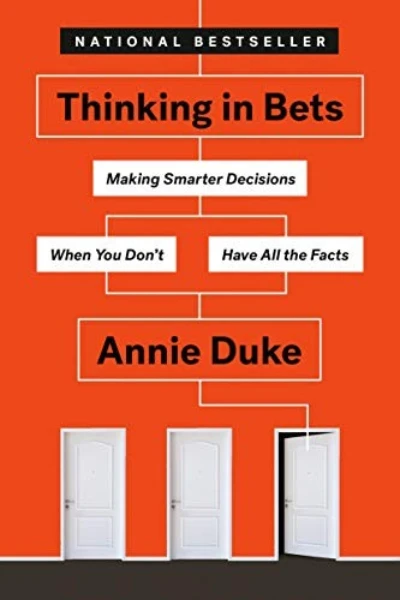
Thinking in Bets
Thinking in Bets — Premortems: working backward from a negative future
company can also make precommitments to a plan developed through backcasting, including responses to developments that can interfere with reaching the goal and identifying inflection points for re-evaluating the plan as the future unfolds.
In planning a trial strategy after taking a new case, a trial lawyer can imagine the headline of winning at trial. What favorable rulings did the lawyer get along the way? How did the most favorable testimony play out?
What kind of evidence did the judge allow or throw out? What points did the jury respond to?
If our goal is to lose twenty pounds in six months, we can plan how to achieve that by imagining it’s six months from now and we’ve lost the weight. What are the things we did to lose the weight? How did we avoid junk food? How did we increase the amount of exercise we were doing?
How did we stick to the regimen?
Imagining a successful future and backcasting from there is a useful time-travel exercise for identifying necessary steps for reaching our goals.
Working backward helps even more when we give ourselves the freedom to imagine an unfavorable future.
Premortems: working backward from a negative
future
If you know medical terms or watch forensic-crime dramas on TV, you are familiar with a postmortem: that’s where a medical examiner determines the cause of death. A premortem is an investigation into something awful, but before it happens. We all like to bask in an optimistic view of the future. We generally are biased to overestimate the probability of good things happening. Looking at the world through rose-colored glasses is natural and feels good, but a little naysaying goes a long way. A premortem is where we check our positive attitude at the door and imagine not achieving our goals.
Backcasting and premortems complement each other. Backcasting imagines a positive future; a premortem imagines a negative future. We can’t create a complete picture without representing both the positive space
and the negative space. Backcasting reveals the positive space. Premortems reveal the negative space. Backcasting is the cheerleader; a premortem is the heckler in the audience.
Imagining a headline that reads “We Failed to Reach Our Goal” challenges us to think about ways in which things could go wrong that we otherwise wouldn’t if left to our own (optimistic, team-player) devices. For the company with the three-year plan to double market share, the premortem headline is “Company Fails to Reach Market Share Goal; Growth Again Stalls.” Members of the planning team now imagine delays in new products, loss of key executives or sales or marketing or technical personnel, new products by competitors, adverse economic developments, paradigm shifts that could lead customers to do without the product or rely on alternatives not on the market or in use, etc.
A lawyer trying a case now considers favorable evidence being disallowed, undiscovered evidence undermining the case, drawing an unsympathetic judge, and the jury disliking or distrusting the main witnesses.
When we set a weight-loss goal and put a plan to reach that goal in place, a premortem will reveal how we felt obligated to eat cake when it was somebody’s birthday, how hard it was to resist the bagels and cookies in the conference room, and how hard it was to find time for the gym or how easy it was to find excuses to procrastinate going. There has been a massive amount written about visualizing success as a way to achieve our goals. Because that’s such a common element in self-help strategies, conducting a premortem (with its negative visualization) may seem like a counterproductive way to succeed.
Despite the popular wisdom that we achieve success through positive visualization, it turns out that incorporating negative visualization makes us more likely to achieve our goals. Gabriele Oettingen, professor of psychology at NYU and author of Rethinking Positive Thinking: Inside the New Science of Motivation, has conducted over twenty years of research, consistently finding that people who imagine obstacles in the way of reaching their goals are more likely to achieve success, a process she has called “mental contrasting.” Her first study, of women enrolled in a weight- loss program, found that subjects “who had strong positive fantasies about slimming down . . . lost twenty-four pounds less than those who pictured
themselves more negatively. Dreaming about achieving a goal apparently didn’t help that goal come to fruition. It impeded it from happening. The starry-eyed dreamers in the study were less energized to behave in ways that helped them lose weight.”
She repeated these results in different contexts. She recruited college students who claimed to have an unrequited crush. She then prompted one group to imagine positive scenarios of initiating a relationship, and another group to imagine negative scenarios of how that would play out. The results were similar to those in the weight-loss study: five months later, the subjects indulging in the positive scenario planning were less likely to initiate the relationship. She found the same results when studying job seekers, students before a midterm exam, and patients undergoing hip replacement surgery.
Oettingen recognized that we need to have positive goals, but we are more likely to execute on those goals if we think about the negative futures.
We start a premortem by imagining why we failed to reach our goal: our company hasn’t increased its market share; we didn’t lose weight; the jury verdict came back for the other side; we didn’t hit our sales target. Then we imagine why. All those reasons why we didn’t achieve our goal help us anticipate potential obstacles and improve our likelihood of succeeding.
A premortem is an implementation of the Mertonian norm of organized skepticism, changing the rules of the game to give permission for dissent.
Being a team player in a premortem isn’t about being the most enthusiastic cheerleader; it’s about being the most productive heckler. “Winning” isn’t about the group feeling good because everyone confirms their (and the organization’s) narrative that things are going to turn out great. The premortem starts with working backward from an unfavorable future, or failure to achieve a goal, so competing for favor, or feeling good about contributing to the process, is about coming up with the most creative, relevant, and actionable reasons for why things didn’t work out.
The key to a successful premortem is that everyone feels free to look for those reasons, and they are motivated to scour everything—personal experience, company experience, historical precedent, episodes of The Hills, sports analogies, etc.—to come up with ways a decision or plan can go bad, so the team can anticipate and account for them.
Conducting a premortem creates a path to act as our own red team.
Once we frame the exercise as “Okay, we failed. Why did we fail?” that frees everyone to identify potential points of failure they otherwise might not see or might not bring up for fear of being viewed as a naysayer. People can express their reservations without it sounding like they’re saying the planned course of action is wrong. Because of that, a planning process that includes a premortem creates a much healthier organization because it means that the people who do have dissenting opinions are represented in the planning. They don’t feel like they’re shut out or not being heard.
Everyone’s voice now has more value. The organization is less likely to discourage dissent and thereby lose the value of diverse opinions. Those who have reservations are less likely to have resentment or regret build if things don’t work out; their voices were represented in the strategic plan.
Incorporating this type of imagining of the negative space into a truthseeking group reinforces a new habit routine of visualizing and anticipating future obstacles. As always, when a group we are part of reinforces this kind of thinking, we are more likely in our own thinking to consider the downside of our decisions.
Imagining both positive and negative futures helps us build a more realistic vision of the future, allowing us to plan and prepare for a wider variety of challenges, than backcasting alone. Once we recognize the things that can go wrong, we can protect against the bad outcomes, prepare plans of action, enable nimble responses to a wider range of future developments, and assimilate a negative reaction in advance so we aren’t so surprised by it or reactive to it. In doing so, we are more likely to achieve our goals.
Of course, when we backcast and imagine the things that went right, we reveal the problems if those things didn’t go right. Backcasting doesn’t, therefore, ignore the negative space so much as it overrepresents the positive space. It’s in our optimistic nature (and natural in backcasting) to imagine a successful future. Without a premortem, we don’t see as many paths to the future in which we don’t reach our goals. A premortem forces us to build out that side of the tree where things don’t work out. In the process, we are likely to realize that’s a pretty robust part of the tree.
Remember, the likelihood of positive and negative futures must add up to 100%. The positive space of backcasting and the negative space of a premortem still have to fit in a finite amount of space. When we see how