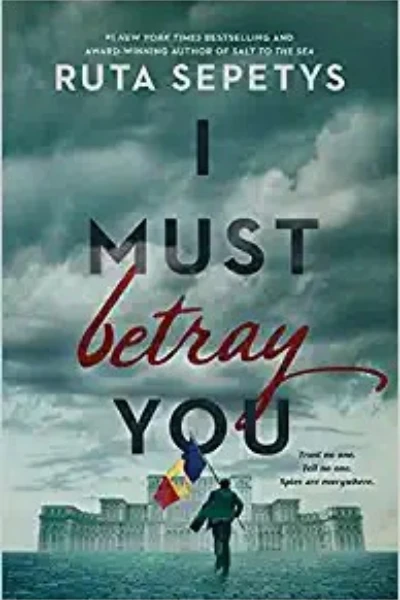
I Must Betray You
I Must Betray You — Epilogue (Epilog)
EPILOGUE
EPILOG
ow long does it take to uncover the truth? For me it took more than twenty years. I was teaching English and Liliana wasH managing a bookstore. Luca had emigrated to England with his parents.
The Securitate Archives, CNSAS, contained over twenty-six kilometers of files—sixteen miles. And those were just the surviving files.
After Ceauşescu’s execution, many of the Secu files disappeared. So did some of the agents. But communism didn’t disappear, not for many years. A group of second-tier communists took over. The Van Dorns never returned to Romania, but I’m still in occasional touch with Dan. And guess what?
Disneyland is a real place. I’ve been there. But I’ve never developed a taste for coffee.
When the Securitate Archives were finally opened, Liliana and I agreed that I needed to see my family’s files. There were still so many unanswered questions. My parents were no longer alive. I needed the truth.
They had found Cici’s body the day after Christmas. Dumped between two buildings; beaten, bent, and buckled with bullets. The revolution had taken my sister. But until I saw the files, I never knew what had really happened.
I was contacted by CNSAS when the Securitate files were “ready” for me.
I arrived in the reading room to find five massive stacks of decaying papers. Each stack held hundreds of pages wedged between a flimsy
cardboard cover and a string binding. Our family wasn’t famous or infamous like some, but regardless, I estimated our files to be about three thousand pages. That’s the equivalent of ten three-hundred-page novels.
It took me many visits to get through them. The files, they were poisonous, disrupting my life and my conscience. Photos from hidden cameras, transcripts from the listening devices in our apartment. Countless reports on Bunu. Over fifty different people had informed on our family.
The extent of the surveillance was shocking.
And haunting.
As was my unknown role in it.
When we don’t know the full story, sometimes we create one of our
own. That’s what I had done.
And that can be dangerous.
But I didn’t realize my error—until I saw the reports from a source called MARIA.
|| OFFICIAL REPORT ||
TOP SECRET [3 November, 1988]
Ministry of the Interior
Department of State Security Directorate III, Service 330
Meeting with source “MARIA” revealed the following: • MARIA confirms that her father-in-law is a dissident and her husband harbors anti-communist sentiments. She will continue to provide information and advises that she has found ways to cause the radio to malfunction. • MARIA also agrees to provide information about the U.S. Embassy in exchange for merchandise and the safeguarding of her children— whom she fears are being negatively impacted by their grandfather • today MARIA requested a carton of Kents
I thought I knew my family.
It turns out, I didn’t.
Mama was an informer. She very willingly informed on Bunu, and she informed on her own husband. And my father knew. That’s why he retreated into silence. Did Bunu know? Was Mama the rat in our apartment that he referred to? Her reports contained many statements that informing about dissent was not only her patriotic duty, but her maternal duty.
The stress took its toll. The Secu took the upper hand.
To me, Bunu was a hero. To Mama, he was a threat.
And Cici, she understood both perspectives.
In early 1989, Cici was recruited as an informer.
She was my sister. She was my friend. She was also a double agent for the Americans, trying to secure a better life for our family.
The files indicated that Cici repeatedly rejected the idea of enlisting my help to inform on the Van Dorns. She had tried to protect me. What finally changed her mind? The promise of two passports. She planned that
we’d emigrate to Canada or the U.S.
Just the two of us.
The Secu used her, blackmailed her, and repeatedly criticized her in the files. Her code name was FRITZI and the reports from Paddle Hands about her were denigrating and demeaning. The reports suggested ways to exploit Cici’s body to gain information on a multitude of targets. The files said she helped the woman from Boston get to the U.S. Embassy so she could leave the country just prior to the uprising. And that’s when the regime discovered she had been working with the Americans.
Cici had tried to help others but couldn’t save herself.
She had begged to stay at the hospital that night. She told me it was “safer.”
I didn’t realize Cici was in danger. I left her, believing she was working against me when in reality, she was trying to help me. But what exactly had happened when she left the hospital?
Those details weren’t in the files.
Nor was the fact that I had misunderstood and failed my sister.
In addition to his reports on Cici, Paddle Hands’s reports on me were sobering and, at times, chilling: OSCAR is no longer of use. Take necessary measures.
“Take necessary measures” was also the phrase they applied to Bunu before his death.
There were so many disturbing details of the surveillance. Things I felt sure were private were not private. Not my first kiss at fourteen, not my trades with Starfish, not even the Twinkies. Reading the files was indescribably violating and needled trust issues I had hoped were long buried. Seeing the reports opened a door I couldn’t close. I constantly wondered: Was it better to know, or better not to?
Me personally, I needed to know. But I still had unanswered questions about my sister.
• • •
A year later, at my high school reunion, I lingered near the bar with a classmate.
“So, what are you doing these days?” he asked.
“Teaching English. You?”
“Accounting. We were in the same class,” he said. “Do you remember?
I’m the guy who had the breakdown and screamed about being an informer.
That’s how most people remember me.”
“You know what I remember?” I said. “That none of us did anything to comfort you. I’m sorry. I was in the same position. I should have helped
you.”
“Same agent?” he asked.
“Big hands and BT cigarettes?”
“Yeah, that’s him. I thought he was so evil, but now I sometimes wonder—maybe he was a pawn of the regime, just like the rest of us. But you know what’s weird?” he whispered. “His daughter goes to the school right next to my apartment building.”
A cold clench gripped my abdomen. “Wait, you see Paddle Hands?”
“Yeah, he lives right near me, in building F2.”
Paddle Hands, the guards at Station 14, most of the torturers were never charged. They lived among us. Maybe the events of 1989 are a distant memory to them. But they’re not a distant memory to me. Like I said, too many unanswered questions.
“He lives near you?” I asked again. “Do you know his real name?”
He gave me the name.
I repeated it in my head.
Memorized it.
Vowed never to forget it.
And that’s how I eventually ended up at the cemetery, standing at our family gravesite with a manuscript. I’ve spent years panning for truth, interrogating my memories, correcting false narratives, and pondering the fact that when betraying others, we often betray ourselves.
My students sometimes ask about the revolution and I share stories. I change the names, just in case. They love hearing about Liliana, Bunu, and Starfish. When I speak of Cici, their sadness is palpable.
Sometimes we think we know. We’re sure we know. But we know nothing. Years pass and eventually, time becomes the unveiler of truth. And that painful shift in comprehension, I tell my students, is called “a rite of passage”—that’s the English term for it.
“Mr. Florescu, you should write a book about it,” they constantly tell
me.
So I have.
The story ends well: Liliana. Me. Spectacular hope.
I’ve left it for Bunu to read. Maybe one day others will read it too.
But now I’ve arrived at Paddle Hands’s apartment, and I’m ready for answers. I’m ready to put the past behind me.
I’ve knocked.
I’ve heard his footsteps, and I can smell the cigarette smoke.
It’s happening.
This is it.
He’s going to open the door.
End of book
You finished I Must Betray You
by Ruta Sepetys