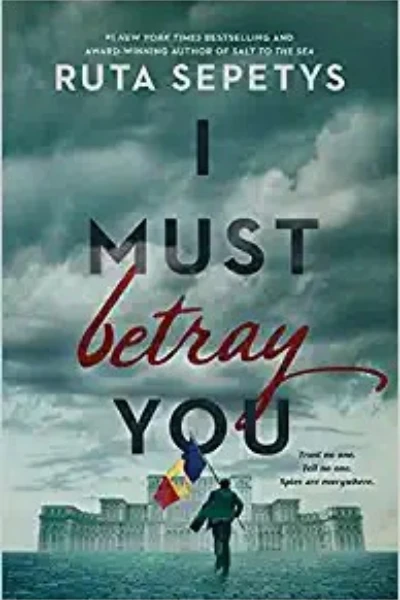
I Must Betray You
I Must Betray You — 12 (Doisprezece)
12
DOISPRE ZECE
e couldn’t stop laughing, drunk on contraband and sugar.
By the time we got to video night there was little room toW move.
“You’re late,” whispered Starfish. “Movie’s starting. You’ll have to stand in the back. Is your sister coming?”
“No, she’s not coming. What’s the movie?” I asked.
“First movie is called Die Hard.”
I leaned over and whispered to Liliana. “Die Hard. Bulă says they’re making an action film about Romania. It’s called Live Hard.”
We laughed and Starfish told us to shut up. I wanted to brush Liliana’s hair from her face so I could see her eyes when she laughed. But I didn’t.
Over thirty people sat, crammed in the small, musty living room. Girls in the front, guys in the back. I spotted Luca among the boys. Arriving late had worked in my favor. I could stand against the wall, next to Liliana. In the dark, amidst the glow of the small television, I felt the press of her arm against mine. Did she feel it?
Video nights were forbidden. The Securitate could burst in at any time and haul us to headquarters. That only increased the excitement. The nervous energy in the room buzzed like a fizzy static over my entire body. I looked around. How did this video network function? It had to be big business. Who was duplicating the tapes and secretly distributing them to neighborhood operators like Starfish? Starfish was probably making more money in one night than most Romanians made in a month. I once spied the
Securitate agent in our building with a handful of videos. Had they been confiscated from a video night somewhere, or were they his own?
Everyone sat, hypnotized by the screen and the woman’s voice coming from it, speaking the dubbed Romanian translation. No one cared that the copies were poor and grainy. We’d watch four movies per night and be blissfully bleary-eyed by morning.
Liliana leaned in to whisper. “She’s replacing the swear words. Can you hear it? She’s using ‘Get lost’ for all the swears.”
Her mouth was so close to my ear. Liliana smelled like flowers—the type you smell on the air in spring but can’t find when you look for them.
That smell, the press of her arm against mine, it made it difficult to concentrate and look at the TV. I wanted to look at her instead. But Liliana was right. The woman dubbing the English into Romanian was replacing the swear words.
“If you listen closely,” I told her, “sometimes you can also hear forbidden English words like ‘priest’ or ‘God.’ ”
She nodded then touched my hand. “Look! They’re drinking a Coke.”
“Be quiet or leave!” said a girl next to us.
We laughed but stopped talking. We didn’t want to be kicked out.
When I watched the movies, I generally tracked the plot. The stories were far-fetched yet fascinating. But Liliana absorbed detail. I decided to watch the film as I imagined she was watching it. And I noticed something.
Choice.
Options.
The characters in foreign movies had both.
In Romania, jobs were assigned. Apartments were assigned. We had no choice.
But the characters in movies, they made their own decisions—what to eat, where to live, what kind of car to drive, what type of work to pursue, and who to speak to. They didn’t have to stand in line for food. If they turned on a faucet, hot water rolled out. If they didn’t like something, they complained out loud. It was crazy.
But crazier—the interactions. They looked at one another for extended periods without diverting their eyes.
There was an ease between them. Unspoken comfort.
They weren’t worried they might be standing next to an informer.
Like me.