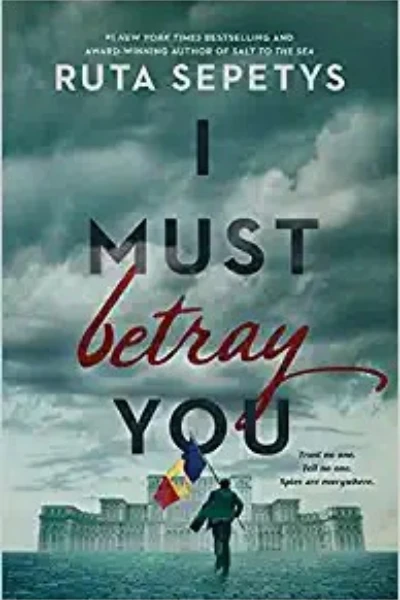
I Must Betray You
I Must Betray You — 29 (Douăzeci Și Nouă)
29
DOUĂZECI ȘI NOUĂ
noted Dan’s behavior as we walked through Rosetti Square, his general ease in all things. He swung his arms, casually looking about, speakingI louder than most Romanians would.
I envied him, the courage to be himself. In public.
The American Library was housed in two elegant turn-of-the-century villas—buildings spared by the bulldozers. As we entered the library, we had to present identification in a reception area. Dan leaned across the desk.
“Hi there, Brenda. What are you doing up front?” he asked.
“Reception clerk is sick,” said the older woman. “It’s so chilly by the door. Sure do miss the weather in California.”
“I know. I’m missing the weather in New Jersey. So that says a lot!” replied Dan.
Dan and the woman shared a laugh. He gestured to me.
“This is my friend Cristian. He’s my guest today. He speaks English.”
“Hello, Cristian,” said the woman, smiling brightly. “Just need a peek at your ID.”
A peek. What did that mean? Dan had given his ID, so I handed her mine.
She looked at the photo on my identification for an extended beat. She finally looked up and stared straight at me. A gentle smile appeared.
“My, what lovely eyes you have,” she said.
“Oh, they’re . . . weird,” I blurted. I was uncomfortable with the exchange but comfortable with the memory of Liliana’s description.
“No, not weird at all,” she insisted, handing back my card. “But maybe weird that an old lady is complimenting them?” She then did something I’d
seen in movies.
She winked.
An American woman winked at me, as if sharing some sort of private joke. Was this as strange as it felt? I turned to Dan for his reaction.
“Thanks, Brenda,” he said, unfazed. “We’re off to rot our minds with pop culture crap.” He gave a salute.
“Rot away!” she said with a wave of her hand.
Was I misunderstanding their English? This was an official building.
Yet they were being so casual, just like in the movies. Were Americans ever serious? No—I reframed the question. Were Romanians always serious?
Dan walked casually to a long table positioned near a shelf of newspapers. He tossed his backpack on the table and it landed with a thud.
“You can leave your bag here. Have a look around.”
I wasn’t going to leave my bag anywhere. It remained hanging from my shoulder as I walked through the warm building. There were shelves of fiction, nonfiction, biography, reference, and a section for children. There was also a section with books on Romanian history and language. Most of the books were in English. I wanted to read them. Every single one.
And I wanted to share them with Liliana.
I continued browsing the section. At the end of the bookshelf I noticed a wooden podium containing an official-looking album with the Romanian flag on the cover. I opened it.
The first page featured the new portrait of Ceauşescu. Two ears.
Beneath the portrait was a paragraph in Romanian:
Leader of the nation, Father of Romania, Nicolae Ceauşescu has established diplomatic relations all over the world and has visited over 100 countries.
The album contained photos of our leader during his travels or hosting other countries:
1969—U.S. President Richard Nixon visits Bucharest. He is the first American president to visit a communist country.
1975—U.S. President Gerald Ford visits Bucharest.
1978—U.S. President Jimmy Carter holds a state dinner at the White House in honor of the Ceauşescus.
The album was packed full of colorful photos featuring Beloved Leader and Heroine Mother with dignitaries and heads of state. I scanned through some of the names: UK Prime Minister Margaret Thatcher, Queen Elizabeth II, Queen Silvia of Sweden, Indira Gandhi of India, Pope Paul VI of the Vatican, Canadian Prime Minister Brian Mulroney, Charles De Gaulle of France, King Juan Carlos of Spain, Queen Margrethe II of Denmark.
And this one:
President Nicolae Ceauşescu of Romania joined the long list of international celebrities who have visited Disneyland, the world- famous “Magic Kingdom” in California, to meet Mickey Mouse.
Ceauşescu was accompanied by his wife and children.
I stared at the photograph.
Mickey Mouse.
I flipped back through the pages toward the front of the album.
Ceauşescu hadn’t outfoxed America.
No.
He’d outfoxed . . . everyone.
They thought he was a benevolent dictator. They’d welcomed him into their countries.
It wasn’t disgust. It was despair. That’s what I felt, seeing the colorful photos of our leader cuddling with kangaroos in Australia and posing with Mickey Mouse in some citrus dream called California.
And . . . Disneyland. It was a real place?
Ceauşescu and his family were free to travel to every continent and experience all the world had to offer, but he kept his people caged within the country’s borders, working, full of fear, terrorized if they inquired about a passport. My parents longed to return to the Romanian seaside or to spend time in the mountains. But in recent years, Ceauşescu’s work mandates and petrol rations made that difficult.
I wanted my mother to have a lighted stairwell.
I wanted my father to have a real vacation or a car.
I wanted Liliana to have the birds she missed.
I closed the album and wandered to the shelves with magazines, looking for the one Mr. Van Dorn had suggested.
TIME.
I found it. The moment is forever engraved in my memory.
The headline of the issue:
THE BIG BREAK Moscow Lets Eastern Europe Go Its Own Way
I shot a quick glance over my shoulder. My pulse began to tick.
The magazine cover featured a large crowd with a teenager waving a
flag.
A Hungarian flag.
Hungary bordered Romania.
Wait.
Hungary was no longer ruled by communism?
Hungary was free?