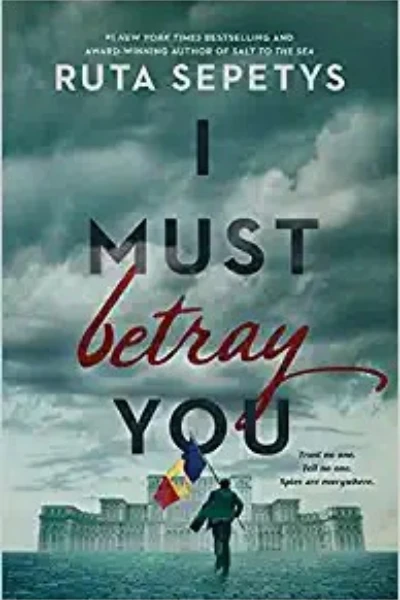
I Must Betray You
I Must Betray You — 57 (Cincizeci Şi Șapte)
57
CINCIZECI ŞI ȘAPTE
hadn’t slept but by morning felt invincible. I ran to school, passing a banner proclaiming LONG LIVE CEAUŞESCU! What if I tore it down? No,I we needed a group. We had to join together. In Romania it was against the law to gather in groups larger than a few people. But no one would pay attention to that now, would they?
I couldn’t wait to get to school. There would be chatter, discussions, plans. Cici and my parents were full of fear rather than fortitude. I missed Bunu. He would know what to do and how to do it.
But school that day was a morgue. Cold silence. Blank faces.
Comrade Instructor spoke the same waste of time, wooden tongue nonsense. I couldn’t understand it. Had no one heard the radio reports? Did they care nothing for the brave people of Timișoara? Were they too scared, or just programmed to believe that they were owned by the State and could do nothing about it?
Winter break began the next day. This was our last opportunity to be together and make plans. Between classes, I whispered to a fellow student.
“Hey, did you hear about Timișoara?”
He nodded. “My parents are terrified we’ll all be mowed down.
They’ve ordered me to stay inside.”
I looked at my classmate. Stay inside? I thought about Bunu, about his comment that an unexamined life wasn’t worth living, his reminders that sometimes to go inside, we needed to go outside.
I left school and walked home in the dark. A tall figure fell into step
beside me.
Luca.
“Did you hear the reports last night?” he whispered.
“Yes! You?”
“Yeah. Couldn’t sleep. Can’t stop thinking of the people in Timișoara.”
Finally. Someone who understood. And of course, it was Luca. Luca with his eager heart. With everything that was happening, it was impossible
to stay mad at him.
“I looked on the map,” I told him.
“Me too. Over five hundred kilometers to Timișoara.”
“Finally, Romanians have taken a stand.”
“And not just Romanians,” said Luca. “The report said that local Hungarians and Serbs took part. Real solidarity. We have to support them.”
I threw a glance over my shoulder. “In school, no one mentioned it.”
“Of course not,” said Luca. “They’re terrified. Can you blame them?
What do you think your bunu would say?”
“I wish he was here to help.”
“If he was, what would he tell us?”
I thought for a moment, trying to think like my philosophical grandfather. “He’d say . . . this is bigger than the ‘I’ or the ‘me.’ This must be ‘we.’ ”
“Exactly!” said Luca, his feet slowing. “Wait, the university students are probably mobilizing.”
Of course. Why hadn’t I thought of that? “I bet you’re right.”
“I’ll ask around,” said Luca. “You too.”
I nodded.
We arrived on our street. Luca paused before heading to his building.
“If you have an update, call my house and let it ring once. That’ll be our signal. I’ll meet you in the street,” he said.
“Okay. You do the same.”
Luca nodded, and we went our separate ways. And then I heard his voice.
“Hey, Cristian,” he called.
I looked across the street. Luca smiled at me. He raised his hand and
flashed a signal.
The peace sign.
Before I could signal back, Starfish appeared, our block dogs beside him. “The English papers I mentioned. I’ll have them tomorrow.”
“Okay. You have any updates?”
“Waiting for tonight’s radio reports like everyone else,” he said. “I heard they blocked the borders. But things must be quieting down. They say Ceauşescu left for meetings in Iran.”
If Ceauşescu left for Iran, did that mean he didn’t take the protests seriously? What had happened to the people in Timișoara?
“Find me tomorrow for the papers. Bring your money,” said Starfish.
• • •
That night, all of Romania sat by their radios. Was Mr. Van Dorn listening?
Had he found my notebook?
My father stood with his hand on the radio, as if to protect it.
“Gabriel, step away. What if the regime sends an electric shock of some sort?”
“You think they’ll blow up the radio?” I said.
“Well, the transmitter for Radio Free Europe must be powerful if it can broadcast all the way from Munich,” whispered Mama.
The transmitter was powerful. Over a thousand kilowatts. I thought of Bunu, trading the Kents to repair our radio. It was our main source of information, but only if the electricity was on. When would it snap off?
At 10:00 p.m. the announcer’s voice appeared through the static. I jumped from the couch.
‹‹Tensions escalated yesterday in Timișoara. It’s been reported that thousands have been killed. The recording you’re about to hear was
smuggled out of Romania by a German tourist and delivered to us at Radio Free Europe.››
I stepped closer to the radio. Audible static—and then the sounds came
through.
Chaos. Screaming. Crowd noise.
A woman’s pleading voice. “Stop! Shame on you, they’re Romanians, just like you!”
A man’s voice, “Shoot, you bastards. Shoot!”
A breath of silence.
A wave of gunfire.
Children screaming.
“They’re shooting them,” I gasped.
“The sound could be misleading,” said Cici. “Please, let’s hope it’s wrong.”
“I don’t care if it’s three people or three thousand. Our country is murdering its citizens!” I exclaimed. “We can’t just stand here and do
nothing!”
“You’re right.”
The voice, it startled me.
“You’re right,” repeated my father. “They’ve blocked the borders.
They’re trapping us.” He quickly began gathering things in the kitchen.
Knives, broom and mop handles.
“Gabriel, what are on earth are you doing?” asked Mama.
“Preparing,” said my father. “When it’s time, we have to be ready.”
“For what?” asked Cici.
“To fight,” he replied.