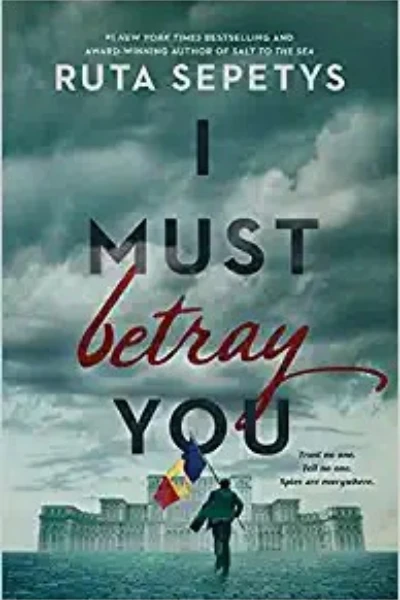
I Must Betray You
I Must Betray You — 2 (Doi)
2
DOI
entered the school office. The old, brittle secretary glanced at me, then looked to her lap. No eye contact. She pointed a shriveled fingerI
toward the director’s office.
My stomach curled, tighter.
A windowless box. Smoke-stained ceiling. The stale, suspended tang of moldy paper. Hanging above the director’s plain, blocky desk was a portrait in a golden frame. Identical portraits decorated all of Romania— classrooms, train stations, stores, hospitals, and even the front of books.
Him.
Nicolae Ceauşescu.
Our beloved leader. Our hero. Maverick of the grand Communist Party of Romania and vampire to the necks of millions. Illegal metaphor?
Absolutely.
The new portrait depicted our hero with blushing cheeks and wavy, thick brown hair. He and his wife, Heroine Mother Elena, had guided the country of Romania for twenty-four years. I didn’t linger on the picture that showed a much younger version of our leader. Instead, my eyes pulled to the stranger seated below the portrait.
Mid-thirties. Unbroken line of an eyebrow. More scalp than hair.
Hands each the size of a tennis racket and shoulders extending well beyond
the width of the chair.
“Close the door,” instructed the man.
I closed the wooden door but did not sit. I was not told to.
The stranger peeled through a file in front of him. A photo clipped to the upper edge of the folder showed a young man with messy dark hair and pale eyes. And that’s when the floor of my stomach collapsed.
Sitting a meter away was not just a hulking man with one eyebrow and
paddles for hands.
No.
This man was executioner, black rider, and spy. He was an agent of the Securitate, Romania’s fearsome secret police. Within his grasp sat a file and
a photo.
Of me.
“They say there’s one Secu per every fifty Romanians,” my sister Cici once warned. “There are twenty-three million Romanians. Do the math.
Securitate agents, they’re everywhere.”
We called them “the blue-eyed boys.” Nickname aside, they were generally easy to spot. In Romania, if your family was lucky enough to afford a car and could wait five years until one became available, you knew what you were getting. There was only one brand of car—Dacia. They came in a few colors like white, blue, or green. But the secret police, they drove black Dacias. A young man in our apartment block drove a black Dacia. I watched him from our balcony. I was intrigued from afar.
The man in front of me drove a black Dacia. I was certain of it. But I
was not intrigued.
I was scared.
The agent leaned back, bullying the metal chair he sat upon. His eyes drilled silent holes through me, splitting the walls of my confidence. He waited, and waited, allowing the holes to fill with fear.
His weight suddenly shifted. The front legs of the chair clapped to the floor. He leaned across the desk, exhaling the dead nicotine that lived on his pasty, yellow tongue. His words still haunt me.
“You’re Cristian Florescu,” he said. “And I know what you’ve done.”