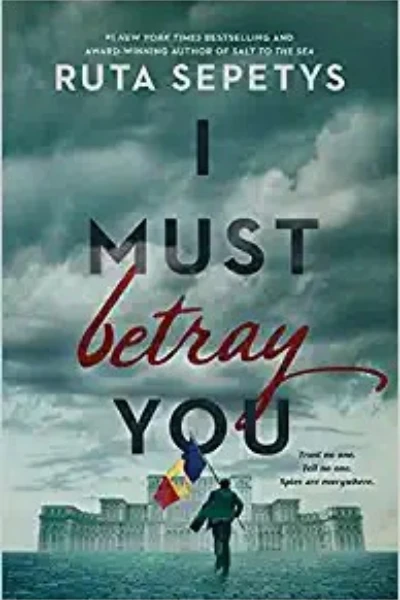
I Must Betray You
I Must Betray You — 45 (Patruzeci Și Cinci)
45
PATRUZECI ȘI CINCI
links of orange.
I saw them as I approached our building. Burning taperB candles stood in pots of sand, flickering through the darkness. A six-foot wooden cross, hauled from a nearby church, leaned against the entry of our building. The tradition when someone dies.
At least Mrs. Drucan hadn’t suffered long. Her daughter was probably already packed for Boston. Her comment still haunted me.
How many Kents will I need to make sure they turn up the gas?
I shook off the thought.
The Reporters were absent from their perch. I passed Mirel, standing in his familiar spot near the building. I nodded to him.
“Sorry,” he said.
I shrugged. What was he sorry for?
My feet stopped.
The candles. The cross.
No.
Bunu?
I ran inside and up the stairs. My father stood outside our apartment
door.
“Go inside. Now. I’m waiting for Cici.”
“But—”
“I said, go inside.”
His tone wasn’t of someone who had just lost his father. It was terse, urgent.
Mama sat at the table, a shadowed stick figure beneath a crooked beam of light, smoking an open package of Kents. Her thin hand trembled. The tip of the cigarette glowed as she pressed it to her lips. We used Kents for bribes. We didn’t smoke them.
“Mama?” I looked into the kitchen toward Bunu’s narrow couch.
Empty.
“Come here, Cristian.”
“Mama, where’s Bunu?”
“Come here, please.”
A cold twist of fear seized my abdomen. I slowly approached the table.
“I came home from work,” she whispered, “and found your grandfather.” The illuminated cigarette in her hand began to vibrate. “We’ve put him . . . in the bedroom.” She set the quivering cigarette on the lip of the ashtray and reached for my hand. I helped her out of the chair, then followed her to the closed door. She took a breath, turned the knob, and
pushed the door open.
And then she turned her back.
Bunu lay on the bed. But it wasn’t Bunu. Life had fled and left a waxy corpse—a withered leaf that had lost its water. Bunu’s gray skin stretched gaunt and taut over his angular cheekbones. His open eyes stared hollow and his mouth pulled wide, as if living a silent scream, gasping for freedom.
My chest rose and fell, panting. “Bunu . . . no. He was feeling better.” I stared at the husk of my grandfather and then I realized.
“Mama—”
She turned to me, shook her head, and put a finger to her lips.
I took a step closer to the bed.
Bunu’s hands lay like broken birds. Their color, a purple so dark, nearly black. The bones above his palms were snapped, smashed.
Mama pulled back the blanket covering his legs. A wave of nausea rolled through me. Bunu’s bare feet had been clubbed beyond recognition.
“His chest. The same. All ribs broken,” she whispered in my ear.
“They beat him to death.”
My body was instantly cold. A rush of shock and frozen fury. I stood shaking at the side of the bed and felt myself buckling to the floor. Who did this? Who would viciously beat an elderly man? And why? My god, was leukemia not enough?
Bunu. My grandfather, my teacher, my inspiration.
My hero.
How could I ever live without him?
My mother kneeled down. She laid her hand upon my shoulder.
“This,” she whispered, “is what happens to philosophers.”