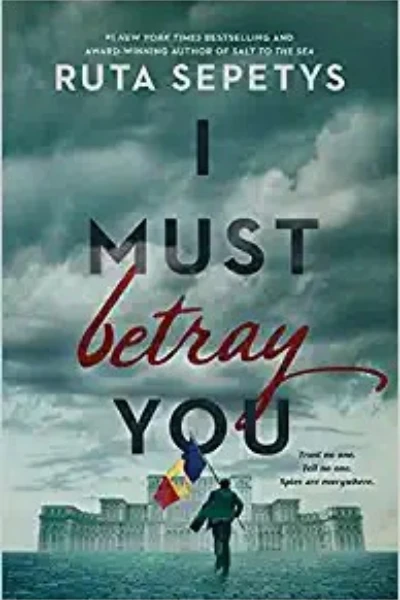
I Must Betray You
I Must Betray You — 66 (Şaizece Şi Şase)
66
ŞAIZECE ŞI ŞA SE
mon, wake up. You gotta wake up.”
Someone was slapping me.C’ I blinked, trying to make out the scene. Over a dozen people, crammed together in a moving vehicle.
“You’ve had a nasty blow to the head. You passed out, but you gotta
wake up,” said a man.
“Where are we?”
“In a police van. They’re taking us to Station 14.”
I slowly sat up and looked around. There were adults in the van and also children.
“Luca,” I whispered. My head was so heavy.
“They dragged him away,” said a small voice. Peering through the darkness was the little boy who had been crouching near the tire.
“Who dragged him away?” I asked.
“I don’t know,” said the boy. “That’s when they took me. They got my dad and sister too.” He pointed to shadowed figures in the vehicle.
The van jerked to a halt. The back door flew open.
“Get out!”
They herded us from the van toward what looked like a garage. I
stumbled, my head pounding.
“Put your hands up!”
We put our hands on the building and they began to search us. Let them, I thought. And then I remembered. The papers from Amnesty
International. They were in my coat pocket.
And they were a death sentence.
Was it the left pocket, or the right pocket? My head, I couldn’t remember which pocket I had put them in. I had to check. Had to shove the papers down my pants.
There was a tart, oily smell and moisture beneath my fingers. I squinted: wet green paint.
Our hands in paint, they were marking us. If I touched my jacket or my pants, they’d notice. And then I heard it.
Screaming.
Torturous screaming from inside the garage. Male voices. Female voices. Screaming and begging for mercy. They made us wait, listening, anticipating our turn. The children began to cry. I closed my eyes and
thought of Luca.
Hang on, Luca. Please.
When the guard got to me, he didn’t search me, he merely frisked me. I was both relieved and terrified. The papers were still on me.
After several minutes, the sound of screaming dissipated. Guards lined us up and marched us inside. Yellow, caged lights buzzed and sizzled, illuminating the square space. Green handprints of all sizes lined the walls.
Water dripped from a pipe in the center of the room, plunking into a pool of blood. A patch of hair, still attached to a piece of scalp, lay discarded.
A guard tossed water from a bucket, rinsing torture from the cement.
“Next round. Face the wall!” barked the guard. “Hands up!”
“Please,” a man pleaded. “Leave my children. Take me, but let my children go.”
They grabbed him and pulled him to the center of the room. While they beat the man, they slashed at our backs with canes.
“Why didn’t you leave your children at home?” they yelled. “You brought them to an illegal demonstration. You will pay for that.”
“Papa, no!” cried a girl.
They took us in turns, dragging each person to the center of the garage, kicking, punching, and clubbing each one of us. When it was finally his
turn to step forward, the little boy fainted and slid down the wall.
To gather courage, I focused on Luca. Hold on, Luca.
Yes. I would think of what they did to Luca. What they did to Bunu.
Resolve rose within me. Three men dragged me to the center of the room and pushed me down on the concrete. Each time I tried to stand, they slammed me down. I tried nonetheless.
“He’s the one,” commented a guard from the corner of the room.
The torturer circled me, thumping a rubber club against his thigh.
“He’s one of the special ones, huh? And young. Good evening, traitor.”
The first blow was to the top of my spine, between my shoulder blades.
Bunu.
Then they sat me up and clubbed my ribs.
Luca.
They took turns punching my face.
Romania.
Then they kicked me below the waist. I lost breath and all track of what was happening.
My cheek pressed against the cold, wet concrete. The room distorted.
A garbled voice appeared at my ear. “We’ve been told you’re on a special list, so we have something special for you.”
My eyes fluttered. I heard the ring and clank of a metal chain. A growling. Feral.
“He’s very hungry. And very devoted to Beloved Leader.”
The other prisoners gasped. A child whimpered.
They corralled the other captives and pushed them out of the room and into a hallway.
I lay, splashed on the floor. Blood, wet and metallic-tasting, leaked from my mouth. I blinked. Two bloody teeth came into focus on the ground.
Were they mine?
The dog pulled, bucking against the chain, ready to attack. Would he eat my face first? My groin? The guards made a semicircle and lit cigarettes to watch the show.
I looked to the dog. Once a sweet face, now twisted into madness. He was a prisoner too—denied food, shelter, and security. Beaten and driven to a state of desperation and savagery. I felt a tear slide from the corner of my eye and stream down my cheek. The dog watched me and calmed.
They let go of the chain and the animal leapt toward me. He stopped.
His face cocked, evaluating. One of the officers kicked him, prodding him on. The dog stiffened, turned from me, and lunged at his attacker. While the guards scrambled to protect themselves, I dragged myself up off the floor. I wouldn’t give them the satisfaction of knowing they’d hurt me. No.
Better to die in battle, in full glory I limped to join the others in the hallway.
We stood, lining both sides of the corridor. They tied our hands in front of us. Some with wire, others with rope.
“You will all make official statements!” yelled a guard.
They slapped us, over and over, prodding us to confess guilt. No one did. Not even the children.
“I am living history. I am freedom,” said a man. “That is my statement.”
“You’ve taken everything. I have nothing to lose,” whispered a woman.
They made their way to me, demanding confession.
I licked the wash of blood from my lips and nodded. My voice was hoarse with revolution, but I was ready. I would turn the tables. “He smokes BT cigarettes. Likes Steaua. Has hands the size of tennis rackets. He meets a pretty girl on the side of the road in the early mornings,” I said. “He has big plans. He’s the one you want.”
The guard’s brow narrowed with confusion, but he wrote down my words. They believed I was confessing. They looked at my identity card.
“Wait, I thought you said that this one . . . He’s only seventeen,” said
the guard.
The torturer shrugged.
They began herding us outside, toward a line of waiting vans.
“Where are you taking us?” said a man.
“Where do you think?” sneered the guard. “To Jilava.”
Jilava.
No.
Jilava was where they sent maximum-security prisoners. Prisoners serving over ten years. Prisoners who would be tortured. They were sending teenagers and children to Jilava?
The vans were packed with injured captives. Some were crying.
No, I would not get in the van.
I stood at the back of the line, planning to escape at the last minute. I would kick the guard in the crotch. I’d try something, anything. I approached the open back of the vehicle. Smoky heat from the exhaust pipe swirled around my ankles. I needed to stay. I needed to fight. I needed to find Luca. I was not getting in the van. I was not going to Jilava.
“Hey, you,” whispered a man in the van. I looked to him.
He motioned with his head to a person sitting near him. “Someone’s trying to get your attention.”
I peered through the darkness. Beneath the interior light of the van I saw a familiar face, streaked with blood and tears. She raised her roped
wrists and gestured with a green palm.
I jumped in the van.