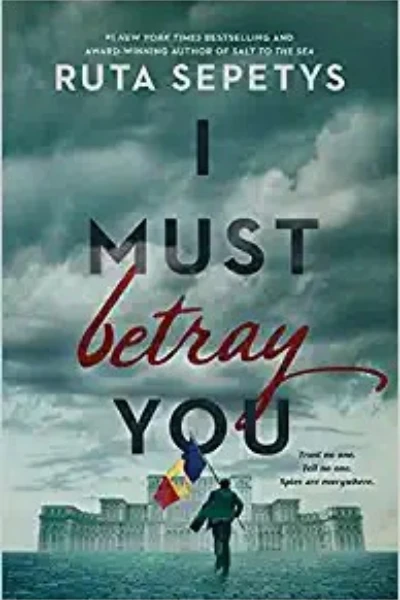
I Must Betray You
I Must Betray You — 71 (Şaptezeci Şi Unu)
71
ŞAPTE ZECI ŞI UNU
crept to the open van doors and watched the guard approach the beastly building. The driver of the van leaned against the vehicle. He closedI his eyes.
Quietly, painfully, I stepped down from the back of the van, and hid by the tire. I made it across the street and crouched in a pool of shadow by a building. I crawled until I was beyond the line of sight.
And then I tried to run.
Pain jolted through my torso. I clutched my ribs, stumbling, but kept going, looking over my shoulder. I darted between buildings and saw a thick crowd in front of the U.S. Embassy. I waded into the swarm. I picked up a filthy knitted hat from the ground and put it on, tucking my wild hair beneath it. I zipped up my coat so the scarf around my torso wasn’t visible.
The tired guards wouldn’t be able to distinguish one protester from another.
One positive about bland communist clothing—many of us looked alike.
My conscience pecked at me. Should I have left Liliana and the kids?
Would they punish them when they realized I was gone? I pushed my way up to the gate, armed by an American soldier.
“Please, I need to see Mr. Van Dorn. Is he here?”
“Do you have a U.S. passport?”
I shook my head.
“I’m sorry, we’re only allowing entrance to Americans.”
“But I really need to see Mr. Van Dorn. I need his help.”
“You need a doctor. You’re badly injured,” said the U.S. soldier.
A man next to me tugged at my arm. “Here, drink some water.”
I took a sip then poured the water on my hands to try to clean them.
The man eyed me. “Where have you been?” he asked.
“Jilava,” I whispered. “I need to go home.”
“My son has a bicycle. Radu, help this boy.”
“Salajan sector three,” I told the guy on the bike.
“Get on. I can take you.”
He pedaled as fast as he could, taking side streets, trying to avoid crowds. The morning chill was balmy and the smoke-smothered streets frothed with war. Bloodstained pavement, buildings pocked with bullet holes, burned portraits of Ceauşescu. A child’s bloody shoe lay orphaned beneath a spray-painted wall that said Jos Tiranul, down with tyranny.
As we passed wide avenues, street cleaning machines chugged along, hosing blood from the pavement. Removing evidence of our murderous regime.
A black Dacia appeared at the end of the road. The rider swerved the bike off the street and bounced up onto the sidewalk.
“Ow!” My ribs screamed.
“Can’t help it, man. You want to get home or what?”
“Where are they taking the wounded?” I asked the cyclist. “My friend was shot last night in University Square.”
“If he survived, they probably took him to Colţea Hospital. If not, the
morgue.”
If he survived.
“Have many died?”
“Too many to count. Vehicles plowed over crowds.”
It hurt too much to inquire further.
“You smell. Where have you been?” asked the driver.
“Jilava. There were lots of us. Including little kids.”
“People are looking for their children. They’re going to morgues and hospitals.”
“Spread the word they’re holding children on Aaron Florian. Tell them to check there,” I told him.
“Will do. Don’t give up. We just need the military on our side.”
We approached my street. Would Paddle Hands or the Secu be waiting for me? “I’m on a list,” I told him. “I don’t want to put you in danger. You can let me off here.”
The cyclist rolled to a stop and I climbed off the bike, wincing in pain.
“You don’t want to put me in danger?” He laughed. “In case you haven’t noticed, we’re all in danger.”
He pedaled off, disappearing into the smoke.