Babel
Babel — Chapter no 4
Chapter Four
So the Lord scattered them abroad from there over the face of all the earth, and they left off building the city. Therefore its name was called Babel, because there the Lord confused the language of all the earth; and from there the Lord scattered them abroad over the face of all the earth.
Genesis 11:8–9, Revised Standard Version
Sleep felt impossible. Robin kept seeing the face of his doppelgänger floating in the dark. Had he, fatigued and rattled, imagined the whole thing?
But the streetlamps had shone so brightly, and his twin’s features – his fear, his panic – were so sharply etched into his memory. He knew it was not a projection. It had not quite felt like looking into a mirror, where all his features were reflected backwards, a false representation of what the world saw, but a gut recognition of sameness. Whatever was in that man’s face was in his as well.
Was that why he had helped him? Some instinctive sympathy?
He was only beginning to fathom the weight of his actions. He’d stolen from the university. Was it a test? Stranger rituals were practised at Oxford.
Had he passed or failed? Or would constables come banging on his door the next morning and ask him to leave?
But I can’t be sent down, he thought. I’ve only just got here. Suddenly the delights of Oxford – the warmth of his bed, the smell of new books and new clothes – made him squirm in discomfort, for now all he could think about was how soon he might lose it all. He tossed and turned in sweaty sheets, conjuring up more and more detailed visions of how the morning might go – how the constables would pull him from his bed, how they’d shackle his wrists and drag him to the gaol, how Professor Lovell would sternly ask Robin never to contact him or Mrs Piper again.
At last he fell asleep from exhaustion. He woke to a persistent tapping at his door. ‘What are you doing?’ Ramy demanded. ‘You haven’t even washed?’
Robin blinked at him. ‘What’s going on?’ ‘It’s Monday morning, you dolt.’ Ramy was already dressed in his black gown, cap in hand. ‘We’re due at the tower in twenty minutes.’
They made it in time, but barely; they were half running down the greens of the quadrangle to the Institute, gowns flapping in the wind, when the bells rang for nine.
Two slim youths awaited them on the green – the other half of their cohort, Robin assumed. One was white; the other was Black. ‘Hello,’ said the white one as they approached. ‘You’re late.’ Robin gaped at her, trying to catch his breath. ‘You’re a girl.’ This was a shock. Robin and Ramy had both grown up in sterile, isolated environments, kept far away from girls their own age. The feminine was an idea that existed in theory, the stuff of novels or a rare phenomenon to be glimpsed from across the street. The best description Robin knew of women came from a treatise he’d once flipped through by a Mrs Sarah * Ellis,which labelled girls ‘gentle, inoffensive, delicate, and passively amiable’. As far as Robin was concerned, girls were mysterious subjects imbued not with a rich inner life but with qualities that made them otherworldly, inscrutable, and possibly not human at all. ‘Sorry – I mean, hello,’ he managed. ‘I didn’t mean to – anyhow.’ Ramy was less subtle. ‘Why are you girls?’ The white girl gave him a look of such withering scorn that Robin wilted on Ramy’s behalf. ‘Well,’ she drawled, ‘I suppose we decided to be girls because being boys seems to require giving up half your brain cells.’ ‘The university has asked us to dress like this so as to not upset or distract the young gentlemen,’ the Black girl explained. Her English carried a faint accent, which Robin thought resembled French, though he wasn’t sure. She shook her left leg at him, displaying trousers so crisp and stiff they looked like they’d been purchased yesterday. ‘Not every faculty is as liberal as the Translation Institute, you see.’ ‘Is it uncomfortable?’ Robin asked, trying valiantly to prove his own lack of prejudice. ‘Wearing trousers, I mean?’ ‘It’s not, in fact, since we have two legs and not fish tails.’ She extended
her hand to him. ‘Victoire Desgraves.’ He shook it. ‘Robin Swift.’
She arched an eyebrow. ‘Swift? But surely—’ ‘Letitia Price,’ the white girl interjected. ‘Letty, if you like. And you?’ ‘Ramiz.’ Ramy halfway extended his hand, as if unsure whether he wanted to touch the girls or not. Letty decided for him and shook it; Ramy winced in discomfort. ‘Ramiz Mirza. Ramy to friends.’ ‘Hello, Ramiz.’ Letty glanced around. ‘So we’re the whole cohort, then.’ Victoire gave a little sigh. ‘Ce sont des idiots,’ she said to Letty. ‘Je suis tout à fait d’accord,’ Letty murmured back.
They both burst into giggles. Robin could not understand French, but felt distinctly that he had been judged and found wanting. ‘There you are.’ They were saved from further conversation by a tall, slender Black man who shook all their hands and introduced himself as Anthony Ribben, a postgraduate specializing in French, Spanish, and German. ‘My guardian fancied himself a Romanticist,’ he explained. ‘He hoped I’d follow his passion for poetry, but when it became apparent I had more than just a passing talent for languages, he had me sent here.’ He paused expectantly, which prompted them to respond with their own
languages. ‘Urdu, Arabic, and Persian,’ said Ramy. ‘French and Kreyòl,’ said Victoire. ‘I mean – Haitian Creole, if you
think that counts.’
‘That counts,’ Anthony said cheerfully. ‘French and German,’ said Letty. ‘Chinese,’ Robin said, feeling somewhat inadequate. ‘And Latin and Greek.’ ‘Well, we’ve all got Latin and Greek,’ said Letty. ‘It’s an entry requirement, isn’t it?’ Robin’s cheeks flushed; he hadn’t known.
Anthony looked amused. ‘A nicely cosmopolitan group, aren’t you?
Welcome to Oxford! How are you finding it?’ ‘Lovely,’ said Victoire. ‘Though . . . I don’t know, it’s strange. It doesn’t quite feel real. It feels like I’m at the theatre, and I keep waiting for the curtains to come down.’ ‘That doesn’t go away.’ Anthony headed towards the tower, gesturing for them to follow. ‘Especially once you’ve gone through these doors.
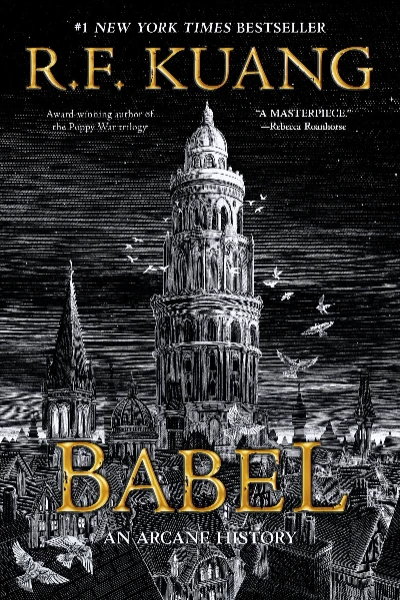
They’ve asked me to show you about the Institute until eleven, and then I’ll leave you with Professor Playfair. Will this be your first time inside?’ They gazed up at the tower. It was a magnificent building – a gleaming white edifice built in the neoclassical style, eight storeys tall and ringed with ornamental pillars and high stained-glass windows. It dominated the skyline of High Street, and made the nearby Radcliffe Library and University Church of St Mary the Virgin look quite pathetic in comparison.
Ramy and Robin had walked past it countless times over the weekend, marvelling at it together, but always from a distance. They hadn’t dared approach. Not then. ‘Magnificent, isn’t it?’ Anthony sighed with satisfaction. ‘You never get used to the sight. Welcome to your home for the next four years, believe it or not. We call it Babel.’ ‘Babel,’ Robin repeated. ‘Is that why—?’ ‘Why they call us Babblers?’ Anthony nodded. ‘A joke as old as the Institute itself. But some first year at Balliol thinks he conceived it for the first time every September, and so we’ve been doomed to that unwieldy moniker for decades.’ He strode briskly up the front steps. At the top a blue and gold seal was carved into the stone before the door, the Oxford University coat of arms.
Dominus illuminatio mea, it read. The Lord is my light. The moment Anthony’s foot touched the seal, the heavy wooden door swung out on its own accord, revealing a golden, lamplit interior of staircases, bustling dark- robed scholars, and books upon books upon books.
Robin paused, too dazzled to follow. Of all the marvels of Oxford, Babel seemed the most impossible – a tower out of time, a vision from a dream. Those stained-glass windows, that high, imposing dome; it all seemed to have been pulled straight from the painting in Professor Lovell’s dining room and dropped whole onto this drab grey street. An illumination in a medieval manuscript; a door to a fairy land. It seemed impossible that they should come here every day to study, that they had the right to enter at all.
Yet here it stood, right in front of them, waiting.
Anthony beckoned, beaming. ‘Well, come on in.’
‘Translation agencies have always been indispensable tools of – nay, the centres of – great civilizations. In 1527, Charles V of Spain created the
Secretaría de Interpretación de Lenguas, whose employees juggled over a dozen languages in service of governing his empire’s territories. The Royal Institute of Translation was founded in London in the early seventeenth century, though it didn’t move to its current home in Oxford until 1715 and the end of the War of the Spanish Succession, after which the British decided it might be prudent to train young lads to speak the languages of the colonies the Spanish had just lost. Yes, I’ve memorized all this, and no, I didn’t write it, but I’ve been giving this tour since my first year on account of my immense personal charisma, so I’ve got quite good at it. Through the foyer this way.’ Anthony had the rare skill of talking smoothly while walking backwards. ‘There’s eight floors to Babel,’ he said. ‘The Book of Jubilees claims the historical Tower of Babel reached a height of over five thousand cubits – that’s nearly two miles – which is of course impossible, though our Babel is the tallest building in Oxford, and likely all of England, excepting St Paul’s. We’re nearly three hundred feet tall, not counting the basement, which means our total height is twice that of the Radcliffe Library—’ Victoire lifted her hand. ‘Is the tower—’ ‘Larger on the inside than it seems on the outside?’ Anthony asked. ‘Indeed.’ Robin had not noticed this at first, but now felt disoriented by the contradiction. Babel’s exterior was massive, but it still did not appear tall enough to admit the high ceilings and towering shelves of each interior floor. ‘It’s a pretty trick of silver-working, though I’m not sure of the match- pair involved. It’s been like this since I got here; we take it for granted.’ Anthony guided them through a throng of townsfolk standing in busy queues before cashier windows. ‘We’re in the lobby now – all business gets conducted here. Local tradesmen ordering bars for their equipment, city officials requesting public works maintenance, that sort of thing. It’s the only area of the tower accessible to civilians, though they don’t interact with scholars much – we’ve got clerks to process their requests.’ Anthony waved for them to follow him up the central staircase. ‘This way.’ The second floor was the Legal Department, which was full of dour- faced scholars scratching at paper and flipping through thick, musty reference volumes. ‘It’s always busy here,’ said Anthony. ‘International treaties, overseas trade, that sort of thing. The gears of empire, the stuff that makes the world go round. Most Babel students end up here after graduation, as the pay is
good and they’re always hiring. They do quite a lot of pro bono work here, too – the whole southwest quadrant is a team working on translating the * Code Napoléon into other European languages.But we charge a pretty penny for the rest. This is the floor that draws the largest income – except silver-working, of course.’ ‘Where’s silver-working?’ Victoire asked.
‘Eighth floor. Up at the very top.’ ‘For the view?’ Letty asked. ‘For the fires,’ said Anthony. ‘When fires start you’d rather they be at the top of the building so everyone has time to get out.’ *No one could tell if he was joking.
Anthony led them up another flight of stairs. ‘The third floor is the landing base for the live interpreters.’ He gestured around the largely empty room, which showed few signs of use except for several stained teacups lying askew and the occasional stack of paper on a desk corner. ‘They’re almost never here, but they need a place to prepare briefing files in confidence when they are, so they get this entire space. They accompany dignitaries and foreign service officials on their trips abroad, attending balls in Russia and taking tea with sheikhs in Arabia and whatnot. I’m told all the travel gets quite exhausting, so there aren’t too many career interpreters who come out of Babel. They’re usually natural polyglots who picked up their languages elsewhere – they had missionary parents, or they spent summers with foreign relatives, for example. Babel graduates tend to avoid
it.’ ‘Why?’ Ramy asked. ‘It sounds fun.’ ‘It’s a cushy posting if what you want is to travel abroad on someone else’s money,’ said Anthony. ‘But academics by nature are a solitary, sedentary lot. Travel sounds fun until you realize what you really want is to stay at home with a cup of tea and a stack of books by a warm fire.’ ‘You have a dim view of academics,’ said Victoire. ‘I have a view informed by experience. You’ll understand in time.
Alums who apply for interpreting jobs always quit within the first two years. Even Sterling Jones – Sir William Jones’s nephew, mind you – couldn’t hack it for more than eight months, and they had him travelling first class wherever he went. Anyway, live interpretation isn’t considered all that glamorous, because all that really matters is that you get your basic
points across without offending anyone. You don’t get to play around with the intricacies of language, which is of course where the real fun is.’ The fourth floor was a good deal busier than the third. The scholars also appeared to be younger: messy-haired and patch-sleeved types compared with the polished, well-dressed folks in Legal. ‘Literature,’ Anthony explained. ‘That is, the businesses of translating foreign novels, stories, and poems into English and – less frequently – vice versa. It’s a bit low on the prestige rung, to be honest, but it’s a more coveted placement than interpretation. One considers a postgraduation appointment to Literature the natural first step towards becoming a Babel professor.’ ‘Some of us actually like it here, mind you.’ A young man wearing postgraduate gowns strode up next to Anthony. ‘These are the first years?’ ‘That’s all of them.’ ‘Not a big class, are you?’ The man waved cheerfully at them. ‘Hello.
Vimal Srinivasan. I’ve just graduated last term; I do Sanskrit, Tamil, *Telugu, and German.’ ‘Does everyone here introduce themselves with their languages?’ Ramy asked. ‘Of course,’ Vimal said. ‘Your languages determine how interesting you are. Orientalists are fascinating. Classicists are dull. Anyhow, welcome to the best floor in the tower.’ Victoire was peering around the shelves with great interest. ‘So do you get your hands on every book that’s published abroad?’ ‘Most of them, yes,’ said Vimal. ‘All the French releases? As soon as they come out?’ ‘Yes, greedy,’ he said, with absolutely no malice. ‘You’ll find our book- buying budget is effectively limitless, and our librarians like to maintain a thorough collection. Though we can’t translate everything that comes through here; we just haven’t the manpower. Translating ancient texts still occupies a good part of our time.’ ‘Which is why they’re the only department that runs a deficit every year,’ said Anthony. ‘Bettering one’s understanding of the human condition is not a matter of profit.’ Vimal sniffed. ‘We’re always updating the classics – between the past century and now, we’ve become a lot better at certain languages, and
there’s no reason why classics should remain so inaccessible. I’m currently working on a better Latin version of the Bhagavad Gita—’ ‘Never mind that Schlegel just put one out,’ Anthony quipped. ‘Over ten years ago,’ Vimal dismissed. ‘And the Schlegel Gita is dreadful; he said himself that he hadn’t grasped the basic philosophy that underlies the whole thing. Which shows, because he’s used about seven different words for yoga—’ ‘Anyway,’ Anthony said, ushering them away, ‘that’s Literature. One of the worst applications of a Babel education, if you ask me.’ ‘You don’t approve?’ Robin asked. He shared Victoire’s delight; a life spent on the fourth floor, he thought, would be wonderful. ‘Me, no.’ Anthony chuckled. ‘I’m here for silver-working. I think the Literature Department are an indulgent lot, as Vimal knows. See, the sad thing is, they could be the most dangerous scholars of them all, because they’re the ones who really understand languages – know how they live and breathe and how they can make our blood pump, or our skin prickle, with just a turn of phrase. But they’re too obsessed fiddling with their lovely images to bother with how all that living energy might be channelled into something far more powerful. I mean, of course, silver.’ The fifth and sixth floors housed both instruction rooms and reference materials – the primers, grammars, readers, thesauruses, and at least four different editions of every dictionary published in what Anthony claimed was every language spoken in the world. ‘Well, the dictionaries are really scattered all over the tower, but here’s where you come if you need to do some archival heavy lifting,’ Anthony explained. ‘Right in the middle, you see, so no one ever has to walk more than four flights to get what they need.’ In the centre of the seventh floor, a series of red-bound books sat on crimson velvet cloth beneath a glass display case. The way the soft lamplight gleamed against their leather covers made them look quite magical – more like magicians’ grimoires than common reference materials. ‘These are the Grammaticas,’ said Anthony. ‘They look impressive, but it’s all right, you can touch. They’re meant to be consulted. Just wipe your fingers on the velvet first.’ The Grammaticas were bound volumes of varying thicknesses but identical binding, arranged alphabetically by the Romanized name of the language and by publication date within those languages. Some
Grammatica sets – notably the European languages – took up entire display cases on their own; others, largely the Oriental languages, contained very few volumes. The Chinese Grammaticas spanned only three volumes; the Japanese and Korean Grammaticas contained only one volume each.
Tagalog, surprisingly, spanned five volumes. ‘But we can’t take credit for that,’ said Anthony. ‘All of that translation work was done by the Spanish; that’s why you’ll also see Spanish-to- English translator credits behind the cover pages. And a good deal of the Caribbean and South Asian Grammaticas – here they are – are still in progress. Those languages weren’t of interest at Babel until after the Peace of Paris, which of course dumped a great deal of territory into Britain’s imperial holdings. Similarly, you’ll find most of the African Grammaticas are translated into English from German – it’s the German missionaries and philologists who are doing the most work there; we haven’t had anyone doing African languages for years.’ Robin couldn’t help himself. He reached eagerly for the Oriental language Grammaticas and began thumbing through the front material.
Written on the cover page of each volume in very neat, tiny handwriting were the names of those scholars who had produced the first edition of each Grammatica. Nathaniel Halhed had written the Bengali Grammatica, Sir William Jones the Sanskrit Grammatica. This was a pattern, Robin noticed – the initial authors all tended to be white British men rather than native speakers of those languages. ‘It’s only recently that we’ve done much in Oriental languages at all,’ said Anthony. ‘We were lagging behind the French there for quite a while.
Sir William Jones made some headway introducing Sanskrit, Arabic, and Persian to the courses lists when he was a fellow here – he started the Persian Grammatica in 1771 – but he was the only one doing any serious
work in those languages until 1803.’ ‘What happened then?’ asked Robin. ‘Then Richard Lovell joined the faculty,’ said Anthony. ‘I hear he’s something like a genius with Far Eastern languages. He’s contributed two volumes to the Chinese Grammatica alone.’ Reverently, Robin reached out and pulled the first volume of the Chinese Grammatica towards him. The tome felt inordinately heavy, each page weighted down by ink. He recognized Professor Lovell’s cramped, neat handwriting on each page. It covered an astonishing breadth of
research. He put the volume down, struck with the unsettling realization that Professor Lovell – a foreigner – knew more about his mother tongue than he did. ‘Why are these under display cases?’ asked Victoire. ‘Seems rather difficult to take them out.’ ‘Because these are the only editions in Oxford,’ said Anthony. ‘There are backups at Cambridge, Edinburgh, and the Foreign Offices in London.
Those are updated annually to account for new findings. But these are the only comprehensive, authoritative collections of knowledge of every language that exist. New work is added by hand, you’ll notice – it costs too much to reprint every time new additions are made, and besides, our printing presses can’t handle that many foreign scripts.’ ‘So if a fire tore through Babel, we could lose a full year of research?’ asked Ramy. ‘A year? Try decades. But that’ll never happen.’ Anthony tapped the table, which Robin noticed was inlaid with dozens of slim silver bars. ‘The Grammaticas are better protected than the Princess Victoria. These books are impervious to fire, flood, and attempted removal by anyone who isn’t in the Institute register. If anyone tried to steal or damage one of these, they’d be struck by an unseen force so powerful they’d lose all sense of self and purpose until the police arrived.’ ‘The bars can do that?’ Robin asked, alarmed. ‘Well, something close,’ Anthony said. ‘I’m just guessing. Professor Playfair does the protective wards, and he likes to be mysterious about them. But yes, the security of this tower would astound you. It looks like your standard Oxford building, but if anyone ever tried to break in, they’d find themselves bleeding out on the street. I’ve seen it happen.’ ‘That’s a lot of protection for a research building,’ said Robin. His palms felt suddenly clammy; he wiped them on his gown. ‘Well, of course,’ said Anthony. ‘There’s more silver in these walls than
in the vaults of the Bank of England.’ ‘Truly?’ Letty asked. ‘Of course,’ said Anthony. ‘Babel is one of the richest places in the entire country. Would you like to see why?’ They nodded. Anthony snapped his fingers and beckoned for them to follow him up the stairs.
The eighth floor was the only part of Babel that lay hidden behind doors and walls. The other seven were designed following an open floor plan, with no barriers surrounding the staircase, but the stairs to the eighth floor led to a brick hallway which in turn led to a heavy wooden door. ‘Fire barrier,’ Anthony explained. ‘In case of accidents. Seals off the rest of the building so that the Grammaticas don’t get burnt if something up here explodes.’ He leaned his weight against the door and pushed.
The eighth floor looked more like a workshop than a research library.
Scholars stood bent around worktables like mechanics, holding assortments of engraving tools to silver bars of all shapes and sizes. Whirring, humming, drilling sounds filled the air. Something exploded near the window, causing a shower of sparks followed by a round of cursing, but no one so much as glanced up.
A portly, grey-haired white man stood waiting for them in front of the workstations. He had a broad, smile-wrinkled face and the sort of twinkling eyes that could have placed him anywhere between forty and sixty. His black master’s gowns were coated with so much silver dust that he shimmered whenever he moved. His eyebrows were thick, dark, and extraordinarily expressive; they seemed ready to leap off his face with enthusiasm whenever he spoke. ‘Good morning,’ he said. ‘I’m Professor Jerome Playfair, chair of the faculty. I dabble in French and Italian, but my first love is German. Thank you, Anthony, you’re free to go. Are you and Woodhouse all set for your Jamaica trip?’ ‘Not yet,’ said Anthony. ‘Still need to track down the Patois primer. I suspect Gideon took it without signing it out again.’ ‘Get on, then.’ Anthony nodded, tipped an imaginary hat at Robin’s cohort, and retreated back through the heavy door.
Professor Playfair beamed at them. ‘So now you’ve seen Babel. How are we all doing?’ For a moment, no one spoke. Letty, Ramy, and Victoire all seemed as stunned as Robin felt. They’d been exposed to a great deal of information at once, and the effect was that Robin wasn’t sure the ground he stood on was real.
Professor Playfair chuckled. ‘I know. I had the same impression on my first day here as well. It’s rather like an induction into a hidden world, isn’t
it? Like taking food in the seelie court. Once you know what happens in the tower, the mundane world doesn’t seem half as interesting.’ ‘It’s dazzling, sir,’ said Letty. ‘Incredible.’ Professor Playfair winked at her. ‘It’s the most wonderful place on earth.’ He cleared his throat. ‘Now I’d like to tell a story. Forgive me for being dramatic, but I like to mark this occasion – your first day, after all, in what I believe is the most important research centre in the world. Would that be all right?’ He didn’t need their approval, but they nodded regardless. ‘Thank you. Now, we know this following story from Herodotus.’ He paced several steps before them, like a player marking out his position on the stage. ‘He tells us of the Egyptian king Psammetichus, who once formed a pact with Ionian sea raiders to defeat the eleven kings who had betrayed him. After he had overthrown his enemies, he gave large tracts of land to his Ionian allies. But Psammetichus wanted an even better guarantee that the Ionians would not turn on him as his former allies once had. He wanted to prevent wars based on misunderstandings. So he sent young Egyptian boys to live with the Ionians and learn Greek so that when they grew up, they could serve as interpreters between the two peoples. ‘Here at Babel, we take inspiration from Psammetichus.’ He peered around, and his sparkling gaze landed on each of them in turn as he spoke. ‘Translation, from time immemorial, has been the facilitator of peace.
Translation makes possible communication, which in turn makes possible the kind of diplomacy, trade, and cooperation between foreign peoples that brings wealth and prosperity to all. ‘You’ve noticed by now, surely, that Babel alone among the Oxford faculties accepts students not of European origin. Nowhere else in this country will you find Hindus, Muslims, Africans, and Chinamen studying under the same roof. We accept you not despite, but because of your foreign backgrounds.’ Professor Playfair emphasized this last part as if it was a matter of great pride. ‘Because of your origins, you have the gift of languages those born in England cannot imitate. And you, like Psammetichus’s boys, are the tongues that will speak this vision of global harmony into being.’ He clasped his hands before him as if in prayer. ‘Anyhow. The postgrads make fun of me for that spiel every year. They think it’s trite. But I think the
situation calls for such gravity, don’t you? After all, we’re here to make the unknown known, to make the other familiar. We’re here to make magic with words.’ This was, Robin thought, the kindest thing anyone had ever had to say about his being foreign-born. And though the story made his gut squirm – for he had read the relevant passage of Herodotus, and recalled that the Egyptian boys were nevertheless slaves – he felt also a thrum of excitement at the thought that perhaps his unbelonging did not doom him to existing forever on the margins, that perhaps, instead, it made him special.
Next, Professor Playfair gathered them around an empty worktable for a demonstration. ‘Now, the common man thinks that silver-working is equivalent to sorcery.’ He rolled his sleeves up to his elbows as he spoke, shouting so they could hear him over the din. ‘They think that the power of the bars lies in the silver itself, that silver is some inherently magical substance which contains the power to alter the world.’ He unlocked the left drawer and pulled out a blank silver bar. ‘They’re not wholly wrong. There is indeed something special about silver that makes it an ideal vehicle for what we do. I like to think that it was blessed by the gods – it’s refined with mercury, after all, and Mercury is the messenger god, no? Mercury, Hermes. Does silver not then have an inextricable link to hermeneutics? But let’s not get too romantic. No, the power of the bar lies in words. More specifically, the stuff of language that words are incapable of expressing – the stuff that gets lost when we move between one language and another. The silver catches what’s lost and manifests it into being.’ He glanced up, took in their baffled faces. ‘You have questions. Don’t worry. You won’t start working with silver until near the end of your third year. You’ll have plenty of time to catch up on the relevant theory before then. What matters now is that you understand the magnitude of what we do here.’ He reached for an engraving pen. ‘Which is, of course, the casting of spells.’ He began carving a word into one end of the bar. ‘I’m just showing you a simple one. The effect will be quite subtle, but see if you feel it.’ He finished writing on that end, then held it up to show them. ‘Heimlich.
German for the secret and clandestine, which is how I’ll translate it to English. But heimlich means more than just secrets. We derive heimlich
from a Proto-Germanic word that means “home”. Put together this constellation of meaning, and what do you get? Something like the secret, private feeling you get from being somewhere you belong, secluded from the outside world.’ As he spoke, he wrote the word clandestine on the flip side of the bar.
The moment he finished, the silver began to vibrate. ‘Heimlich,’ he said. ‘Clandestine.’ Once again Robin heard a singing without a source, an inhuman voice from nowhere.
The world shifted. Something bound them – some intangible barrier blurred the air around them, drowned out the surrounding noise, made it feel as though they were the only ones on a floor they knew was crowded with scholars. They were safe here. They were alone. This was their tower, *their refuge.
They were no strangers to this magic. They had all seen silver-work in effect before; in England it was impossible to avoid. But it was one thing to know the bars could work, that silver-work was simply the foundation of a functioning, advanced society. It was another thing to witness with their own eyes the warping of reality, the way words seized what no words could describe and invoked a physical effect that should not be.
Victoire had her hand to her mouth. Letty was breathing hard. Ramy blinked very rapidly, as if trying to hold back tears.
And Robin, watching the still quivering bar, saw clearly now that it was all worth it. The loneliness, the beatings, the long and aching hours of study, the ingesting of languages like bitter tonic so that he could one day do this – it was all worth it.
‘One last thing,’ Professor Playfair said as he accompanied them down the stairs. ‘We’ll need to take your blood.’ ‘I beg your pardon?’ asked Letty. ‘Your blood. It won’t take long.’ Professor Playfair led them through the lobby to a small, windowless room hidden behind the shelves, which was empty save for a plain table and four chairs. He gestured for them to sit, then strode to the back wall, where a series of drawers were concealed inside the stone. He pulled out the top drawer, revealing stacks and stacks of tiny glass vials within. Each one was labelled with the name of the scholar whose blood it contained.
‘It’s for the wards,’ Professor Playfair explained. ‘Babel sees more robbery attempts than all of the banks in London combined. The doors keep most of the riffraff out, but the wards need some way to distinguish scholars from intruders. We’ve tried hair and fingernails, but they’re too easy to
steal.’ ‘Thieves can steal blood,’ said Ramy. ‘They can,’ said Professor Playfair. ‘But they’d have to be much more determined about the whole endeavour, wouldn’t they?’ He pulled a handful of syringes from the bottom drawer. ‘Sleeves up, please.’ Reluctantly, they pushed up their gowns. ‘Shouldn’t we have a nurse in here?’ asked Victoire. ‘Don’t you worry.’ Professor Playfair tapped the needle. ‘I’m quite good at this. Won’t take me too long to find a vein. Who’s first?’ Robin volunteered; he didn’t want to suffer the anticipation of watching the others. Ramy went next, and then Victoire, and then Letty. The whole procedure took less than fifteen minutes, with none the worse for the wear, though Letty had turned disturbingly green by the time the needle left her arm. ‘Have a hearty lunch,’ Professor Playfair told her. ‘Blood pudding’s good, if they have any.’ Four new glass vials were added to the drawer, all labelled with neat, tiny handwriting. ‘Now you’re part of the tower,’ Professor Playfair told them as he locked the drawers. ‘Now the tower knows you.’ Ramy made a face. ‘Bit creepy, isn’t it?’ ‘Not at all,’ said Professor Playfair. ‘You’re in the place where magic is made. It’s got all the trappings of a modern university, but at its heart, Babel isn’t so different from the alchemists’ lairs of old. But unlike the alchemists, we’ve actually figured out the key to the transformation of a thing. It’s not in the material substance. It’s in the name.’
Babel shared a buttery in the Radcliffe quadrangle with several other humanities faculties. The food there was supposedly very good, but it was closed until start of classes tomorrow, so instead they headed back to the college just in time for the tail end of lunch service. All the hot food was gone, but afternoon tea and its trappings were on offer until supper. They
loaded trays with teacups, teapots, sugar bowls, milk jugs, and scones, then navigated the long wooden tables in hall until they found an unoccupied one in the corner. ‘So you’re from Canton, then?’ asked Letty. She had a very forceful personality, Robin had noticed; she asked all her questions, even the benign ones, in the tone of an interrogator.
He’d just bitten into a scone; it was dry and stale, and he had to take a sip of tea before he could answer. She turned her gaze on Ramy before he
could. ‘And you – Madras? Bombay?’ ‘Calcutta,’ Ramy said pleasantly. ‘My father was stationed in Calcutta,’ she said. ‘Three years, from 1825 to 1828. Could be you saw him around.’ ‘Lovely,’ said Ramy as he slathered jam over his scone. ‘Could be he pointed a gun at my sisters once.’ Robin snorted, but Letty blanched. ‘I’m only saying I’ve met Hindus
before—’
‘I’m Muslim.’ ‘Well, I’m just saying—’ ‘And you know,’ now Ramy was buttering his scone with great vim, ‘it’s very irritating, actually, the way everyone wants to equate India with Hinduism. “Oh, Muslim rule is an aberration, an intrusion; the Mughals just interlopers, but tradition – that’s Sanskrit, that’s the Upanishads.”’ He lifted his scone to his mouth. ‘But you don’t even know what any of those words mean, do you?’ They’d got off to a bad start. Ramy’s humour did not always work on new acquaintances. One needed to take his glib tirades in one’s stride, and Letitia Price seemed capable of anything but that. ‘So, Babel,’ Robin interjected before Ramy could say anything else.
‘Nice building.’ Letty cast him an amazed look. ‘Quite.’ Ramy, rolling his eyes, coughed and set down his scone.
They sipped their tea in silence. Victoire clinked her spoon nervously around her cup. Robin stared out of the window. Ramy tapped his fingers against the table but stopped when Letty shot him a glare. ‘How have you found the place?’ Victoire tried valiantly to rescue their conversation. ‘Oxfordshire, I mean. I feel like we’ve only seen a fraction of
it so far, it’s so big. I mean, not like London or Paris, but there are so many hidden corners, don’t you think?’ ‘It’s incredible,’ Robin said with a bit too much enthusiasm. ‘It’s unreal, every single building – we spent the first three days just walking around, staring. We saw all the tourist attractions – the Oxford Museum, the Christ Church gardens—’ Victoire arched an eyebrow. ‘And they’re letting you in wherever you go?’ ‘Actually, no.’ Ramy set down his teacup. ‘Remember, Birdie, the Ashmolean—’ ‘Right,’ said Robin. ‘They seemed so certain we were going to steal something, they made us turn out our pockets on the way in and out, as if they were convinced we’d stolen the Alfred Jewel.’ ‘They wouldn’t let us in at all,’ Victoire said. ‘They said unchaperoned
ladies weren’t allowed.’ Ramy snorted. ‘Why?’ ‘Probably because of our nervous dispositions,’ said Letty. ‘They couldn’t have us fainting against the paintings.’ ‘But the colours are so exciting,’ said Victoire. ‘Battlefields and breasts.’ Letty put the back of her hand to her forehead.
‘Too much for my nerves.’ ‘So what’d you do?’ Ramy asked. ‘We came back when a different docent was on shift and pretended this time to be men.’ Victoire deepened her voice. ‘Excuse me, we’re just countryside lads visiting our cousins here and we’ve nothing to do when
they’re in class—’
Robin laughed. ‘You didn’t.’
‘It worked,’ Victoire insisted. ‘I don’t believe you.’ ‘No, really.’ Victoire smiled. She had, Robin noticed, enormous and very pretty doe-like eyes. He liked listening to her speak; every sentence felt like she was pulling laughter out from inside him. ‘They must have thought we were about twelve, but it worked like a dream—’ ‘Until you got excited,’ Letty cut in. ‘All right, it worked until we were just past the docent—’ ‘But then she saw a Rembrandt she liked and let out this squeak—’ Letty made a chirping noise. Victoire shoved at her shoulder, but she was
laughing too. ‘“Excuse me, miss.”’ Victoire pulled down her chin in imitation of the disapproving docent. ‘“You’re not supposed to be here, I think you’ve got
turned around—”’ ‘So it was nerves, after all—’ That was all it took. The ice melted. In an instant they were all laughing – a bit harder, perhaps, than the joke justified, but what mattered was that they were laughing at all. ‘Has anyone else found you out?’ Ramy asked. ‘No, they all just think we’re particularly slim freshers,’ Letty said. ‘Though once someone yelled at Victoire to take off her gown.’ ‘He tried to pull it off me.’ Victoire’s gaze dropped to her lap. ‘Letty had to beat him off with her umbrella.’ ‘Similar thing happened to us,’ Ramy said. ‘Some drunkards from Balliol started shouting at us one night.’ ‘They don’t like dark skin in their uniforms,’ said Victoire. ‘No,’ said Ramy, ‘they don’t.’ ‘I’m so sorry,’ said Victoire. ‘Did they – I mean, did you get away all right?’ Robin cast Ramy a concerned glance, but Ramy’s eyes were still crinkled with good humour. ‘Oh, yes.’ He threw his arm around Robin’s shoulders. ‘I was ready to break some noses, but this one did the prudent thing – started running like the hounds of hell were behind him – so then I couldn’t do anything but run as well.’ ‘I don’t like conflict,’ Robin said, blushing. ‘Oh, no,’ said Ramy. ‘You’d disappear into the stones if you could.’ ‘You could have stayed,’ Robin quipped. ‘Fought them off single- handed.’ ‘What, and leave you to the scary dark?’ Ramy grinned. ‘Anyway, you looked absurd. Sprinting like your bladder was bursting and you couldn’t
find a privy.’ And then they were laughing again.
Soon it became apparent that no topics were off limits. They could talk about anything, share all the indescribable humiliations they felt being in a place they were not supposed to be, all the lurking unease that until now they’d kept to themselves. They offered up everything about themselves
because they had, at last, found the only group of people for whom their experiences were not so unique or baffling.
Next they traded stories about their educations before Oxford. Babel, apparently, always anointed its chosen ones at a young age. Letty, who was from down south in Brighton, had dazzled family friends with her prodigious memory ever since she could speak; one such friend, who knew some Oxford dons, secured her a set of tutors and had her drilled in French, German, Latin, and Greek until she was old enough to matriculate. ‘Though I almost didn’t make it.’ Letty blinked, eyelashes fluttering madly. ‘Father said he’d never pay for a woman’s education, so I’m grateful for the scholarship. I had to sell a set of bracelets to pay for the coach fare up.’ Victoire, like Robin and Ramy, had come to Europe with a guardian. ‘Paris,’ she clarified. ‘He was a Frenchman, but he had acquaintances at the Institute, and he was going to write to them when I was old enough. Only then he died, and for a while I wasn’t sure I’d get to come.’ Her voice faltered a bit. She took a sip of tea. ‘But I managed to get in touch with them, and they arranged to bring me over,’ she concluded vaguely.
Robin suspected this was not the full extent of this story, but he, too, was practised in the art of papering over pain, and he did not pry.
One thing united them all – without Babel, they had nowhere in this country to go. They’d been chosen for privileges they couldn’t have ever imagined, funded by powerful and wealthy men whose motives they did not fully understand, and they were acutely aware these could be lost at any moment. That precariousness made them simultaneously bold and terrified.
They had the keys to the kingdom; they did not want to give them back.
By the time they’d finished their tea, they were almost in love with each other – not quite yet, because true love took time and memories, but as close to love as first impressions could take them. The days had not yet come when Ramy wore Victoire’s sloppily knitted scarves with pride, when Robin learned exactly how long Ramy liked his tea steeped so he could have it ready when he inevitably came to the Buttery late from his Arabic tutorial, or when they all knew Letty was about to come to class with a paper bag full of lemon biscuits because it was a Wednesday morning and Taylor’s bakery put out lemon biscuits on Wednesdays. But that afternoon they could see with certainty the kind of friends they would be, and loving that vision was close enough.
Later, when everything went sideways and the world broke in half, Robin would think back to this day, to this hour at this table, and wonder why they had been so quick, so carelessly eager to trust one another. Why had they refused to see the myriad ways they could hurt each other? Why had they not paused to interrogate their differences in birth, in raising, that meant they were not and could never be on the same side?
But the answer was obvious – that they were all four of them drowning in the unfamiliar, and they saw in each other a raft, and clinging to one another was the only way to stay afloat.
The girls were not allowed to live in college, which was why they hadn’t crossed paths with Robin and Ramy until the first day of instruction.
Instead, Victoire and Letty lodged about two miles away in the servant annex of one of the Oxford day schools, which was apparently a common arrangement for Babel’s female students. Robin and Ramy accompanied them home because it seemed the gentlemanly thing to do, but Robin hoped this would not become a nightly routine, as the road really was quite far away and there was no omnibus at this hour. ‘They couldn’t put you anywhere closer?’ Ramy asked.
Victoire shook her head. ‘All of the colleges said our proximity risked
corrupting the gentlemen.’ ‘Well, that’s not fair,’ said Ramy.
Letty shot him a droll look. ‘Say more.’ ‘But it’s not so bad,’ said Victoire. ‘There are some fun pubs on this street – we like the Four Horsemen, the Twisted Root, and there’s this place called Rooks and Pawns where you can play chess—’ ‘Sorry,’ said Robin. ‘Did you say the Twisted Root?’ ‘It’s up ahead on Harrow Lane near the bridge,’ said Victoire. ‘You won’t like it, though. We took a peek and walked right back out – it’s awfully dirty inside. Run your finger around the glass and you’ll find a wadge of grease and dirt a quarter of an inch thick.’ ‘Not a haunt for students, then?’ ‘No, Oxford boys wouldn’t be seen dead there. It’s for town, not gown.’ Letty pointed out a herd of meandering cows up ahead, and Robin let the conversation drift. Later, after they’d seen the girls safely home, he told Ramy to head back to Magpie Lane on his own.
‘I forgot I’ve got to go and see Professor Lovell,’ he said. Jericho was conveniently closer to this part of town than it was to Univ. ‘It’s a long walk; I don’t want to drag you over there.’ ‘I thought your dinner wasn’t until next weekend,’ said Ramy. ‘It is, but I’ve just remembered I was supposed to visit sooner.’ Robin cleared his throat; he felt terrible lying to Ramy’s face. ‘Mrs Piper said she had some cakes for me.’ ‘Thank heavens.’ Amazingly, Ramy suspected nothing. ‘Lunch was inedible. Are you sure you don’t want company?’ ‘I’m all right. It’s been quite a day, and I’m tired, and I think it’ll be nice
just to walk for a bit in silence.’ ‘Fair enough,’ Ramy said pleasantly.
They parted on Woodstock Road. Ramy went down south straight back to the college. Robin cut right in search of the bridge Victoire had pointed out, unsure of what he was looking for except for the memory of a whispered phrase.
The answer found him. Halfway through Harrow Lane he heard a second pair of footsteps behind him. He glanced over his shoulder and saw a dark figure following him up the narrow road. ‘Took you long enough,’ said his doppelgänger. ‘I’ve been skulking here all day.’ ‘Who are you?’ Robin demanded. ‘What are you – why do you have my face?’ ‘Not here,’ said his doppelgänger. ‘The pub’s round this corner, let’s go inside—’ ‘Answer me,’ Robin demanded. A belated sense of danger had only now kicked in; his mouth had gone dry; his heart was hammering furiously. ‘Who are you?’ ‘You’re Robin Swift,’ said the man. ‘You grew up without a father but with an inexplicable English nursemaid and a never-ending supply of books in English, and when Professor Lovell turned up to carry you off to England, you said farewell to your motherland for good. You think the professor might be your father, but he hasn’t admitted that you are his own.
You’re quite sure he never will. Does that make sense?’ Robin couldn’t speak. His mouth opened, and his jaw worked pointlessly, but he simply had nothing to say. ‘Come with me,’ said his doppelgänger. ‘Let’s have a drink.’