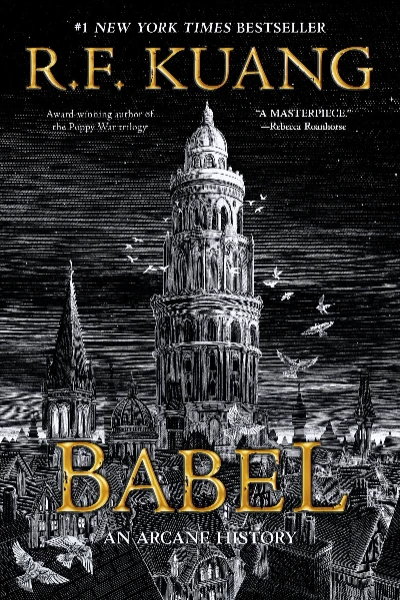
Babel
Babel — Chapter no 15
Chapter Fifteen
As the days take on a mellower light, and the apple at last hangs really finish’d and indolent- ripe on the tree, Then for the teeming quietest, happiest days of all!
WALT WHITMAN, ‘Halcyon Days’
Robin received his exam marks in his pidge the next morning (Merit in Translation Theory and Latin, Distinction in Etymology, Chinese, and Sanskrit), along with the following note printed on thick, creamy paper: The board of undergraduate studies at the Royal Institute of Translation is pleased to inform you that you have been invited to continue your tenure as undergraduate scholar for the following year.
Only when he had the papers in hand did it all seem real. He’d passed; they’d all passed. For at least another year, they had a home. They had room and board paid for, a steady allowance, and access to all of Oxford’s intellectual riches. They would not be forced to leave Babel. They could breathe easy again.
Oxford in June was hot, sticky, golden, and beautiful. They had no pressing summer assignments – they could do further research on their independent projects if they liked, though generally, the weeks between the end of Trinity and the start of next Michaelmas were tacitly acknowledged as a reward, and brief respite, that incoming fourth years deserved.
Those were the happiest days of their lives. They had picnics of ripe, bursting grapes; fresh rolls; and Camembert cheese on the hills of South Park. They went punting up and down the Cherwell – Robin and Ramy got passably good at it, but the girls could not seem to manage the art of pushing them straight ahead instead of sideways into the bank. They walked the seven miles north to Woodstock to tour Blenheim Palace, but did not go in, as the sightseeing fee was exorbitant. A visiting acting troupe from London put on some excerpts of Shakespeare at the Sheldonian; they were
undeniably awful, and the heckling from badly behaved undergraduates probably made them worse, but quality was not the point.
Near the end of June, all anyone could talk about was the coronation of Queen Victoria. Many of the students and fellows still on campus took coaches to Didcot for the train to London the day before, but those who remained in Oxford were treated to a dazzling lighting-up show. There were rumours of a grand dinner to be put on for Oxford’s poor and homeless, but the city authorities argued that the richness of roast beef and plum pudding would put the poor in such a state of excitement that they would lose their * ability to properly enjoy the illumination.So the poor went hungry that night, but at least the lights were lovely. Robin, Ramy, and Victoire strolled with Letty down High Street with mugs of cold cider in hand, trying to conjure up the same sense of patriotism visible in everyone else.
Near the end of summer they took a weekend trip to London, where they drank in the vitality and variety that Oxford, suspended centuries in the past, so lacked. They went to Drury Lane and saw a show – the acting wasn’t very good, but the garish make-up and the ingenue’s pitchy warbling kept them fascinated for the full three-hour run time. They browsed the stalls at New Cut for plump strawberries, copper trinkets, and sachets of supposedly exotic teas; tossed pennies to dancing monkeys and organ- grinders; dodged beckoning prostitutes; perused street stands of counterfeit * silver bars with amusement;had dinner at an ‘Authentick Indian’ curry house that disappointed Ramy but satisfied the rest of them; and slept overnight in a single crowded townhouse room on Doughty Street. Robin and Ramy lay on the floor swaddled in coats while the girls huddled on the narrow bed, all of them giggling and whispering until long past midnight.
The next day they took a walking tour of the city that ended by the Port of London, where they strolled down to the docks and marvelled at the massive ships, their great white sails, and the complex interlacing of their masts and rigging. They tried identifying the flags and company logos of the departing vessels, speculating on where they might be coming from or going. Greece? Canada? Sweden? Portugal? ‘A year from now we’ll be getting on one of these,’ said Letty. ‘Where do you think it’ll be sailing to?’ Every graduating cohort at Babel went on a grand, fully compensated international voyage at the conclusion of fourth-year exams. These voyages usually corresponded with some Babel business – graduates had served as
live interpreters at the court of Nicholas I, hunted for cuneiform tablets in the ruins of Mesopotamia, and once, accidentally, caused a near diplomatic breakdown in Paris – but they were primarily a chance for the graduates to simply see the world, and to soak in the foreign linguistic environments they had been sequestered from during their years of study. Languages had to be lived to be understood, and Oxford was, after all, the opposite of real life.
Ramy was convinced their class would be sent to either China or India. ‘There’s simply so much happening. The East India Company’s lost its monopoly in Canton, which means they’ll need translators for all kinds of business reorientations. I’d give my left arm for it to be Calcutta. You’ll love it – we’ll go and stay with my family for a bit; I’ve written to them all about you, they even know Letty can’t take her tea too hot. Or perhaps we’ll go to Canton – wouldn’t that be lovely, Birdie? When’s the last time you were home?’ Robin wasn’t sure he wanted to return to Canton. He’d considered it a few times, but couldn’t summon any feelings of excitement, only a confused, vaguely guilty dread. Nothing awaited him there; no friends, no family, just a city he only half remembered. Rather, he was afraid of how he might react if he did go home; if he stepped back into the world of a forgotten childhood. What if, upon return, he couldn’t bring himself to
leave?
Worse, what if he felt nothing at all? ‘More likely we’ll be sent somewhere like Mauritius,’ he said. ‘Let the girls make use of their French.’ ‘You think Mauritian Creole is anything like Haitian Creole?’ Letty asked Victoire. ‘I’m not sure they’ll be mutually intelligible,’ said Victoire. ‘They’re both French-based, of course, but Kreyòl takes grammar cues from the Fon language, while Mauritian Creole . . . hm. I don’t know. There’s no Grammatica, so I’ve nothing to consult.’ ‘Perhaps you’ll write one,’ said Letty.
Victoire cast her a small smile. ‘Perhaps.’ The happiest development of that summer was that Victoire and Letty had gone back to being friends. In fact, all the strange, ill-defined awfulness of their third year had evaporated with the news that they’d passed their
exams. Letty no longer grated on Robin’s nerves, and Ramy no longer made Letty scowl every time he opened his mouth.
To be fair, their fights were tabled rather than resolved. They had not really confronted the reasons why they’d fallen out, but they were all willing to blame it on stress. There would be a time when they had to face up to their very real differences, when they would hash things out instead of always changing the subject, but for now they were content to enjoy the summer and to remember again what it was like to love one another.
For these, truly, were the last of the golden days. That summer felt all the more precious because they all knew it couldn’t last, that such delights were only so because of the endless, exhausting nights that had earned them. Soon year four would start, then graduating exams, and then work.
None of them knew what life might look like after that, but surely they could not remain a cohort forever. Surely, eventually, they had to leave the city of dreaming spires; had to take up their respective posts and repay all that Babel had given them. But the future, vague as it was frightening, was easily ignored for now; it paled so against the brilliance of the present.
In January of 1838, the inventor Samuel Morse had given a demonstration in Morristown, New Jersey, showing off a device that could transmit messages over long distances using electrical impulses to convey a series of dots and dashes. Sceptical, the United States Congress declined to grant him funding to build a line connecting the capitol in Washington, DC, with other cities, and would drag their feet in doing so for another five years. But scholars at the Royal Institute of Translation, as soon as they heard that Morse’s device worked, went overseas and cajoled Morse into making a months-long visit to Oxford, where the silver-working department was amazed that this device required no match-pairs to work, but instead ran on pure electricity. By July 1839, Babel hosted the first working telegraph line *in England, which was connected to the British Foreign Office in London.
Morse’s original code transmitted only numerals, under the assumption that the receiver could look up the corresponding words in a guidebook.
This was fine for conversations that involved a limited vocabulary – train signals, weather reports, and certain kinds of military communications. But soon after Morse’s arrival, Professors De Vreese and Playfair developed an * alphanumeric code that allowed exchange of messages of any kind.This expanded the telegraph’s possible uses to the commercial, personal, and
beyond. Word spread quickly that Babel had means of communicating instantaneously with London from Oxford. Soon clients – largely businessmen, government officials, and the occasional clergyman – were crammed in the lobby and lined up around the block clutching messages they needed sent. Professor Lovell, exasperated by the clamour, wanted to set the defensive wards on crowd. But calmer, more financially attuned heads prevailed. Professor Playfair, seeing great potential for profit, ordered that the northwest wing of the lobby, which was formerly used for storage, be converted into a telegraph office.
The next obstacle was staffing the office with operators. Students were the obvious source of free labour, and so every Babel undergraduate and graduate fellow was required to learn Morse code. This took only a matter of days, since Morse code was the rare language that did in fact have a perfect one-to-one correlation between language symbols, provided one was communicating in English. When September bled into October and Michaelmas term began that autumn, all students on campus were assigned to work at least one three-hour shift a week. And so, at nine o’clock every Sunday night, Robin dragged himself to the little lobby office and sat by the telegraph machine with a stack of course readings, waiting for the needle to buzz into life.
The advantage of the late shift was that the tower received very little correspondence during those hours, since everyone in the London office would have already gone home. All Robin had to do was stay awake from nine to midnight, in case any urgent missives arrived. Otherwise, he was free to do as he liked, and he usually spent these hours reading or revising his compositions for the next morning’s class.
Occasionally he glanced out of the window, squinting across the quad to relieve the strain of the dim light on his eyes. The green was usually empty.
High Street, so busy during the day, was eerie late at night; when the sun had gone down, when all the light came from pale streetlamps or from candles inside windows, it looked like another, parallel Oxford, an Oxford of the faerie realm. On cloudless nights especially, Oxford was transformed, its streets clear, its stones silent, its spires and turrets promising riddles and adventures and a world of abstraction in which one could get lost forever.
On one such night, Robin glanced up from his translation of Sima Qian’s histories and saw two black-clad figures striding briskly towards the tower. His stomach dropped.
Only when they reached the front steps, when the lights from inside the tower shone against their faces, did he realize it was Ramy and Victoire.
Robin sat frozen at his desk, unsure what to do. They were here on Hermes business. They had to be. Nothing else explained the attire; the furtive glances; the late night trip to the tower when Robin knew they had no business being there, because he’d seen them finish their papers for Professor Craft’s seminar on the floor of Ramy’s room just several hours before.
Had Griffin recruited them? Certainly, that was it, Robin thought ruefully. He’d given up on Robin, so he’d gone for the others in his cohort instead.
Of course he wouldn’t report them – that was not in question. But should he help them? No, perhaps not – the tower was not wholly empty; there were researchers still on the eighth floor, and if he startled Ramy and Victoire, he might attract unwanted attention. The only choice seemed to be to do nothing. If he pretended never to notice, and if they succeeded in whatever it was they wanted, then the fragile equilibrium of their lives at Babel would not be disturbed. Then they could maintain the thin veneer of deniability Robin had lived with for years. Reality was, after all, just so malleable – facts could be forgotten, truths suppressed, lives seen from only one angle like a trick prism, if only one resolved never to look too closely.
Ramy and Victoire slipped through the door and up the stairs. Robin trained his eyes on his translation, trying not to strain his ear for any hint of what they might be doing. Ten minutes later, he heard descending footsteps.
They’d got what they’d come for. Soon they’d be back out the door. Then the moment would pass, and the calm would resume, and Robin could consign this to the back of his mind with all the other unpleasant truths he hadn’t the will to untangle— A shrieking, inhuman wail pierced the tower. He heard a great crash, then a bout of cursing. He jumped up and dashed out of the lobby.
Ramy and Victoire were trapped just outside the front door, ensnared in a web of glistening silvery string that doubled and multiplied before his eyes, new strands lashing around their wrists, waists, ankles, and throats with every passing second. A smattering of items lay scattered at their feet – six silver bars, two old books, one engraving stylus. Items Babel scholars regularly took home at the end of the day.
Except, it appeared, Professor Playfair had successfully changed the wards. He’d achieved even more than Robin had feared – he’d altered them to detect not only which people and things were passing through, but whether their purposes were legitimate. ‘Birdie,’ gasped Ramy. Silver webs tightened around his neck; his eyes bulged. ‘Help—’ ‘Hold still.’ Robin yanked at the strands. They were sticky but pliable, breakable; impossible to escape alone but not without help. He freed Ramy’s neck and hands first, then together they pulled Victoire out of the web, though Robin’s legs became entangled in the process. The web, it seemed, gave only if it could take. But its vicious lashing had ceased; whatever match-pair triggered the alarm seemed to have calmed. Ramy pulled his ankles free and stepped back. For a moment they all regarded each other under the moonlight, baffled. ‘You too?’ Victoire finally asked. ‘Looks like it,’ said Robin. ‘Did Griffin send you?’ ‘Griffin?’ Victoire looked bewildered. ‘No, Anthony—’
‘Anthony Ribben?’
‘Of course,’ said Ramy. ‘Who else?’ ‘But he’s dead—’ ‘This can wait,’ Victoire interrupted. ‘Listen, the sirens—’ ‘Damn it,’ said Ramy. ‘Robin, lean this way—’ ‘There’s no time,’ said Robin. He couldn’t move his legs. The strings had ceased multiplying – perhaps because Robin was not the thief – but the web was now impossibly dense, stretching across the entire front entrance, and if Ramy came any closer, he feared, they’d both be trapped. ‘Leave me.’ They both began to protest. He shook his head. ‘It has to be me. I haven’t conspired, I have no idea what’s going on—’ ‘Isn’t it obvious?’ Ramy demanded. ‘We’re—’ ‘It’s not obvious, so don’t tell me,’ Robin hissed. The siren’s wailing was endless; soon the police would be at the green. ‘Say nothing. I know nothing, and when they question me, that’s what I’ll say. Just hurry and go,
please, I’ll think of something.’
‘You’re sure—’ Victoire began. ‘Go,’ Robin insisted.
Ramy opened his mouth, closed it, then bent down to scoop up the stolen materials. Victoire followed suit. They left just two bars behind – clever, Robin thought, for that was some evidence that Robin had been working alone, that he had no accomplices who’d disappeared with all the contraband. Then they dashed down the steps, across the green and into the alley. ‘Who’s there?’ someone shouted. Robin saw lamps bobbing at the other end of the quadrangle. He twisted his head and squinted towards Broad Street, trying and failing to glimpse any trace of his friends. They’d got away, it had worked, the police were coming only for the tower. Only for him.
He took a shaky breath, then turned to face the light.
Angry shouts, bright lamps in his face, firm hands on his arms. Robin hardly processed what happened over the next several minutes; he was aware only of his vague, incoherent rambles, a cacophony of policemen yelling different orders and questions in his ear. He tried piecing together an excuse, some story about seeing thieves caught in the webbing, and how they’d snagged him when he went to stop them, but that was incoherent upon utterance, and the police only laughed. Eventually they prised him free of the web and led him back into the tower to a small, windowless room in the lobby, empty save for a single chair. The door had a small grate at eye level covered by a sliding flap; it resembled a jail cell more than a reading room. He wondered if he was not the first Hermes operative to be detained here. He wondered if the faint brown splotch in the corner might be dried blood. ‘You’ll stay here,’ said the constable in charge as he cuffed Robin’s hands behind his back. ‘Till the professor arrives.’ They locked the door and left. They had not said which professor, or when they would return. Not knowing was torture. Robin sat and waited, knees jangling, arms shuddering miserably from waves and waves of nauseating adrenaline.
He was finished. There was, surely, no coming back from this. It was so difficult to be expelled from Babel, which invested so much in its hard- sought talent that previous Babel undergraduates had been pardoned for * almost every kind of offence save for murder.But surely thievery and treason were grounds for expulsion. And then what? A cell in the city gaol?
In Newgate? Would they hang him? Or would he simply be put on a ship and sent back to where he had come from, where he had no friends, no family, and no prospects?
An image rose in his mind, one he had locked away for nearly a decade now – a hot, airless room, the smell of sick, his mother lying stiff beside him, her drawn cheeks turning blue before his eyes. The last ten years – Hampstead, Oxford, Babel – had all been a miraculous enchantment, but he had broken the rules – had broken the spell – and soon the glamour would fall away and he would be back among the poor, the sick, the dying, the
dead.
The door creaked open. ‘Robin.’ It was Professor Lovell. Robin searched his eyes for a shred of something – kindness, disappointment, or anger – anything that might prophesy what he should expect. But his father’s expression, as ever before, was only a blank, inscrutable mask. ‘Good morning.’
‘Have a seat.’ The first thing Professor Lovell had done was unlock Robin’s cuffs. Then he’d led him up the stairs to his office on the seventh floor, where now they sat facing each other as casually as if convening for a weekly tutorial. ‘You’re very lucky the police contacted me first. Imagine if they’d found Jerome instead. You’d be missing your legs right now.’ Professor Lovell leaned forward, hands clasped over his desk. ‘How long have you been pilfering resources for the Hermes Society?’ Robin blanched. He had not expected Professor Lovell to be so direct.
This question was very dangerous. Professor Lovell evidently knew about Hermes. But how much did he know? How much could Robin lie about?
Perhaps he was bluffing, and perhaps Robin could fumble his way out of this if he minced his words in just the right way. ‘Tell the truth,’ Professor Lovell said in a hard, flat voice. ‘That’s the only thing that will save you now.’ ‘Three months,’ Robin breathed. Three months felt less damning than three years, but long enough to sound plausible. ‘Only – only since the summer.’ ‘I see.’ There was no ire in Professor Lovell’s voice. The calm made him terrifyingly unreadable. Robin would have preferred that he screamed.
‘Sir, I—’ ‘Quiet,’ Professor Lovell said.
Robin clamped his mouth shut. It didn’t matter. He didn’t know what he would have said. There was no explaining himself out of this mess, no possible exoneration. He could only face up to the stark evidence of his betrayal and await the consequences. But if he could keep Ramy and Victoire’s names out of this, if he could convince Professor Lovell that he’d acted alone, that would be enough. ‘To think,’ Professor Lovell said after a long while, ‘that you would have turned out so abominably ungrateful.’ He leaned back, shook his head. ‘I have done more for you than you could ever imagine. You were a dock boy in Canton. Your mother was an outcast. Even if your father had been Chinese,’ Professor Lovell’s throat pulsed then, and this was as much of an admission as he would ever make, Robin knew, ‘your station would have been the same. You would have scraped along for pennies your entire life. You never would have seen the shores of England. You never would have read Horace, Homer, or Thucydides – you never would have opened a book, for that matter. You would have lived and died in squalor and ignorance, never imagining the world of opportunities that I have afforded you. I lifted you from
destitution. I gifted you the world.’ ‘Sir, I didn’t—’ ‘How dare you? How dare you spit in the face of all you were given?’ ‘Sir—’ ‘Do you know how privileged you’ve been by this university?’ Professor Lovell’s voice remained unchanged in volume, but each syllable grew longer, first drawled and then spat out as if he were biting the words off at the ends. ‘Do you know how much most households pay to send their sons to Oxford? You enjoy rooms and lodging at no cost. You’re blessed with a monthly allowance. You have access to the largest stores of knowledge in the world. Did you think your situation was common?’ A hundred arguments swam through Robin’s head – that he had not requested these privileges of Oxford, had not chosen to be spirited out of Canton at all, that the generosities of the university should not demand his constant, unswerving loyalty to the Crown and its colonial projects, and if it did, then that was a peculiar form of bondage he had never agreed to. That he had not wished for this fate until it was thrust upon him, decided for him.
That he didn’t know what life he would have chosen – this one, or a life in which he’d grown up in Canton, among people who looked and spoke like him.
But what did it matter? Professor Lovell would hardly sympathize. All that mattered was that Robin was guilty. ‘Was it fun for you?’ Professor Lovell’s lip curled. ‘Did you get a thrill out of it? Oh, you must have. I imagine you considered yourself the hero of one of your little stories – a regular Dick Turpin, didn’t you? You always did love your penny dreadfuls. A weary student by day, and a dashing thief by night? Was it romantic, Robin Swift?’ ‘No.’ Robin squared his shoulders and tried, at least, not to sound so pathetically scared. If he was going to be punished, he might as well own his principles. ‘No, I was doing the right thing.’ ‘Oh? And what is the right thing?’ ‘I know you don’t care. But I did it, and I’m not sorry, and you can do whatever you like—’ ‘No, Robin. Tell me what you were fighting for.’ Professor Lovell leaned back, steepled his fingers together, and nodded. As if this were an examination. As if he were really listening. ‘Go, on, convince me. Try to recruit me. Do your very best.’ ‘The way Babel hoards materials isn’t just,’ said Robin. ‘Oh! It’s not just!’ ‘It’s not right,’ Robin continued angrily. ‘It’s selfish. All our silver goes to luxury, to the military, to making lace and weapons when there are people dying of simple things these bars could fix. It’s not right that you recruit students from other countries to work your translation centre and that their motherlands receive nothing in return.’ He knew these arguments well. He was parroting what Griffin had told him, truths he had come to internalize. Yet in the face of Professor Lovell’s stony silence, it all seemed so silly. His voice sounded frail and tinny, desperately unsure of itself. ‘And if you are indeed so disgusted by the ways Babel enriches itself,’ continued Professor Lovell, ‘how is it that you seemed delighted, always, to take its money?’ Robin flinched. ‘I didn’t – I didn’t ask—’ But this was incoherent upon utterance. He trailed off, cheeks burning.
‘You drink the champagne, Robin. You take your allowance. You live in your furnished room on Magpie Lane, you parade down the streets in your robes and tailored clothes, all paid for by the school, and yet you say all this money comes from blood. This does not bother you?’ And that was the heart of it all, wasn’t it? Robin had always been willing, in theory, to give up only some things for a revolution he halfway believed in. He was fine with resistance as long as it didn’t hurt him. And the contradiction was fine, as long as he didn’t think too hard about it, or look too closely. But spelled out like this, in such bleak terms, it seemed inarguable that far from being a revolutionary, Robin, in fact, had no convictions whatsoever.
Professor Lovell’s lip curled again. ‘Not so bothered by empire, now, are you?’ ‘It’s not just,’ Robin repeated. ‘It’s not fair—’ ‘Fair,’ mimicked Professor Lovell. ‘Suppose you invented the spinning wheel. Are you suddenly obligated to share your profits with everyone who
still spins by hand?’ ‘But that’s not the same—’ ‘And are we obligated to distribute silver bars all around the world to backward countries who have had every opportunity to construct their own centres of translation? It takes no great investment to study foreign languages. Why must it be Britain’s problem if other nations fail to take advantage of what they have?’ Robin opened his mouth to reply, but could think of nothing to say. Why was it so difficult to find the words? There was something wrong with this argument, but once again, he could not figure out what. Free trade, open borders, equal access to the same knowledge – it all sounded so fine in theory. But if the playing field really was so even, why had all the profits accumulated in Britain? Were the British really so much more clever and industrious? Had they simply played the game, fair and square, and won? ‘Who recruited you?’ Professor Lovell inquired. ‘They must not have
done a very good job.’
Robin did not respond. ‘Was it Griffin Harley?’ Robin flinched, and that was confession enough. ‘Of course. Griffin.’ Professor Lovell spat the name like a curse. He watched Robin for a long moment, scrutinizing his face as if he could find
the ghost of his elder son in the younger. Then he asked, in a strangely soft tone, ‘Do you know what happened to Eveline Brooke?’ ‘No,’ Robin said, even as he thought yes; he did know, not the particulars of the story but its general outline. He had nearly put it all together by now, though he’d held off sliding in the final piece, because he did not want to know, and did not want it to be true. ‘She was brilliant,’ said Professor Lovell. ‘The best student we’ve ever had. The pride and joy of the university. Did you know it was Griffin who
murdered her?’ Robin recoiled. ‘No, that’s not—’ ‘He never told you? I’m surprised, to be honest. I would have expected him to gloat.’ Professor Lovell’s eyes were very dark. ‘Then let me enlighten you. Five years ago, Evie – poor, innocent Evie – was working on the eighth floor after midnight. She’d kept her lamp on, but she hadn’t realized the rest of the lights were off. That’s how Evie was. When she was caught up in her work, she lost track of what was going on around her.
Nothing existed for her but the research. ‘Griffin Harley entered the tower at about two in the morning. He didn’t see Evie – she was working in the back corner behind the workstations. He thought he was alone. And Griffin proceeded to do what Griffin does best – pilfer and steal, root through precious manuscripts to smuggle them to God knows where. He was nearly at the door when he realized Evie had seen him.’ Professor Lovell fell silent. Robin was confused by this pause, until he saw, to his astonishment, that his eyes were red and wet at the corners.
Professor Lovell, who’d never shown the slightest ounce of feeling in all the years Robin had known him, was crying. ‘She never did anything.’ His voice was hoarse. ‘She didn’t raise the alarm. She didn’t scream. She never had the chance. Eveline Brooke was simply in the wrong place at the wrong time. But Griffin was so afraid she might turn him in that he killed her anyway. I found her the next morning.’ He reached out and tapped the worn silver bar lying at the corner of his desk. Robin had seen it many times before, but Professor Lovell had always kept it turned away, half-hidden behind a picture frame, and he’d never been bold enough to ask. Professor Lovell flipped it over. ‘Do you know what this match-pair does?’
Robin glanced down. The front side read 爆 . His gut twisted. He was too afraid to look at the back. ‘Bào,’ said Professor Lovell. ‘The radical for fire. And beside it, the radical for violence, cruelty, and turbulence; the same radical which on its own can mean untamed, savage brutality; the same radical used in the * words for thunder and cruelty.And he translated it against burst, the tamest English translation possible, so tame that it hardly translates as such at all – so that all of that force, that destruction, was trapped in the silver. It exploded against her chest. Sprang her ribs apart like an open birdcage. And then he left her there, lying among the shelves, books still in hand. When I saw her, her blood had pooled across half the floor. Stained every page red.’ He slid the bar across the table. ‘Hold it.’ Robin flinched. ‘Sir?’ ‘Pick it up,’ snapped Professor Lovell. ‘Feel the weight of it.’ Robin reached out and closed his fingers around the bar. It was terribly cold to the touch, colder than any other silver he’d encountered, and inordinately heavy. Yes, he could believe that this bar had murdered someone. It seemed to hum with trapped, furious potential, a lit grenade, waiting to go off.
He knew it was pointless to ask, but he had to regardless. ‘How do you know it was Griffin?’ ‘We’ve had no other students in Chinese in the past ten years,’ said Professor Lovell. ‘Do you suppose I did it? Or Professor Chakravarti?’ Was he lying? It was possible – this story was so grotesque, Robin nearly didn’t believe it, didn’t want to believe that Griffin could be capable of something like murder.
But wasn’t he? Griffin, who spoke of Babel faculty as if they were enemy combatants, who sent his own brother repeatedly into the fray without care for the consequences, who was so convinced of the Manichaean justice of the war he fought that he could see little else.
Wouldn’t Griffin have murdered a defenceless girl, if it meant keeping Hermes secure? ‘I’m sorry,’ Robin whispered. ‘I didn’t know.’ ‘This is who you’ve thrown your lot in with,’ said Professor Lovell. ‘A liar and a killer. Do you imagine you’re aiding some movement of global liberation, Robin? Don’t be naive. You’re aiding Griffin’s delusions of
grandeur. And for what?’ He nodded to Robin’s shoulder. ‘A bullet in your
arm?’ ‘How did you—’ ‘Professor Playfair observed you might have hurt your arm rowing. I am not quite so easily deceived.’ Professor Lovell clasped his hands over the desk and leaned back. ‘So. The choice ought to be very obvious, I think.
Babel, or Hermes.’ Robin frowned. ‘Sir?’ ‘Babel, or Hermes? It’s quite simple. You may decide.’ Robin felt like a broken instrument, capable of uttering only one sound.
‘Sir, I don’t . . .’
‘Did you think you would be expelled?’ ‘Well – yes, wouldn’t—’ ‘It’s not quite so easy to leave Babel, I’m afraid. You’ve strayed down the wrong path, but I believe it was as a result of vicious influences – influences crueller and wilier than you could have been expected to handle.
You’re naive, yes. And a disappointment. But you’re not finished. This does not need to end with gaol or prison.’ Professor Lovell tapped his fingers against the desk. ‘But it would be very helpful if you could give us
something useful.’ ‘Useful?’ ‘Information, Robin. Help us find them. Help us root them out.’ ‘But I don’t know anything about them,’ said Robin. ‘I don’t even know
any of their names, except Griffin’s.’ ‘Really.’ ‘It’s true, it’s how they operate – they’re so decentralized, they don’t tell new associates anything. In case—’ Robin swallowed. ‘In case something
like this happens.’
‘How unfortunate. You’re quite sure?’ ‘Yes, I really don’t—’ ‘Say what you mean, Robin. Don’t dither.’ Robin flinched. Those were precisely the same words Griffin had used; he remembered. And Griffin had said it exactly the same way Professor Lovell did now, cold and imperious, as if he’d already won the argument, as if any response Robin made was bound to be nonsense.
And Robin could imagine Griffin’s smirk just now; knew exactly what he would say – of course you’ll choose your creature comforts, you coddled
little scholar. But what right did Griffin have to judge his choices? Staying at Babel, at Oxford, wasn’t indulgence; it was survival. It was his only ticket into this country, the one thing between him and the streets.
He felt a sudden flare of hatred towards Griffin. Robin had asked for none of this, and now his future – and Ramy’s and Victoire’s futures – hung in the balance. And where was Griffin? Where was he when Robin had been shot? Vanished. He’d used them to do his bidding, then abandoned them when things went sour. At least if Griffin went to prison, he deserved it. ‘If it’s loyalty that’s keeping you quiet, then there’s nothing else to be done,’ said Professor Lovell. ‘But I think we can work together still. I think you’re not quite ready to leave Babel. Don’t you?’ Robin took a deep breath.
What was he giving up, really? The Hermes Society had abandoned him, had ignored his warnings and endangered his two dearest friends. He owed them nothing.
In the days and weeks that followed he would try to persuade himself that this was a moment of strategic concession, not of betrayal. That he was not giving up much of importance – Griffin himself had said they had multiple safe houses, hadn’t he? – and that this way Ramy and Victoire were protected, he was not expelled, and all the lines of communication existed still for some future cooperation with Hermes. But he’d never quite talk himself out of the nasty truth – that this was not about Hermes, nor about Ramy or Victoire, but about self-preservation. ‘St Aldate’s,’ he said. ‘The back entrance to the church. There’s a door near the basement that looks rusted shut, but Griffin has a key. They use it as a safe room.’ Professor Lovell scribbled this down. ‘How often does he go there?’
‘I don’t know.’ ‘What’s in there?’ ‘I don’t know,’ Robin said again. ‘I never went myself. Truly, he told me very little. I’m sorry.’ Professor Lovell cast him a long, cool look, then appeared to relent. ‘I know you’re better than this.’ He leaned forward over his desk. ‘You are unlike Griffin in every way possible. You’re humble, you’re bright, and you work hard. You are less corrupted by your heritage than he was. If I’d only just met you, I’d be hard pressed to guess you were a Chinaman at all.
You have prodigious talent, and talent deserves a second chance. But careful, boy.’ He gestured to the door. ‘There won’t be a third.’ Robin stood up, then glanced down at his hand. He noticed he’d been clutching the bar that had killed Evie Brooke this whole time. It felt simultaneously very hot and very cold, and he had the strange fear that if he touched it for a moment longer, it might erode a hole through his palm. He
held it out. ‘Here, sir—’
‘Keep it,’ said Professor Lovell. ‘Sir?’ ‘I have been staring at that bar every day for the past five years, wondering where I went wrong with Griffin. If I had raised him differently, or seen him earlier for what he was, if Evie would still – but never mind.’ Professor Lovell’s voice hardened. ‘Now it weighs on your conscience.
Keep it, Robin Swift. Carry it in your front pocket. Pull it out whenever you begin to doubt, and let it remind you which side are the villains.’ He motioned for Robin to leave the office. Robin stumbled down the stairs, the silver clutched tight in his fingers, dazed and quite sure he’d pushed his entire world off course. Only he hadn’t the faintest clue whether he’d done the right thing, what right and wrong meant at all, or how the pieces might now fall.