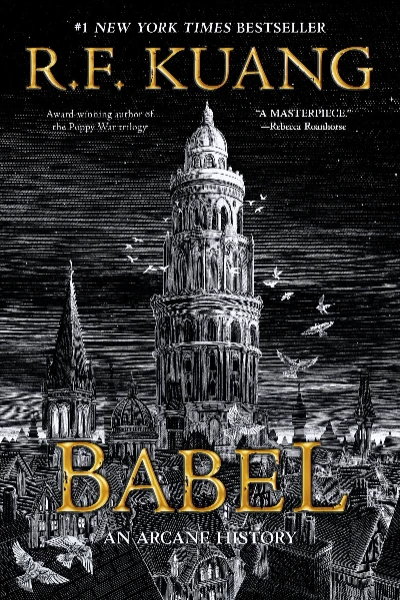
Babel
Babel — Chapter no 3
Chapter Three
But this shall never be: to us remains One city that has nothing of the beast, That was not built for gross, material gains, Sharp, wolfish power or empire’s glutted feast.
C.S. LEWIS, ‘Oxford’
The next morning Robin and Professor Lovell took a cab to a station in central London, where they transferred to a stagecoach bound all the way for Oxford. As they waited to board, Robin entertained himself by trying to guess at the etymology of stagecoach. Coach was obvious, but why stage?
Was it because the flat, wide carriage looked something like a stage?
Because entire troupes of actors might have travelled thus, or performed atop one? But that was a stretch. A carriage looked like a lot of things, but he couldn’t imagine how a stage – a raised public platform – was the obvious association. Why not a basketcoach? An omnicoach? ‘Because the journey happens in stages,’ Professor Lovell explained when Robin gave up. ‘Horses don’t want to run all the way from London to Oxford, and usually neither do we. But I detest travellers’ inns, so we’re doing the single-day run; it’s about ten hours with no stops, so use that lavatory before we go.’ They shared their stagecoach with nine other passengers – a well- dressed little family of four and a group of slouching gentlemen in drab suits and elbow patches who Robin assumed were all professors. Robin sat squeezed between Professor Lovell and one of the suited men. It was too early for conversation. As the carriage bounced along the cobblestones, the passengers either dozed or stared blankly in various directions.
It took Robin a while to realize the woman across from him was staring over her knitting. When he met her eyes, she promptly turned to Professor Lovell and asked, ‘Is that an Oriental?’
Professor Lovell jerked his head up, roused from slumber. ‘I beg your pardon?’ ‘I was asking about your boy,’ said the woman. ‘Is he from Peking?’ Robin glanced at Professor Lovell, suddenly very curious what he might say.
But Professor Lovell only shook his head. ‘Canton,’ he said curtly. ‘Further south.’ ‘Ah,’ said the woman, clearly disappointed when he wouldn’t elaborate.
Professor Lovell went back to sleep. The woman looked Robin up and down again with an unsettlingly eager curiosity, then turned her attention to her children. Robin remained silent. Suddenly his chest felt very tight, though he couldn’t understand why this was.
The children wouldn’t stop staring at him; their eyes were wide and their mouths gaped in a way that would have been precious if they didn’t make Robin feel as if he’d sprouted another head. After a moment the boy tugged on his mother’s sleeve and made her bend down so he could whisper in her ear. ‘Oh.’ She chuckled, then glanced at Robin. ‘He’d like to know if you
can see.’ ‘I – what?’ ‘If you can see?’ The woman raised her voice and overenunciated her every syllable, as if Robin had difficulty hearing. (This had happened often to Robin on the Countess of Harcourt; he could never understand why people treated those who couldn’t understand English as if they were deaf.) ‘With your eyes like that – can you see everything? Or is it only in little slits?’ ‘I can see perfectly well,’ Robin said quietly.
The boy, disappointed, turned his attention to pinching his sister. The woman resumed her knitting as if nothing had happened.
The little family got off at Reading. Robin found he breathed more easily when they were gone. He could also stretch his legs over the aisle to give his stiff knees a respite without the mother shooting him a startled, suspicious look, as if she’d caught him in the act of trying to pick her pockets.
The last ten or so miles to Oxford were an idyllic stretch of green pastureland, punctuated by the occasional herd of cows. Robin tried reading
a guidebook entitled The University of Oxford and Her Colleges, but found himself with a throbbing headache, and so began nodding off. Some stagecoaches were outfitted with silver-work to make the ride feel as smooth as skates on ice, but theirs was an older model, and the constant jostling was exhausting. He awoke to wheels rumbling against cobblestones and glanced around to discover they had arrived in the middle of High Street, right before the walled gates of his new home.
Oxford was composed of twenty-two colleges, all with their own residential complexes, coats of arms, dining halls, customs, and traditions.
Christ Church, Trinity, St John’s, and All Souls boasted the largest endowments and therefore the nicest grounds. ‘You’ll want to make friends there, if only to have a look at the gardens,’ said Professor Lovell. ‘You can safely ignore anyone from Worcester or Hertford. They’re poor and ugly,’ whether he was referring to the people or the gardens, Robin couldn’t be sure, ‘and their food is bad.’ One of the other gentlemen gave him a sour look as they stepped off the coach.
Robin would live in University College. His guidebook informed him that it was commonly referred to as ‘Univ’, that it housed all students enrolled in the Royal Institute of Translation, and that in aesthetic it was ‘sombre and venerable, a look befitting of the university’s oldest daughter’.
It certainly looked like a Gothic sanctuary; its front wall was all turrets and uniform windows against smooth white stone. ‘Well, here you are.’ Professor Lovell stood with his hands shoved in his pockets, looking slightly uncomfortable. Now that they’d been to the porter’s lodge, acquired Robin’s keys, and dragged Robin’s trunks off High Street onto the paved sidewalk, it seemed obvious that a parting was imminent. Professor Lovell simply didn’t know how to go about it. ‘Well,’ he said again. ‘You have a few days before classes start, so you ought to spend them getting to know the city. You’ve got a map – yes, there – though the place is small enough you’ll learn it by heart after a few strolls. Perhaps seek out the members of your cohort; they’ll likely have moved in by now.
My residence here is up north in Jericho; I’ve written you directions in that envelope. Mrs Piper will join me there next week, and we’ll expect you at dinner the Saturday after next. She’ll be very happy to see you.’ All this he rattled off like a memorized checklist. He seemed to have a hard time looking Robin in the eyes. ‘Are you all set?’ ‘Oh, yes,’ said Robin. ‘I’ll be very happy to see Mrs Piper as well.’
They blinked at each other. Robin felt that surely there were other words that should be said, words to mark this occasion – his growing up, leaving home, his entering university – as momentous. But he couldn’t imagine what they might be, and apparently neither could Professor Lovell. ‘Well, then.’ Professor Lovell gave him a curt nod and turned halfway towards High Street, as if confirming he was no longer needed. ‘You can
manage your trunks?’ ‘Yes, sir.’ ‘Well, then,’ Professor Lovell said again, then headed back out to High Street.
It was an awkward phrase to end on, two words that suggested more to come. Robin watched him for a moment, half expecting him to turn around, but Professor Lovell seemed focused solely on hailing a cab. Strange, yes.
But this did not bother Robin. This was how things had always been between them: conversations unfinished, words best left unsaid.
* Robin’s lodgings were in Number 4, Magpie Lane– a green-painted building halfway down the crooked, narrow alley that connected High Street and Merton Street. Someone else was already standing at the front door, fiddling with the lock. He had to be a new student – satchels and trunks were scattered on the cobblestones around him.
He was, Robin saw as he drew closer, very clearly not native to England. South Asia was more likely. Robin had seen sailors with the same colouring in Canton, all from ships arriving from India. The stranger had smooth dusky skin, a tall and graceful build, and the longest, darkest eyelashes that Robin had ever seen. His eyes flickered up and down Robin’s frame before settling on his face, questioning – determining, Robin suspected, just how foreign Robin was in return. ‘I’m Robin,’ Robin burst out. ‘Robin Swift.’ ‘Ramiz Rafi Mirza,’ the other boy pronounced proudly, extending his hand. He spoke with such proper English diction he sounded nearly like Professor Lovell. ‘Or just Ramy, if you like. And you – you’re here for the Translation Institute, aren’t you?’ ‘I am,’ said Robin, then added, on a hunch, ‘I’m from Canton.’
Ramy’s face relaxed. ‘Calcutta.’ ‘Did you just get in?’
‘To Oxford, yes. To England, no – I came in through Liverpool on a ship four years ago and I’ve been holed up in a big, boring estate in Yorkshire until now. My guardian wanted me to acclimatize to English society before I matriculated.’ ‘Mine too,’ Robin said eagerly. ‘What did you think?’ ‘Awful weather.’ One side of Ramy’s mouth quirked up. ‘And the only
thing I can eat here is fish.’ They beamed at each other.
Robin felt a strange, bursting feeling in his chest then. He’d never met someone else in his situation, or anything like it, and he strongly suspected that should he keep probing, he would uncover a dozen more similarities.
He had a thousand questions, but he didn’t know where to start. Was Ramy also orphaned? Who was his sponsor? What was Calcutta like? Had he been back since? What brought him to Oxford? He was suddenly anxious – he felt his tongue stiffen, unable to choose a word – and there was also the matter of the keys, and their scattered trunks, which made the alley look as if a hurricane had emptied a ship’s hold onto the street— ‘Should we—’ Robin managed, just as Ramy asked, ‘Shall we open that door?’ They both laughed. Ramy smiled. ‘Let’s drag these inside.’ He nudged a trunk with his toe. ‘Then I’ve got a box of very nice sweets which I think we should open, yes?’
Their quarters were across the hall from one another – rooms six and seven.
Each unit consisted of a large bedroom and a sitting room equipped with a low table, empty bookshelves, and a couch. The couch and table both seemed too formal, so they sat cross-legged on the floor of Ramy’s room, blinking like shy children as they regarded each other, unsure what to do with their hands.
Ramy pulled a colourfully wrapped parcel from one of his trunks and set it on the floor between them. ‘Sending-off gift from Sir Horace Wilson, my guardian. He gave me a bottle of port, too, but I threw that away. What would you like?’ Ramy ripped the parcel open. ‘There’s toffee, caramel, peanut brittle, chocolates, and all kinds of candied fruits . . .’ ‘Oh, goodness – I’ll have some toffee, thank you.’ Robin hadn’t spoken * to another person near his age in as long as he could remember.He was only now realizing how badly he wanted a friend, but he didn’t know how
to make one, and the prospect of trying but failing suddenly terrified him.
What if Ramy found him dull? Annoying? Oversolicitous?
He took a bite of toffee, swallowed, and placed his hands in his lap. ‘So,’ he said. ‘Tell me about Calcutta?’ Ramy grinned.
In the years to come, Robin would return so many times to this night.
He was forever astonished by its mysterious alchemy, by how easily two badly socialized, restrictively raised strangers had transformed into kindred spirits in the span of minutes. Ramy seemed just as flushed and excited as Robin felt. They talked and talked. No topics seemed taboo; everything they brought up was either a point of instant agreement – scones are better without sultanas, thank you – or a cause for fascinating debate – no, London’s lovely, actually; you country mice are just prejudiced because you’re jealous. Only don’t swim in the Thames.
At some point they began reciting poems to each other – lovely chains of Urdu couplets Ramy told him were called ghazals, and Tang poetry which Robin frankly didn’t love but which sounded impressive. And he so badly wanted to impress Ramy. He was so witty, so well-read and funny. He had sharp, scathing opinions on everything – British cuisine, British manners, and the Oxbridge rivalry (‘Oxford is larger than Cambridge, but Cambridge is prettier, and anyhow I think they only established Cambridge as overflow for the mediocre talent.’) He’d travelled half the world; he’d been to Lucknow, Madras, Lisbon, Paris, and Madrid. He described his native India as a paradise: ‘The mangoes, Birdie’ (he’d already started calling Robin ‘Birdie’), ‘they’re ridiculously juicy, you can’t buy anything similar on this sorry little island. It’s been years since I’ve had one. I’d give anything to see a proper Bengal mango.’ ‘I’ve read Arabian Nights,’ Robin offered, drunk on excitement and trying to seem worldly as well. ‘Calcutta’s not in the Arab world, Birdie.’ ‘I know.’ Robin blushed. ‘I just meant—’ But Ramy had already moved on. ‘You didn’t tell me you read Arabic!’
‘I don’t, I read it in translation.’ Ramy sighed. ‘Whose?’ Robin tried hard to remember. ‘Jonathan Scott’s?’ ‘That’s a terrible translation.’ Ramy waved his arm. ‘Throw it away. For one thing, it’s not even a direct translation – it went into French first, and
then English – and for another, it’s not remotely like the original. What’s more, Galland – Antoine Galland, the French translator – did his very best to Frenchify the dialogue and to erase all cultural details he thought would confuse the reader. He translates Haroun Alraschid’s concubines as dames ses favourites. Favourite ladies. How do you get “favourite ladies” from “concubines”? And he entirely cuts out some of the more erotic passages, and injects cultural explanations whenever he feels like it – tell me, how would you like to read an epic with a doddering Frenchman breathing down your neck at all the raunchy bits?’ Ramy gesticulated wildly as he spoke. It was clear he wasn’t truly angry, just passionate and clearly brilliant, so invested in the truth he needed the whole world to know. Robin leaned back and watched Ramy’s lovely, agitated face, both amazed and delighted.
He could have cried then. He’d been so desperately lonely, and had only now realized it, and now he wasn’t, and this felt so good he didn’t know what to do with himself.
When at last they grew too sleepy to finish their sentences, the sweets were half-gone and Ramy’s floor was littered with wrappers. Yawning, they waved each other good night. Robin tripped back to his own quarters, swung the door shut, then turned around to face his empty rooms. This was his home for the next four years – the bed under the low, sloping ceiling where he would wake every morning, the leaking tap over the sink where he would wash his face, and the desk in the corner that he would hunch over every evening, scribbling by candlelight until wax dripped onto the floorboards.
For the first time since he’d arrived at Oxford, it struck him that he was to make a life here. He imagined it stretched out before him: the gradual accumulation of books and trinkets in those spare bookshelves; the wear and tear of those crisp new linen shirts still packed in his trunks, the change of seasons seen and heard through the wind-rattled window above his bed that wouldn’t quite shut. And Ramy, right across the hall.
This wouldn’t be so bad.
The bed was unmade, but he was too tired now to fiddle with the sheets or search for covers, so he curled up on his side and pulled his coat over him. In a very short while he was fast asleep and smiling.
Classes would not begin until the third of October, which left three full days in which Robin and Ramy were free to explore the city.
These were three of the happiest days of Robin’s life. He had no readings or classes; no recitations or compositions to prepare. For the first time in his life he was in full control of his own purse and schedule, and he went mad with freedom.
They spent their first day shopping. They went to Ede & Ravenscroft to be fitted for gowns; to Thornton’s Bookshop for the entirety of their course list; to the home-goods stands at Cornmarket for teapots, spoons, bed linens, and Argand lamps. After acquiring everything they assumed necessary for student life, they both found they had a generous fraction of their stipends left over, with no danger of running out – their scholarship allowed them to withdraw the same amount from the bursary every month.
So they were profligate. They bought bags of candied nuts and caramels.
They rented the college punts and spent the afternoon driving each other into the Cherwell’s banks. They went to the Queen’s Lane coffeehouse, at which they spent a ridiculous amount of money on a variety of pastries neither of them had ever tried. Ramy was very fond of flapjacks – ‘They make oats taste so good,’ he said, ‘I understand the joys of being a horse,’ – while Robin preferred sticky sweet buns so drenched in sugar they made his teeth ache for hours.
In Oxford, they stuck out like sore thumbs. This rattled Robin at first. In London, which was slightly more cosmopolitan, foreigners never drew such prolonged stares. But Oxford’s townsfolk seemed constantly startled by their presence. Ramy attracted more attention than Robin did. Robin was foreign only when viewed up close and in certain lights, but Ramy was immediately, visibly other. ‘Oh, yes,’ he said, when the baker asked if he was from Hindustan, speaking in an exaggerated accent Robin had never heard before. ‘I’ve got quite a big family there. Don’t tell anyone, but I’m actually royalty, fourth in line to the throne – what throne? Oh, just a regional one; our political system is very complicated. But I wanted to experience a normal life – get a proper British education, you know – so I’ve left my palace for here.’ ‘Why did you talk like that?’ Robin asked him once they were out of earshot. ‘And what do you mean, you’re actually royalty?’ ‘Whenever the English see me, they try to determine what kind of story they know me from,’ Ramy said. ‘Either I’m a dirty thieving lascar, or I’m a
servant in some nabob’s house. And I realized in Yorkshire that it’s easier if they think I’m a Mughal prince.’ ‘I’ve always just tried to blend in,’ said Robin. ‘But that’s impossible for me,’ said Ramy. ‘I have to play a part. Back in Calcutta, we all tell the story of Sake Dean Mahomed, the first Muslim from Bengal to become a rich man in England. He has a white Irish wife. He owns property in London. And you know how he did it? He opened a restaurant, which failed; and then he tried to be hired as a butler or valet, which also failed. And then he had the brilliant idea of opening a shampoo house in Brighton.’ Ramy chuckled. ‘Come and get your healing vapours!
Be massaged with Indian oils! It cures asthma and rheumatism; it heals paralysis. Of course, we don’t believe that at home. But all Dean Mahomed had to do was give himself some medical credentials, convince the world of this magical Oriental cure, and then he had them eating out of the palm of his hand. So what does that tell you, Birdie? If they’re going to tell stories about you, use it to your advantage. The English are never going to think I’m posh, but if I fit into their fantasy, then they’ll at least think I’m royalty.’ That marked the difference between them. Ever since his arrival in London, Robin had tried to keep his head down and assimilate, to play down his otherness. He thought the more unremarkable he seemed, the less attention he would draw. But Ramy, who had no choice but to stand out, had decided he might as well dazzle. He was bold to the extreme. Robin found him incredible and a little bit terrifying. ‘Does Mirza really mean “prince”?’ Robin asked, after he’d overheard Ramy declare this to a shopkeeper for the third time. ‘Sure. Well, really, it’s a title – it’s derived from the Persian Amīrzādeh,
but “prince” comes close enough.’ ‘Then are you—?’ ‘No.’ Ramy snorted. ‘Well. Perhaps once. That’s the family story, anyhow; my father says we were aristocrats in the Mughal court, or
something like that. But not anymore.’ ‘What happened?’ Ramy gave him a long look. ‘The British, Birdie. Keep up.’
That evening they paid far too much money for a hamper of rolls, cheese, and sweet grapes, which they brought to a hill in South Park on the eastern
part of campus for a picnic. They found a quiet spot near a thicket of trees, secluded enough that Ramy could conduct his sunset prayer, and sat cross- legged on the grass, pulling bread apart with their bare hands, interrogating each other about their lives with the eager fascination of boys who, for many years, thought they were the only ones in their particular situation.
Ramy deduced very quickly that Professor Lovell was Robin’s father. ‘Has to be, right? Otherwise, why’s he so cagey about it? And otherwise to that otherwise, how’d he come to know your mother? Does he know that you know, or is he really still trying to hide it?’ Robin found his frankness alarming. He’d got so used to ignoring the issue that it was odd to hear it described in such blunt terms. ‘I don’t know.
About any of it, I mean.’ ‘Hm. Does he look like you?’ ‘A bit, I think. He teaches here, he does East Asian languages – you’ll
meet him, you’ll see.’ ‘You’ve never asked him about it?’ ‘I’ve never tried,’ said Robin. ‘I . . . I don’t know what he would say.’ No, that wasn’t true. ‘I mean, I just don’t think he would answer.’ They’d known each other for less than a day at that point, yet Ramy could read Robin’s face well enough not to push the subject.
Ramy was far more open about his own background. He had spent the first thirteen years of his life in Calcutta, the older brother to three younger sisters in a family employed by a wealthy nabob named Sir Horace Wilson, and the next four in a Yorkshire countryside estate as a consequence of impressing Wilson, reading Greek and Latin, and trying not to claw out his eyes from boredom. ‘Lucky you got your education in London,’ Ramy said. ‘At least you had somewhere to go at the weekends. My whole adolescence was hills and moors, and not a single person under forty in sight. Did you ever see the King?’ This was another talent of Ramy’s: switching subjects so nimbly that Robin found himself struggling to keep up. ‘William? No, not really, he doesn’t come out in public much.
Especially recently, what with the Factory Act and the Poor Law – the reformers were always rioting in the streets, it wouldn’t have been safe.’ ‘Reformers,’ Ramy repeated jealously. ‘Lucky you. All that ever happened in Yorkshire was a marriage or two. Sometimes the hens got out,
on a good day.’ ‘I didn’t get to participate, though,’ Robin said. ‘My days were rather monotonous, to be honest. Endless studying – all in preparation for here.’ ‘But we’re here now.’ ‘Cheers to that.’ Robin settled back with a sigh. Ramy passed him a cup – he’d been mixing elderflower syrup with honey and water – and they clinked and drank.
From their vantage point at South Park they could look over the whole of the university, draped in a golden blanket at sunset. The light made Ramy’s eyes glow, made his skin shine like burnished bronze. Robin had the absurd impulse to place his hand against Ramy’s cheek; indeed, he’d half lifted up his arm before his mind caught up with his body.
Ramy glanced down at him. A curl of black hair fell in his eyes. Robin found it absurdly charming. ‘You all right?’ Robin leaned back on his elbows, turning his gaze to the city. Professor Lovell was right, he thought. This was the loveliest place on earth. ‘I’m all right,’ he said. ‘I’m just perfect.’
The other residents of Number 4, Magpie Lane filled in over the weekend.
None of them were translation students. They introduced themselves as they moved in: Colin Thornhill, a wide-eyed and effusive solicitor-in-training who talked only in full paragraphs and about himself; Bill Jameson, an affable redhead studying to be a surgeon who seemed perpetually worried about how much things cost; and at the end of the hall, a pair of twin brothers, Edgar and Edward Sharp, who were second years nominally pursuing an education in the Classics but who, as they loudly proclaimed, were more ‘just interested in the social aspect until we come into our inheritances.’ On Saturday night, they congregated for drinks in the common room adjoining the shared kitchen. Bill, Colin, and the Sharps were all seated around the low table when Ramy and Robin walked in. They’d been told to come at nine, but the wine had clearly been flowing for a while – empty bottles littered the floor around them, and the Sharp brothers were slouched against each other, both visibly drunk.
Colin was holding forth on the differences between the student gowns. ‘You can tell everything about a man from his gown,’ he said importantly.
He had a peculiar, overpronounced, suspiciously exaggerated accent that
Robin couldn’t place but quite disliked. ‘The bachelor’s gown loops at the elbow and terminates at a point. The gentleman-commoner’s gown is silk and plaited at the sleeves. The commoner’s gown has no sleeves, and has plaits at the shoulder, and you can tell the servitors and the commoners apart because their gowns don’t have plaits, and their caps don’t have tassels—’ ‘Good Lord,’ said Ramy as he sat down. ‘Has he been going on about
this all this time?’ ‘For ten minutes at least,’ Bill said. ‘Oh, but proper academic dress is of the utmost importance,’ Colin insisted. ‘It’s how we display our status as Oxford men. It’s considered one of the seven deadly sins to wear an ordinary tweed cap with a gown, or to use a walking stick with a gown. And I once heard of a fellow who, not knowing the kinds of gowns, told the tailor he was a scholar, so of course he needed a scholar’s gown, only to be laughed out of hall the next day when it transpired that he was not a scholar, for he’d won no scholarship, but merely a paying commoner—’ ‘So what gowns do we wear?’ Ramy cut in. ‘Just so I know if we told our tailor the right thing.’ ‘Depends,’ Colin said. ‘Are you a gentleman-commoner or a servitor? I pay tuition, but not everyone does – what’s your arrangement with the bursar?’ ‘Don’t know,’ said Ramy. ‘Do you think the black robes will do? All I know is we got the black ones.’ Robin snorted. Colin’s eyes bulged slightly. ‘Yes, but the sleeves—’ ‘Leave off him,’ Bill said, smiling. ‘Colin’s very concerned with status.’ ‘They take gowns very seriously here,’ Colin said solemnly. ‘I read it in my guidebook. They won’t even let you into lectures if you’re not in the proper attire. So are you a gentleman-commoner or a servitor?’ ‘They’re neither.’ Edward turned to Robin. ‘You’re Babblers, aren’t you? I heard all Babblers are on scholarships.’ ‘Babblers?’ Robin repeated. It was the first time he’d heard the term. ‘The Translation Institute,’ Edward said impatiently. ‘You’ve got to be, right? They don’t let your kind in otherwise.’ ‘Our kind?’ Ramy arched an eyebrow. ‘So what are you, anyway?’ Edgar Sharp asked abruptly. He’d seemed on the verge of falling asleep, but now he made a mighty effort to sit up,
squinting as if trying to see Ramy through a fog. ‘A Negro? A Turk?’ ‘I’m from Calcutta,’ Ramy snapped. ‘Which makes me Indian, if you
like.’ ‘Hm,’ said Edward. ‘“London streets, where the turbaned Moslem, bearded Jew, and woolly Afric, meet the brown Hindu,”’ said Edgar in a sing-song tone. Beside him, his twin snorted and took another swig of port.
Ramy, for once, had no riposte; he only blinked at Edgar, amazed. ‘Right,’ Bill said, picking at his ear. ‘Well.’ ‘Is that Anna Barbauld?’ Colin asked. ‘Lovely poet. Not as deft with wordplay as the male poets, of course, but my father loves her stuff. Very romantic.’ ‘And you’re a Chinaman, aren’t you?’ Edgar fixed his lidded gaze on Robin. ‘Is it true that the Chinese break their women’s feet with bindings so that they can’t walk?’ ‘What?’ Colin snorted. ‘That’s ridiculous.’ ‘I read about it,’ Edgar insisted. ‘Tell me, is it meant to be erotic? Or is it just so that they can’t run away?’ ‘I mean . . .’ Robin had no idea where to begin with this. ‘It’s not done everywhere – my mother didn’t have her feet bound, and there’s quite a lot of opposition where I’m from—’ ‘So it’s true,’ Edgar crowed. ‘My God. You people are perverse.’ ‘Do you really drink little boys’ urine for medicine?’ Edward inquired. ‘How’s it collected?’ ‘Suppose you shut up and stick to dribbling wine down your front,’ Ramy said sharply.
Any hopes of fraternity fizzled out quite quickly after that. A round of whist was proposed, but the Sharp brothers did not know the rules and were too drunk to learn. Bill begged a headache and left for bed early. Colin went on another long tirade about the intricacies of hall etiquette, including the very long Latin grace he suggested they all learn by heart that night, but no one listened. The Sharp brothers, in a strange show of contrition, then asked Robin and Ramy some polite if inane questions about translation, but it was clear they were not too interested in the answers. Whatever esteemed company the Sharps were seeking at Oxford, they had clearly not found it here. In half an hour the gathering was over, and all parties slunk back to their respective rooms.
Some noise had been made that night about a house breakfast. But when Ramy and Robin appeared in the kitchen the next morning, they found a note for them on the table.
We’ve gone to a café the Sharps know in Iffley. Didn’t think you’d like it – see you later. – CT
‘I suppose,’ Ramy said drily, ‘it’s going to be them and us.’ Robin didn’t mind this one bit. ‘I like just us.’ Ramy cast him a smile.
They spent their third day together touring the jewels of the university.
Oxford in 1836 was in an era of becoming, an insatiable creature feeding on the wealth which it bred. The colleges were constantly renovating; buying up more land from the city; replacing medieval buildings with newer, lovelier halls; constructing new libraries to house recently acquired collections. Almost every building in Oxford had a name – derived not from function or location, but from the wealthy and powerful individual who inspired its creation. There was the massive, imposing Ashmolean Museum, which housed the cabinet of curiosities donated by Elias Ashmole, including a dodo’s head, hippopotamus skulls, and a three-inch-long sheep’s horn that was supposed to have grown out of the head of an old woman in Cheshire named Mary Davis; the Radcliffe Library, a domed library that somehow appeared even larger and grander from the inside than from the outside; and the Sheldonian Theatre, ringed by massive stone busts known as the Emperor Heads, all of whom looked like ordinary men who had stumbled upon Medusa.
And there was the Bodleian – oh, the Bodleian, a national treasure in its own right: home of the largest collection of manuscripts in England (‘Cambridge has only got a hundred thousand titles,’ sniffed the clerk who admitted them, ‘and Edinburgh’s only got a paltry sixty-three’), whose collection only continued to expand under the proud leadership of the Reverend Doctor Bulkeley Bandinel, who had a book-buying budget of nearly £2,000 a year.
It was the Reverend Doctor Bandinel himself who came to greet them on their first tour of their library and guided them to the Translators’ Reading Room. ‘Couldn’t let a clerk do it,’ he sighed. ‘Normally we let the
fools wander about on their own and ask around for directions if they get lost. But you translators – you truly appreciate what’s going on here.’ He was a heavy-set man with droopy eyes and a similarly droopy demeanour whose mouth seemed permanently slumped in a frown. Yet as he moved through the building, his eyes lit up with genuine pleasure. ‘We’ll start in the main wings, then traipse over to the Duke Humphreys. Follow along, feel free to have a look – books are meant to be touched, otherwise they’re useless, so don’t be nervous. We’re quite proud of our last few major acquisitions. There’s the Richard Gough map collection donated in 1809 – the British Museum didn’t want them, can you believe it? And then the Malone donation ten or so years ago – it greatly expanded our Shakespearean materials. Oh, and just two years ago, we received the Francis Douce collection – that’s thirteen thousand volumes in French and English, though I suppose neither of you is specializing in French . . .
Arabic? Oh, yes – right this way; the Institute has the bulk of Arabic materials at Oxford, but I’ve got some poetry volumes from Egypt and Syria that may interest you . . .’ They left the Bodleian dazed, impressed, and a bit intimidated by the sheer amount of material at their disposal. Ramy made an imitation of Reverend Doctor Bandinel’s hanging jowls, but could summon no real malice; it was difficult to disdain a man who so clearly adored the accumulation of knowledge for knowledge’s sake.
They ended the day with a tour of University College by Billings, a senior porter. It turned out that thus far they had seen only a small corner of their new home. The college, which lay just to the east of the houses on Magpie Lane, boasted two green quadrangle courtyards and an arrangement of stone buildings that resembled castle keeps. As they walked, Billings rattled off a list of namesakes and biographies of those namesakes, including donors, architects, and otherwise significant figures. ‘ . . . now, the statues over the entrances are of Queen Anne and Queen Mary, and in the interior, James II and Dr Radcliffe . . . And those brilliant painted windows in the chapel were done by Abraham van Linge in 1640, yes, they’ve held up very well, and the glass painter Henry Giles of York did the east window . . . There’s no service on, so we can take a poke around inside; follow me.’ Inside the chapel, Billings paused before a bas-relief monument. ‘I suppose you’ll know who that is, being translation students and all.’
They knew. Robin and Ramy both had been hearing the name constantly since their arrival at Oxford. The bas-relief was a memorial to the University College alum and widely recognized genius who in 1786 published a foundational text identifying Proto-Indo-European as a predecessor language linking Latin, Sanskrit, and Greek. He was now perhaps the single best-known translator on the continent, save for his nephew, the recently graduated Sterling Jones. ‘It’s Sir William Jones.’ Robin found the scene depicted in the frieze somewhat discomfiting. Jones was positioned at a writing desk, one leg crossed pertly over the other, while three figures, clearly meant to be Indians, sat submissively on the floor before him like children receiving a lesson.
Billings looked proud. ‘That’s right. Here he is translating a digest on the Hindu laws, and there are some Brahmins on the floor to assist him. We are, I believe, the only college whose walls are graced with Indians. But * then Univ has always had a special link to the colonies.And those tigers’ heads, as you know, are emblematic of Bengal.’ ‘Why’s he the only one with a table?’ Ramy asked. ‘Why are the Brahmins on the floor?’ ‘Well, I suppose Hindus preferred it that way,’ said Billings. ‘They like sitting cross-legged, you see, for they find it more comfortable.’ ‘Very illuminating,’ said Ramy. ‘I never knew.’
They spent Sunday night in the depths of the Bodleian bookcases. They’d been assigned a reading list upon registration, but both, faced with a sudden deluge of freedom, had left it off until the last possible moment. The Bodleian was supposed to close by 8.00 p.m. on weekends. They reached its doors at 7.45 p.m., but mention of the Translation Institute seemed to hold immense power, for when Ramy explained what they needed, the clerks told them they could stay as late as they liked. The doors would be unlocked for the night staff; they could leave at their own convenience.
By the time they emerged from the stacks, satchels heavy with books and eyes dizzy from squinting at tiny fonts, the sun had long gone down. At night, the moon conspired with streetlamps to bathe the city in a faint, otherworldly glow. The cobblestones beneath their feet seemed like roads leading into and out of different centuries. This could be the Oxford of the
Reformation, or the Oxford of the Middle Ages. They moved within a timeless space, shared by the ghosts of scholars past.
The journey back to college took less than five minutes, but they detoured up and around Broad Street to lengthen their walk. This was the first time they’d been out so late; they wanted to savour the city at night.
They moved in silence, neither daring to break the spell.
A burst of laughter drifted from across the stone walls when they passed New College. As they turned down Holywell Lane, they saw a group of six or seven students, all garbed in black gowns, though from the sway of their walk they must have just departed not from a lecture but from a pub.
‘Balliol, you think?’ Ramy murmured.
Robin snorted.
They’d been three days at University College, but they’d already learned the intercollegiate pecking order and associated stereotypes. Exeter was genteel but unintellectual; Brasenose was rowdy and lush with wine.
Their neighbouring Queen’s and Merton were safely ignored. Balliol boys, who paid near the highest tuitions at the University, next to Oriel, were better known for running up the tab than for showing up for their tutorials.
The students glanced their way as they approached. Robin and Ramy nodded towards them, and a few of them nodded back, a mutual acknowledgment between gentlemen of the university.
The street was wide, and the two groups were walking on opposite sides. They would have passed each other without commotion, except that one of the boys pointed suddenly at Ramy and shouted, ‘What’s that? Did
you see that?’ His friends pulled him along, laughing. ‘Come on, Mark,’ one said. ‘Let them go—’ ‘Hold it,’ said the boy called Mark. He shrugged his friends off. He stood still on the street, squinting at Ramy with drunken concentration. His hand hung in midair, still pointing. ‘Look at his face – you see it?’ ‘Mark, please,’ said the boy furthest down the road. ‘Don’t be an idiot.’ None of them were laughing any more. ‘That’s a Hindu,’ said Mark. ‘What’s a Hindu doing here?’ ‘Sometimes they visit,’ said one of the other boys. ‘Remember the two foreigners last week, those Persian sultans or whatever they were—’ ‘I think I do, those fellows in turbans—’
‘But he’s got a gown.’ Mark raised his voice at Ramy. ‘Hey! What have you got a gown for?’ His tone turned vicious. The atmosphere was no longer so cordial; the scholarly fraternity, if it had ever existed, evaporated. ‘You can’t wear a gown,’ Mark insisted. ‘Take that off.’
Ramy took a step forward.
Robin gripped his arm. ‘Don’t.’ ‘Hello, I’m talking to you.’ Mark was now crossing the street towards them. ‘What’s the matter? Can’t you speak English? Take off that gown, do you hear me? Take it off.’ Clearly Ramy wanted to fight – his fists were clenched, his knees bent in preparation to spring. If Mark drew any closer, this night would end in
blood.
So Robin began to run.
He hated it as he did so, he felt like such a coward, but it was the only act he could imagine that didn’t end in catastrophe. For he knew that Ramy, shocked, would follow. Indeed – seconds later he heard Ramy’s footsteps behind him, his hard breathing, the curses he muttered under his breath as they sprinted down Holywell.
The laughter – for there was laughter again, though it was no longer born of mirth – seemed to amplify behind them. The Balliol boys hooted like monkeys; their cackles stretched alongside their shadows against the brick walls. For a moment Robin was terrified they were being chased, that the boys were hot on their heels, footsteps hammering all around them. But it was only the blood thundering in his ears. The boys had not followed them; they were too drunk, too easily amused, and certainly, by now, distracted in pursuit of their next entertainment.
Even so, Robin didn’t stop until they reached High Street. The way was clear. They were alone, panting in the dark.
‘Damn it,’ Ramy muttered. ‘Damn it—’ ‘I’m sorry,’ Robin said. ‘Don’t be,’ Ramy said, though he wouldn’t meet Robin’s eye. ‘You did the right thing.’ Robin wasn’t sure either of them believed that.
They were much further from home now, but they were at least back under the streetlamps, where they could see trouble coming from further off.
They walked awhile in silence. Robin could think of nothing appropriate to say; any words that came to mind died immediately on his tongue. ‘Damn it,’ Ramy said again. He stopped abruptly, one hand on his satchel. ‘I think – hold on.’ He dug through his books, then cursed again. ‘I
left my notebook behind.’ Robin’s gut twisted. ‘On Holywell?’ ‘In the Bod.’ Ramy pressed his fingertips against the bridge of his nose and groaned. ‘I know where – right on the corner of the desk; I was going to place it on top because I didn’t want the pages crumpled, only I got so tired I must have forgotten.’ ‘Can’t you leave it until tomorrow? I don’t think the clerks will move it, and if they do we could just ask—’ ‘No, it’s got my revision notes, and I’m nervous they’ll make us do a recitation tomorrow. I’ll just head back—’ ‘I’ll get it,’ Robin said quickly. This felt like the right thing to do; it felt
like making amends.
Ramy frowned. ‘Are you sure?’ There was no fight in his voice. They both knew what Robin would not say out loud – that Robin, at least, could pass for white in the dark, and that if Robin came across the Balliol boys alone, they wouldn’t give him a second glance. ‘I won’t be twenty minutes,’ Robin vowed. ‘I’ll drop it outside your door when I’m back.’
Oxford took on a sinister air now that he was alone; the lights were no longer warm but eerie, stretching and warping his shadow against the cobblestones. The Bodleian was locked, but a night clerk noticed him waving at the window and let him in. He was, thankfully, one of the staff from before, and he let Robin into the west wing without question. The Reading Room was pitch-black and freezing. All the lamps were off; Robin could only just see by the moonlight streaming in at the far end of the room.
Shivering, he snatched Ramy’s notebook, shoved it into his satchel, and hurried out the door.
He’d just made it past the quadrangle when he heard whispers.
He should have quickened his pace, but something – the tones, the shape of the words – compelled him to stop. Only after he’d paused to
strain his ears did he realize he was listening to Chinese. One Chinese phrase, uttered over and over again with increasing urgency. ‘Wúxíng.’ Robin crept cautiously around the walled corner.
There were three people in the middle of Holywell Street, all slim youths dressed entirely in black, two men and a woman. They were struggling with a trunk. The bottom must have dropped out, because what were unmistakably silver bars were strewn across the cobblestones.
All three glanced up as Robin approached. The man whispering furiously in Chinese had his back to Robin; he turned around last, only after his associates had gone stock-still. He met Robin’s eyes. Robin’s heart
caught in his throat.
He could have been looking in a mirror.
Those were his brown eyes. His own straight nose, his own chestnut hair that even fell over his eyes the same way, swooping messily from left
to right.
The man held a silver bar in his hand.
Robin realized instantly what he was trying to do. Wúxíng – in Chinese, * ‘formless, shapeless, incorporeal’.The closest English translation was ‘invisible’. These people, whoever they were, were trying to hide. But something had gone wrong, for the silver bar was only barely working; the three youths’ images flickered under the streetlamp, and occasionally they seemed translucent, but they were decidedly not hidden.
Robin’s doppelgänger cast him a plaintive look. *‘Help me,’ he begged. Then in Chinese, ‘Bāngmáng.’ Robin didn’t know what it was that compelled him to act – the recent terror of the Balliol boys, the utter absurdity of this scene, or the disorienting sight of his doppelgänger’s face – but he stepped forward and put his hand on the bar. His doppelgänger relinquished it without a word. ‘Wúxíng,’ Robin said, thinking of the myths his mother had told him, of spirits and ghosts hiding in the dark. Of shapelessness, of nonbeing. ‘Invisible.’ The bar vibrated in his hand. He heard a sound from nowhere, a breathy
sigh.
All four of them disappeared.
No, disappeared was not quite the word for it. Robin didn’t have the words for it; it was lost in translation, a concept that neither the Chinese nor
the English could fully describe. They existed, but in no human form. They were not merely beings that couldn’t be seen. They weren’t beings at all.
They were shapeless. They drifted, expanded; they were the air, the brick walls, the cobblestones. Robin had no awareness of his body, where he ended and the bar began – he was the silver, the stones, the night.
Cold fear shot through his mind. What if I can’t go back?
Seconds later a constable rushed up to the end of the street. Robin caught his breath, squeezing the bar so hard that pangs of pain shot up his arm.
The constable stared right at him, squinting, seeing nothing but darkness. ‘They’re not down here,’ he called over his shoulder. ‘Try chasing them
up Parks . . .’ His voice faded as he sprinted away.
Robin dropped the bar. He couldn’t maintain his hold on it; he was barely aware of its presence anymore. He didn’t so much as use his hand and open his fingers as he did violently thrust the bar away to try to separate his essence from the silver.
It worked. The thieves rematerialized in the night. ‘Hurry,’ urged the other man, a youth with pale blond hair. ‘Shove it in your shirts and let’s leave the trunk behind.’ ‘We can’t just leave it,’ said the woman. ‘They’ll trace it.’ ‘Pick up the pieces then, come on.’ All three began scooping the silver bars off the ground. Robin hesitated for a moment, arms hanging awkwardly at his sides. Then he bent down to help them.
The absurdity of this had not yet sunk in. Dimly he realized that whatever was happening had to be very illegal. These youths could not be associated with Oxford, the Bodleian, or the Translation Institute, or else they wouldn’t be skulking about at midnight, clad in black and hiding from the police.
The right and obvious thing to do was to raise the alarm.
But somehow, helping seemed the only option. He didn’t question this logic, he simply acted. It felt like falling into a dream, like stepping into a play where he already knew his lines, though everything else was a mystery. This was an illusion with its own internal logic, and for some reason he couldn’t quite name, he didn’t want to break it.
At last all the silver bars had been shoved down shirt fronts and into pockets. Robin gave the ones he’d picked up to his doppelgänger. Their fingers touched, and Robin felt a chill. ‘Let’s go,’ said the blond man.
But none of them moved. They all looked at Robin, visibly uncertain
what to do with him. ‘What if he—’ began the woman. ‘He won’t,’ Robin’s doppelgänger said firmly. ‘Will you?’ ‘Of course not,’ Robin whispered.
The blond man looked unconvinced. ‘Would be easier to just—’ ‘No. Not this time.’ Robin’s doppelgänger looked Robin up and down for a moment, then seemed to come to a decision. ‘You’re a translator, aren’t you?’ ‘Yes,’ Robin breathed. ‘Yes, I’ve only just got here.’ ‘The Twisted Root,’ said his doppelgänger. ‘Find me there.’ The woman and the blond man exchanged a glance. The woman opened her mouth as if to object, paused, and then closed it. ‘Fine,’ said the blond man. ‘Now let’s go.’ ‘Wait,’ Robin said desperately. ‘Who are – when should—’ But the thieves had broken into a run.
They were startlingly fast. Just seconds later, the street was empty.
They’d left no trace they’d ever been there – they’d picked up every last bar, had even run away with the broken ruins of the trunk. They could have been ghosts. Robin could have imagined this entire encounter, and the world would have looked no different at all.
Ramy was still awake when Robin returned. He opened his door at the first
knock.
‘Thanks,’ he said, taking the notebook. ‘Of course.’ They stood looking at each other in silence.
There was no question about what had happened. They were both shaken by the sudden realization that they did not belong in this place, that despite their affiliation with the Translation Institute and despite their gowns and pretensions, their bodies were not safe on the streets. They were men at Oxford; they were not Oxford men. But the enormity of this
knowledge was so devastating, such a vicious antithesis to the three golden days they’d blindly enjoyed, that neither of them could say it out loud.
And they never would say it out loud. It hurt too much to consider the truth. It was so much easier to pretend; to keep spinning the fantasy for as long as they could. ‘Well,’ Robin said lamely, ‘good night.’ Ramy nodded and, without speaking, closed his door.