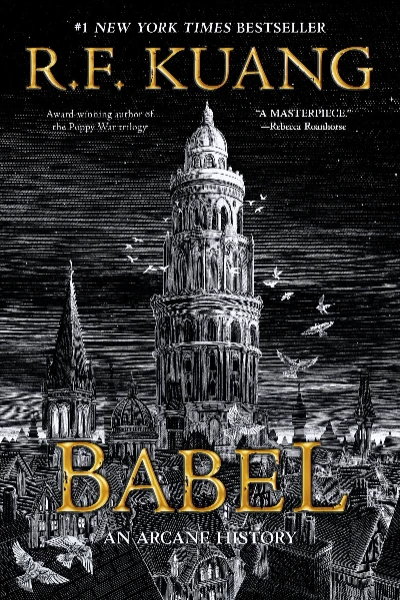
Babel
Babel — Chapter no 11
Chapter Eleven
But slaves we are, and labour in another man’s plantation; we dress the vineyard, but the wine is the owner’s.
JOHN DRYDEN, extract from the ‘Dedication’ to his translation of the Aeneid
Robin saw none of Griffin for the rest of Hilary Term, or Trinity. In truth, he hardly noticed; his second-year coursework only got more difficult as the weeks went on, and he barely had time to dwell on his resentment.
Summer came, though it was not a summer at all but rather an accelerated term, and his days were occupied with frantically cramming Sanskrit vocabulary for an assessment the week before next Michaelmas began. Then they were third-year students, a status that entailed all the exhaustion of Babel with none of its novelties. Oxford lost its charm that September; the golden sunsets and bright blue skies replaced by an endless chill and fog. It rained an inordinate amount, and the storm winds felt uniquely vicious compared to previous years. Their umbrellas kept *breaking. Their socks were always wet. Rowing that term was cancelled.
That was just as well. None of them had time for sports anymore. The third year at Babel was traditionally known as the Siberian winter, and the reason became obvious when they were issued their courses lists. They were all continuing in their tertiary languages and in Latin, which was rumoured to become devilishly difficult when Tacitus entered the picture.
They were also continuing in Translation Theory with Professor Playfair and Etymology with Professor Lovell, though the workload for each course had now doubled, as they were expected to produce a five-page paper for each class every week.
Most importantly, they were all assigned supervisors with whom they would pursue an independent research project. This counted as their proto- dissertation – their first piece of work that would, if completed successfully, be preserved on Babel’s shelves as a true piece of scholarly contribution.
Ramy and Victoire were both immediately unhappy with their supervisors. Ramy had been invited by Professor Joseph Harding to contribute to an editorial round of the Persian Grammatica, which was * nominally a great honour.But Ramy couldn’t see the romance in such a project. ‘Initially I proposed a translation of Ibn Khaldun’s manuscripts,’ he told them. ‘The ones Silvestre de Sacy’s got hold of. But Harding objected that the French Orientalists were already working on that, and that it was unlikely I could get Paris to lend them to me for the term. So then I asked if I might just translate Omar ibn Said’s Arabic essays into English, given that they’ve just been sitting around for a near decade in our collections, but Harding said that was unnecessary because abolition had already passed * into law in England, can you believe it?As if America doesn’t exist? At last Harding said if I wanted to do something authoritative, then I could edit the citations in the Persian Grammatica, so he’s got me reading Schlegel now. Über die Sprache und Weisheit der Indier. And you know what?
Schlegel wasn’t even in India when he wrote that. He wrote it all from Paris. How do you write a definitive text on the “language and wisdom” of *India from Paris?’ Yet Ramy’s indignation seemed trivial compared to what Victoire was dealing with. She was working with Professor Hugo Leblanc, with whom she’d studied French for two years with no trouble, but who now became a source of ceaseless frustration. ‘It’s impossible,’ she said. ‘I want to work on Kreyòl, which he’s not wholly opposed to despite thinking it’s a degenerate language, but all he
wants to know about is Vodou.’ ‘That pagan religion?’ Letty asked.
Victoire shot her a scathing look. ‘The religion, yes. He keeps asking about Vodou spells and poems, which he can’t access, of course, because they’re in Kreyòl.’ Letty looked confused. ‘But isn’t that just the same thing as French?’ ‘Not even remotely,’ said Victoire. ‘French is the lexifier, yes, but Kreyòl is its own language, with its own grammatical rules. French and Kreyòl are not mutually intelligible. You could have studied French for a decade, but a Kreyòl poem might still be impossible to decipher without a dictionary. Leblanc doesn’t have a dictionary – there is no dictionary, not yet – so I’m the next best thing.’
‘Then what’s the problem?’ asked Ramy. ‘Seems like you’ve got a pretty good project, there.’ Victoire looked uncomfortable. ‘Because the texts he wants translated are – I don’t know, they’re special texts. Texts that mean something.’ ‘Texts so special that they shouldn’t even be translated?’ Letty asked. ‘They’re heritage,’ insisted Victoire. ‘They’re sacred beliefs—’ ‘Not your beliefs, surely—’ ‘Perhaps not,’ said Victoire. ‘I haven’t – I mean, I don’t know. But they’re not meant to be shared. Would you be content to sit hour after hour with a white man as he asks you the story behind every metaphor, every god’s name, so he can pilfer through your people’s beliefs for a match-pair that might make a silver bar glow?’ Letty looked unconvinced. ‘But it’s not real, is it?’
‘Of course it’s real.’ ‘Oh, please, Victoire.’ ‘It’s real in a sense you can never know.’ Victoire was growing agitated. ‘In a sense that only someone from Haiti could have access to. But not in the sense that Leblanc is imagining.’ Letty sighed. ‘So why don’t you tell him just that?’ ‘You don’t think I’ve tried?’ Victoire snapped. ‘Have you ever tried to convince a Babel professor not to pursue something?’ ‘Well anyhow,’ said Letty, annoyed and defensive now and therefore vicious, ‘what would you know about Vodou? Didn’t you grow up in France?’ This was the worst reply she could have made. Victoire clamped her mouth shut and looked away. The conversation died. An awkward silence descended, which neither Victoire nor Letty made any attempt to break.
Robin and Ramy exchanged a glance, clueless, foolish. Something had gone terribly wrong, a taboo had been breached, but they were all too afraid to probe at precisely what.
Robin and Letty were passably happy with their projects, plodding and time-consuming as they were. Robin was working with Professor Chakravarti to complete a list of Sanskrit loanwords to Chinese, and Letty was working with Professor Leblanc to wade through French scientific papers for possibly useful and untranslatable metaphors in the realm of mathematics and engineering. They learned to avoid discussing the details
around Ramy and Victoire. They all used platitudes with each other; Robin and Letty were always ‘making good progress’ while Ramy and Victoire were ‘struggling on as usual’.
Privately, Letty was not so generous. The subject of Professor Leblanc had become a sticking point between her and Victoire, who was hurt and astounded by Letty’s lack of sympathy, while Letty thought Victoire was being too sensitive about it all. ‘She’s brought this on herself,’ she complained to Robin. ‘She could make this so much easier if she’d just do the research – I mean, no one’s done a third-year project in Haitian Creole, there’s barely even a Grammatica. She could be the very first!’ There was no debating with Letty when she was in these moods – it was obvious she only wanted an audience to vent to – but Robin tried anyway. ‘Suppose it means more to her than you realize.’ ‘But it doesn’t. I know it doesn’t! She’s not the slightest bit religious; I mean, she’s civilized—’ He whistled. ‘That’s a loaded word, Letty.’ ‘You know what I mean,’ she huffed. ‘She’s not Haitian. She’s French.
And I just don’t see why she has to be so difficult.’ Halfway into Michaelmas, Letty and Victoire were hardly talking to each other. They always came to class several minutes apart, and Robin wondered if it took skill to space out their departures so that they never crossed paths on the long walk down.
The girls were not the only ones suffering fractures. The atmosphere of those days was oppressive. Something had seemed to break between them all – no, break was perhaps too strong a word, for they still clung to each other with the force of people who had no one else. But their bond had twisted in a decidedly hurtful direction. They still spent nearly all their waking moments together, but they dreaded each other’s company.
Everything was an unintended slight or deliberate offence – if Robin complained about Sanskrit, it was insensitive to the fact that Professor Harding kept insisting Sanskrit was one of Ramy’s languages when it wasn’t; if Ramy was pleased he and Professor Harding had finally agreed on a research direction, it was a callous remark to Victoire, who had got nowhere with Professor Leblanc. They used to find solace in their solidarity, but now they saw each other only as reminders of their own misery.
The worst, from Robin’s perspective, was that something had changed suddenly and mysteriously between Letty and Ramy. Their interactions were as heated as ever – Ramy never ceased to make fun, and Letty never ceased to flare up in response. But now Letty’s rejoinders had acquired an oddly victimized tone. She snapped at the smallest, often intangible slights.
Ramy in return had got more cruel and more snide in a way that was hard to describe. Robin didn’t know what to do about this, nor did he have the faintest clue what it was all about, other than that it gave him strange pangs in his chest whenever he watched these exchanges happen. ‘She’s just being Letty,’ said Ramy when pressed about it. ‘She wants attention, and she thinks throwing a tantrum is the way to get it.’ ‘Did you do something to upset her?’ Robin asked. ‘Other than generally exist? I don’t think so.’ Ramy seemed bored by the subject. ‘Suppose we get on with this translation? Everything’s all right, Birdie, I promise.’ But things were decidedly not all right. Things were in fact very weird.
Ramy and Letty seemed unable to stand each other, and at the same time, they gravitated around each other; they could not speak normally without fiercely opposing each other in a way that made them the protagonists of the conversation. If Ramy wanted coffee, Letty wanted tea; if Ramy thought that a painting on the wall was pretty, then Letty suddenly had twelve reasons why it exemplified the worst of the Royal Academy’s adherence to artistic conventionalism.
Robin found it unbearable. One night, during a fitful burst of sleep, he had a sudden and violent fantasy of pushing Letty into the Cherwell. When he awoke he searched himself for any hint of guilt, but could find none; the thought of Letty drenched and sputtering brought just as much vicious satisfaction in the sober light of day.
There was at least the distraction of their third-year apprenticeships, for which they would each assist a faculty member in their silver-working duties throughout the term. ‘Theory comes from the Greek theōria, meaning a sight or spectacle, whose root also gives us the word theatre.’ So Professor Playfair expounded before he sent them off with their respective supervisors. ‘But it is not enough to merely watch the operations. You must get your hands dirty. You must understand how the metal sings.’
In practice this meant a lot of unpaid donkey work. To Robin’s disappointment, the apprentices spent very little time on the eighth floor, where all the exciting research happened. Instead, three times a week, he accompanied Professor Chakravarti on trips around Oxford, helping with silver-work installation and upkeep. He learned how to polish silver until it shone (oxidation and tarnishing greatly dampened the match-pair effect), how to choose between different sizes of engraving styluses to painstakingly restore an inscription to its original clarity, and how to deftly slide the bars in and out of their specially welded fixtures. It was too bad that Griffin had gone underground, he thought, for his apprenticeship gave him almost unrestricted access to the tower’s tools and raw materials. He wouldn’t have had to let thieves in at midnight. Amidst whole drawers of engraving equipment and absent-minded professors who wouldn’t have noticed a thing, he could have plucked whatever he liked from the tower at will. ‘How often do you have to do this?’ he asked. ‘Oh, it never ends,’ said Professor Chakravarti. ‘It’s how we make all our money, you see. The bars fetch a high price, but it’s the upkeep that’s the real grift. The workload is a bit harder on myself and Richard, though, since there are so few Sinologists.’ That afternoon they were doing a house call on an estate in Wolvercote, where a silver-work installation in the back garden had ceased to function despite a twelve-month warranty. They’d had some trouble getting through the front gate – the housekeeper seemed unconvinced they were Babel scholars, and rather suspicious that they were here to rob the place – but after supplying various proofs of identification, including the recitations of many Latin graces, they were at last invited in. ‘Happens about twice a month,’ Professor Chakravarti told Robin, though he looked quite put off. ‘You get used to it. They don’t give Richard *half the trouble.’ The housekeeper led them through the estate to a very lush, pretty garden with a burbling, serpentine stream and several large rocks arranged at random. It was designed in the Chinese style, they were informed, which had become very popular in that era after William Chambers’s Oriental landscaping designs were shown for the first time in Kew Gardens. Robin could not recall ever seeing anything like this in Canton, but he nodded along appreciatively until the housekeeper had gone.
‘Well, the problem here’s obvious.’ Professor Chakravarti pushed some shrubbery aside to reveal the fence corner where the silver-work was installed. ‘They’ve been pushing a cart back and forth over the bar. It’s rubbed the engraving half off. That’s their own fault – this won’t qualify under the warranty.’ He let Robin extract it from its fixture, then turned the bar around to show him the inscription. On one side: garden; on the other, the character 齋 , which could mean a landscape garden, but more generally evoked a place for private withdrawal, to retreat from the world, with connotations of ritual purification, cleansing, alms-giving, and Daoist acts of repentance. ‘The idea is to make their gardens nicer and quieter than the hubbub of Oxford allows. Keeps out the riffraff. The effect is quite subtle, if we’re being honest; we didn’t do all that much testing, but there’s really no limit to what the wealthy will throw money at.’ Professor Chakravarti whittled at the bar as he spoke. ‘Hm. We’ll see if that’ll do the trick.’ He let Robin reinstall the bar, then bent down to check his work.
Satisfied, he stood and brushed his hands on his trousers. ‘Would you like to activate it?’ ‘I just – what, say the words?’ Robin had seen the professors do the same many times, though he couldn’t imagine it was all that easy. Then again, he recalled, the wúxíng bar had worked for him on the first try. ‘Well, it’s a particular kind of mental state. You do speak the words, but more importantly, you hold two meanings in your head at once. You exist in both linguistic worlds simultaneously, and you imagine traversing them.
Does that make sense?’ ‘I – I think so, sir.’ Robin frowned at the bar. ‘That’s really all it takes?’ ‘Oh, no, I’m being careless. There are some good mental heuristics you’ll learn during your fourth year, and some theory seminars you’ll have to sit through, but when it comes down to it, it’s about the feeling.’ Professor Chakravarti seemed rather bored; Robin got the impression he was still very irritated by this household and wanted to be away as quickly as possible. ‘Go on.’ ‘Well – all right.’ Robin placed his hand on the bar. ‘Zhāi. Garden.’ He felt a slight thrum beneath his fingertips. The garden did seem quieter then, more serene, though he couldn’t tell if this was his doing or his imagination. ‘Have we done it?’
‘Well, we’d better hope so.’ Professor Chakravarti slung his tool bag over his shoulder. He was not concerned enough to check. ‘Come on, let’s go and get paid.’
‘Do you always need to speak the match-pair to make it work?’ Robin asked as they walked back to campus. ‘It seems untenable – that is, there are so many bars, and so few translators.’ ‘Well, that depends on a number of things,’ said Professor Chakravarti. ‘To begin with, the nature of the impact. With some bars, you want a temporary manifestation. Suppose you need a short and extreme physical effect – a lot of military bars work this way. Then they need to be activated each time upon use, and they’re designed so that the effects don’t last long.
But other bars have an enduring effect – like the wards in the tower, for example, or the bars installed in ships and carriages.’ ‘What makes them last longer?’ ‘The number of carats, to start with. Finer silver endures, and the higher the percentage of other alloys, the shorter the time of effect. But there are also subtle differences in the way they’re smelted and engraved; you’ll learn soon enough.’ Professor Chakravarti shot him a smile. ‘You’re eager
to get started, aren’t you?’ ‘It’s just very exciting, sir.’ ‘That’ll wear off,’ said Professor Chakravarti. ‘Walk around town muttering the same words over and over again, and soon you start feeling like a parrot instead of a magician.’
One afternoon, they arrived at the Ashmolean Museum to fix a silver bar that no number of incantations would activate. The English side read verify, and the Chinese side used the character 參, meaning ‘to validate’. It could also mean ‘to juxtapose’, ‘to arrange side by side’, and ‘to compare things’.
The Ashmolean staff had been using this to compare fraudulent artifacts against the real ones, but recently it had failed several test runs, which the staff wisely conducted before appraising new acquisitions.
They carefully inspected the bar under a hand-held microscope, but neither the Chinese nor the English calligraphy showed any sign of erosion.
Even after Professor Chakravarti went over the whole thing with his smallest engraving stylus, it still failed to activate.
He sighed. ‘Wrap that up and put it in my bag, won’t you?’ Robin obeyed. ‘What’s wrong?’ ‘Its resonance link has stopped working. It happens sometimes, especially with some of the older match-pairs.’ ‘What’s a resonance link?’ ‘Off to the tower,’ said Professor Chakravarti, already walking away. ‘You’ll see what I mean.’ Back at Babel, Professor Chakravarti led Robin up to the southern wing of the eighth floor, past the worktables. Robin had never been in this area before. All of his visits to the eighth floor had been restricted to the workshop, which occupied most of what the eye saw past the thick fire door. But another set of doors blocked off the southern wing, bolted shut with three sets of locks, which Professor Chakravarti now opened with a jangling ring of keys. ‘I’m really not supposed to show you just yet.’ Professor Chakravarti winked at him. ‘Privileged information and all that. But there’s no other way to explain.’ He undid the final lock. They stepped through.
It was like entering a fun house exhibit, or the inside of a giant piano.
Massive silver rods of varying heights and lengths stood upright all across the floor. Some were waist high; others towered above him, stretching from the floor to the ceiling, with just enough room between them for one to step nimbly through without touching any. They reminded Robin rather of church organs; he had a strange impulse to take a mallet and strike them all at once. ‘Resonance is a way of cutting costs,’ Professor Chakravarti explained. ‘We need to save the higher-carat silver for bars with endurance needs – the bars that go into the Navy, that protect merchant ships, and the like. So we use silver with a higher percentage of alloys for the bars that operate on English land, since we can keep them fuelled with resonance.’ Robin peered around, amazed. ‘But how does it all work?’ ‘It’s easiest to think of Babel as the centre, and all the resonance- dependent bars in England as the periphery. The periphery draws on the centre for power.’ Professor Chakravarti gestured around him. Each rod, Robin noticed, appeared to be vibrating at a very high frequency, but though it felt as if the tower should be ringing with discordant notes, the air was still and silent. ‘These rods, engraved with commonly used match-
pairs, sustain linked bars throughout the country. The manifesting power comes from the rod, you see, which means that the bars outside don’t require such constant reactivation.’ ‘Like British outposts in the colonies,’ said Robin. ‘Calling upon home
for soldiers and supplies.’ ‘A convenient metaphor, yes.’ ‘So do these resonate with every bar in England?’ Robin saw in his mind an invisible network of meaning stretching over the country, keeping the silver-work alive. It was quite terrifying to consider. ‘I’d have thought there would be more of them.’ ‘Not quite. There are much smaller resonance centres across the country – there’s one in Edinburgh, for example, and one in Cambridge. The effect does weaken with distance. But the lion’s share is in Oxford – it spreads the Translation Institute too far out to maintain multiple centres, as you need trained translators for the upkeep.’ Robin bent to examine one of the closest rods. In addition to the match- pair, written in large calligraphy at the top, he saw a series of letters and symbols that he could make no sense of. ‘How’s the link forged, then?’ ‘It’s a complicated process.’ Professor Chakravarti led Robin to a slender rod near the south-side window. He knelt down, retrieved the Ashmolean bar from his bag, and held it up against the rod. Robin noticed then a number of etchings in the side of the rod that corresponded with similar etchings in the bar. ‘They’ve got to be smelted from the same material. And then there’s a good deal of etymological symbol work – you’ll learn all of that in your fourth year, if you specialize in silver- working. We actually use an invented alphabet, based on a manuscript first * discovered by an alchemist from Prague in the seventeenth century.It’s so that no one outside Babel can replicate our process. For now, you can think of all this adjustment as deepening the bond of connection.’ ‘But I thought fake languages didn’t work to activate the bars,’ said Robin. ‘They don’t to manifest meaning,’ said Professor Chakravarti. ‘As a linking mechanism, however, they work quite well. We could do with basic numbers, but Playfair likes his mysteries. Keeps things proprietary.’ Robin stood awhile in silence, watching as Professor Chakravarti adjusted the etchings on the Ashmolean bar with a fine stylus, examined them with a lens, and then made corresponding adjustments to the
resonance rod. The whole process took about fifteen minutes. At last, Professor Chakravarti wrapped the Ashmolean bar back up in velvet, returned it to his bag, and stood up. ‘That should do the trick. We’ll head back to the museum tomorrow.’ Robin had been reading the rods, noticing what a large percentage of them appeared to use Chinese match-pairs. ‘You and Professor Lovell have to maintain all of these?’ ‘Oh, yes,’ said Professor Chakravarti. ‘There’s no one else who can do it. Your graduation will make three.’ ‘They need us,’ Robin marvelled. It was strange to think the functioning of an entire empire depended on just a handful of people. ‘They need us so terribly,’ agreed Professor Chakravarti. ‘And it’s good, in our situation, to be needed.’ They stood together at the window. Looking out over Oxford, Robin had the impression that the whole city was like a finely tuned music box, relying wholly on its silver gears to keep running; and that if the silver ever ran out, if these resonance rods ever collapsed, then the whole of Oxford would stop abruptly in its tracks. The bell towers would go mute, the cabs would halt on the roads, and the townsfolk would freeze in motion on the street, limbs lifted in midair, mouths open in midspeech.
But he couldn’t imagine that it would ever run out. London, and Babel, were getting richer every day, for the same ships fuelled by long-enduring silver-work brought back chests and chests of silver in return. There wasn’t a market on earth that could resist British incursion, not even the Far East.
The only thing that would disrupt the inflow of silver was the collapse of the entire global economy, and since that was ridiculous, the Silver City, and the delights of Oxford, seemed eternal.
One day in mid-January, they showed up at the tower to find all the upperclassmen and graduate fellows wearing black under their gowns. ‘It’s for Anthony Ribben,’ explained Professor Playfair when they filed into his seminar. He himself was wearing a shirt of lilac blue. ‘What about Anthony?’ Letty asked. ‘I see.’ Professor Playfair’s face tightened. ‘They haven’t told you.’ ‘Told us what?’ ‘Anthony went missing during a research expedition to Barbados last summer,’ said Professor Playfair. ‘He disappeared the night before his ship
was due to return to Bristol, and we haven’t heard from him since. We’re presuming he’s dead. His colleagues on the eighth floor are quite upset; I believe they’ll be wearing black for the rest of the week. A few of the other cohorts and fellows have joined in, if you care to participate.’ He said this with such casual unconcern that they might have been discussing whether they wanted to go punting that afternoon. Robin gaped at him. ‘But isn’t he – aren’t you – I mean, doesn’t he have family? Have they been told?’ Professor Playfair scribbled an outline for that day’s lecture on the chalkboard as he answered. ‘Anthony has no family except his guardian. Mr Falwell’s been notified by post, and I hear he’s quite upset.’ ‘My God,’ said Letty. ‘That’s terrible.’ She said this with a solicitous glance at Victoire, who among them had known Anthony the best. But Victoire looked surprisingly unfazed; she didn’t seem shocked or upset so much as vaguely uncomfortable. Indeed, she looked as if she hoped they might change topics as quickly as possible.
Professor Playfair was more than happy to oblige. ‘Well, on to business,’ he said. ‘We left off last Friday on the innovations of the German Romantics . . .’ Babel did not mourn Anthony. The faculty did not so much as hold a memorial service. The next time Robin went up to the silver-working floor, a wheat-haired graduate fellow he didn’t know had taken over Anthony’s workstation. ‘It’s disgusting,’ Letty said. ‘Can you believe – I mean, a Babel graduate, and they just act like he was never here?’ Her distress belied a deeper terror, a terror which Robin felt as well, which was that Anthony had been expendable. That they were all expendable. That this tower – this place where they had for the first time found belonging – treasured and loved them when they were alive and useful but didn’t, in fact, care about them at all. That they were, in the end, only vessels for the languages they spoke.
No one said that out loud. It came too close to breaking the spell.
Of them all, Robin had assumed Victoire would be most devastated. She and Anthony had grown quite close over the years; they were two of only a handful of Black scholars in the tower, and they were both born in the West Indies. Occasionally he’d seen them talking, heads bent together, as they walked from the tower to the Buttery.
But he never once saw her cry that winter. He wanted to comfort her, but he did not know how, especially as it seemed impossible to broach the topic with her. Whenever Anthony was brought up, she flinched, blinked rapidly, and then tried very hard to change the subject. ‘Did you know Anthony was a slave?’ Letty asked one night in hall.
Unlike Victoire, she was determined to raise the issue at every opportunity; indeed, she was obsessed with Anthony’s death in a way that felt uncomfortably, performatively righteous. ‘Or would have been. His master didn’t want him freed when abolition took effect, so he was going to take him to America, and he only got to stay at Oxford because Babel paid for his freedom. Paid. Can you believe it?’ Robin glanced to Victoire, but her face had not changed one bit. ‘Letty,’ she said very calmly, ‘I am trying to eat.’