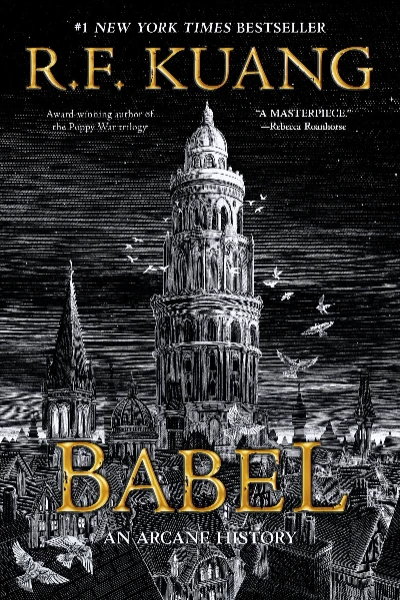
Babel
Babel — Chapter no 2
Chapter Two
That vast metropolis, The fountain of my country’s destiny
And of the destiny of earth itself WILLIAM WORDSWORTH, The Prelude
London was drab and grey; was exploding in colour; was a raucous din, bursting with life; was eerily quiet, haunted by ghosts and graveyards. As the Countess of Harcourt sailed inland up the River Thames into the dockyards at the beating heart of the capital, Robin saw immediately that London was, like Canton, a city of contradictions and multitudes, as was any city that acted as a mouth to the world.
But unlike Canton, London had a mechanical heartbeat. Silver hummed through the city. It glimmered from the wheels of cabs and carriages and from horses’ hooves; shone from buildings under windows and over doorways; lay buried under the streets and up in the ticking arms of clock towers; was displayed in shopfronts whose signs proudly boasted the magical amplifications of their breads, boots, and baubles. The lifeblood of London carried a sharp, tinny timbre wholly unlike the rickety, clacking bamboo that underwrote Canton. It was artificial, metallic – the sound of a knife screeching across a sharpening steel; it was the monstrous industrial labyrinth of William Blake’s ‘cruel Works / Of many Wheels I view, wheel *without wheel, with cogs tyrannic, moving by compulsion each other’.
London had accumulated the lion’s share of both the world’s silver ore and the world’s languages, and the result was a city that was bigger, heavier, faster, and brighter than nature allowed. London was voracious, was growing fat on its spoils and still, somehow, starved. London was both unimaginably rich and wretchedly poor. London – lovely, ugly, sprawling, cramped, belching, sniffing, virtuous, hypocritical, silver-gilded London – was near to a reckoning, for the day would come when it either devoured
itself from inside or cast outwards for new delicacies, labour, capital, and culture on which to feed.
But the scales had not yet tipped, and the revels, for now, could be sustained. When Robin, Professor Lovell, and Mrs Piper stepped ashore at the Port of London, the docks were a flurry of the colonial trade at its apex.
Ships heavy with chests of tea, cotton, and tobacco, their masts and crossbeams studded with silver that made them sail more quickly and safely, sat waiting to be emptied in preparation for the next voyage to India, to the West Indies, to Africa, to the Far East. They sent British wares across the world. They brought back chests of silver.
Silver bars had been used in London – and indeed, throughout the world – for a millennium, but not since the height of the Spanish Empire had any place in the world been so rich in or so reliant on silver’s power. Silver lining the canals made the water fresher and cleaner than any river like the Thames had a right to be. Silver in the gutters disguised the stink of rain, sludge, and sewage with the scent of invisible roses. Silver in the clock towers made the bells chime for miles and miles further than they should have, until the notes clashed discordantly against each other throughout the city and over the countryside.
Silver was in the seats of the two-wheeled Hansom cabs Professor Lovell hailed when they had cleared customs – one for the three of them, and a second for their trunks. As they settled in, tightly nestled against each other in the tiny carriage, Professor Lovell reached over his knees and pointed out a silver bar embedded in the floor of the carriage. ‘Can you read what that says?’ he asked.
Robin bent over, squinting. ‘Speed. And . . . spes?’ ‘Spēs,’ said Professor Lovell. ‘It’s Latin. It’s the root word of the English speed, and it means a nexus of things involving hope, fortune, success, and reaching one’s goal. Makes the carriages run a bit more safely and quickly.’ Robin frowned, running his finger along the bar. It seemed so small, too innocuous to produce such a profound effect. ‘But how?’ And a second, more urgent question. ‘Will I—’ ‘In time.’ Professor Lovell patted him on the shoulder. ‘But yes, Robin Swift. You’ll be one of the few scholars in the world that knows the secrets of silver-working. That’s what I’ve brought you here to do.’
Two hours in the cab brought them to a village called Hampstead several miles north of London proper, where Professor Lovell owned a four-storey house made of pale red brick and white stucco, surrounded by a generous swath of neat green shrubbery. ‘Your room is at the top,’ Professor Lovell told Robin as he unlocked the door. ‘Up the stairs and to the right.’ The house was very dark and chilly inside. Mrs Piper went about pulling open the curtains, while Robin dragged his trunk up the spiralling staircase and down the hall as instructed. His room consisted of only a little furniture – a writing desk, a bed, and a sitting chair – and was bare of any decorations or possessions except for the corner bookshelf, which was packed with so many titles that his treasured collection felt paltry in comparison.
Curious, Robin approached. Had those books been prepared especially for him? That felt unlikely, though many of the titles looked like things he would enjoy – the top shelf alone had a number of Swifts and Defoes, novels by his favourite authors he hadn’t known existed. Ah, there was Gulliver’s Travels. He pulled the book off the shelf. It seemed well-worn, some pages creased and dog-eared and others stained by tea or coffee.
He replaced the book, confused. Someone else must have lived in this room before him. Some other boy, perhaps – someone his age, who loved Jonathan Swift just as much, who had read this copy of Gulliver’s Travels so many times that the ink at the top right where one’s finger turned the page was starting to fade.
But who could that have been? He’d assumed Professor Lovell had no children. ‘Robin!’ Mrs Piper bellowed from downstairs. ‘You’re wanted outside.’ Robin hurried back down the stairs. Professor Lovell waited by the door, looking impatiently at his pocket-watch. ‘Will your room do?’ he asked. ‘Has everything you need?’ Robin nodded effusively. ‘Oh, yes.’ ‘Good.’ Professor Lovell nodded to the waiting cab. ‘Get in, we’ve got to make you an Englishman.’ He meant this literally. For the rest of the afternoon, Professor Lovell took Robin on a series of errands in the service of assimilating him into British civil society. They saw a physician who weighed him, examined him, and reluctantly declared him fit for life on the island: ‘No tropical
diseases nor fleas, thank heavens. He’s a bit small for his age, but raise him on mutton and mash and he’ll be fine. Now let’s have a smallpox jab – roll that sleeve up, please, thank you. It won’t hurt. Count to three.’ They saw a barber, who clipped Robin’s unruly, chin-length curls into a short, neat crop above his ears. They saw a hatter, a bootmaker, and finally a tailor, who measured every inch of Robin’s body and showed him several bolts of cloth among which Robin, overwhelmed, chose at random.
As the afternoon wound down, they went to the courthouse for an appointment with a solicitor who drafted a set of papers which, Robin was told, would make him a legal citizen of the United Kingdom and a ward under the guardianship of Professor Richard Linton Lovell.
Professor Lovell signed his name with a flourish. Then Robin went up to the solicitor’s desk. The surface was too high for him, so a clerk dragged over a bench on which he could stand. ‘I thought I had signed this already.’ Robin glanced down. The language seemed quite similar to the guardianship contract that Professor Lovell had given him in Canton. ‘Those were the terms between you and me,’ said Professor Lovell. ‘This makes you an Englishman.’ Robin scanned the looping script – guardian, orphan, minor, custody. ‘You’re claiming me as a son?’ ‘I’m claiming you as a ward. That’s different.’ Why?, he almost asked. Something important hinged on that question, though he was still too young to know what precisely it was. A moment stretched between them, pregnant with possibility. The solicitor scratched his nose. Professor Lovell cleared his throat. But the moment passed without comment. Professor Lovell was not forthcoming, and Robin already knew better than to press. He signed.
The sun had long set by the time they returned to Hampstead. Robin asked if he might head up to bed, but Professor Lovell urged him to the dining room. ‘You can’t disappoint Mrs Piper; she’s been in the kitchen all afternoon.
At least push your food around on your plate for a bit.’ Mrs Piper and her kitchen had enjoyed a glorious reunion. The dining room table, which seemed ridiculously large for just the two of them, was piled with pitchers of milk, white rolls of bread, roast carrots and potatoes,
gravy, something still simmering in a silver-gilded tureen, and what looked like an entire glazed chicken. Robin hadn’t eaten since that morning; he should have been famished, but he was so exhausted that the sight of all that food made his stomach twist.
Instead, he turned his eyes to a painting that hung behind the table. It was impossible to ignore; it dominated the entire room. It depicted a beautiful city at dusk, but it was not London, he didn’t think. It seemed more dignified. More ancient. ‘Ah. Now that,’ Professor Lovell followed his gaze, ‘is Oxford.’ Oxford. He’d heard that word before, but he wasn’t sure where. He tried to parse the name, the way he did with all unfamiliar English words. ‘A . . . a cow-trading centre? Is it a market?’ ‘A university,’ said Professor Lovell. ‘A place where all the great minds of the nation can congregate in research, study, and instruction. It’s a wonderful place, Robin.’ He pointed to a grand domed building in the middle of the painting. ‘This is the Radcliffe Library. And this,’ he gestured to a tower beside it, the tallest building in the landscape, ‘is the Royal Institute of Translation. This is where I teach, and where I spend the majority of the year when I’m not in
London.’ ‘It’s lovely,’ said Robin. ‘Oh, yes.’ Professor Lovell spoke with uncharacteristic warmth. ‘It’s the loveliest place on earth.’ He spread his hands through the air, as if envisioning Oxford before him. ‘Imagine a town of scholars, all researching the most marvellous, fascinating things. Science. Mathematics. Languages. Literature. Imagine building after building filled with more books than you’ve seen in your entire life. Imagine quiet, solitude, and a serene place to think.’ He sighed. ‘London is a blathering mess. It’s impossible to get anything done here; the city’s too loud, and it demands too much of you. You can escape out to places like Hampstead, but the screaming core draws you back in whether you like it or not. But Oxford gives you all the tools you need for your work – food, clothes, books, tea – and then it leaves you alone. It is the centre of all knowledge and innovation in the civilized world. And, should you progress sufficiently well in your studies here, you might one day be lucky enough to call it home.’
The only appropriate response here seemed to be an awed silence.
Professor Lovell gazed wistfully at the painting. Robin tried to match his enthusiasm, but could not help glancing sideways at the professor. The softness in his eyes, the longing, startled him. In the little time he’d known him, Robin had never seen Professor Lovell express such fondness for anything.
Robin’s lessons began the next day.
As soon as breakfast concluded, Professor Lovell instructed Robin to wash and return to the drawing room in ten minutes. There waited a portly, smiling gentleman named Mr Felton – a first class at Oxford, an Oriel man, mind you – and yes, he’d make sure Robin was up to Oxford’s Latinate speed. The boy was starting a bit late compared to his peers, but if he studied hard, that could be easily remedied.
Thus began a morning of memorizing basic vocabulary – agricola, terra, aqua – which was daunting, but then seemed easy compared to the head-spinning explanations of declensions and conjugations which followed. Robin had never been taught the fundamentals of grammar – he knew what worked in English because it sounded right – and so in learning Latin, he learned the basic parts of language itself. Noun, verb, subject, predicate, copula; then the nominative, genitive, accusative cases . . . He absorbed a bewildering amount of material over the next three hours, and had forgotten half of it by the time the lesson ended, but he came away with a deep appreciation of language and all the words for what you could do with it. ‘That’s all right, lad.’ Mr Felton, thankfully, was a patient fellow, and seemed sympathetic to the mental brutalization he’d subjected Robin to. ‘You’ll have much more fun after we’ve finished laying the groundwork.
Just wait until we get to Cicero.’ He peered down at Robin’s notes. ‘But you’ve got to be more careful with your spelling.’ Robin couldn’t see where he’d gone wrong. ‘How do you mean?’ ‘You’ve forgotten nearly all the macron marks.’ ‘Oh.’ Robin suppressed a noise of impatience; he was very hungry, and just wanted to be done so he could go to lunch. ‘Those.’ Mr Felton rapped the table with his knuckles. ‘Even the length of a single vowel matters, Robin Swift. Consider the Bible. The original Hebrew text never specifies what sort of forbidden fruit the serpent persuades Eve to
eat. But in Latin, malum means “bad” and mālum,’ he wrote the words out for Robin, emphasizing the macron with force, ‘means “apple”. It was a short leap from there to blaming the apple for the original sin. But for all we know, the real culprit could be a persimmon.’ Mr Felton departed at lunchtime, after assigning a list of nearly a hundred vocabulary words to memorize before the following morning.
Robin ate alone in the drawing room, mechanically shoving ham and potatoes into his mouth as he blinked uncomprehendingly at his grammar. ‘More potatoes, dear?’ Mrs Piper asked. ‘No, thank you.’ The heavy food, combined with the tiny font of his readings, was making him sleepy. His head throbbed; what he really would have liked then was a long nap.
But there was no reprieve. At two on the dot, a thin, grey-whiskered gentleman who introduced himself as Mr Chester arrived at the house, and for the next three hours, they commenced Robin’s education in Ancient Greek.
Greek was an exercise in making the familiar strange. Its alphabet mapped onto the Roman alphabet, but only partly so, and often letters did not sound how they looked – a rho (P) was not a P, and an eta (H) was not an H. Like Latin, it made use of conjugations and declensions, but there were a good deal more moods, tenses, and voices to keep track of. Its inventory of sounds seemed further from English than Latin’s did, and Robin kept struggling not to make Greek tones sound like Chinese tones.
Mr Chester was harsher than Mr Felton, and became snippy and irritable when Robin kept flubbing his verb endings. By the end of the afternoon, Robin felt so lost that it was all he could do to simply repeat the sounds Mr Chester spat at him.
Mr Chester left at five, after also assigning a mountain of readings that hurt Robin to look at. He carried the texts to his room, then stumbled, head spinning, to the dining room for supper. ‘How did your classes go?’ Professor Lovell inquired.
Robin hesitated. ‘Just fine.’ Professor Lovell’s mouth quirked up in a smile. ‘It’s a bit much, isn’t
it?’ Robin sighed. ‘Just a tad, sir.’ ‘But that’s the beauty of learning a new language. It should feel like an enormous undertaking. It ought to intimidate you. It makes you appreciate
the complexity of the ones you know already.’ ‘But I don’t see why they have to be quite so complicated,’ Robin said with sudden vehemence. He couldn’t help it; his frustration had been mounting since noon. ‘I mean, why so many rules? Why so many endings?
Chinese doesn’t have any of those; we haven’t got tenses or declensions or conjugations. Chinese is much simpler—’ ‘You’re wrong there,’ said Professor Lovell. ‘Every language is complex in its own way. Latin just happens to work its complexity into the shape of the word. Its morphological richness is an asset, not an obstacle. Consider the sentence He will learn. Tā huì xué. Three words in both English and Chinese. In Latin, it takes only one. Discet. Much more elegant, you see?’ Robin wasn’t sure he did.
This routine – Latin in the morning, Greek in the afternoon – became Robin’s life for the foreseeable future. He was grateful for this, despite the toil. At last, he had some structure to his days. He felt less unrooted and bewildered now – he had a purpose, he had a place, and even though he still couldn’t quite fathom why this life had fallen to him, of all the dock boys in Canton, he took to his duties with determined, uncomplaining diligence.
Twice a week he had conversational practice with Professor Lovell in * Mandarin.At first, he could not understand the point. These dialogues felt artificial, stilted, and most of all, unnecessary. He was fluent already; he didn’t stumble over vocabulary recall or pronunciations the way he did when he and Mr Felton conversed in Latin. Why should he answer such basic questions as how he found his dinner, or what he thought about the weather?
But Professor Lovell was adamant. ‘Languages are easier to forget than you imagine,’ he said. ‘Once you stop living in the world of Chinese, you stop thinking in Chinese.’ ‘But I thought you wanted me to start thinking in English,’ Robin said, confused. ‘I want you to live in English,’ said Professor Lovell. ‘This is true. But I still need you to practise your Chinese. Words and phrases you think are carved into your bones can disappear in no time.’ He spoke as if this had happened before. ‘You’ve grown up with solid foundations in Mandarin, Cantonese, and English. That’s very fortunate – there are adults who spend their lifetimes
trying to achieve what you have. And even if they do, they achieve only a passable fluency – enough to get by, if they think hard and recall vocabulary before speaking – but nothing close to a native fluency where words come unbidden, without lag or labour. You, on the other hand, have already mastered the hardest parts of two language systems – the accents and rhythm, those unconscious quirks that adults take forever to learn, and even then, not quite. But you must maintain them. You can’t squander your natural gifts.’ ‘But I don’t understand,’ said Robin. ‘If my talents lie in Chinese, then what do I need Latin and Greek for?’ Professor Lovell chuckled. ‘To understand English.’ ‘But I know English.’ ‘Not as well as you think you do. Plenty of people speak it, but few of them really know it, its roots and skeletons. But you need to know the history, shape, and depths of a language, particularly if you plan to manipulate it as you will one day learn to do. And you’ll need to attain that mastery of Chinese as well. That begins with practising what you have.’ Professor Lovell was right. It was, Robin discovered, startlingly easy to lose a language that had once felt as familiar as his own skin. In London, without another Chinese person in sight, at least not in the circles of London where he lived, his mother tongue sounded like babble. Uttered in that drawing room, the most quintessentially English of spaces, it didn’t feel like it belonged. It felt made-up. And it scared him, sometimes, how often his memory would lapse, how the syllables he’d grown up around could suddenly sound so unfamiliar.
He put twice the effort into Chinese that he did into Greek and Latin.
For hours a day he practised writing out his characters, labouring over every stroke until he achieved a perfect replica of the characters in print. He reached into his memory to recall how Chinese conversations felt, how Mandarin sounded when it rolled naturally off his tongue, when he didn’t have to pause to remember the tones of the next word he uttered.
But he was forgetting. That terrified him. Sometimes, during practice conversations, he found himself blanking on a word he used to toss around constantly. And sometimes he sounded, to his own ears, like a European sailor imitating Chinese without knowing what he said.
He could fix it, though. He would. Through practice, through memorization, through daily compositions – it wasn’t the same as living
and breathing Mandarin, but it was close enough. He was of an age when the language had made a permanent impression on his mind. But he had to try, really try, to make sure that he did not stop dreaming in his native tongue.
At least thrice a week Professor Lovell received a variety of guests in his sitting room. Robin supposed they must have also been scholars, for often they came bearing stacks of books or bound manuscripts, which they would pore over and debate about until the late hours of the night. Several of these men, it turned out, could speak Chinese, and Robin sometimes hid out over the banister, eavesdropping on the very strange sound of Englishmen discussing the finer points of Classical Chinese grammar over afternoon tea. ‘It’s just a final particle,’ one of them would insist, while the others cried, ‘Well, they can’t all be final particles.’ Professor Lovell seemed to prefer that Robin keep out of sight when company came. He never explicitly forbade Robin’s presence, but he would make a note to say that Mr Woodbridge and Mr Ratcliffe were visiting at eight, which Robin interpreted to mean that he ought to make himself scarce.
Robin had no issue with this arrangement. Admittedly, he found their conversations fascinating – they spoke often of far-flung things like expeditions to the West Indies, negotiations over cotton prints in India, and violent unrest throughout the Near East. But as a group, they were frightening; a procession of solemn, erudite men, all dressed in black like a murder of crows, each more intimidating than the last.
The only time he barged in on one of these gatherings was by accident.
He’d been out in the garden, taking his daily physician-recommended turn, when he overheard the professor and his guests loudly discussing Canton. ‘Napier’s an idiot,’ Professor Lovell was saying. ‘He’s playing his hand too early – there’s no subtlety. Parliament’s not ready, and he’s irritating the compradors besides.’ ‘You think the Tories will want to move in at any point?’ asked a man with a very deep voice. ‘Perhaps. But they’ll have to get a better stronghold in Canton if they’re going to bring ships in.’ At this point Robin could not help but venture into the sitting room. ‘What about Canton?’
The gentlemen all turned to regard him at once. There were four of them, all very tall, and all either spectacled or monocled. ‘What about Canton?’ Robin asked again, suddenly nervous. ‘Shush,’ said Professor Lovell. ‘Robin, your shoes are filthy, you’re tracking mud everywhere. Take them off and go and have a bath.’ Robin persisted. ‘Is King George going to declare war on Canton?’ ‘He can’t declare war on Canton, Robin. No one declares war on cities.’ ‘Then is King George going to invade China?’ he persisted.
For some reason this made the gentlemen laugh. ‘Would that we could,’ said the man with the deep voice. ‘It’d make this whole enterprise a lot easier, wouldn’t it?’ A man with a great grey beard peered down at Robin. ‘And where would your loyalties lie? Here, or back home?’ ‘My goodness.’ The fourth man, whose pale blue eyes Robin found unnerving, bent down to inspect him, as if through a massive, invisible magnifying glass. ‘Is this the new one? He’s even more of your spitting image than the last—’ Professor Lovell’s voice cut through the room like glass. ‘Hayward.’ ‘Really, it’s uncanny, I mean, look at his eyes. Not the colour, but the
shape—’ ‘Hayward.’ Robin glanced back and forth between them, baffled. ‘That’s quite enough,’ said Professor Lovell. ‘Robin, go.’ Robin muttered an apology and hurried up the stairs, muddy boots forgotten. Over his shoulder, he heard fragments of Professor Lovell’s response: ‘He doesn’t know, I don’t like giving him ideas . . . No, Hayward, I won’t—’ But by the time he reached the safety of the landing, where he could lean over the banister and listen in without being caught, they had already changed the topic to Afghanistan.
That night, Robin stood before his mirror, staring intently at his face for so long that eventually it began to seem alien.
His aunts liked to say he had the kind of face that could blend in anywhere – his hair and eyes, both a softer shade of brown than the indigo- black that coloured the rest of his family, could have plausibly marked him as either the son of a Portuguese sailor or the heir to the Qing Emperor. But Robin had always attributed this to some accidental arrangement of nature
that ascribed him features that could have belonged anywhere on the spectrum of either race, white or yellow.
He had never wondered whether he might not be full-blooded Chinese.
But what was the alternative? That his father was white? That his father
was— Look at his eyes.
That was incontrovertible proof, wasn’t it?
Then why would his father not claim Robin as his own? Why was he only a ward, and not a son?
But even then, Robin was not too young to understand there were some truths that could not be uttered, that life as normal was only possible if they were never acknowledged. He had a roof over his head, three guaranteed meals a day, and access to more books than he could read in a lifetime. He did not, he knew, have the right to demand anything more.
He made a decision then. He would never question Professor Lovell, never probe at the empty space where the truth belonged. As long as Professor Lovell did not accept him as a son, Robin would not attempt to claim him as a father. A lie was not a lie if it was never uttered; questions that were never asked did not need answers. They would both remain perfectly content to linger in the liminal, endless space between truth and denial.
He dried himself, dressed, and sat down at his desk to finish his translation exercise for the evening. He and Mr Felton had moved on to Tacitus’s Agricola now.
Auferre trucidare rapere falsis nominibus imperium atque ubi solitudinem faciunt pacem appellant.
Robin parsed the sentence, consulted his dictionary to check that auferre *meant what he thought it did, then wrote out his translation.
When Michaelmas term began in early October, Professor Lovell departed for Oxford, where he would stay for the next eight weeks. He would do this for each of Oxford’s three academic terms, returning only during the breaks.
Robin relished these periods; even though his classes did not pause, it felt possible to breathe and relax then without risk of disappointing his guardian at every turn.
It also meant that, without Professor Lovell breathing over his shoulder, he had the freedom to explore the city.
Professor Lovell gave him no allowance, but Mrs Piper occasionally let him have some small change for fares, which he saved up until he could get to Covent Garden by carriage. When he learned from a paperboy about the horse-drawn omnibus service, he rode it almost every weekend, crisscrossing the heart of London from Paddington Green to the Bank. His first few trips alone terrified him; several times he grew convinced he would never find his way back to Hampstead again and would be doomed to live out his life as a waif on the streets. But he persisted. He refused to be cowed by London’s complexity, for wasn’t Canton, too, a labyrinth? He determined to make the place home by walking every inch of it. Bit by bit London grew to feel less overwhelming, less like a belching, contorted pit of monsters that might swallow him up at any corner and more like a navigable maze whose tricks and turns he could anticipate.
He read the city. London in the 1830s was exploding with print.
Newspapers, magazines, journals, quarterlies, weeklies, monthlies, and books of every genre were flying off the shelves, tossed on doorsteps, and hawked from the corners of nearly every street. He pored over newsstand copies of The Times, the Standard, and the Morning Post; he read, though did not fully comprehend, articles in academic journals like Edinburgh Review and Quarterly Review; he read penny satirical papers like Figaro in London, melodramatic pseudo-news like colourful crime reports and a series on the dying confessions of condemned prisoners. For cheaper stuff, he entertained himself with the Bawbee Bagpipe. He stumbled on a series called The Pickwick Papers by someone named Charles Dickens, who was very funny but seemed to hate very much anyone who was not white. He discovered Fleet Street, the heart of London publishing, where newspapers came off the printing presses still hot. He went back there time and time again, bringing home stacks of yesterday’s papers for free from piles that were dumped on the corner.
He didn’t understand half of what he read, even if he could decipher all the individual words. The texts were packed with political allusions, inside jokes, slang, and conventions that he’d never learned. In lieu of a childhood spent absorbing it all in London, he tried devouring the corpus instead, tried to plough through references to things like Tories, Whigs, Chartists, and Reformers and memorize what they were. He learned what the Corn Laws were and what they had to do with a Frenchman named Napoleon. He learned who the Catholics and Protestants were, and how the (he thought, at
least) small doctrinal differences between the two were apparently a matter of great and bloody importance. He learned that being English was not the same as being British, though he was still hard-pressed to articulate the difference between the two.
He read the city, and he learned its language. New words in English were a game to him, for in understanding the word he always came to understand something about English history or culture itself. He delighted when common words were, unexpectedly, formed from other words he knew. Hussy was a compound of house and wife. Holiday was a compound of holy and day. Bedlam came, implausibly, from Bethlehem. Goodbye was, incredibly, a shortened version of God be with you. In London’s East End he encountered Cockney rhyming slang, which initially presented a great *mystery, for he had no clue how Hampstead could come to mean ‘teeth.’ But once he learned about the omitted rhyming component, he had great fun coming up with his own. (Mrs Piper was not very amused when he began *referring to dinner as the ‘meal of saints’.) Long after he learned the proper meanings of words and phrases that had once confused him, his mind still formed funny associations around them. He imagined the Cabinet as a series of massive shelves where men in fancy dress were arranged like dolls. He thought the Whigs were named for their wigs, and the Tories for the young Princess Victoria. He imagined Marylebone was composed of marble and bone, that Belgravia was a land of bells and graves, and that Chelsea was named for shells and the sea.
Professor Lovell kept a shelf of Alexander Pope titles in his library, and for a full year Robin thought The Rape of the Lock was about fornication with *an iron bolt instead of the theft of hair.
He learned that a pound was worth twenty shillings, and a shilling was worth twelve pence – clarity on florins, groats, and farthings would have to come in time. He learned there were many types of British people, just as there were many types of Chinese people, and that being Irish or Welsh was distinct in important ways from being English. He learned Mrs Piper was from a place called Scotland, which made her a Scot, and also explained why her accent, lilting and rhotic, sounded so different from Professor Lovell’s crisp, straight intonations.
He learned that London in 1830 was a city that could not decide what it wanted to be. The Silver City was the largest financial centre of the world, the leading edge of industry and technology. But its profits were not shared
equally. London was as much a city of plays at Covent Garden and balls in Mayfair as it was a city of teeming slums around St Giles. London was a city of reformers, a place where the likes of William Wilberforce and Robert Wedderburn had urged the abolition of slavery; where the Spa Fields riots had ended with the leaders charged for high treason; where Owenites had tried to get everyone to join their utopian socialist communities (he was still not sure what socialism was yet); and where Mary Wollstonecraft’s Vindication of the Rights of Woman, published only forty years ago, had inspired waves of loud, proud feminists and suffragists in its wake. He discovered that in Parliament, in town halls, and on the streets, reformers of every stripe were fighting for the soul of London, while a conservative, landed ruling class fought back against attempts at change at every turn.
He did not understand these political struggles, not then. He only sensed that London, and England at large, was very divided about what it was and what it wanted to be. And he understood that silver lay behind it all. For when the Radicals wrote about the perils of industrialization, and when the Conservatives refuted this with proof of the booming economy; when any of the political parties spoke about slums, housing, roads, transportation, agriculture, and manufacturing; when anyone spoke about Britain and the Empire’s future at all, the word was always there in papers, pamphlets, magazines, and even prayer books: silver, silver, silver.
From Mrs Piper, he learned more than he’d imagined possible about English food and England. Adjusting to this new palate took some time. He had never thought much about food when he lived in Canton – the porridge, steamed buns, dumplings, and vegetable dishes that comprised his daily meals had seemed unremarkable to him. They were the staples of a poor family’s diet, a far cry from high Chinese cuisine. Now he was astonished by how much he missed them. The English made regular use of only two flavours – salty and not salty – and did not seem to recognize any of the others. For a country that profited so well from trading in spices, its citizens were violently averse to actually using them; in all his time in Hampstead, he never tasted a dish that could be properly described as ‘seasoned’, let alone ‘spicy’.
He took more pleasure in learning about the food than in eating it. This education came unprompted – dear Mrs Piper was the chatty sort, and would happily lecture as she served up lunch if Robin displayed even the
slightest interest in what was on his plate. He was told that potatoes, which he found quite tasty in any form, were not to be served around important company, for they were considered lower-class. He found that newly invented silver-gilded dishes were used to keep food warm throughout a meal, but that it was rude to reveal this trickery to guests, and so the bars were always embedded on the very bottoms of the platters. He learned that the practice of serving food in successive courses was adopted from the French, and that the reason it was not yet a universal norm was a lingering resentment over that little man Napoleon. He learned, but did not quite understand, the subtle distinctions between lunch, luncheon, and a noon dinner. He learned he had the Roman Catholics to thank for his favourite almond cheesecakes, for the prohibition of dairy during fast days had forced English cooks to innovate with almond milk.
One night Mrs Piper brought out a round, flat circle: some kind of baked dough that had been cut into triangular wedges. Robin took one and tentatively bit at the corner. It was very thick and floury, much denser than the fluffy white rolls his mother used to steam every week. It was not unpleasant, just surprisingly heavy. He took a large gulp of water to guide the bolus down, then asked, ‘What’s this?’ ‘That’s a bannock, dear,’ said Mrs Piper.
‘Scone,’ corrected Professor Lovell. ‘It’s properly a bannock—’ ‘The scones are the pieces,’ said Professor Lovell. ‘The bannock is the entire cake.’ ‘Now look here, this is a bannock, and all the itty pieces are bannocks as well. Scones are those dry, crumbly things you English love to shove in your mouths—’ ‘I assume you’re excepting your own scones, Mrs Piper. No one in their right mind would accuse those of being dry.’ Mrs Piper did not succumb to flattery. ‘It’s a bannock. They’re bannocks. My grandmother called them bannocks, my mother called them bannocks, so bannocks they are.’ ‘Why’s it – why are they – called bannocks?’ Robin asked. The sound of the word made him imagine a monster of the hills, some clawed and gristly thing that wouldn’t be satisfied unless given a sacrifice of bread. ‘Because of Latin,’ said Professor Lovell. ‘Bannock comes from panicium, meaning “baked bread”.’
This seemed plausible, if disappointingly mundane. Robin took another bite of the bannock, or scone, and this time relished the thick, satisfying way it settled on his stomach.
He and Mrs Piper quickly bonded over a deep love of scones. She made them every which way – plain, served with a bit of clotted cream and raspberry jam; savoury and studded with cheese and garlic chives; or dotted through with bits of dried fruit. Robin liked them best plain – why ruin what was, in his opinion, perfect from conception? He had just learned about Platonic forms, and was convinced scones were the Platonic ideal of bread.
And Mrs Piper’s clotted cream was wonderful, light and nutty and refreshing all at once. Some households simmered milk for nearly a full day on the stove to get that layer of cream on top, she told him, but last Christmas Professor Lovell had brought her a clever silver-work contraption that could separate the cream in seconds.
Professor Lovell liked plain scones the least, though, so sultana scones were the staple of their afternoon teas. ‘Why are they called sultanas?’ Robin asked. ‘They’re just raisins, aren’t they?’ ‘I’m not sure, dear,’ said Mrs Piper. ‘Perhaps it’s where they’re from.
Sultana does sound rather Oriental, doesn’t it? Richard, where are these grown? India?’ ‘Asia Minor,’ said Professor Lovell. ‘And they’re sultanas, not sultans, because they haven’t got seeds.’ Mrs Piper winked at Robin. ‘Well, there you have it. It’s all about the seeds.’ Robin didn’t understand this joke, but he knew he didn’t like sultanas in his scones; when Professor Lovell wasn’t looking, he picked out his sultanas, slathered the denuded scone in clotted cream, and popped it in his mouth.
Apart from scones, Robin’s other great indulgence was novels. The two dozen tomes he’d received every year in Canton had been a meagre trickle.
Now he had access to a veritable flood. He was never without a book, but he had to get creative in squeezing leisure reading into his schedule – he read at the table, scarfing down Mrs Piper’s meals without a second thought to what he was putting in his mouth; he read while walking in the garden, though this made him dizzy; he even tried reading in the bath, but the wet,
crumpled fingerprints he left on a new edition of Defoe’s Colonel Jack shamed him enough to make him give up the practice.
He enjoyed novels more than anything else. Dickens’s serials were well and fun, but what a pleasure it was to hold the weight of an entire, finished story in his hands. He read any genre he could get his hands on. He enjoyed all of Jane Austen’s oeuvre, though it took much consulting with Mrs Piper to understand the social conventions Austen described. (Where was *Antigua? And why was Sir Thomas Bertram always going there?) He devoured the travel literature of Thomas Hope and James Morier, through whom he met the Greeks and the Persians, or at least some fanciful version of them. He greatly enjoyed Mary Shelley’s Frankenstein, though he could not say the same of the poems by her less talented husband, whom he found overly dramatic.
Upon his return from Oxford that first term, Professor Lovell took Robin to a bookshop – Hatchards on Piccadilly, just opposite Fortnum & Mason. Robin paused outside the green-painted entrance, gaping. He’d passed by bookshops many times during his jaunts about the city, but never had he imagined he might be allowed to go inside. He had somehow developed the idea that bookshops were only for wealthy grown-ups, that he’d be dragged out by the ear if he dared to enter.
Professor Lovell smiled when he saw Robin hesitating at the doors. ‘And this is just a shop for the public,’ he said. ‘Wait until you see a college library.’ Inside, the heady wood-dust smell of freshly printed books was overwhelming. If tobacco smelled like this, Robin thought, he’d huff it every day. He stepped towards the closest shelf, hand lifted tentatively towards the books on display, too afraid to touch them – they seemed so new and crisp; their spines were uncracked, their pages smooth and bright.
Robin was used to well-worn, waterlogged tomes; even his Classics grammars were decades old. These shiny, freshly bound things seemed like a different class of object, things to be admired from a distance rather than handled and read. ‘Pick one,’ said Professor Lovell. ‘You ought to know the feeling of acquiring your first book.’ Pick one? Just one, of all these treasures? Robin didn’t know the first title from the second, and he was too dazzled by the sheer amount of text to flip through and decide. His eyes alighted on a title: The King’s Own by
Frederick Marryat, an author he was, so far, unfamiliar with. But new, he thought, was good. ‘Hm. Marryat. I haven’t read him, but I’m told he’s popular with boys your age.’ Professor Lovell turned the book over in his hands. ‘This one, then? You’re sure?’ Robin nodded. If he didn’t decide now, he knew, he’d never leave. He was like a starved man in a pastry shop, dazzled by his options, but he did not want to try the professor’s patience.
Outside, the professor handed him the brown-paper-wrapped parcel.
Robin hugged it to his chest, willing himself not to rip it open until they’d returned home. He thanked Professor Lovell profusely, and stopped only when he noticed this made the professor look somewhat uncomfortable. But then the professor asked him whether it felt good to hold the new book in his hands. Robin enthusiastically agreed and, for the first time he could remember, they traded smiles.
Robin had planned to save The King’s Own until that weekend, when he had a whole afternoon without classes to slowly savour its pages. But Thursday afternoon came, and he found he couldn’t wait. After Mr Felton left, he wolfed down the plate of bread and cheese Mrs Piper had set out and hurried upstairs to the library, where he curled up in his favourite armchair and started to read.
He was immediately enchanted. The King’s Own was a tale of naval exploits; of revenge, daring, and struggle; of ship battles and far-flung travels. His mind drifted to his own voyage from Canton, and he reframed those memories in the context of the novel, imagined himself battling pirates, building rafts, winning medals for courage and valour— The door creaked open. ‘What are you doing?’ asked Professor Lovell.
Robin glanced up. His mental image of the Royal Navy navigating choppy waters had been so vivid, it took him a moment to remember where he was. ‘Robin,’ Professor Lovell said again, ‘what are you doing?’ Suddenly the library felt very cold; the golden afternoon darkened.
Robin followed Professor Lovell’s gaze to the ticking clock above the door.
He’d completely forgotten the time. But those hands couldn’t possibly be right, it couldn’t have been three hours since he’d sat down to read.
‘I’m sorry,’ he said, still somewhat dazed. He felt like a traveller from far away, plucked from the Indian Ocean and dropped into this dim, chilly study. ‘I didn’t – I lost track of time.’ He couldn’t read Professor Lovell’s expression at all. That scared him.
That inscrutable wall, that inhuman blankness, was infinitely more frightening than fury would have been. ‘Mr Chester has been downstairs for over an hour,’ said Professor Lovell. ‘I wouldn’t have kept him waiting for even ten minutes, but I’ve only just returned to the house.’ Robin’s gut twisted with guilt. ‘I’m very sorry, sir—’ ‘What are you reading?’ Professor Lovell interrupted. * Robin hesitated for a moment, then held out The King’s Own.‘The book you bought me, sir – there’s a big battle going on, I just wanted to see what—’ ‘Do you think it matters what that infernal book is about?’ In years to come, whenever Robin looked back on that memory, he was appalled by how brazenly he had acted next. He must have been panicked out of his mind, because it was absurdly foolish, in retrospect, how he had simply closed the Marryat book and headed for the door, as if he could merely hurry down to class, as if a fault of this magnitude could be so easily forgotten.
As he neared the door, Professor Lovell drew his hand back and brought his knuckles hard against Robin’s left cheek.
The force of the blow thrust him to the floor. He didn’t register pain so much as shock; the reverberation in his temples didn’t hurt, not yet – that came later, after several seconds passed and the blood began rushing to his head.
Professor Lovell wasn’t finished. As Robin rose to his knees, dazed, the professor pulled the poker from beside the fireplace and swung it diagonally against the right side of Robin’s torso. Then he brought it down again. And again.
Robin would have been more frightened if he’d ever suspected Professor Lovell of violence, but this beating was so unexpected, so wholly out of character, that it felt surreal more than anything else. It didn’t occur to him to beg, to cry, or even to scream. Even as the poker cracked against his ribs for the eighth, ninth, tenth, time – even as he tasted blood on his
teeth – all he felt was a deep bewilderment that this was happening at all. It felt absurd. He seemed to be caught in a dream.
Professor Lovell, too, did not look like a man in the throes of a tempestuous rage. He was not shouting; his eyes were not wild; his cheeks had not even turned red. He seemed simply, with every hard and deliberate blow, to be attempting to inflict maximum pain with the minimum risk of permanent injury. For he did not strike Robin’s head, nor did he apply so much force that Robin’s ribs would crack. No; he only dealt bruises that could be easily hidden and that, in time, would heal completely.
He knew very well what he was doing. He seemed to have done this before.
After twelve strikes, it all stopped. With just as much poise and precision, Professor Lovell returned the poker to the mantel, stepped back, and sat down at the table, regarding Robin silently as the boy climbed to his knees and wiped the blood, as best he could, from his face.
After a very long silence, he spoke. ‘When I brought you from Canton, I made clear my expectations.’ A sob had finally built up in Robin’s throat, a choking, delayed emotional reaction, but he swallowed it down. He was terrified of what Professor Lovell would do if he made a noise. ‘Get up,’ Professor Lovell said coldly. ‘Sit down.’ Automatically, Robin obeyed. One of his molars felt loose. He probed at it, wincing when a fresh, salty spurt of blood coated his tongue.
‘Look at me,’ Professor Lovell said.
Robin lifted his eyes. ‘Well, that’s one good thing about you,’ said Professor Lovell. ‘When you’re beaten, you don’t cry.’ Robin’s nose prickled. Tears threatened to burst forth, and he strained to hold them back. He felt as if a spike were being driven through his temples.
He was so overcome with pain then that he could not breathe, and still it seemed the most important thing was to display no hint of suffering at all.
He had never felt so wretched in his life. He wanted to die. ‘I won’t tolerate laziness under this roof,’ said Professor Lovell. ‘Translation is no easy occupation, Robin. It demands focus. Discipline.
You are already at a disadvantage for your lack of an early education in Latin and Greek, and you’ve only six years to make up the difference before
you begin at Oxford. You cannot sloth. You cannot waste time on daydreams.’ He sighed. ‘I hoped, based on Miss Slate’s reports, that you had grown to be a diligent and hardworking boy. I see now that I was wrong. Laziness and deceit are common traits among your kind. This is why China remains an indolent and backwards country while her neighbours hurtle towards progress. You are, by nature, foolish, weak-minded, and disinclined to hard work. You must resist these traits, Robin. You must learn to overcome the pollution of your blood. I’ve gambled greatly on your capacity to do so.
Prove to me that it was worth it, or purchase your own passage back to Canton.’ He cocked his head. ‘Do you wish to return to Canton?’ Robin swallowed. ‘No.’ He meant it. Even after this, even after the miseries of his classes, he could not imagine an alternate future for himself. Canton meant poverty, insignificance, and ignorance. Canton meant the plague. Canton meant no more books. London meant all the material comforts he could ask for.
London meant, someday, Oxford. ‘Then decide now, Robin. Dedicate yourself to excelling at your studies, make the sacrifices that entails, and promise me you will never embarrass me so much again. Or take the first packet home. You’ll be back on the streets with no family, no skills, and no money. You’ll never get the kinds of opportunities I’m offering you again. You’ll only ever dream of seeing London again, much less Oxford. You will never, ever touch a silver bar.’ Professor Lovell leaned back, regarding Robin through cold, scrutinizing
eyes. ‘So. Choose.’
Robin whispered a response. ‘Louder. In English.’ ‘I’m sorry,’ Robin said hoarsely. ‘I want to stay.’ ‘Good.’ Professor Lovell stood up. ‘Mr Chester is waiting downstairs.
Collect yourself and go to class.’
Somehow Robin made it through the entirety of that class, sniffling, too dazed to focus, a great bruise blooming on his face while his torso throbbed from a dozen invisible hurts. Mercifully, Mr Chester said nothing about the incident. Robin went through a list of conjugations and got all of them wrong. Mr Chester patiently corrected him in a pleasant if forcedly even
tone. Robin’s tardiness had not shortened the class – they went far past suppertime, and those were the longest three hours of Robin’s life.
The next morning, Professor Lovell acted as if nothing had happened.
When Robin came down for breakfast, the professor asked if he’d finished his translations. Robin said he had. Mrs Piper brought out eggs and ham for breakfast, and they ate in a somewhat frenzied silence. It hurt to chew, and at times to swallow – Robin’s face had swollen even more overnight – but Mrs Piper only suggested he cut his ham into smaller pieces when he coughed. They all finished their tea. Mrs Piper cleared the plates away, and Robin went to retrieve his Latin textbooks before Mr Felton arrived.
It never occurred to Robin to run, not then, and not once in the weeks that followed. Some other child might have been frightened, might have seized the first chance to escape into London’s streets. Some other child suited to better, kinder treatment might have realized that such nonchalance on the part of adults like Mrs Piper, Mr Felton, and Mr Chester to a badly bruised eleven-year-old was frightfully wrong. But Robin was so grateful for this return to equilibrium that he couldn’t find it in himself to even resent what had happened.
After all, it never happened again. Robin made sure it did not. He spent the next six years studying to the point of exhaustion. With the threat of expatriation looming constantly above him, he devoted his life to becoming the student Professor Lovell wanted to see.
Greek and Latin grew more entertaining after the first year, after he’d assembled enough building blocks of each language to piece together fragments of meaning for himself. From then on it felt less like groping in the dark whenever he encountered a new text and more like filling in the blanks. Figuring out the precise grammatical formulation of a phrase that had been frustrating him gave him the same sort of satisfaction he derived from reshelving a book where it belonged or finding a missing sock – all the pieces fitted together, and everything was whole and complete.
In Latin, he read through Cicero, Livy, Virgil, Horace, Caesar, and Juvenal; in Greek, he tackled Xenophon, Homer, Lysias, and Plato. In time, he realized he was quite good at languages. His memory was strong, and he had a knack for tones and rhythm. He soon reached a level of fluency in both Greek and Latin that any Oxford undergraduate would have been jealous of. In time, Professor Lovell stopped commenting on his inherited
inclination to sloth, and instead nodded in approval at every update on Robin’s rapid progress through the canon.
History, meanwhile, marched on around them. In 1830, King George IV had died and was succeeded by his younger brother, William IV, the eternal compromiser who pleased no one. In 1831, another cholera epidemic swept through London, leaving thirty thousand dead in its wake. The brunt of its impact fell on the poor and the destitute; those living in close, cramped * quarters who could not escape each other’s tainted miasmas.But the neighbourhood in Hampstead was untouched – to Professor Lovell and his friends in their remote walled estates, the epidemic was something to mention in passing, wince about in sympathy, and quickly forget.
In 1833, a momentous thing happened – slavery was abolished in England and its colonies, to be replaced by a six-year apprenticeship term as a transition to freedom. Among Professor Lovell’s interlocutors, this news was taken with the mild disappointment of a lost cricket match. ‘Well, that’s ruined the West Indies for us,’ Mr Hallows complained. ‘The abolitionists with their damned moralizing. I still believe this obsession with abolition is a product of the British needing to at least feel culturally superior now that they’ve lost America. And on what grounds? It isn’t as if those poor fellows aren’t equally enslaved back in Africa under *those tyrants they call kings.’ ‘I wouldn’t give up on the West Indies just yet,’ Professor Lovell said. ‘They’re still allowing a legal kind of forced labour—’ ‘But without ownership, it takes the teeth out of it all.’ ‘Perhaps that’s for the best, though – freedmen do work better than slaves after all, and slavery is in fact more expensive than a free labour market—’ ‘You’ve been reading too much of Smith. Hobart and MacQueen had * the right idea – just smuggle in a ship full of Chinamen,that’ll do the trick.
They’re so very industrious and orderly, Richard should know—’ ‘No, Richard thinks they’re lazy, don’t you, Richard?’ ‘Now, what I wish,’ interrupted Mr Ratcliffe, ‘is that all these women would stop taking part in those anti-slavery debates. They see too much of themselves in their situation; it puts ideas in their head.’ ‘What,’ asked Professor Lovell, ‘is Mrs Ratcliffe unsatisfied with her domestic situation?’
‘She’d like to think that it’s a hop and a skip from abolition to women’s suffrage.’ Mr Ratcliffe let out a nasty laugh. ‘That would be the day.’ And with that, the conversation turned to the absurdity of women’s rights.
Never, Robin thought, would he understand these men, who talked of the world and its movements like a grand chess game, where countries and peoples were pieces to be moved and manipulated at will.
But if the world was an abstract object for them, it was even more abstract to him, for he had no stake in any of these matters. Robin processed that era through the myopic world of Lovell Manor. Reforms, colonial uprisings, slave revolts, women’s suffrage, and the latest Parliamentary debates all meant nothing to him. All that mattered were the dead languages before him, and the fact that one day, a day that drew ever closer as the years trickled by, he would matriculate at the university he knew only from the painting on the wall – the city of knowledge, the city of dreaming spires.
It all ended without circumstance, without celebration. One day Mr Chester told Robin as he packed up his books that he’d enjoyed their lessons, and that he wished him well at university. This was how Robin discovered he was to be sent up to Oxford the next week. ‘Oh, yes,’ said Professor Lovell when asked. ‘Did I forget to tell you?
I’ve written to the college. They’ll be expecting you.’ Supposedly there was an application process, some exchange of letters of introduction and guarantees of funding that secured his position. Robin was involved with none of this. Professor Lovell simply informed him he was due to move into his new lodgings on 29th September, so he’d best have his bags packed by the evening of the 28th. ‘You’ll arrive a few days before the start of term. We’ll ride up together.’ The night before they left, Mrs Piper baked Robin a plate of small, hard, round biscuits so rich and crumbly they seemed to melt away in his mouth. ‘It’s shortbread,’ she explained. ‘Now, they’re very rich, so don’t eat them all at once. I don’t make them much, as Richard thinks sugar ruins a boy, but you’ve deserved it.’ ‘Shortbread,’ Robin repeated. ‘Because they don’t last long?’ They had been playing this game since the night of the bannock debate.
‘No, dear.’ She laughed. ‘Because of the crumble. Fat “shortens” the pastry. That’s what short means, you know – it’s how we get the word shortening.’ He swallowed the sweet, fatty lump and chased it down with a gulp of milk. ‘I’ll miss your etymology lessons, Mrs Piper.’ To his surprise, her eyes turned red at the corners. Her voice grew thick. ‘Write home whenever you need a sack of victuals,’ she said. ‘I don’t know much of what goes on inside those colleges, but I know their food is something awful.’