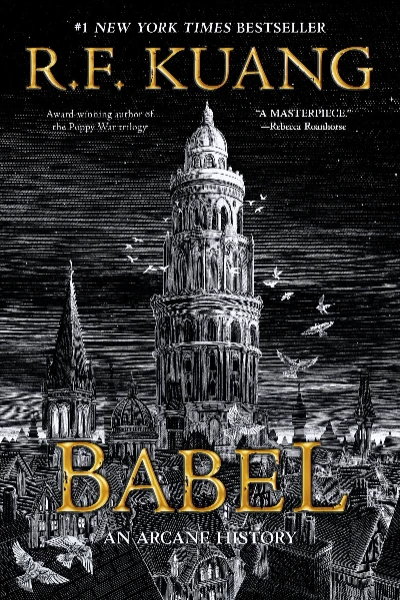
Babel
Babel — Chapter no 13
Chapter Thirteen
Mountains will be in labour, the birth will be a single laughable little mouse.
HORACE, Ars Poetica, trans. E.C. Wickham
Griffin made good on his word. He never left another note for Robin. At first, Robin was sure Griffin would merely take some time to sulk before pestering him again for smaller, more routine errands. But a week became a month, which became a term. He’d expected Griffin to be a bit more vindictive – to leave a recriminating farewell letter, at least. For the first few days after their falling-out, he flinched every time a stranger glanced his way on the street, convinced that the Hermes Society had decided it best to
tie up this loose end.
But Griffin had cut him out entirely.
He tried not to let his conscience bother him. Hermes was not going anywhere. There would always be battles to fight. They would all be there waiting when Robin was ready to rejoin them, he was sure. And he could do nothing for Hermes if he did not remain firmly ensconced within Babel’s ecosystem. Griffin had said it himself – they needed people on the inside.
Wasn’t that reason enough to stay right where he was?
Meanwhile, there were third-year exams. End-of-year exams were quite a matter of ceremony at Oxford. Up until the last years of the previous century, viva voce exams – oral questioning ordeals made public for crowds of spectators to witness – had been the norm, although by the early 1830s the regular BA degree required only five written examinations and one viva voce exam, on the grounds that oral responses were too difficult to assess objectively and were unnecessarily cruel besides. By 1836, spectators were no longer allowed at the vivas either, and the townspeople lost a great source of annual entertainment.
Instead, Robin’s cohort was told to expect a three-hour essay exam in each of their research languages; a three-hour essay exam in Etymology; a
viva voce exam in Translation Theory, and a silver-working test. They could not stay on at Babel if they failed any of their language or theory exams, and if they failed the silver-working test, they could not, in the future, work *on the eighth floor.
The viva voce would be done in front of a panel of three professors led by Professor Playfair, who was a notoriously tough examiner, and who was rumoured to make at least two students dissolve into tears every year. ‘Balderdash,’ he would drawl slowly, ‘is a word which used to refer to the cursed concoction created by bartenders when they’d nearly run out of every drink at the end of the night. Ale, wine, cider, milk – they’d dump it all in and hope their patrons wouldn’t mind, since after all the goal was simply to get drunk. But this is Oxford University, not the Turf Tavern after midnight, and we are in need of something slightly more illuminating than getting sloshed. Would you like to try again?’
Time, which had felt infinite during their first and second years, now ran quickly down the hourglass. No longer could they put off their readings to have a lark on the river under the assumption there was always the opportunity later to catch up. Exams were in five weeks, then four, then three. When Trinity term drew to an end, the last day of class should have culminated in a golden afternoon, in desserts and elderflower cordial and punting on the Cherwell. But the moment the bells rang at four, they packed up their books and walked straight from Professor Craft’s classroom to one of the study rooms on the fifth floor, where they would wall themselves in, every day for the next thirteen days, to pore over dictionaries and translated passages and vocabulary lists until their temples throbbed.
Acting from generosity, or perhaps sadism, the Babel faculty made available a set of silver bars for examinees to use as study aids. These bars were engraved with a match-pair using the English word meticulous and its Latin forerunner metus, meaning ‘fear, dread’. The modern usage of meticulous had arisen just a few decades before in France, with the connotation of being fearful of making a mistake. The effect of the bars was to induce a chilling anxiety whenever the user erred in their work.
Ramy hated and refused to use them. ‘It doesn’t tell you where you went wrong,’ he complained. ‘It just makes you want to vomit for no reason you can discern.’
‘Well, you could do with more caution,’ Letty grumbled, returning his marked-up composition. ‘You’ve made at least twelve errors on this page, and your sentences are far too long—’ ‘They’re not too long; they’re Ciceronian.’ ‘You can’t just excuse all bad writing on the grounds that it’s Ciceronian —’ Ramy waved a hand dismissively. ‘That’s fine, Letty, I cranked that one out in ten minutes.’ ‘But it’s not about speed. It’s about precision—’ ‘The more I get done, the larger range I’ve acquired for the possible paper questions,’ said Ramy. ‘And that’s what we’ve really got to prepare for. I don’t want to go blank when the paper’s in front of me.’ This was a valid worry. Stress had the unique ability to wipe students’ minds clear of things they had been studying for years. During the fourth- year exams last year, one examinee was rumoured to have become so paranoid that he declared not only that he could not finish the exam but that he was lying about being fluent in French at all. (He was in fact a native speaker.) They all thought they were immune to this particular folly until one day, a week before exams, Letty suddenly broke down crying and declared she knew not a word of German, not a single word, that she was a fraud and her entire career at Babel had been based on pretence. None of them understood this rant until much later, for she had indeed delivered it in German.
Failure of memory was only the first symptom to come. Never had Robin’s anxiety over his marks made him so physically ill. First came a persistent, throbbing headache, and then the constant urge to throw up every time he stood or moved. Waves of tremors kept coming over him with no warning; often his hand shook so hard that he had difficulty gripping his pen. Once, during a practice paper, he found his vision blacking out; he couldn’t think, couldn’t remember a single word, couldn’t even see. It took him nearly ten minutes to recover. He couldn’t make himself eat. He was somehow both exhausted all the time and unable to sleep from a surplus of nervous energy.
Then, like all good Oxford upperclassmen, he found himself losing his mind. His grip on reality, already tenuous from sustained isolation in a city of scholars, became even more fragmented. Hours of revision had interfered with his processing of signs and symbols, his belief in what was real and
what was not. The abstract was factual and important; daily exigencies like porridge and eggs were suspect. Everyday dialogue became a chore; small talk was a horror, and he lost his grip on what basic salutations meant.
When the porter asked him if he’d had a good one, he stood still and mute for a good thirty seconds, unable to process what was meant by ‘good’, or indeed, ‘one’. ‘Oh, same,’ Ramy said cheerfully when Robin brought this up. ‘It’s awful. I can’t have basic conversations anymore – I keep on wondering what the words really mean.’ ‘I’m walking into walls,’ said Victoire. ‘The world keeps disappearing around me, and all I can perceive are vocabulary lists.’ ‘It’s tea leaves for me,’ said Letty. ‘They keep looking like glyphs, and I really did find myself trying to gloss one the other day – I’d even started copying it out on paper and everything.’ It relieved Robin to hear he wasn’t the only one seeing things, because the visions worried him the most. He’d begun to hallucinate entire persons.
Once when hunting through the bookshelves at Thornton’s for a poetry anthology on their Latin reading list, Robin glimpsed what he thought was a familiar profile by the door. He walked closer. His eyes had not betrayed him – Anthony Ribben was paying for a paper-wrapped parcel, hale and
healthy as could be. ‘Anthony—’ Robin blurted.
Anthony glanced up. He saw Robin. His eyes widened. Robin started forward, confused yet elated, but Anthony hastily pushed several coins at the bookseller and darted out of the shop. By the time Robin made his way out onto Magdalene Street, Anthony had disappeared from sight. Robin stared around for several seconds, then returned to the bookshop, wondering if it was possible he’d mistaken a stranger for Anthony. But there were not many young Black men in Oxford. Which meant either he’d been lied to about Anthony’s death – that indeed, all of Babel’s faculty had done it as some elaborate hoax – or he’d imagined the whole thing. In his current state, he found the latter far more likely.
The exam they all dreaded most was the silver-working test. During the last week of Trinity term, they’d been informed they’d have to devise a unique match-pair and engrave it in front of a proctor. In their fourth year, once they had finished their apprenticeships, they would learn proper techniques
of match-pair design, engraving, and experimentation for magnitude and duration of effect, as well as the intricacies of resonance links and spoken manifestation. But for now, armed with just the basic principles of how match-pairs worked, they had only to achieve any effect at all. It did not need to be perfect; indeed, first tries never were. But they had to do something. They had to prove they possessed the undefinable stuff, the inimitable instinct for meaning, that made a translator a silver-worker.
Help from postgraduates here was technically forbidden, but sweet, kind Cathy O’Nell surreptitiously slipped Robin a faded yellow pamphlet on the basics of match-pair research one afternoon when she caught him looking dazed and scared in the library. ‘It’s just in the open stacks,’ she said sympathetically. ‘We’ve all used it; have a read through and you’ll be fine.’ The pamphlet was rather dated – it was written in 1798, and employed many archaic spellings – but did contain a number of brief, easily digestible tips. The first was to stay away from religion. This one they already knew from dozens of horror stories. It was theology that had got Oxford interested in Oriental languages in the first place – the only reason Hebrew, Arabic, and Syriac had initially become subjects of academic study was the translation of religious texts. But the Holy Word, it turned out, was both unpredictable and unforgiving on silver. There was a desk in the north wing of the eighth floor that no one dared approach because it still occasionally emitted smoke from an unseen source. There, it was rumoured, some foolish graduate fellow had attempted to translate on silver the name of God.
More helpful was the second lesson in the pamphlet, which was to focus their research by looking for cognates. Cognates – words in different languages that shared a common ancestor and often similar meanings as * well– were often the best clues for fruitful match-pairs, since they were on such close branches of the etymological tree. But the difficulty with cognates was that often their meanings were so close that there was little distortion in translation, and thus little effect that the bars could manifest.
There was, after all, no significant difference between the word chocolate in English and in Spanish. Moreover, in looking for cognates, one had to be wary of false friends – words which seemed like cognates but had utterly different origins and meanings. The English have did not come from the Latin habere (‘to hold, to possess’), for example, but from the Latin capere
(‘to seek’). And the Italian cognato did not mean ‘cognate’ like one might hope, but rather ‘brother-in-law’.
False friends were especially tricky when their meanings appeared related as well. The Persian word farangiha, which was used to refer to Europeans, appeared to be a cognate of the English foreign. But farang actually arose from a reference to the Franks, and morphed to encompass Western Europeans. The English foreign, on the other hand, originated from the Latin fores, meaning ‘doors’. Linking farang and foreign, then, *produced nothing.
The third lesson in the pamphlet introduced a technique called daisy- chaining. This they vaguely recalled from Professor Playfair’s demonstration. If the words in their binary match-pair had evolved too far apart in meaning for a translation to be plausible, one could try adding a third or even fourth language as an intermediary. If all these words were engraved in chronological order of evolution, this could guide the distortion of meaning more precisely in the way they intended. Another related technique was the identification of a second etymon: another source that may have interfered in the evolution of meaning. The French fermer (‘to close, to lock’) was for instance quite obviously based on the Latin firmāre (‘to make hard, to strengthen’) but had also been influenced by the Latin ferrum, meaning ‘iron’. Fermer, firmāre, and ferrum could then, hypothetically, create an unbreakable lock.
All these techniques sounded good in theory. They were much harder to replicate. The difficult part, after all, was coming up with a suitable match- pair in the first place. For inspiration, they took out a copy of the Current Ledger – the comprehensive list of match-pairs in use across the Empire in that year – and skimmed through it for ideas. ‘Look,’ said Letty, pointing at a line on the first page. ‘I’ve figured out how they make those driverless trams run.’ ‘Which trams?’ asked Ramy. ‘Haven’t you seen them running around in London?’ said Letty. ‘They move of their own accord, but there’s no one driving them.’ ‘I always thought there was some internal mechanism,’ said Robin. ‘Like an engine, surely—’ ‘That’s true of the larger ones,’ said Letty. ‘But the smaller cargo trams aren’t that big. Haven’t you noticed they seem to pull themselves?’ She jabbed excitedly at the page. ‘There are bars in the track. Track is related to
trecken, from Middle Dutch, which means to pull – especially when you go through the French intermediary. And now you have two words that mean what we think of as a track, but only one of them involves a moving force.
The result is the tracks pull the carts forward themselves. That’s brilliant.’ ‘Oh, good,’ said Ramy. ‘We’ve only got to revolutionize transportation infrastructure during our exams, and we’ll be set.’ They could have spent hours alone reading the ledger, which was full of endlessly interesting and astonishingly brilliant innovations. Many, Robin discovered, had been devised by Professor Lovell. One particularly ingenious pair was the translation from the Chinese character gǔ ( 古 ) meaning ‘old or aged’, and the English ‘old’. The Chinese gǔ carried a connotation of durability and strength; indeed, the same character 古 was present in the character gù ( 固 ), which meant ‘hard, strong, or solid’.
Linking the concepts of durability and antiquity helped prevent machinery from decaying over time; in fact, the longer it was in use, the more reliable it became. ‘Who’s Eveline Brooke?’ Ramy asked, flipping through the most recent entries near the back. ‘Eveline Brooke?’ Robin repeated. ‘Why does that sound familiar?’ ‘Whoever she is, she’s a genius.’ Ramy pointed at a page. ‘Look, she’s got over twelve match-pairs in 1833 alone. Most of the graduate fellows haven’t got more than five.’ ‘Hold on,’ said Letty. ‘Do you mean Evie?’ Ramy frowned. ‘Evie?’ ‘The desk,’ Letty said. ‘Remember? That time Playfair snapped at me for sitting in the wrong chair? He said it was Evie’s chair.’ ‘Suppose she’s very particular,’ Victoire said. ‘And she doesn’t like when people mess with her things.’ ‘But no one’s moved any of her things since that morning,’ said Letty. ‘I’ve noticed. It’s been months. And those books and pens are right where she left them. So either she’s particular about her things to a frightening degree, or she hasn’t been back at that desk at all.’ As they flipped through the ledger, another theory became more evident.
Evie had been wildly prolific between the years 1833 and 1834, but by 1835, her research had dropped completely off the record. Not a single innovation in the past five years. They’d never met an Evie Brooke at any
of the departmental parties or dinners; she’d given no lectures, no seminars.
Whoever Eveline Brooke was, as brilliant as she’d been, she was clearly no longer at Babel. ‘Hold on,’ said Victoire. ‘Suppose she graduated in 1833. That would have put her in the same class as Sterling Jones. And Anthony.’ And Griffin, Robin realized, though he did not say this out loud. ‘Perhaps she was also lost at sea,’ said Letty. ‘A cursed class, then, that,’ observed Ramy.
The room suddenly felt very cold. ‘Suppose we get back to revising,’ Victoire suggested. No one disagreed.
In the late hours of the night, when they’d been staring at their books for so long that they could no longer think straight, they made a game of conceiving implausible match-pairs that might help them pass.
Robin won one night with jīxīn. ‘In Canton, mothers would send their sons off to the imperial exams with a breakfast of chicken hearts,’ he explained. ‘Because chicken hearts – jīxīn – sounds similar to jìxing, which *means memory.’ ‘What would that do?’ Ramy snorted. ‘Scatter bloody chicken bits all over your paper?’ ‘Or make your heart the size of a chicken’s,’ said Victoire. ‘Imagine, one moment you’ve got a normal-size heart and the next it’s smaller than a thimble, and it can’t pump all the blood you need to survive, so you collapse—’ ‘Christ, Victoire,’ said Robin. ‘That’s morbid.’ ‘No, this is easy,’ said Letty. ‘It’s a metaphor of sacrifice – the key is the trade. The chicken’s blood – the chicken’s heart – is what supports your memory. So you’ve only got to slaughter a chicken to the gods and you’ll pass.’ They stared at each other. It was very late, and none of them had got enough sleep. They were all presently suffering the peculiar madness of the very scared and very determined, the madness that made academia feel as dangerous as the battlefield.
If Letty had suggested they plunder a henhouse right then, none of them would have hesitated to follow.
The fated week came. They were as prepared as they could be. They’d been promised a fair exam as long as they did their work, and they had done their work. They were frightened, of course, but warily confident. These exams, after all, were precisely what they had been trained to do for the last two and a half years; no more and no less.
Professor Chakravarti’s paper was easiest of all. Robin had to translate, unseen, a five-hundred-character-long passage in Classical Chinese that Professor Chakravarti had composed. It was a charming parable about a virtuous man who loses one goat in a mulberry field but finds another.
Robin realized after the exam that he’d mistranslated yànshǐ, which meant * ‘romantic history’, as the tamer ‘colourful history’,which missed the tone of the passage somewhat, but hoped the ambiguities between ‘sexual’ and ‘colourful’ in English would be enough to fudge things over.
Professor Craft had written a devilishly difficult paper prompt about the fluid roles of the interpretes in the writings of Cicero. They were not simply interpreters, but played a number of roles such as brokers, mediators, and occasionally bribers. Robin’s cohort were instructed to elaborate, then, on the use of language in this context. Robin scribbled an eight-page essay on how the term interpretes was, for Cicero, ultimately value neutral in comparison to Herodotus’s hermeneus, one of whom was killed by Themistocles for using Greek on behalf of the Persians. He concluded with some comments on linguistic propriety and loyalty. He was truly unsure how he’d performed when he walked out of the examination room – his mind had resorted to the funny trick of ceasing to understand what he’d argued as soon as he dotted the last sentence, but the inky lines had looked robust, and he knew he’d at least sounded good.
Professor Lovell’s paper involved two prompts. The first was a challenge to translate three pages of a children’s nonsense alphabet rhyme (‘A is for the apricot, which was eaten by a Bear’) into a language of their choosing. Robin spent fifteen minutes trying to match Chinese characters ordered by their romanizations before giving up and going the easy route, which was just to do it all in Latin. The second page contained an Ancient Egyptian fable told through hieroglyphs and its accompanying English translation with the instructions to identify as best they could, with no prior knowledge of the source language, the difficulties in conveying it into the target language. Here, Robin’s facility with the pictorial nature of Chinese characters helped greatly; he came up with something about ideographic
power and subtle visual implications and managed to get it all down before time ran out.
The viva voce was not as bad as it could have been. Professor Playfair was as harsh as promised, but still an incorrigible showman, and Robin’s anxiety dissipated as he realized how much of Playfair’s loud condescension and indignation was for theatrics. ‘Schlegel wrote in 1803 that the time was not so far away that German would be the speaking voice of the civilized world,’ said Professor Playfair. ‘Discuss.’ Robin had fortunately read this piece by Schlegel in translation, and he knew Schlegel was referring to the unique and complex flexibility of German, which Robin proceeded to argue was an underestimation of other Occidental languages such as English (which Schlegel accused in that same piece of ‘monosyllabic brevity’) and French. This sentiment was also – Robin recalled hastily as his time ran out – the grasping argument of a German aware that the Germanic empire could offer no resistance to the increasingly dominant French, and who sought refuge instead in cultural and intellectual hegemony. This answer was neither particularly brilliant nor original, but it was correct, and Professor Playfair followed up on only a handful of technicalities before dismissing Robin from the room.
Their silver-working test was scheduled for the last day. They were instructed to report to the eighth floor in thirty-minute increments – Letty first at noon, then Robin, then Ramy, then Victoire at half past one.
At half past noon, Robin walked up all seven flights of the tower and stood waiting outside the windowless room at the back of the southern wing. His mouth was very dry. It was a sunny afternoon in May, but he couldn’t stop the shivering in his knees.
It was simple, he told himself. Just two words – he needed only to write down two simple words, and then it would be over. No cause for panic.
But fear, was, of course, not rational. His imagination ran wild with the thousand and one things that could go wrong. He could drop the bar on the floor, he could suffer a lapse of memory the moment he walked through the door, or he could forget a brush stroke or spell the English word wrong despite practising both a hundred times. Or it could fail to work. It could simply fail to work, and he would never get a position on the eighth floor. It could all be over that quickly.
The door swung open. Letty emerged, pale-faced and shaking. Robin wanted to ask her how it had gone, but she brushed past him and hurried down the stairs. ‘Robin.’ Professor Chakravarti poked his head out the door. ‘Come on in.’ Robin took a deep breath and stepped forward.
The room had been cleared of chairs, books, and shelves – anything valuable or breakable. Only one desk remained, in the corner, and that was bare save for a single blank silver bar and an engraving stylus. ‘Well, Robin.’ Professor Chakravarti clasped his hands behind his back. ‘What do you have for me?’ Robin’s teeth were chattering too hard for him to speak. He hadn’t known how debilitatingly scared he would be. The written exams had involved their fair share of shakes and retching, but when it came down to it, when his pen hit parchment, it felt routine. It had been nothing more and nothing less than the accumulation of everything he’d practised for the past three years. This was something else entirely. He had no idea what to expect. ‘It’s all right, Robin,’ Professor Chakravarti said gently. ‘It’ll work.
You’ve just got to focus. It’s nothing you won’t do a hundred times in your career.’ Robin took a deep breath and exhaled. ‘It’s something very basic. It’s – theoretically, metaphorically, I mean, it’s a bit messy, and I don’t think it’ll work—’ ‘Well, why don’t you walk me through the theory first and then we’ll see.’ ‘Míngbai,’ Robin blurted. ‘Mandarin. It means – so it means, “to understand”, right? But the characters are loaded with imagery. Míng – bright, a light, clear. And bai – white, like the colour. So it doesn’t just mean to understand, or to realize – it has the visual component of making clear, to shine a light on.’ He paused to clear his throat. He was not quite so nervous anymore – the match-pair he’d prepared did sound better when he spoke it out loud. In fact, it seemed halfway plausible. ‘So – now this is the part I’m not very sure about, because I don’t know what the light will be associated with. But it should be a way of making things clear, of revealing things, I think.’
Professor Chakravarti gave him an encouraging smile. ‘Well, why don’t we see what it does?’ Robin took the bar in trembling hands and positioned the tip of the stylus against the smooth, blank surface. It took an unexpected amount of force to make the stylus etch out a clear line. This was, somehow, calming – it made him focus on keeping the pressure steady instead of the thousand
other things he could do wrong.
He finished writing. ‘Míngbai,’ he said, holding up the bar so that Professor Chakravarti could see. 明⽩. Then he flipped it over. ‘Understand.’ Something pulsed in the silver – something alive, something forceful and bold; a gale of wind, a crashing wave; and in that fraction of a second Robin felt the source of its power, that sublime, unnameable place where meaning was created, that place which words approximated but could not, could never pin down; the place which could only be invoked, imperfectly, but even so would make its presence felt. A bright, warm sphere of light shone out of the bar and grew until it enveloped them both. Robin had not specified what sort of understanding this light would signify; he had not planned that far; yet in that moment he knew perfectly and, from the look on Professor Chakravarti’s face, his supervisor did too.
He dropped the bar. It stopped glowing. It lay inert on the desk between them, a perfectly ordinary hunk of metal. ‘Very good,’ was all Professor Chakravarti said. ‘Will you retrieve Mr Mirza?’
Letty was waiting for him outside the tower. She’d calmed significantly; the colour had returned to her cheeks, and her eyes were no longer wide with panic. She must have just dashed to the bakery up the street, for she held a crumpled paper bag in her hands. ‘Lemon biscuit?’ she asked as he approached.
He realized he was starving. ‘Yes please, thanks.’ She passed him the bag. ‘How’d it go?’ ‘All right. It wasn’t the precise effect I wanted, but it was something.’ Robin hesitated, biscuit halfway to his mouth, not wanting to celebrate nor elaborate in case she’d failed.
But she beamed at him. ‘Same. I just wanted something to happen, and then it did, and oh, Robin, it was so wonderful—’
‘Like rewriting the world,’ he said. ‘Like drawing with the hand of God,’ she said. ‘Like nothing I’d ever felt before.’ They grinned at each other. Robin savoured the taste of the biscuit melting in his mouth – he saw why these were Letty’s favourite; they were so buttery that they dissolved instantly, and the lemony sweetness spread across his tongue like honey. They’d done it. Everything was okay; the world could keep moving; nothing else mattered, because they’d done it.
The bells rang for one o’clock, and the doors opened again. Ramy strode out, grinning widely. ‘It worked for you too, eh?’ He helped himself to a biscuit. ‘How do you know?’ asked Robin. ‘Because Letty’s eating,’ he said, chewing. ‘If either of you’d failed, she’d be pummelling these biscuits to crumbs.’ Victoire took the longest. It was nearly an hour before she emerged from the building, scowling and flustered. Immediately Ramy was at her side, one arm slung around her shoulder. ‘What happened? Are you all right?’ ‘I gave them a Kreyòl-French match-pair,’ Victoire said. ‘And it worked, worked like a charm, only Professor Leblanc said they couldn’t put it in the Current Ledger because he didn’t see how a Kreyòl match-pair would be useful to anyone who doesn’t speak Kreyòl. And then I said it’d be of great use to people in Haiti, and then he laughed.’ ‘Oh, dear.’ Letty rubbed her shoulder. ‘Did they let you try a different one?’ She’d asked the wrong question. Robin saw a flash of irritation in Victoire’s eyes, but it was gone in an instant. She sighed and nodded. ‘Yes, the French-English one didn’t work quite so well, and I was a bit too shaken so I think my handwriting was off, but it did have some effect.’ Letty made a sympathetic noise. ‘I’m sure you’ll pass.’ Victoire reached for a biscuit. ‘Oh, I passed.’ ‘How do you know?’ Victoire shot her a puzzled look. ‘I asked. Professor Leblanc said I’d passed. He said we’d all passed. What, none of you knew?’ They stared at her for a moment in surprise, and then they burst out into laughter.
If only one could engrave entire memories in silver, thought Robin, to be manifested again and again for years to come – not the cruel distortion of
the daguerreotype, but a pure and impossible distillation of emotions and sensations. For simple ink on paper was not enough to describe this golden afternoon; the warmth of uncomplicated friendship, all fights forgotten, all sins forgiven; the sunlight melting away the memory of the classroom chill; the sticky taste of lemon on their tongues and their startled, delighted relief.