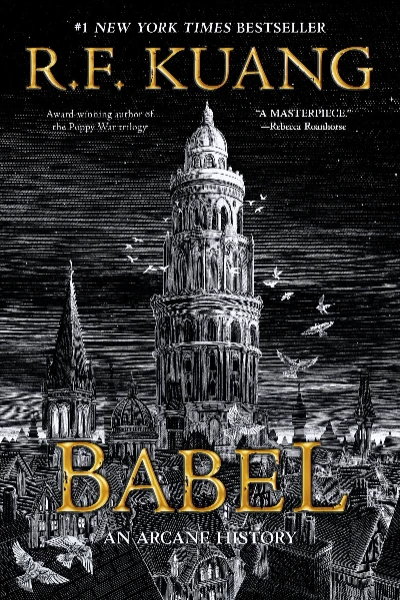
Babel
Babel — Chapter no 31
Chapter Thirty-One
Westminster Bridge fell, and Oxford broke out in open warfare.
They were crowded around the telegraph machine, waiting anxiously for an update, when one of the gunmen rushed in from upstairs and caught his breath before announcing, ‘They’ve killed a girl.’ They followed him to the rooftop. With his naked eye Robin could see a commotion up north in Jericho, a frenzied movement of the crowd, but it took a moment of fumbling with a telescope before he honed in on what the gunmen were pointing at.
Soldiers and labourers at the Jericho barricade had just exchanged fire, the gunman told them. Usually this led to nothing – warning shots echoed throughout the city at all times, and the sides usually took turns firing before retreating back down behind the barricades. Symbolic; it was all supposed to be symbolic. But this time a body had toppled.
The telescope lens revealed a startling amount of detail. The victim was young, she was white, she was fair-haired and pretty, and the blood blossoming from her stomach stained the ground a vivid, unmistakable scarlet. Against the slate-grey cobblestones, it looked like a flag.
She wasn’t wearing trousers. The women who’d joined the barricades usually wore trousers. She had on a shawl and a flowing skirt, and an upturned basket still hung from her left arm. She could have been on her way to buy groceries. She could have been on her way home to a husband,
to parents, to children.
Robin straightened up. ‘Was it—’ ‘It wasn’t us,’ said the other gunman. ‘Look at the angle. She’s turned away from the barricades. It wasn’t one of ours, I tell you.’ Shouts from below. Shots whistled above their heads. Startled, they hurried back down the stairs into the safety of the tower.
They congregated in the basement, huddled nervously, eyes darting around like frightened children who had just done something very naughty.
This was the first civilian casualty of the barricades, and it was momentous.
The line had been breached. ‘It’s over,’ said Professor Craft. ‘This is open warfare on English soil.
This all needs to end.’ A debate broke open then. ‘But it wasn’t our fault,’ said Ibrahim. ‘They don’t care if it’s our fault,’ said Yusuf. ‘We started it—’ ‘Then do we surrender?’ demanded Meghana. ‘After all this? We just stop?’ ‘We don’t stop,’ said Robin. The strength of his voice stunned him. It came from someplace beyond him. It sounded older; it sounded like Griffin’s. And it must have resonated, for the voices quieted, and all faces turned towards him, scared, expectant, hopeful. ‘This is when the tides turn.
This was the most foolish thing they could have done.’ Blood thundered in his ears. ‘Before, the whole city was against us, don’t you see? But now the Army’s messed up. They’ve shot one of the townsfolk. There’s no coming back from that. Do you think Oxford’s going to support the Army now?’ ‘If you’re right,’ Professor Craft said slowly, ‘then things are about to get much worse.’ ‘Good,’ said Robin. ‘As long as the barricades hold.’ Victoire was watching him with narrowed eyes, and he knew what she suspected – that this did not weigh on his conscience at all, that he wasn’t nearly as distressed as the others.
Well, why not admit it? He was not ashamed. He was right. This girl, whoever she was, was a symbol; she proved that empire had no restraints, that empire would do anything to protect itself. Go on, he thought; do it again; kill more of them; turn the streets red with the blood of your own.
Show them who you are. Show them their whiteness won’t save them. Here, at last, was an unforgivable offence with a clear perpetrator. The Army had killed this girl. And if Oxford wanted vengeance, there was only one way to get it.
That night Oxford’s streets exploded into proper violence. The fighting started at the far end of the city, at Jericho where the first blood was shed, and gradually spread as more and more points of conflict developed. The cannon fire was constant. The whole city was awake with shouts and
rioting, and Robin saw on those streets more people than he had ever imagined lived in Oxford.
The scholars clustered by the windows, peeking out in between spates of sniper fire. ‘This is insane,’ Professor Craft kept whispering. ‘Absolutely insane.’ Insane was not enough to cover it, Robin thought. English was insufficient to describe all this. His mind wandered to old Chinese texts, the idioms they employed about dynastic collapse and change. 天 翻 地 覆 ; tiānfāndìfù. The heavens fell, and the earth collapsed in on itself. The world turned upside down. Britain was spilling its own blood, Britain was gouging out its own flesh, and nothing after this could go back to the way it had been before.
At midnight Abel summoned Robin to the lobby. ‘It’s over,’ he said. ‘We’re nearing the end of the road.’ ‘What do you mean?’ Robin asked. ‘This is good for us – they’ve provoked the entire city, haven’t they?’ ‘It won’t last,’ said Abel. ‘They’re angry now, but they’re not soldiers.
They’ve got no endurance. I’ve seen this before. By the early hours of the night, they’ll start straggling home. And I’ve just had word from the Army that at dawn, they’ll start firing on whoever’s still out there.’ ‘But what about the barricades?’ Robin asked, desperate. ‘They’re still up—’ ‘We’re down to the last circle of barriers. High Street is all we’ve got.
There’s no pretence of civility any longer. They’ll break through; it’s not a question of if, but when. And the fact is, we’re a civilian uprising and they’re a trained, armed battalion with reinforcements to spare. If history is anything to go by, if this really does become a battle, then we’re going to * get crushed. We aren’t keen on a repeat of Peterloo.’Abel sighed. ‘The illusion of restraint could only ever last so long. I hope we’ve bought you time.’ ‘I suppose they were happy to fire on you after all,’ said Robin.
Abel cast him a rueful look. ‘I suppose it doesn’t feel good to be right.’ ‘Well then.’ Robin felt a roil of frustration but forced it down; it wasn’t fair to blame Abel for these developments, nor was it fair to ask him to stay
any longer, when all he would face was near certain death or arrest. ‘Thank you, I suppose. Thank you for everything.’ ‘Hold on,’ said Abel. ‘I didn’t come just to announce we were abandoning you.’ Robin shrugged. He tried not to sound resentful. ‘It’ll be over very quickly without those barricades.’ ‘I’m telling you this is your chance to get out. We’ll start ferrying people away before the shooting gets properly vicious. A few of us will stay to defend the barricades, and that’ll distract them long enough to get the rest out to the Cotswolds, at least.’ ‘No,’ Robin said. ‘No, thank you, but we can’t. We’re staying in the
tower.’ Abel arched an eyebrow. ‘All of you?’ What he meant: Can you make that decision? Can you tell me everyone in there wants to die? And he was right to ask, because no, Robin could not speak for all seven remaining scholars; in fact, he realized, he had no idea what they would choose to do next. ‘I’ll ask,’ he said, chastened. ‘How long—’ ‘Within the hour,’ said Abel. ‘Sooner, if you can. Would rather not tarry.’
Robin steeled himself a moment before going back upstairs. He didn’t know how to tell them this was the end. His face kept threatening to crumple, to reveal the scared boy hiding behind the ghost of his older brother. He had roped all these people into this last stand; he could not bear the sight of their faces when he told them it was over.
Everyone was on the fourth floor, clustered at the east window. He joined them. Outside, soldiers were marching forth on the lawn, advancing at an oddly hesitant pace. ‘What are they doing?’ wondered Professor Craft. ‘Is this a charge?’ ‘You’d think they’d charge with more of them,’ said Victoire.
She had a point. More than a dozen troops had halted on High Street, but only five soldiers proceeded the rest of the way towards the tower. As they watched, the soldiers parted, and a solitary figure stepped through their ranks up to the final remaining barricade.
Victoire drew in a sharp breath.
It was Letty. She waved a white flag.