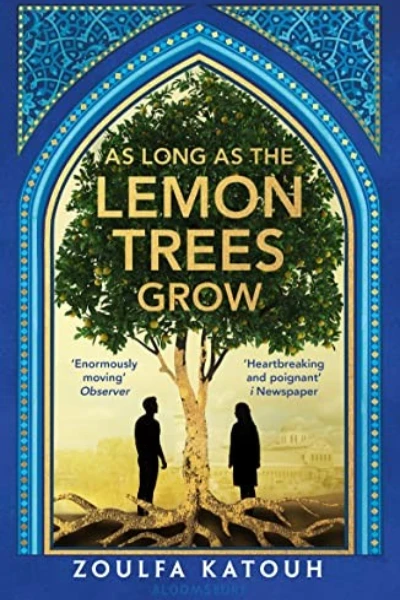
As Long as the Lemon Trees Grow
As Long as the Lemon Trees Grow — Epilogue
A PALE LILAC BLOOMS ON THE HORIZON AS THE SUN slowly breaks through the darkness. September dawn in Toronto takes on many shades of the spectrum, but nowadays it seems to favor skipping from lilac to a bright blue while the stars quietly disappear.
I’m on the balcony, bathing in the soft glow and gazing at the corner I’ve transformed into a small garden. Daisies. Honeysuckle. Peonies. Lavender.
I’ve grown them all myself, tending to their tiny roots and petals with care, murmuring words of love.
“You’re so beautiful,” I coo at a baby daisy shyly splaying out her petals against the scars on my hands. “I’m so proud of you.”
A light breeze coaxes me to pull my blanket more tightly around my shoulders. Even though I’m in wool pajamas, the cold of the Mediterranean hasn’t melted.
Kenan and I have been in Toronto for four months, and I still haven’t gotten used to the chill. It’s so different from Berlin, but both have the same kind of quiet on a Saturday morning: one that’s occasionally broken by the faint rumblings of a plane flying above. It took Kenan and me two years not to go sick with fear at those. And sometimes we still forget, the trauma coming back to us in the form of shaking hands and panic-filled eyes.
“There you are,” Kenan says, shuffling outside with two mugs of
steaming zhoorat tea.
I glance at him, smiling.
He’s become more resistant to the cold and is dressed only in simple pajama pants and a white T-shirt. His hair is disheveled from bed and his eyes are still traced with sleep. It took a while and a lot of hard work, but both of us are now a healthy weight. I eye his biceps, feeling my cheeks warm up as he hands me my mug.
“Thank you,” I whisper, not wanting to disturb the peace.
He sits beside me. I adjust the blanket so it’s wrapped around us both and lay my head against his shoulder.
“You woke up early,” he says quietly. “Bad dream?”
There are times when the nightmares trickle through our sleep like belladonna’s poison. They startle Kenan awake; he gasps for air, sweat running down his forehead. They fill his head with paranoia, convincing him that Lama and Yusuf are trapped in Homs or drowning in the Mediterranean.
Only when he calls his uncle in Germany to talk to them does he calm down.
Only when I hold him to me and play with his hair, whispering “something good,” does he relax and finally falls back asleep on my chest.
And while Khawf has disappeared from my life like a fever dream, the nightmares have picked up where he left off. Their poison paralyzes me, and I’m trapped in my mind, screaming. At times, it takes Kenan a while to wake me, to convince me I’m really here, but his arms are always there to hold me steady—to bring me back.
Kenan laces his fingers through mine and kisses the side of my head. “We promised we’d talk to each other, Sheeta.”
I turn to him, eyes softening. We did. And when we don’t know how to find the words, we have others to help us. A quiet room with a sympathetic woman looking at us over her round glasses. She smiles kindly, and the way her eyes twinkle reminds me of Nour. When the conversation becomes difficult, all I need to do to ease the heaviness is remember the way she used to say “ther-a-pee.”
As soon as Kenan and I settled in Berlin with his aunt and uncle, the shock of what we went through slowly melted into a pain that became more difficult to talk about with each passing day. Layla, Mama, and Baba are buried in Homs. For a while I forgot how to breathe through the agony over Hamza’s life in Syria.
I absently touch the scar on my neck. While the one at the back of my head is covered by my hair, this one isn’t easy to ignore. It looks like a choker, and when my thoughts become dark, I can almost feel it tightening around my throat. Kenan looks at it, realization creasing in his eyes.
He sets his mug down before lowering his head to kiss the scar. I link my arms around his shoulders, hugging him close.
“Any plans today?” I murmur.
He breaks away, cheeks pink. “I’m meeting Tariq to make sure everything’s going okay with our university acceptance.”
“Of all the futures I envisioned for us, living and attending university in
Toronto was not one of them.”
He grins. “Not a bad plot twist.”
It’s all been made possible by one of Hamza’s friends. Shortly before the revolution started, one of his close high school friends moved to Canada to study medicine. Now a Canadian citizen, he offered to sponsor our move to Toronto. Help us continue our education, find jobs, and live a good, safe life.
We connected after I revived my Facebook account in Berlin, where distant family and friends extended all sorts of help.
When Tariq reached out, Kenan and I sat down and studied it from all angles. We know more English than German. In terms of animation, Canada has more options, and I instantly fell in love with the university’s pharmacy program. Yusuf and Lama were adapting well to their German schools and life, their aunt and uncle stepping in like they were their own children. It would just be Kenan and me leaving. For now. We’re too young to care for two children. And I know it breaks Kenan’s heart every single day to be apart from them. But being a refugee limits our options, and I also know that our situation is far better than so many other Syrian families because we have Kenan’s aunt and uncle. Families with no relatives living in diaspora are usually torn apart, scattered over a few countries depending on which accepts them.
Kenan hasn’t changed his phone’s lock screen from Lama and Yusuf, though the background is him and me. He calls them every single day and has been planning how he’ll be able to fly to Germany to see them.
“I can’t believe university starts in a week.” I shake my head. “I can’t believe we’re sitting here drinking zhoorat three years later.”
“I can’t believe you’re with me.” He kisses the wedding ring on my finger, then kisses along one scar sliced into my wrist. “How did I score someone so out of my league?”
I chuckle. “You seduced me with all your Studio Ghibli facts.”
He grins. “Miyazaki doesn’t use scripts in his movies. He comes up with the dialogue as he goes along.”
I act all flustered, fanning myself. “Oh my God!”
He laughs and we finish up our tea. As soon as the sun’s light has
engulfed the sky, we go back inside.
It’s a small one-bedroom apartment but it’s home. A few boxes still clutter the floor. Tariq and his friends furnished the apartment for us, and I had to hide in the bathroom to cry from gratitude for a solid ten minutes before I could face anyone.
Sprawled across the dining table are Kenan’s sketchbooks, all filled with drawings of our stories. Next to them is a half-empty knafeh pan. The charcoal portrait he drew of me at the Brandenburg Gate is enclosed in a wooden frame, hanging over the couch in the living room. The walls are a canvas for our imagination, and we’ve splashed the white with different shades of blue. One wall hosts Kenan’s ongoing work of a map of Syria, while I etched a Nizar Qabbani poem along the surface of the other because it turns out my calligraphy is better than his. It’s one I saw at the revolution’s anniversary protest.
“Every lemon will bring forth a child, and the lemons will never die out.”
We place the mugs in the sink, discussing the various elements of storytelling used in Princess Mononoke. I open a cupboard to take out a breakfast bar. Each cupboard is stocked to the brim with bags of rice, freekeh, canned hummus, and kashk. I finish up the whole bar, not even leaving a crumb, before throwing the wrapper in the trash.
Kenan takes a chicken out of the freezer to let it defrost and I find myself marveling at the fact we have a whole chicken.
While Hamza doesn’t.
Daily, I scour Facebook and Twitter pages that post regular updates on the prisoners in the Syrian detention facilities that have been released, as well as those that have information on prisoners still inside. I look for Hamza’s name until my eyes cross, but he never shows up. And in my heart, I pray he’s become a martyr. I pray he’s with Layla in Heaven, far away from this cruel world.
I glance away and feel Kenan’s hand on my cheek.
“Hey,” he whispers, knowing what’s on my mind. “It’s okay.”
I shudder in a breath, nodding before walking into the living room. To distract myself, I contemplate whether to read a pharmaceutical book or work on a new video. After arriving in Berlin, Kenan picked up where he left off
with his activism and, after a few more videos, he began to garner the world’s attention. I practiced my English by joining him, writing articles and making videos about what we faced in Homs. I threaded our stories together, and at first it was difficult. I’d burst into tears five seconds into a monologue, remembering the feel of a corpse’s cold body.
Kenan catches my arm, spinning me around, and I fall against his chest,
surprised.
“Whoa! What are you doing?”
He smiles, holding up his phone. An English song I don’t know croons out. “Dancing with my wife.”
My eyes burn. We weave distractions between the bouts of agony.
Reminding the other we’re still here.
He drops the phone on the couch beside his laptop, swaying me with the music.
“I’m in my pajamas,” I mumble, pressing my forehead to his collarbone.
He shrugs. “So am I.” He twirls a finger through a lock of my hair, now cut short to my chin. “You’re beautiful in your pajamas.”
“So are you.”
He laughs. In the distance, we hear the low rumble of a plane and I don’t miss the way Kenan’s hand tightens in mine for a fraction of a second.
“What do you think of our new family addition?” I draw him back to me.
He glances at the balcony. “We’ve had her for two months now and we’ve barely seen more than a green blade.”
I laugh. “Lemons take time, Kenan. We’re growing a tree. They need patience, just like change does.”
He gives me a lopsided smile. “I love it when you talk about change.”
I giggle and he rests his forehead on my shoulder, humming to the music.
My eyes wander over his shoulder to the blue ceramic pot perched directly under the sun’s rays. Seedlings have emerged through the dirt, fighting against gravity, and it reminds me of Syria. Of her strength and beauty. Of Layla’s words and her spirit. Of Mama, Baba, and Hamza.
It reminds me that as long as the lemon trees grow, hope will never die.
End of book
You finished As Long as the Lemon Trees Grow
by Zoulfa Katouh