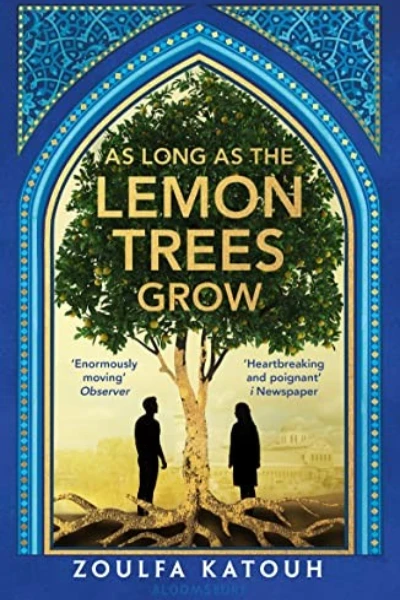
As Long as the Lemon Trees Grow
As Long as the Lemon Trees Grow — Chapter no 2
I LOST EVERYTHING LAST JULY.
All in the span of one week.
Back then I lay on a hospital bed, silent tears stinging the cuts on my face, my left thigh aching from the fall, and my bruised ribs protesting painfully every time I breathed. My hands were wrapped in such heavy gauze, they looked like mittens. Shrapnel had dug holes into my hands; the blood burst out like a fountain. But all of that was manageable.
The only serious injury was at the back of my head. The force of the explosion had me flying back, and concrete met the base of my skull, marking me for life. Dr. Ziad stitched me up. It was the first time I met him.
He told me I was lucky to escape with only a scar. I think he was trying to take my mind off the fact that Mama hadn’t been as lucky. That the bomb snatched her away from me and I’d never be able to hug her again.
Later that day, when Khawf appeared and told me his name, it took a bit for me to realize I was the only one seeing him. At first I thought the drugs were giving me visions—that he would disappear when the morphine did.
But he stayed by my side, whispering horrible things while I cried for Mama.
Even when the pain subsided, and my ribs healed, and my hands scarred, he didn’t leave. And once that conviction settled in, panic followed soon after.
He was a hallucination who had come to stay. One who, every night for the past seven months, has cruelly plucked on my fears, breathing life into them.
There is no other explanation. Boiling him down to scientific facts is the only way I’m able to face him.
“Whatever makes you feel better.” He smiles wickedly.
I rub the scar at the back of my head, feeling the callous ridges against my fingers. “Daisies,” I whisper. “Daisies, daisies.”
Khawf brushes his hair out of his eyes and takes a pack of cigarettes out of his breast pocket. The carton is red, always the same shade as the spots on his shoulders. He plucks one long tube and presses it between his lips before lighting it. The nub blazes, eating away at the edges, and he takes a long drag.
“I want to know why you didn’t talk to Am,” he says. “Didn’t you promise yesterday you would? Like you’ve been promising me every night?”
His voice is low, but there’s no mistaking the threat poisoning each word.
That’s how it started with him: a snide remark here and there, nudging my thoughts toward leaving Syria, until one day he decided I should ask Am for a boat. And he hasn’t stopped demanding I do so. Sometimes I wonder how my brain could conjure someone like him.
A drop of cold sweat trickles down my neck. “Yes,” I manage to answer.
He taps the cigarette and ash falls to the floor, disappearing just as it should hit the ground. “What happened?”
A five-year-old girl with curly brown hair died from a sniper shot to the heart while I saved her older brother from sepsis. I am needed. “I—I couldn’t.”
His eyes narrow. “You couldn’t,” he repeats dryly. “So I take it you want to be crushed under this house. Alive and broken and bleeding. No one coming to save you because how could they? Muscles as atrophied by malnourishment as yours are can barely lift bodies, let alone concrete. Or maybe you want to be arrested. Taken to where your Baba and Hamza are.
Raped and tortured for answers you don’t have. Have the military dangle death as a reward and not a punishment. Is this what you want, Salama?”
My bones shiver. “No.”
He blows out one last trail of smoke before grinding the cigarette under the heel of his oxford shoe. Then he crosses the threshold and stands in front of me. I raise my head to look at him. His eyes are as cold as the Orontes River in December.
“Then couldn’t isn’t going to cut it,” he says. “You promised you would ask Am for a boat today. And three times he passed by and you didn’t.” His lips pull into a thin line, a muscle working in his jaw. “Or do you want me to
go back on my deal?”
“No!” I shout. “No.”
One snap of his fingers and he could completely alter my reality, unleashing hallucination upon hallucination, showing everyone that the
exterior I’ve put up is nothing more than brittle twigs against a strong wind.
Dr. Ziad wouldn’t let me work at the hospital anymore. Not when I could be a danger to the patients. I need the hospital. I need it to forget my pain. To keep my hands busy so my mind doesn’t scream itself hoarse. To save lives.
Worse, I’d be piling more worries and anxieties on Layla, affecting her health and the baby’s. No. I’ll endure it all for her. I’ll drown in my tears and offer my soul to him if I can keep Layla safe in the knowledge I’m all right.
And so, Khawf has promised to keep to himself during the day and confine the terrors he shows me to the night. Far away from anyone else’s eyes.
An unkind smile tilts his lips upward. “This is your last chance, Salama, and I swear to you, if you don’t ask him tomorrow, I will tear your world apart.”
Anger awakens between the heartbeats of fear. My subconscious may have me under its thumb, but it’s my subconscious.
“It’s not that easy, Khawf,” I hiss, shaking away the look on the boy’s face when he held his little sister in his arms, her body small. So small. “Am might not have a boat. And even if he does, the price will be so high we won’t be able to pay it. So then the only way out would be to walk to Turkey.
Making us a perfect target for the military. That is, if Layla survives the walking!”
His eyebrows quirk up in amusement. “Why are you choosing to ignore the promise you made to Hamza about getting Layla out? Your conflicted feelings about the hospital are causing chaos in your heart. Point is, you made promises and you’re backing out. All of this babbling is nothing more than excuses to keep your guilt at bay. What price wouldn’t you pay for Layla’s safety?”
I look away and dig my hands into my pockets, sinking into the mattress.
“This memory”—he straightens, smirking—“should solidify your decision.”
Before I can scream, he snaps his fingers.
The rich smell of mint and cinnamon stewing in a broth of yogurt and meat invades my nose and I’m overwhelmed with nostalgia. I hesitate for a second before opening my eyes. When I do, I’m no longer in my musty room but back home. My home.
The kitchen is exactly how I remember it. The marble walls alternate
between beige and cedar brown, where hanging frames show Arabic calligraphy and painted golden lemons. The storage space beneath the counters holds our saucepans and pots, neatly stacked. A white satin cloth embroidered with lilies drapes over the kitchen table. Around the table stand four wooden chairs, and on top of it, orchids sprout out of a crystal vase. Blue orchids I bought for a visit that was supposed to happen later that day— today. I always bought blue orchids when we had a social gathering.
I finally turn to my left, where Mama stands beside me, her eyes on the shish barak, stirring the pot with a wooden spoon. All the while her lips moving in prayer.
“Keep them safe,” she whispers. “Keep my men safe. Bring them back to me alive and well today. Protect them from those who wish them harm.”
I’m rooted to the spot, my heart tearing in two.
She’s beside me.
A few silent tears trickle down my cheeks, and the need to throw myself into her arms overwhelms me. I want my mama. I want her to soothe away my sadness and kiss me while calling me ya omri and te’eburenee. My life and bury me.
Instead, I gently poke her arm. She glances up with bloodshot eyes, distracted, before a tired smile appears on her lips, and I can see how this war has drastically changed her. Her face, which never seemed to age beyond thirty-five, is weary with nerves, and the roots of her umber-brown hair are gray. She never let her roots go gray, always the picture of prim and proper.
Her bones poke out sharply, and dark shadows tint under her eyes, where they never existed before.
“Te’eburenee, we’ll be okay. Insha’Allah,” she whispers, wrapping one arm around my shoulders and squeezing me to her. Bury me before I bury
you.
I did.
“Yes, Mama,” I manage to choke out, melting into her touch.
“Aw, Saloomeh,” Hamza calls as he walks in with Baba from the living room, and I nearly cry out. They’re here. Hamza’s honey-colored eyes are full of life and mirror Baba’s. They’re both wearing coats with the Syrian Revolution flag hanging over one shoulder. One twist and it could be a noose.
“Are you seriously going to cry?”
I don’t ask Hamza where Layla is because I know she’s back at their
home, waiting for him. But he won’t be returning to her today.
“Hamza, don’t tease your sister,” Baba says, walking over to Mama. She immediately engulfs him in a hug, and he wraps his arms around her, murmuring something in her ear.
I can’t bear to see this, so I turn away.
“You’re leaving now?” I ask Hamza, my voice breaking, and I have to tilt my chin up to look at him. I haven’t done that in seven months.
He smiles softly. “The protest is happening after the prayer, so we need to get there early.”
I bite back the urge to wail. He had just turned twenty-two, freshly graduated from medical school, and had applied for a residency at Zaytouna Hospital. He didn’t know he was going to be a father. Would that have stopped him from joining the protests?
“D-don’t go,” I stammer. Maybe this hallucination can end well. Maybe I can change things. “Please, you and Baba. Don’t go today!”
He grins. “You say that every single time.”
I grab his arm tightly, my eyes memorizing his faint scruff, the dimple in one cheek that appears when he smiles. This is the last memory I have of my brother. With time, memories distort, and I know I’ll forget his exact features.
I’ll forget Baba’s brown hair, streaked with gray, and the gentle twinkle in his eyes. I’ll forget how Hamza is at least two heads taller and that he and I share the same shade of brown hair. I’ll forget the dimples in Mama’s cheeks and her smile, which lights up the world. Our family photos are buried under the rubble of this building, and I’ll never get them back.
“Ew. Salama, why are you being weird?” he says, and then shakes his head when he sees the tears in my eyes. He adds kindly, “I promise you we’ll come back.”
My lungs constrict. I know what he’s going to say next. I have replayed this conversation in my mind on a loop until the words scramble together.
“But if I don’t…” He takes a deep breath, turning serious. “Salama, if I don’t… then you take care of Layla. You make sure she and Mama are okay.
You make sure you three stay alive and safe.”
I swallow hard. “I already promised you that.”
When the people flooded the streets during the very first protest, Hamza immediately took me aside and made me vow exactly that. He was always intuitive. Smart beyond his years. He always sensed when I was down, even
if I didn’t say anything. His heart, as soft as a cloud, reached out to everyone around him. He knew that Mama, despite her terror, would need to be dragged out of Syria kicking and screaming, that Layla would scoff if he asked her to run away, leaving him behind. But I would make sure they both stayed alive. I would put my family’s safety above everything. Whoever was left of it.
“Promise me again,” he says fiercely. “I can’t go out there in good conscience without knowing for sure. I need to hear those words.” The honey in his eyes burns like fire.
“I promise,” I manage to whisper. Two words were never heavier.
Now he’s supposed to ruffle my hair before walking out with Baba, never
to come back.
But he doesn’t.
His hands grip my shoulders. “Did you?”
I falter. “What?”
The fire rages in his gaze. “After the military took me and Baba, did you get Mama out? Did you save Layla? Or did you throw their lives away?”
My bones rattle.
“Salama, did you lie to me?” Agony drips from his expression.
I back away, pressing my hands to my chest.
“Did you let Mama die?” he asks, his voice louder.
Mama and Baba stand beside him, blood trickling down the right side of Mama’s face. It falls to the ceramic floor she polished every single day. Each drop feels like a knife to the heart.
“I’m sorry,” I plead. “Please. Forgive me!”
“Sorry?” Baba says, his brows furrowed. “You let your mother die.
You’re letting Layla die. For what?”
“Mama might forgive you,” Hamza says. “But I won’t. If Layla suffers because of your choices, Salama, I will never forgive you.”
I collapse to the floor, weeping. “I’m sorry. I’m sorry.”
“Not enough,” they all say in unison.
The floor shakes underneath me, and vines twist around my ankles, pulling me beneath the tiles. My kitchen and home crumble, and I fall into the black abyss, screaming. My back hits a slab of stone, and I struggle to take in a breath. When I open my eyes, smoke from a building on fire covers the pale blue sky above.
Oxygen becomes scarce in my lungs and I cough, shakily getting up onto my feet. Before me stands the seven-story building I called home. The balcony on the sixth floor has laundry drying outside and the one under it has the Syrian Revolution flag hanging proudly from the balusters. It ruffles in the wind, looking as if it’ll fly away. But Hamza had knotted it tight on each side to make sure it stayed put. After he and Baba were arrested, Mama couldn’t bear to take it down.
The air around me is very still. I know where I am without needing to ask.
Khawf has dragged me a week into the future to one of the worst days of my
life.
Mama.
“No,” I groan. “No.”
“You can’t save her.” Khawf stands a few feet from me. “She’s already dead.”
My building is fifteen steps away. I can make it. I can save her.
“Mama!” I scream, running toward her. “Get out! Get out! The planes are coming!”
But it’s too late; they’re faster than my voice, and the bombs don’t care that there are innocent people inside. The high-pitched sound rings against my ears as they smash the building to bloodied fragments. The aftershock doesn’t blow me away. It razes the building to the ground, and I’m standing over Mama’s mutilated body. She wasn’t wearing her hijab; her brown hair is gray with debris, her head bent at a wrong angle. And blood. There’s so much blood staining my bare feet, my stomach heaves at the sharp metallic smell.
I cry, falling to my knees, and clutch her body, drawing her closer to my living one. My hands shake uncontrollably as I try to brush away the hair plastered to her cheeks, but I only smear her with her blood. Flecks of it land in my mouth. “Mama! Oh God, not again! Not again!”
Her eyes gloss over, staring right back at me.
“Why didn’t you save me?” Mama whispers, her eyes vacant. “Why?”
“I’m sorry,” I sob. “Please, please forgive me!”
I drip tears on her still face, my lips pleading with her to come back, and I hug her. Even with all the blood drenching us both, she still smells the same.
“She’s gone, Salama,” Khawf says from behind me. “Look, there you are over there.”
I glance toward where he’s pointing. Between the rubble and smoky haze
of the bomb, there’s past me. Her cheeks are still full, her eyes beginning to come to terms with a pain that will become her constant companion. She’s only seventeen and has barely glimpsed what true horror means. She coughs, her clothes and hijab torn, trying to crawl toward Mama’s corpse before her muscles give way, and she falls to the ground, unconscious.
Anger and sadness intertwine through my heart, latching to my deteriorating bones.
“That’s enough,” I pant, pressing Mama closer. “Take me back.”
Khawf crouches beside me, wiping a drop of blood from my cheek, and smiles. The rubble doesn’t come near him; his clothes are untouched. Yet the red spots on his jacket’s shoulders have grown, and I don’t know if I’m seeing things, but they seem to be leaking down his lapels.
He snaps his fingers and I’m back on my bed, all traces of soot and blood gone. I blink, staring at my chapped, scarred hands, unsettled by the sudden disappearance of Mama from my embrace. The tears on my face, still wet, are the only proof of what I went through.
Khawf takes a deep breath, satisfaction etched on every line of his pale face, and retreats to the window.
“That will be Layla if you continue to be obstinate.” He takes out another cigarette. “You’ve already broken half of your promise. Do you want Layla’s death to be your undoing?”
My body betrays me, shaking all over, and I clutch my ragged blankets to hide it.
He blows out a cloud of dark gray smoke that falls to the tattered floor in wisps before vanishing. “Every day more of your patients pass away. Each one of them is another regret in your heart. Staying here will destroy you even if Layla survives.”
“Go away,” I whimper, hating my brain for doing this to me.
“I don’t like being treated as a fool, Salama,” he murmurs. “Give me what I want and I might leave you alone.”
My tongue is dry, and the half-moon scars on my palms, the result of my own nails, begin to hurt. Instead of answering him, I turn away, my brain banging against my skull. My eyes fall on the closed drawer of the nightstand beside the bed, where I keep my hidden stash of Panadol pills. I’ve been collecting them since July in preparation for Layla’s labor, and for one brief second I consider taking one. But decide against it. I don’t know if we’ll have
access to medicine wherever we’ll be.
“Jasmine. Jasmine. Jasmine…,” I murmur over and over until I swear I can smell them like I used to when Mama took me in her arms.