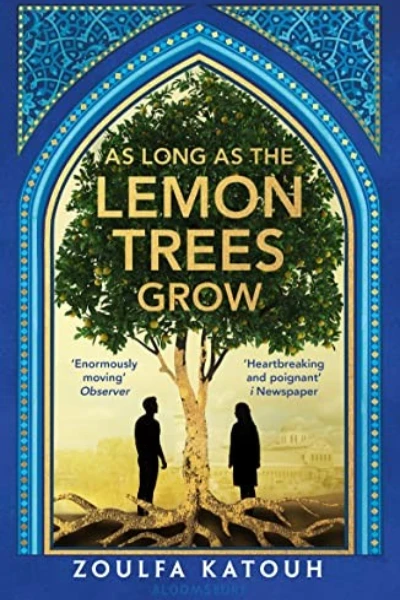
As Long as the Lemon Trees Grow
As Long as the Lemon Trees Grow — Chapter no 8
KENAN STARES AT ME, HIS CHEEKS AND EARS GROWING redder, and I stare right back, remembering Mama and how the beginning of the end began.
The day before my world came crashing down around me, I was on my phone scrolling through my Facebook feed. I’d just paused Princess Mononoke on my laptop—Layla had tagged me in a makeup tutorial video—
when Mama walked in.
“Salama,” she said.
I looked up, my hair falling over my eyes. I pushed it back.
Her smile was tentative, and she brushed her fingers along the devil’s ivy leaves cascading from my bookshelf to the floor. Layla had gifted me the plant when I was accepted into pharmacy school, and I named her Urjuwan.
The name was ironic, seeing as it meant purple, while my devil’s ivy’s leaves were the darkest shade of green. Still, it is a name I love. The way the U, R, J, and W all come together to create a melodic word that sounds the most Arabic. Urjuwan looked pretty beside the jars of herbs and flowers and the two scrapbooks I had made containing all the information I had gathered on medicinal flowers and herbs over many years, with dried petals glued to the heavy pages and captions scribbled on the side. Drawings by Layla when I needed a hand. I was so proud of those scrapbooks, I even showed them to my professor, who praised me in front of the whole class. That was the day I decided to specialize in pharmacology.
Mama sat beside me on the bed. “They’re coming tomorrow.”
I’m sure she didn’t think this day would arrive so soon. Especially since Hamza and Layla had gotten married not even a year ago.
“At three p.m. after Friday prayer,” I said in the voice of someone reciting the history of concrete. “I know.”
She chewed her cheek, and in the light where the sun fell on her face, she
looked younger. Enough to be mistaken as my twin.
“Why are you anxious?” I laughed. “I thought that was supposed to be my job.”
She sighed. Even though I shared her facial features and the color and softness of her russet-brown hair, our eyes were where the similarities ended.
While mine were a mix of hazel and brown, like the bark of our lemon trees, her eyes were deep blue, the color of the sky during twilight. And now they were filled with warmth for me.
“Well, you’re not acting anxious,” she said indignantly. “So, I’m doing it for the both of us.” After a small pause, she said, “Maybe we should postpone.”
“Why?” I had seen his picture on Facebook, and I liked what I saw. I wanted to see if his personality matched his cute face.
“After—” She stopped, took a breath, and continued in a low voice. “I’m not sure if the unrest in Dara’a won’t affect us here in Homs.”
The unrest she was talking about was the government’s kidnapping of fourteen boys—all in their early teens. They were tortured, their fingernails ripped off, and then sent back to their families—all because they’d scribbled “It’s your turn, Doctor” on a wall after the success of the revolutions in Egypt, Tunisia, and Libya. By “Doctor” they meant the president, Bashar al- Assad, who was an ophthalmologist. The irony of a man who was drenched in innocent blood taking a vow to do no harm was not lost on me.
I bit my lip, looking away. No one had spoken about it in university, but I could feel the tension in the air and in the streets. Something had changed. I saw it in the way Baba and Hamza talked at the dinner table.
“Dara’a is miles away from here,” I said quietly. “And… I don’t know.”
“It doesn’t matter.” Mama grasped my hands in hers and squeezed. “If we show even a small amount of resistance, then… I can’t let them take my babies away.”
“Mama, relax,” I said, wincing a bit when her hold got tight. “I’m not going anywhere.”
“Yes you are,” she said with a sad smile. “If it works out with Kenan tomorrow, my baby girl is going to get married.”
I stared at my devil’s ivy, admiring the veins jutting through the leaves, the intricate details. “Is it really bad there are protests in Dara’a? Who would want to live under the thumb of a government like this? You’ve always
told me how Jedee and his brother were taken away and you never saw them again.”
Mama was the one who winced this time, but by the time I turned toward her, there was nothing but serenity on her face.
“Yes, they took my father and uncle.” Her twilight eyes went wet. “They dragged Baba away in front of my sisters and my mother and me. I was only ten, but I’ll never forget that day. I remember hoping he died. Can you believe that?” She stopped, eyes going wide, but I didn’t feel any surprise.
I knew that for fifty years we had lived in fear, trusting no one with the rebellious thoughts in our minds. The government had taken everything from us, stripped away our freedom, and committed genocide in Hama. They’d tried to smother our spirits, tried to torture the fear into us, but we’d survived. The government was an open wound, hemorrhaging our resources for their own gain with their greed and bribery, and yet we persisted. We held our heads high and planted lemon trees in acts of defiance, praying that when they came for us, it’d be a bullet to the head. Because that was far more merciful than what awaited in the bowels of their prison system.
She took a deep breath. “Of course I want justice for my family, Salama.
But I can’t lose you or your brother. Not to mention your father and Layla.
You four are my world.”
Her eyes glazed over.
“So, um, knafeh?” I said meekly, trying to draw her back to me.
She blinked. “Ah, yes. Knafeh. I got you all the ingredients you’ll need.”
“I’ll make it as soon as I’m done with this.” I smiled. “Why knafeh, though?”
Mama’s lips hid a secret. “Because you’re so good at it and I believe in
fate.”
“What’s that supposed to mean?”
She got up and pressed a kiss to my forehead. “Nothing, hayati. I love
you.”
“Love you too.”
Kenan runs a hand over his hair, and my eyes snap back to him, my heart beating painfully against my rib cage.
“I’m right, are—aren’t I?” I stutter, feeling hot in my thin sweater and lab coat. Kenan looks away, cracking his knuckles. “The marriage proposal. The one our mothers set up!”
He grimaces and glances back at me. “When you put it like that, it doesn’t sound very romantic.”
The air feels knocked out of me, and I sink back onto the mattress, hugging my legs. Oh, Layla is going to have a field day with this! I’m hiding in the house of the boy I might have married.
Might.
What a word. It holds infinite possibilities of a life that could have been.
So many options stacked one on top of the other, like cards waiting for a player to pick and choose. To try their luck. I see fragments of a life where might happened. Our souls fit together perfectly from our first conversation.
The rest of our visits bloom. I count down the seconds until we say I do. We buy a beautiful house in the country, dance in the dusk, travel the world, raise a family, discover new ways to fall for each other every single day. I become a renowned pharmacologist, and he becomes a famous animator. We live a long life together, partners in crime, until our souls meet their Creator.
But that is not reality.
Our future is bleak. A half-destroyed apartment, with his little sister fighting for her life. Our life is the stabs of hunger, frozen limbs, orphaned siblings, bloodied hands, old shrapnel, fear of tomorrow, silent tears, and fresh wounds. Our future has been ripped from our hands.
Somewhere far away, I hear freedom’s familiar tune. Or maybe it’s Khawf humming it to himself.
Kenan fiddles with his fingers. “I didn’t want to tell you because I didn’t know if you’d remember.” He blows out a puff of air. “How creepy would I have sounded if I’d said, ‘Hey, our mothers set us up on a social visit about our future marriage. That’s where you know me from’?”
I rub my eyes and laugh to myself silently. He must feel self-conscious
and gawky, which is helping a lot.
“It’s fine. I get it.” I grin.
He eyes me warily. “Why are you smiling?”
“Because it’s the last thing I would have thought of.” I keep giggling until it’s grown into full-blown laughter. His smile grows wider until his laugh joins mine. Every time we look at each other, we double up with mirth. The Arab proverb has never been truer: The worst of outcomes is what is most hilarious.
Khawf smokes his cigarette and retreats to a corner of the room,
seemingly satisfied with the result.
We settle down, chuckling quietly.
“Well, that is one hell of an icebreaker,” I say.
“If I’d known this would happen, I would have come clean sooner.”
Suddenly Lama wakes up, choking out “water,” and the mood instantly changes. Kenan jumps to his feet and fetches a jug. I wipe her brow again and am pleased when I find she has continued to sweat.
“She sweated through her whole shirt.” I smile.
“And that’s good?” he asks with a raised eyebrow, helping her drink.
“It’s excellent. Lama, drink some more water, please.” She obliges. “This is a good sign. It means her body is healing. You can see her breath is steady, and there’s no pus around the wounds. Alhamdulillah. She’s making progress. Keep her warm and make her drink a lot of water.”
Kenan’s eyes brim with tears again. He clearly thought he was going to lose her and had steeled himself to accept the fact she might not open her eyes.
As Lama settles back to sleep, I wrap another blanket around her.
He stares at his sister’s face, taking her small hand in his, engulfing it completely. When he speaks, it’s dreamlike.
“She’s the youngest in the family. We were all so happy when she was born. Two boys are a handful, and then this angel came into the world. I remember the sound of Baba crying with joy when the nurse told him she was a girl. She was so spoiled. A butterfly touching her skin was a catastrophe. We never let any harm come to her. How could we call ourselves her brothers then? Her protectors? And now… her body is hurt by hatred.”
His voice breaks, frustrated and angry. “I failed. I couldn’t protect her. Yusuf hasn’t even spoken since my parents died, and he flinches at the slightest sound. She and I were the ones who were able to keep it together. Not letting the cracks show. But… they’re finally making her suffer. I promised Baba I’d protect them with my life and… I’ve let him down.”
With shaking hands, he tucks the blanket around her more securely. I
think of Baba and Hamza. And Layla.
Please be okay, Layla, I pray. Please.
“What do you do during the day?” I ask, trying to change a horrible subject to one less horrible by a fraction.
“For money? I have family in Germany. They send some whenever they
can.”
I fiddle with my fingers. “The hospital doesn’t pay, but it’s something to help the people. Although who knows if I’m staying long en—”
I immediately stop talking, and Kenan looks up, his brows furrowed. It’s easy for him to piece it together from the mortification on my face. I press my hands against my chest, reciting daisies, daisies, daisies. I can’t believe I let that slip. This must be the lack of sleep and today’s horror catching up with
me.
“You’re going to leave?” he asks.
I ponder for a minute. “I don’t know.”
He looks confused. “You don’t know?”
I chew my tongue. “Wouldn’t you leave, given the chance?”
He has two very malnourished siblings under his care as reasons to leave, so what’s stopping him? The hospital is the only thing holding me back.
“No,” he says without hesitation, looking me straight in the eye.
“What—what about Yusuf and Lama?”
He inhales sharply and glances at Lama. Her face is scrunched with pain, her mouth parted as she breathes. Strands of hair are plastered to her forehead, and Kenan brushes them away, his fingers shaking. “I’d—I’d probably send my siblings alone if it were safe for them, but it’s not. Yusuf is thirteen. She’s nine. They… they can’t make it on their own.”
I stare at him. “Then why don’t you leave with them?”
The sadness disappears from his eyes, replaced with a ferocious intensity.
“This is my country. If I run away—if I don’t defend it, then who will?”
I can’t believe the words I’m hearing.
“Kenan,” I begin slowly, and I don’t know if it’s the wavering candlelight, but his cheeks look flushed. “We’re talking about your siblings’ lives.”
He swallows hard. “And I’m talking about my country. About the freedom I’m so rightly owed. I’m talking about burying Mama and Baba and telling Lama they’ll never come back home. How—” His voice breaks. “How do I leave that? When for the first time in my whole life I’m breathing free Syrian air?”
How can he be so obstinate? I want to shake him.
“I don’t get it. How is your staying here helping this war? Is it just by breathing free Syrian air?”
Kenan frowns at my word choice, but he doesn’t comment on it. He takes
in a deep breath and says, “I record the protests.”
I lose all feeling in my knees and my stomach plummets. “You… you what?” I whisper.
He shudders and his hold tightens on Lama’s hand. “It’s why I can’t leave. I’m showing the people—the world—what’s happening here.” He nods to his laptop. “I upload the videos on YouTube when the electricity is back.”
My nails drag nervously against the floor. “Why are you telling me this?
You do realize if you were found out, you’d be worse than dead? If the Free Syrian Army fails to defend us from the military, you’ll be arrested.”
Kenan laughs, but it’s a hollow sound. “Salama, they’re arresting people for no reason. They’ll torture me for answers I don’t have, knowing full well I don’t have them. And I’m not the only one who’s recording. There are so many of us protesting in our own way. In Daraya, one man, Ghiath Matar, gives out roses to the army soldiers. He fights guns with flowers. And I know in my heart they see that as a threat. Any form of protest, peaceful or not, is a threat to the dictatorship. So it doesn’t matter to them if I record or not. I live in a place the Free Syrian Army protects. We’re all in the same danger, because we’re all in Old Homs. I’m complicit just by existing here. If I’m guilty either way, I might as well protest.” He looks at my hands, and I cover them again with my sleeves. He’s too far away for me to read the flash of emotion searing in his eyes. But it looks like pain.
My mouth is dry, and I stare at him. I don’t believe he’s that indifferent to the threat of being arrested. My gaze slips to the side, to the bedroom’s doorway, and I see Yusuf’s eyes peeking out beneath his messy hair. He’s a thirteen-year-old boy; he’s supposed to be on the brink of leaving behind the innocent wonder he enjoyed in his childhood as adolescence shapes his mind and stretches his limbs. But I don’t see that in him. I see a frightened boy regressing into a child. Desperate to return to a time that was safe. Back when his parents were alive and his greatest worry was whether he’d be allowed to watch an extra hour of cartoons. His eyes are huge and full of tears. He fully understands the choices his brother is making. And the consequences.
I see Layla in him. I see her fear every time I evade the topic of fleeing.
Oh God. Oh God! If anything were to happen to me, she’d be destroyed.
She’d be worse than dead.
My hands shake, and I cover my face, commanding myself to take a deep
breath. Is this how I sound to her? So stubborn I can’t see the way my actions are devastating those around me? Honorable as they may be, it doesn’t lessen their destruction.
I have to leave. I have to take Layla and leave, or she won’t survive this.
Not the pregnancy, but me. She won’t survive my death. And I won’t survive hers.
If Layla died, my last family member—my sister—I would become a husk of a person. We came too close back in October. What would I do if she was gone? Khawf’s low chuckle draws my eyes to him, and he shakes his head,
smiling humorously.
“Now you see,” he says.
I bang a fist against my forehead, cursing myself at my stupidity and naivety. Khawf was right. What price wouldn’t I pay for Layla’s safety?
I have to leave.
The decision blooms an ache inside my heart and the backs of my eyes burn with tears that refuse to fall. How did I not see it? I look up once again to see Khawf standing behind Kenan, leaning against the wall, wearing a satisfied grin.
He winks. “Now all that’s left is to grovel to Am.”
My head feels dizzy.
He straightens up, dusting off his glossy suit jacket. “And true to my word, I’ll leave you alone now. But I’ll see you later.”
When I blink, he’s gone.
My gaze falls, and Kenan is staring at me uncertainly, twiddling his fingers.
“Uh, Salama,” he says, treating each word as if it were a delicate vase he was holding in his hands. “Is everything all right?”
I start. Not at the words but at his tone. “Yes,” I answer a bit too fast.
“Why?”
He scratches the back of his head. “I don’t know. You were looking behind me as if the devil himself were standing there, and I’m too scared to turn around and check myself.”
His voice comes out easy, his lips turned into a tentative, joking smile.
I smile back but it feels forced. “I’m great, thank you.” It’s the best I can do right now.
Kenan’s confusion settles in, and I realize I must have been silent for a
while. And my smiling right after such a long silence must be nothing short of unnerving.
I clear my throat. “Although I disagree with you. On staying here, that is.”
He considers me for a second before saying, “Aren’t you a pharmacist at the hospital bandaging the wounded who are protesting?”
“That has nothing to do with anything. I’m upholding my Hippocratic oath. You’re putting yourself and your siblings in the crossfire.”
He shrugs. “I guess I love Syria so much that the consequences don’t matter.”
Something snaps inside me. “And by telling you to leave, I don’t?”
He becomes alarmed. “No! No, that isn’t what I meant at all! I… Salama, this is my home. For my entire life—my whole nineteen years—I’ve known no other. I’d be cutting out my heart by leaving. This land is me and I am her.
My history, my ancestors, my family. We’re all here.”
His fierce resolution reminds me of Hamza and the spirited speeches he’d give when he came back from the protests with Baba. He would have definitely liked Kenan. The thought makes my stomach constrict.
I shake my head, focusing on the promise I made Hamza. Focusing on Layla’s happiness when I tell her I was wrong and I’m sorry. That I’ll save her and myself. Even though I know Kenan is right.
When I leave, it won’t be easy. It’s going to shred my heart to ribbons and all the pieces will be scattered along Syria’s shore, with the cries of my people haunting me till the day I die.