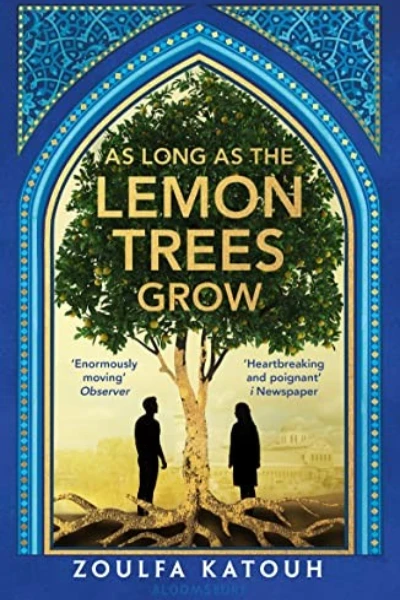
As Long as the Lemon Trees Grow
As Long as the Lemon Trees Grow — Chapter no 35
THE BIRDS ARE CHIRPING WHEN I WAKE SUDDENLY, tucked against Kenan’s chest, his arm wrapped around my shoulder protectively. Dread slithers along my skin, unwelcome and unbidden, and my heart races.
A nightmare?
I sit up and untangle myself from Kenan, praying he doesn’t stir. He mumbles something unintelligible in his sleep.
I can’t remember if my dreams were troubled, but my anxiousness hasn’t dissolved. If anything, it’s escalating. The cut on my neck burns a bit when I twist my head. I stand, looking for my lab coat, and find it draped over Dr.
Ziad’s chair. I wet a corner of it and rub the spot on my stomach that the soldier touched. I frantically press harder, trying to shed the cells, until it burns and my skin protests.
“Morning,” someone murmurs from the corner of the room. My eyes adjust to the scarce early light leaking through the blinds, and I make out Khawf’s silhouette.
“Morning,” I whisper, letting my lab coat fall to the floor.
He steps out of the shadows, his dark suit rippling like the sea on a
moonless night.
That explains the dread.
Khawf looks wary. “Does it?”
“What do you mean?”
He glances around Dr. Ziad’s office and suddenly advances toward me.
His voice is urgent, very different from his usual drawl. “If five soldiers from the military were able to breach the Free Syrian Army’s defenses, what does that say?”
Fear is a cruel thing. The way it distorts thoughts, transforming them from molehills into mountains.
“Listen to me very carefully,” Khawf continues. If I didn’t know better, I’d say he sounds anxious. “It means this hospital isn’t safe anymore. The hospital will be the first place they attack. Either with foot soldiers or bombs.
You know hospitals are always targeted, and the clock has run out on yours.”
The veins and capillaries in my hands constrict.
“It means you need to leave right now or else—” He pauses, sussing out my reaction, but I don’t move. My heart is racing as I try to understand why he’s acting like this. Something about him, about his tone and the way he’s looking at me, feels different. It’s almost as if I’m talking to someone whose soul isn’t extracted from mine.
He groans, his jaw twitching. “You never learn. Fine.”
And he snaps his fingers.
Dr. Ziad’s office shifts, morphing into a graveyard. In front of me are four cracked slab stones crowning four hastily made graves. Mine, Kenan’s, Lama’s, and Yusuf’s. The backdrop is my hospital, flattened.
The scenery changes sharply before I can comprehend. I’m standing on the shore, with a gray sky lining the horizon, watching a boat filled to the brim with refugees sail away. Waves crash over the sand, soaking my sneakers, and the salty sea air burns my nose. Behind me the sound of falling missiles thunders against my eardrums, and the sky glows a lustrous orange- red, swallowing the dreariness. Trees catch fire and the cries of the injured
rise with the smoke.
My future is on the sea, disappearing.
“Wait!” I scream at the boat, lunging forward through the winter-cold water. The iciness of it makes me hiss.
A bomb falls, and the force of it obliterates everything in its path, creating a hot current of wind that pushes me to my hands and knees, drenched in the Mediterranean Sea. Trembling, I glance over my shoulder to see the outline of another missile dropping.
It’s seconds away. I open my mouth to scream again and— I stumble, my back hitting the wall of Dr. Ziad’s office, and I slide to the floor, sobbing quietly into my sleeve. I bite into the fabric as my chest heaves. Khawf crouches in front of me.
“Death will take over this hospital,” he whispers. “Do you remember what the soldier said? Think, Salama! Think!”
The military won’t make it here. We need to buy time until they—
My heart is about to burst—I know it will. Khawf’s face breaks out with a relieved smile and he nods. There are hidden words in his eyes he refuses to say but expects me to know.
When I blink, he’s gone. I clamber to my feet and grab my hijab.
“Kenan, wake up,” I say, my voice raspy. I can still taste the acidity of the smoke in my throat.
He sits up, eyes wild. “Wha—what happened?”
“Nothing.” I pull my lab coat firmly over me. “We need to get out of the
hospital.”
He rubs his eyes. “What?”
I hoist my backpack on. “No time to explain. Get Lama and Yusuf and meet me outside. We need to leave now.”
I open the door and see the doctors and patients starting their day. I hurry to look for Dr. Ziad. Thankfully Kenan doesn’t argue and follows me.
My heart beats painfully and with each passing second I’m sure we’re closer to our deaths. After frantically searching through a couple of rooms and the atrium, I find him in the stockroom.
“Doctor!” I gasp. “We need to evacuate the hospital.”
He starts. “Salama! Are you all right? How are you—”
I zoom past him and snatch Panadol and amoxicillin packs from the shelves, then shove them into my pocket. “Doctor! Grab whatever medications you can carry and let’s leave!”
His confusion deepens.
My desperation is making it hard for me to string my thoughts into a coherent sentence. “We must—there’s probably going to be—all the other hospitals—”
He raises his hands in an attempt to calm me. “Salama, slow down.”
I inhale deeply, holding it in my lungs, and in a forced calm voice say, “If the military was able to get into the hospital, it means they’re already at our doorstep. One of the soldiers yesterday said something about buying time until the military did—I don’t know what. It might be a bomb. It might be something else. But we need to leave.…”
I can’t explain it. Something’s about to happen. Khawf is right.
Where would you go?
Everywhere.
Dr. Ziad’s face is stricken, but he doesn’t move. We don’t have time.
“I haven’t been able to contact the FSA for the past three hours,” he says.
My stomach falls. “We have to go.”
He nods, grabbing a stray cardboard box and shoveling the medications inside. “Salama, tell everyone to evacuate right now.”
I don’t waste another second and run through the hallways to the atrium.
“Everyone!” I yell, and all the faces turn toward me, recognition flickering in some. “Leave the hospital now! It’s not safe!”
For a few precious seconds, they glance at one another with unease.
Frustration builds inside me. It’s because I’m a teenager. They’re more reluctant to listen. It’s not easy for some of them to move, because they’re missing limbs, and others are hooked to IVs. Many are children and elderly.
“The military is going to bomb the hospital! We have to leave!”
Kenan screeches to a halt behind me, holding Lama’s and Yusuf’s hands.
He is horrified.
“Bomb?” he says, out of breath. With the lighting, I can finally see that his left eye is swollen, barely open, and the bruise has turned darker in the daylight.
“Where’s Dr. Ziad?” one patient moans from their bed. “He’ll know—”
“Dr. Ziad says we have to leave!” I snap. I’m not sitting around waiting for them to listen, so I grab Kenan’s arm and start pulling him behind me.
Lama and Yusuf trail after in shock.
The action triggers an effect in the rest of the room. The mothers are first to rise; they grab their children and fling the doors open, then run.
Chaos unfolds. The crowds shove against one another. Doctors help the bedridden to their feet. My hold on Kenan tightens. I refuse to let my grip waver.
As soon as we’re by the door, I hear Dr. Ziad’s voice booming over the masses. “Leave now!”
His tone sparks another urgent rush, and footsteps rumble along the floors.
We all run down the stairs and out of the hospital’s gates. My eyes dart to the skies and I search the blue for planes as we cross the street. The mob pushes against me, and their panicked force nearly makes my grasp on Kenan’s sweater slip. Pins and needles prick through my arm, but I don’t care. Out of the corner of my eye, I see Am, pushing his way through, and I feel a surge of relief. After we pass the first building, I yank Kenan to the side, moving against the current to take refuge behind a torn-down wall, and let him go.
Our breaths are ragged as we stare at each other. The sun is out today, the rays hot on my hijab. Lama and Yusuf are confused and scared, their eyes glued to Kenan. He gives them a reassuring smile.
I glance back toward the hospital, and my heart starts thundering when I can’t spot Dr. Ziad among the people hemorrhaging out. And then the realization hits me.
The babies in the incubators are still inside.
My stomach drops and I hold the wall for support. I need to go back. I need to save the babies. But my legs are heavy with fear, half of me screaming to stay put—to stay safe. The other replays Samar’s ashen, bloodless face as I held her life hostage.
I grit my teeth, pushing away the fear, and before I can rethink my decision, I fling myself from behind the wall and run toward the hospital.
“Salama!” Kenan shouts.
I dash across the road, pushing through the swarms, through the courtyard, and back up the steps.
The atrium is empty, a sight I never thought I’d see. Linens are strewn on the floor, some of the beds overturned in the panic. Two figures emerge from the hallway. Dr Ziad balances a huge cardboard box under one arm and cradles two small shapes with the other. Nour’s white hijab flutters as she sprints past me, huddling two babies close to her.
Dr. Ziad stops short and hands me the babies. They’re wrapped in thin white blankets, each the size of a small loaf of bread. Their skin is red, their mouths tiny, and their fingers barely visible.
“There’s a third in here,” Dr. Ziad says, panting hard and putting down the box. The wrinkles around his eyes deepen. I glance inside the box and see a baby resting atop a small pile of medication packets. “Can you carry the box? I need—”
“Give it to me.” Kenan stops short beside me, his breaths shallow. He tucks the box under his arm, twists on his heels, and flees. Dr. Ziad turns, heading straight back toward the incubators.
“Doctor!” I shriek, rooted to the spot. “Doctor!”
He doesn’t look back.
“Salama! Come on!” Kenan shouts from the front.
Tears erupt from my eyes, and I sob as I hug the babies closer and run after him.
As soon as we cross the road, we hear it.
The plane.
We reach the wall where Kenan’s siblings are peering out, scared out of their wits.
“No,” I choke, whirling around to face the hospital and hugging the babies closer to me. “Please come out!”
Patients, rescuers, and staff are still spilling out the front doors. At the very last second, I see him. He nearly stumbles, supporting two more babies as he runs. His lab coat is half torn and the distance feels impossibly great.
“Yalla,” I beg. “God, please!”
The piercing sound of the bomb slices through the air as it falls.
“No!” I scream, my arms trembling. “Doctor, quickly!”
Kenan grabs me, ducking my head down as the bomb shatters the one place in Homs that held hope. The earth rumbles and cracks as if an earthquake hit. My eardrums ring from the force and debris-filled smoke blinds and chokes me. My limbs shake and I hunch over, trying to protect the infants.
After a few heartbeats where the only sound is the crash of the hospital’s columns collapsing, howls of mourning shake the dust-filled skies. Heart- wrenching cries and prayers rattle my core.
“Are you okay?” I direct at Kenan. The dust settles just enough for me to make out his shape.
“Yes,” he says, coughing hoarsely, and he winces. He turns to his siblings, making sure they’re all right.
“Kenan, take the babies,” I order. “I need to find Dr. Ziad.”
He shakes his head fiercely. “I—”
“Salama, give them to me,” Nour says, and I glance up at her, my heart soaring for a brief moment. She’s unharmed. “They can’t stay here. They need fresh air. Some are already struggling without their incubators.” Two volunteers stand behind her, and I hand the babies over to one of them while the other picks up the cardboard box.
“If you find Dr. Ziad—” Nour stops, her voice shaking. “Tell him—tell him we’ll be at his house.”
I nod and stand despite my wobbly knees. The wreckage throws me into another whirl of despair. The hospital I spent all my days in is gone.
It’s a graveyard.
The building has been reduced to rocks. The volunteers are scattered over the remains, desperately trying to remove the debris. When I get closer, I hear the faint screaming of those still trapped inside. It tears my heart in half.
Their agony makes me forget the reason I’m leaving.
From the smoke, Khawf emerges, his eyebrows raised, not a wisp of the destruction touching him.
“Salama, there’s nothing you can do,” he says coldly. “Don’t you dare rethink your decision. The hospital is gone. Your workplace destroyed.
There’s nothing left for you here. Your family is dead or arrested. I know you don’t want to be next.”
I look away from him, tears streaming down my face, and trudge forward despite my limbs shaking from fear.
“Dr. Ziad!” I call over the moaning. “Doctor!”
Slowly, the dust settles. The sun’s rays poke holes through the plumes of smoke. The ringing in my ears lessens, and when I scream his name for the
fourth time, I hear a faint response.
“Salama!”
I look around wildly, tumbling in the direction of the main gates, to find Dr. Ziad sitting on the curb. There’s a cut on his forehead, blood trickling down his cheek. His face is ashy gray, the tips of his hair and lab coat singed.
“Doctor!” I exclaim, falling to my knees in front of him. “Are you hurt?”
He shudders in a breath, slowly extending his arms to reveal two babies tucked in the crooks. “I had to choose.” He falls quiet, his face white and his eyes void of emotion. “I ran with the ones I chose. But… I can’t hear their
heartbeats.”
It hurts to swallow.
“I tried to save them,” he whispers. Tears roll down his cheeks. “I had to choose. The rest are still inside. They killed babies.”
I wipe my eyes. “They’re in Heaven, Doctor. They’re not suffering anymore.”
He raises them, pressing a kiss to each of their foreheads. “Forgive us,” he whispers to them. “Forgive us for our shortcomings.”
I sit there with him, mourning. They were premature and their chances of surviving without their incubators were slim. Still… still.
After a few minutes, I say, “Nour took the other babies to your house. I think they’re alive.”
He glances up. “Thank you.”
I shake my head. “We’re doing what’s right. We don’t do it to be thanked.”
He hands me one baby. It’s a girl, swaddled in a pink blanket. I hold her closer. Would Baby Salama have been this small? I shudder and we manage to stand carefully. The baby’s face is still, and if I close my eyes, I can pretend she’s sleeping.
“Salama,” Dr. Ziad says, and I look at him. He extends one arm and I gently hand the baby back to him.
“You saved a lot of people today,” he says after a beat of silence.
“Without your quick thinking—your gut feeling—I wouldn’t be in front of you now.” He exhales. “I should have known something wasn’t right when my calls to the FSA weren’t going through, but my mind was muddled after yesterday’s attack.”
“We’re only human. No one can expect you to anticipate everything.”
His smile turns sad. “If only my guilty conscience could agree.”
“What are you going to do?” I gesture at the hospital. “Where will the people go?”
His back is hunched, the years catching up to him, and in his eyes I see devastation. He looks around at the destroyed hospital, taking it all in.
“We’ll build a new one,” he whispers. Then he straightens his back and determination burns away the sorrow. “Other cities, like Ghouta, are setting up underground hospitals. We’ll build tunnels and mazes deep in the ground.
They can bomb us all they want—we’ll never bow down.”
His resilience humbles me.
“May God keep you safe,” I murmur. I feel I shouldn’t leave Syria without telling him. He’d be worried sick if I just never showed up again.
“Doctor, I’m leaving. Tomorrow.”
Surprise flits to sorrow, but there’s no judgment in his eyes. “It was an honor and privilege working with you, Salama. May God keep you alive and well. Please don’t forget us in your prayers.”
The backs of my eyes burn, and I manage to nod. He walks away, still carrying the two bodies as if they were his own children.
Layla’s home is haunting. It’s as if it knows I’m leaving tomorrow.
Kenan limps to the couch as soon as we walk in. We left the hospital site only when we could no longer stand. Kenan hauled debris until his arms shook. He was already weak from the beating he took yesterday, and he suppressed the pain until exhaustion claimed him.
Lama and Yusuf crowd beside him, their faces fearful. I quickly light the candles.
“I’m okay,” Kenan says, closing his eyes and breathing in quick puffs. “I just need a minute.”
“Can someone please get a glass of water?” I open my backpack and rummage through the contents for the Panadol. There’s a strip somewhere.
Yusuf rushes to the kitchen, where he scoops water from the rain bucket
into a mug, and hurries back.
“Here,” he whispers, and we all freeze.
Kenan reacts first, shock easing the tension in his expression. With a shaking hand, he sets the mug on the table in front of him before holding his hand out. Yusuf takes it. Kenan pulls him closer, not even flinching from the pain, and hugs his brother tightly. Lama bursts into tears and I shed a few happy ones too.
Then Lama jumps on Yusuf and holds him close as her sobs muffle on his shoulder.
“Kenan, take your Panadol,” I whisper, handing him the tablet, and he swallows it with the water.
Lama and Yusuf move out of the way, but not too far from Kenan as I help him lie down. Kenan holds his brother’s hand in his, grinning. “Maybe I should get hurt more often.”
Yusuf blushes, and Kenan launches into an exaggerated tale of the ridiculous ways he’ll get injured as they giggle. I recognize the effort in his words and the forced easiness in his tone. He’s trying to distract them from the devastation they witnessed today. Of a refuge reduced to ash.
“Or maybe I’ll let a whale snap me up!” he says.
Lama titters and Yusuf can’t fight the smile on his lips.
“Too unrealistic?” Kenan says thoughtfully. “Then I’ll slip on a banana like in those cartoons! What would you say to that?”
Yusuf lightly punches his arm. “You’re weird.”
Kenan’s eyes shine with joy. “I like weird.”
They stay like that for a while before Kenan finally convinces his siblings to try and sleep. With a newfound hope in their eyes, they skip to my room. I help, tugging the covers over their small frames, making sure the cold doesn’t seep through the cracks. I kiss Lama’s cheek and smile at Yusuf. He hesitates for a second before smiling back. My heart swells, and I whisper, “Good night. Sleep well; tomorrow’s a big day.”
I close the door gently, tiptoe down the hallway, and stop when I get to Layla and Hamza’s room. My fingers dance over the brass handle. I don’t need to go in. Once was more than enough.
I lay my head against the door and whisper, “Goodbye.”
I grab the two bags I packed with Layla and make my way to the living room. Kenan’s eyes are closed but they blink open as I walk in and sit on the rug in front of the couch. I slip off my hijab, run my fingers through my hair, and wince from the ache in my scalp. The cut on my throat stings, but I don’t
dare touch it under the bandages.
“How are you?” he whispers.
“Surviving,” I whisper back. “Are you in pain?”
He shifts slowly. “The Panadol is helping.”
“Good news is we’re meeting Am early.”
“When I talked to my uncle a few days ago, he said he’s flying to Syracuse today,” he says. “He’ll meet us at the shore. Worst-case scenario, we call him.”
Safety is so close I can almost taste it. I take out the USB stick from Layla’s bag and run my thumb over its metallic shell, smiling.
Thank you, Hamza.
“As agreed, we’ll only pay him five hundred dollars and the gold necklace now that Layla—” I stop, breathing deeply.
Kenan trails his fingers over my cheek and I look up. His touch is comforting.
I give him a watery smile before rummaging through Layla’s bag and taking out the gold. I stash it in my bag’s inner pocket and pull the zipper tight. I count the contents inside one more time. Eight cans of tuna, three cans of beans, one Panadol box, my high school certificate and passport, socks, one set of clothes.
“I got the lemons,” Kenan says. He nods toward the kitchen. “They’re in the fridge.”
“Thank you.” I jump to my feet and rush to get them.
“Where’s your camera?” I ask as I put the lemons in the bag.
He cringes. “I destroyed it the night of the chemical attack.”
My mouth drops open.
“It’s okay,” he whispers. “I uploaded all the videos to YouTube first.”
I hold his hand tightly. “Oh, Kenan.”
His smile is sad. “It’s just a camera.”
“I’ll get you a new one.”
He laughs lightly and kisses my knuckles. When he brushes my cheek, my eyelashes flutter.
“I’m sorry,” he murmurs, guilt saturating his voice.
“What for?” I frown.
His jaw strains. “For what happened at the hospital when you were… when that happened.”
I shake my head. That little girl’s terror reminded me of Samar. Of my sin. “I couldn’t let him… get to that little girl.”
“I know,” Kenan whispers. “It’s okay. You did what you had to do. I’m just glad you’re safe.” His fingers brush over the bandage on my throat. “It may scar.”
I nod, fussing with my sleeves, needing the comfort, so I ask, “Would you be okay with that?”
He lets out an incredulous laugh. “My wife has a battle scar. She’s a badass.”
I shake my head, smiling. “It’s not the only scar I have.”
He raises his eyebrows. “You mean the ones on your hands. I love those.”
My smile deepens.
“Here.” I take his hand and place it at the base of my skull, under my hair.
“Do you feel it?”
“Yeah.” He traces the ridges lightly, his touch gentle. His eyes are wide with wonder. “Does it hurt?”
“No. I got it when that bomb killed Mama. When I started seeing Khawf.”
I frown. When Khawf warned me about the hospital getting bombed, it felt like a blindfold I didn’t know I was wearing dropped from my eyes.
Now, I can see clearer than before, but I don’t know what it is I’m seeing.
“Are you okay?” Kenan asks and I blink. His fingers slip down, and he loops one through my wedding ring.
“Yeah.” I smile and it dispels the concern on his face.
“Are you okay with this?” He points at his busted lips. “It might scar. I know you fell for my pretty face.”
I laugh and delicately run my thumb along the stitches on the edge of his lower lip. His eyelashes flutter. “I guess I’ll make do.” His expression then turns serious and he sits up and reaches for my hands. “Whatever happens tomorrow, we’ll be okay. Even if…” He takes in a deep breath and presses his forehead against mine. “Know that even in death, you’re my life.”
My heart skips a beat. Then another. I have no words to fashion into an everlasting promise that defies the world. So I press a quiet kiss to his lips.
He sighs and after a few seconds says, “Tell me something good, Sheeta.”
I blush. “Are you trying to distract me from today?”
He smiles. “And me.”
I sigh. “You’ll like this one. The day you were supposed to come over, I was going to prepare a whole knafeh.”
He jerks back, a different glimmer growing in his eyes, until I swear the candlelight is trapped in them. “You know how to make knafeh?”
“From the semolina dough to the cheese to the drizzled orange blossom water over the pistachios and almonds,” I murmur and tap my forehead. “It’s all saved here.”
There’s genuine happiness in his expression, all traces of pain gone.
“You’re perfect,” he declares.
I laugh, lacing my fingers through his. “You’re not so bad yourself.”
And in those final hours of our time in Homs, my bruised heart quietly heals. Cell by cell.