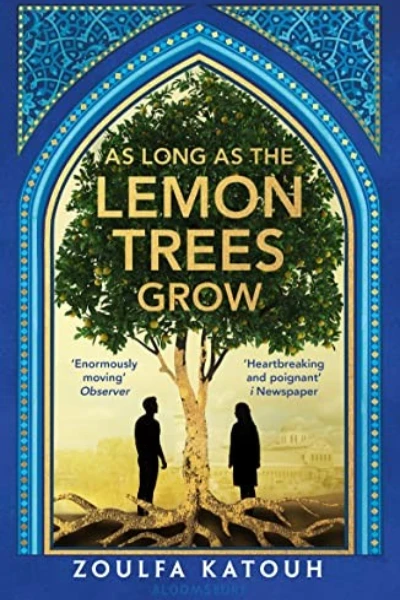
As Long as the Lemon Trees Grow
As Long as the Lemon Trees Grow — Chapter no 16
“WE’LL DEFINITELY NEED A CHANGE OF CLOTHES,” Layla exclaims, rushing through the corridor from the kitchen to the living room to my room and back again.
I’m sitting cross-legged on the couch, counting our money.
Two thousand and thirty dollars.
Five hundred will go to Am at the end of this month along with the gold necklace.
My mind whirs with plan after plan for how we’ll survive on foreign soil with so little. Will the man driving us to Munich also demand some sort of payment? Am said it was all inclusive, but you can never know what will happen beyond the sea. Greed is an illness and it won’t take pity on the weak and desperate.
It doesn’t matter. All that matters is that we get there.
I look up to see Layla standing breathless in front of me, her eyes shining with newfound excitement. Now there’s a clear goal in front of her.
Something solid to hang on to and invest all her energy in.
“We’ll pack two hoodies and three pairs of jeans. Is that enough?”
I nod, thinking. “Nothing heavy, though. Like blankets or something. It’ll weigh us down.”
She looks at me pointedly. “And it’s going to be March when we leave.
As in the weather will be freezing. You’re allowed one thing that keeps you warm.”
I sigh. “Fine. A coat, then. And we only get one outfit each to balance the weight!”
She pouts, throwing me a sad look. Layla was a fashion icon. She was a walking piece of art that could have been hung in the Louvre, radiating inspiration. And now she’s being forced to give up the identity she forged for
herself.
“We’ll buy more in Germany,” I reassure her, and her eyes light up. “New jeans, blouses. Everything. We’ll even have a moolid for Little Salama. A celebration for her.”
An astonished joyful smile lights up her face, but it quickly vanishes into guilt. “No, it’s fine. We don’t have to do… especially since Hamza—”
I shake my head. “It’s what he would have wanted. You and me
celebrating his daughter.”
I hold out my hand and she takes it.
“You’re my sister and I love you.” I squeeze it. “I want us to be happy for Little Salama.”
Her smile is gentle. “Happiness starts here, Salama. In this home. In Old Homs. Remember?”
I remember Kenan and the way he sat with me yesterday until my breathing was calm. I remember the longing creased in his eyes.
Longing for me.
I suddenly feel hot under my sweater and scramble for a distraction. “So what else do we need to take with us?”
Layla’s lips have turned into a knowing smile, but I stare at her defiantly, daring her to say what’s on her mind.
Then she lets it go and says, “Our passports and high school certificates.”
I nod. “Those are the essentials. Think, Layla, we’re on a boat at sea.
We’re cold so we have our coats. What else?”
“Panadol,” she says, and I feel my veins turn to ice. “If we get headaches or anything. You still have the stash, right?”
“Yeah,” I answer immediately, forcing my tone to be casual, and play with the hem of my sweater. Surely I can salvage one strip for Layla and me until we make it to the boat. Hopefully we won’t need more than that, and she won’t know why I had to trade our supply until we land in Italy. Then she can hate me all she wants. Look at me the same way I look at myself in the
mirror.
Murderer.
My stomach lurches and I stand quickly, startling Layla. I run to the bathroom, my sock-clad feet thumping on the carpeted floor, before I reach the sink and heave. My hands clutch the edges tightly, the blood disappearing from the capillaries as I vomit bile.
I haven’t eaten anything in two days save for a small piece of dry bread.
When I glance up at the bathroom mirror, I fight the urge not to cry out. The sour taste burns my throat. My eyes are bloodshot, my hair sticking to my sweaty forehead in clumps. Black shadows encircle my eyes. I’m deteriorating from guilt.
“Salama!” Layla’s voice cuts through the heavy air.
I cup my hands in the water bucket and splash my face.
“Salama,” Layla repeats, and she clutches my shoulder, spins me around.
I’m met with worried eyes and instantly put on my everything’s fine face.
Her grip is firm on me. “What the hell happened?”
I give a half-hearted shrug. “I think I ate something bad.”
Her eyes narrow. “You didn’t eat anything when you came back from the hospital.”
The sour taste is pungent in my mouth. “I ate at the hospital,” I manage to say in a convincing voice.
Before she can say anything else, I push past her and walk back to the living room, crumpling on the couch. Layla appears a second later, arms
folded and lips curled with suspension.
“Are you hiding something from me?”
I groan and reach down, picking up the hoodie and hugging it. It has a musty closet smell. “No, I’m not. Layla, I don’t have the energy to keep things from you.”
Calendula, I think, remembering the dried flower I taped into my scrapbook with my scribbled notes beside it. Bright orange petals. Used to heal burns and wounds. It has excellent antibacterial, antiviral, and anti- inflammatory properties.
Layla tuts but, when I peek at her, she looks concerned.
“I’m fine,” I whisper. “I promise.”
But I’m not fine.
Samar isn’t at the hospital when I arrive the next day, which means Am took her home during the night. My heart expands, glad it won’t squeeze painfully
at the sight of her heavily bandaged neck. Still, the shame is in my vessels, poisoning my blood.
A patient calls for me, complaining of a pain in his amputated leg, and I run to him, quickly clearing the troublesome thoughts away.
I work like I worked yesterday until my vision blurs, and when I stop running on fumes, I run on remorse. Today brings in a wave of victims from a military plane’s bombs that rained on a residential area south of Old Homs.
Just on the other side of where our home is. For now, for another day, Layla is safe.
The patients vary from civilians to a couple of the Free Syrian Army’s soldiers. With Nour’s help, I operate on one whose right arm is hanging on by just a few tendons. His whole face is twisted in pain but no whimper escapes his lips. Instead, through silent tears and a pool of blood, he sings
softly.
“How Sweet Is Freedom.”
Torn, bloodied muscle curls over the fractured humerus, the tendons pink and stretched like an elastic band. My stomach heaves but I swallow down the nausea. I hold up his arm carefully and when I look at Dr. Ziad, who’s operating on the laceration on the soldier’s thigh, he shakes his head. The patient has lost too much blood. Not even the manual transfusions would be enough, and it would take too much time and effort that could be spent saving another life. Not to mention the high risk of infection. Our hospital isn’t built on preserving limbs, but on preserving life.
The soldier suddenly stops singing and looks at me. “You’re going to cut it off, aren’t you?”
I nod slowly, my eyes aching with tears. His uniform is shredded, the green turning dark with blood. It leaks into the stitched revolution flag on his chest, coloring the white stripe red. He’s not that much older than I am, his dirty blond hair matted and his forest-green eyes glistening with tears. In another life, he wouldn’t live with death. The world would be his oyster and, starry-eyed, he’d venture out to find his place in it. He’d have read about wars and revolutions in schoolbooks, where they’d remain confined. Never a reality.
But even with this reality, his face betrays no hysteria. I presume it’s a combination of shock and the minimal dose of anesthesia we gave him.
“Do it,” he grits out.
His arm suddenly feels very real in my hands. Usually patients scream, begging us to save them. All they know is the pain.
“But—but how will you fight?” I ask.
He grins and nods to his left arm. “I still have another one, don’t I?”
This time the ache transforms into my own tears that slip down my cheeks. The soldier lays his head back on the hospital bed, casts his eyes to the ceiling, and goes back to singing.
His arm is sent with the rest of the casualties from today to be buried in the cemetery.
I lose track of time as I try to race against it and catch the souls before they rise from their bodies. Only when Dr. Ziad physically intervenes and confiscates my scalpel do I stop.
“Salama,” he says, eyes blazing. “Enough. Go home.”
My stare drops to my hands, which are sticky with dried blood.
The main atrium’s lights are dimmer, the moans of those in pain low, and doctors and families alike are sprawled against the walls and floors, catching their breath. The sun’s rays filtering through the windows give the colors a harsh hue. The red vicious, and the gray desolate. These are the shades seen when twilight takes over the world. I’ve never stayed this late before. During the day, the colors are electric, urging me to work faster before they slip from my fingers into nothing. The red is vibrant, carrying life, and the gray promises the fall of rain.
The atrium suddenly feels like a casket.
“Okay,” I choke out. “Okay.”
I clean my hands and grab my bag. Dr. Ziad gives me a reassuring nod. I stumble through the patients, dragging my feet, until I push the hospital doors wide open. Cool air washes me from head to toe and I take in a deep breath, begging it to launder away the residue of bile and blood from my mouth.
Daisies. Daisies. Daisies.
I’m standing on the brink of sunset, the honey-orange dye taking over the sky and the horizon above me deepening into a rich navy blue. A canvas for
the stars.
It looks… haunting.
Someone moves and my eyes snap down to see Kenan lying on the hospital’s steps, his camera atop his chest. His long legs stretch out in front of him and he glows under the twilight sky. The way stars shine in his eyes and
the small upturn of his lips make him look like something out of a story. For a minute, in the day’s tail end, he looks as if he’s dreaming aloud.
God, he’s beautiful.
I watch him for a while, remembering how near he was to me last night when he walked me home. I feel warm all over.
My hands coil tightly into the fabric of my lab coat, frustration about to cleave my heart into two. It’s during the quiet times that it raises its head, taunting me about my lost teenage years. We’re so young. Too young to be suffering like this. And I know I’m holding myself back from falling for him.
But his kindness is addictive, and I’ve found myself craving it, basking in the image he’s constructed of me. In the lie—a selfless girl who saves the wounded regardless of her own safety.
In that might life, with his ring glittering on my finger, we’d be going out for dinner on a Thursday night to a fancy restaurant where the street would be filled with laughing people and couples celebrating the end of winter, drinking warm tea. The shops would be open until late, the lights keeping the night at bay, flickering to yellow sunbursts on the century-aged stone walls.
We’d be lulled into our own world where everyone else’s conversations would be muted and the clock’s arrows would blur, defying the laws of time until he’d take me home. And under the flowering lemon trees outside my apartment building with the lunula moon as our witness, he’d cup my cheeks and kiss me.
Without meaning to, I let out a sigh and his chin snaps back down, eyes sparkling when they catch on my silhouette.
“Salama,” he says, his voice warm as a summer’s day.
“Kenan.” I relish his name. It leaves a sweet aftertaste on my tongue.
He jumps to his feet, stretching his arms overhead.
“Let’s go?” he asks, and I nod, trying not to look too eager.
He falls into step and I notice he’s wearing the same jacket he draped on my shoulders. My fingers tingle, wanting to run along the seam and the
collar.
“Did you—” I begin.
“How are—” he says.
He looks away, blushing, and I do the same. Is this a symptom of falling in love? Or a crush? I’m hyperaware of each breath he takes in and lets out.
“Sorry. You go first,” he murmurs.
I clutch the strap of my bag and take a deep breath. If this is an ailment, then there must be a cure. “I wanted to ask if you recorded today?”
He nods. “I got good footage. Two people I talked to are from Hama. It was good hearing stories about my mom’s hometown. About what’s happening there too. I’m thinking of compiling everything into a documentary and posting it on YouTube. Not too long, though. Just straight to the point.”
I give him a small smile. “That’s great.”
He scratches the back of his head and then says, “I, uh, also brought the money.”
I start. I didn’t see Am all day and I know he wouldn’t miss the chance at collecting his money. But his daughter is still in a critical condition, even if she can’t stay at the hospital.
“The man you were talking to yesterday. He’s the one who gets the boats, right?” Kenan asks.
I nod. “I don’t think he came in today.”
“Me neither. I walked through the whole hospital recording but he wasn’t anywhere.”
“I’m sure he’ll be there tomorrow.” And after a heartbeat, I add, “Do Lama and Yusuf know you’re not coming with them?”
A shadow falls on his face, and he grips his camera. “Yes. They… weren’t happy. Lama threw a fit and Yusuf… he went straight to bed and hasn’t even looked at me since.”
The sky is now an iris hue, and we begin to pass people walking in groups, all carrying handmade signs. A few have the Syrian Revolution flag draped over their necks. A nightly protest. I recognize one young woman I stitched up after she tried to escape from the guns at another demonstration.
She grins when she sees me and mouths a “hello” before hurrying after the others.
“Kenan,” I begin and feel the aura around him twist with apprehension.
“You can still come with us.”
Nervous energy evaporates off him and he lets go of the camera. It swings down, hitting his side. He averts his gaze, gluing it ahead. Is he too ashamed to tell me he wants to leave? I see the similarities between us so clearly. But as Layla is my weakness, his siblings are his.
“I can’t,” he whispers. “I won’t forgive myself.”
“And you think I will? This isn’t an easy choice, but it’s not wrong.”
He stops walking and stares at me for a few seconds before pulling out his phone. He opens it, presses the screen, and then holds it in front of me. It’s the comments section on a YouTube video. “Look at the comments, Salama.”
I squint. There are about fifty, all of them praying for Syria’s safety and liberation. A few users talk about how the channel has been covering what’s happening better than any news outlet.
“This is my video. My channel,” Kenan says. “I’m making a difference.
I’m adding English subtitles and explaining what’s going on so the world can know. Arabs know, but the rest of the world doesn’t. They don’t know it’s a revolution. They have no idea we’ve been living in a dictatorship for fifty years. The news shows the military killing people. They don’t know who the Free Syrian Army is. Who the military is. Syria is just a word to them. But to
us, she’s our life. I can’t leave her.”
My heart hammers painfully.
He puts his phone back in his pocket. “I talked to my uncle yesterday.
Once we know when the boat leaves, we’ll tell him, and he’ll come to Syracuse. He’ll pick up Lama and Yusuf.”
I don’t like this. I don’t like how he’s not including himself. “Kenan—”
“So there’s no need for them to go by car to Munich. My uncle will also help you, of course. I told him. He’ll make sure you and Layla are safe.”
“Kenan.”
He stops talking, stops walking, but there’s a wild desperation in his eyes.
Like he’s swallowing down the words and wants threatening to spill from his lips. He’s clinging to duty like a burning coal. I ignore the stab of remorse at having a hand in this and focus on how it could save him.
“The journey to Syracuse is long,” I say. “We’re going by boat. Do you understand that? It’s not a luxurious ship with a five-course meal. You’ve seen pictures of them on the internet. We all have. The boats are old and weak, and some… some don’t even make it. They’re overcrowded. Out there in the Mediterranean, there are no laws. Everyone’s mindset will be to survive regardless of who gets hurt in the process. And people will get hurt.
Lama and Yusuf are perfect candidates.”
His shoulders sag as if the world and all seven skies rest upon him. He’s tired and I don’t know him well enough to be sure if my nagging is doing more damage than good. So I decide to take a page out of Layla’s book.
Remind him of the happiness. Or at least of the past, so he knows this pain isn’t eternal.
“I remember your mother,” I say, making my voice gentle, and he looks at me with surprise. He stands in front of a building charred black from a fire. I have to tilt my chin up to look him in the eyes. Those beautiful, hurting eyes of his.
I silently scold myself. I can’t think of him like this. He might be holding on to a burning coal but he has no intention of letting go. He’s been holding on to it ever since he was born. In a month’s time, I’ll be sailing away and he’ll be stuck onshore, growing more distant by the second. He’ll be a daydream I visit when I’m alone in Germany, mourning the loss of my might life and obsessively checking his YouTube account for any updates, wondering if he’s still alive and free.
I grip the loose end of my hijab and squeeze with frustration. This isn’t fair.
“She was at my brother and Layla’s wedding,” I continue. “I remember seeing her. You—you have her eyes.”
Those same eyes soften, and he takes a step closer.
“You know, my mom told me about you that night.”
My stomach flips.
He laughs lightly, all traces of agony disappearing. How we can skip from one emotion to the other like a well-coordinated dance, I’ll never know.
“Yeah, she came back home talking about this girl who’s a bubble of life.
Whose confidence and joy infected everyone around her.”
Heat envelops me whole.
I miss that girl.
“She was absolutely determined to have us meet.” He runs a hand through his hair, and it gets messier. “Said you and I were like two peas in a pod. I was curious, but your mama wanted you to focus on your studies before we met. Honestly, I thought you’d be more stuck-up.”
I splutter and he grins. “Excuse me?”
He laughs again and it sounds heavenly, full of life. Not like Khawf’s laugh.
“Sorry. I judged you by your appearance. Freshman at pharmacy school, a good family name, a brother who’s a doctor, the only daughter, the youngest in your family. I mean, all the factors pointed toward it. I didn’t think
someone like me would meet your standards.”
I blink.
He cracks his knuckles, looking guilty. “I was wrong, obviously.” He gives me a shy smile. “I’m sorry.”
“How do you know I didn’t become less stuck-up after everything that happened to me?” I ask, needing to know the answer but worried just the same.
He shakes his head. “I don’t think so. You’ve always been this way, I’m sure. I was feeling awkward about being set up, so I kept making silly excuses like that.”
“For the record,” I say, not believing the words I’m about to utter, “I would have thought I wouldn’t meet your standards.”
He tilts his head to the side, puzzled.
“The eldest child, all the responsibility on your shoulders. And instead of taking the safe route of studying medicine, which you could have, you followed your heart and studied what you love. Even after everything you’ve been through, there’s light in your eyes. You still laugh. So I can only imagine how you were before. I’d have felt self-conscious about how free- spirited you are. How you see the world in all its colors and shades of beauty.
I’d have worried I couldn’t keep up.” I stop talking because the way he’s staring at me is making butterflies flap their wings in my stomach.
“Well,” he says after a while. “Our fears had no basis, then.”
“I—I guess so,” I whisper and shudder in a breath. “It’s… it’s a shame, Kenan.”
“What is?” His voice is hushed, and I know he knows what I’m about to say.
“That we never had the chance to find out if we’re each other’s Pazu and Sheeta.”
When he doesn’t say anything, I step so close I can count the freckles on his neck. His breath hitches in his throat and his gaze drops to my lips.
“I wish we had that time,” I whisper. “I really do. I wish—”
I stop.
He glances at my lips and reads the words I’m too shy to speak.
I wish you’d come with me.
I wish we could fall in love.