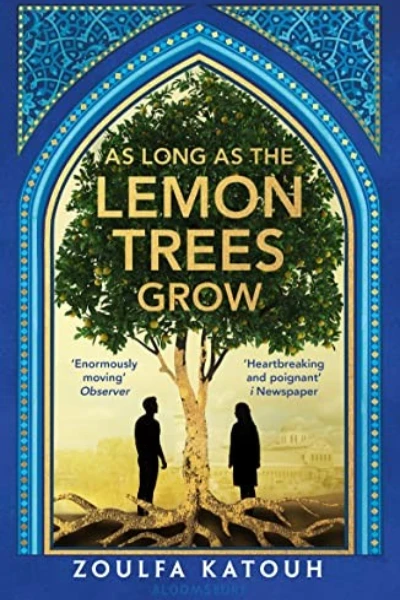
As Long as the Lemon Trees Grow
As Long as the Lemon Trees Grow — Chapter no 5
“WHAT ARE YOU GOING TO DO?” KHAWF ASKS FROM the dark corner, and I jump
and press a hand to my heart.
“What?”
He steps out, the shadows melting off him, eyes glinting. “What are you
doing about Am?”
“I don’t know.”
“That means you’ll do nothing.”
“It means I don’t know.” I swallow down my anxiety. “Leave me alone.”
He chews his cheek, examining me from head to toe, and I press my legs to my chest in an effort to become smaller.
“I did what you wanted,” I say. “I asked Am. Is it my fault that the price is so high?”
He doesn’t answer me, simply takes out a cigarette and tucks it between his lips. His smoking mannerisms remind me of my grandfather. When asked a question, Jedo—may his soul rest in peace—wouldn’t answer until he took that drag of smoke. But Jedo had a gentle smile and such a proud way of looking at me, and there’s nothing like that about Khawf. Nothing.
“No, it’s not. But it seems like you’ve given up. Didn’t you tell Layla
you’ll haggle with him?”
I shrug.
His eyes bore into mine. “While your apparent enthusiasm is admirable,” he sneers, “it’s not enough. You need to get that boat.”
“I’m at my limit here. What do you want, Khawf?” I say wearily.
A plume of silver smoke obscures him from my view.
“Why, your safety, of course.” He grins. “Don’t you believe I’m some
sort of a defense mechanism?”
I manage a pathetic snort.
He stands in front of me and I instinctively jerk back. “Salama, you should know better by now. Unlike you, I don’t tire, I don’t feel pain, and I won’t stop until I get what I want. Fighting me, fighting your mind”—he twirls his fingers and my pulse races as pitch darkness envelops us until nothing is visible but his icy-blue eyes and the flash of his white teeth—“you won’t win.”
I can’t see anything. Can’t hear the faint voices of the protests outside.
Nothing exists but Khawf and me in this black hole. He extends his hand to my chin and I flinch, but he doesn’t touch me. Yet his power over me is so great that I look up, shivering and frozen in place.
“I am infinite, and you are not,” he whispers. He trails a finger I don’t feel along the hollow of my throat, but my teeth still chatter as if I can sense the blade of his fingernail. “Find a way to get that boat.”
The morning sun bleeds over my shivering body. I get dressed, trying to ignore the weight of Khawf’s presence on my life. My stomach rumbles with hunger; my limbs ache. But none of my pain matters as long as I can save lives today. If I can make up for my shortcomings. For all the lives that I couldn’t save yesterday.
The year I spent in pharmacy school didn’t prepare me for any of this.
Even if I had graduated, it wouldn’t have made a difference. I was never supposed to do the work I do now. My first-year classes were mostly theoretical, and my lab courses were about mixing simple formulations, laying the foundation to build on in the coming years.
My first day at the hospital was akin to being dropped with no swimming lessons into the deep end. I taught myself how to swim, to kick my legs and stay afloat before the heavy weight of the waves dragged me down.
At noon, catastrophe strikes in the form of shrapnel raining on a nearby elementary school. On children.
When they are wheeled in, the world slows down. My legs are rooted in the sticky blood staining my sneakers. I’m standing in the middle of the carnage, watching the moments between life and death unfold in front of me.
My eyes catch every tear falling and every soul rising to meet its Creator.
I see a child crying for his mother, who is nowhere to be seen.
I see a tight-lipped boy no older than ten, face as white as a sheet, with a large slice of metal stuck in his right arm. He grimaces in pain but doesn’t let out a sound, not wanting to scare his little sister, who’s holding his other hand and crying te’eburnee.
I see doctors, the last few in Homs, shaking their heads at small, limp, frail bodies and moving to the next.
I see little girls with legs twisted into unnatural positions. Their eyes carry the full meaning of what’s about to happen. Amputation.
I wish we were being broadcast live on every channel and smartphone in the world so everyone could see what they’re allowing to happen to children.
A little boy starts singing with glazed eyes, staring into the ceiling. He’s shirtless, and his black hair is thin. His chest heaves with each breath; he’s struggling to fill his lungs. I can see his ribs, count each one of them. He sings one of the many freedom songs made by the rebels. His young voice is quiet but strong. It carries over the chaos and embeds itself within the hospital walls. If these walls could speak, imagine what they would say. I walk toward him in a trance, guided only by the tune of his singing. There’s no one beside him. Neither his legs nor his arms are severed. There’s no blood coming out of his mouth or dripping from his head. He’s not a priority.
And yet… I clasp his hands in mine. They’re as cold as ice. His little coat must be back at the school, buried under the rubble.
“Are you hurt?” I ask through silent tears.
He doesn’t stop singing, but his voice is lower. I check his pulse; it’s slow and unnatural. I don’t see any wounds.
“Are you hurt?” I ask again, urgently. At this rate, his heart will stop.
He turns toward me. “My name is Ahmad. I’m six years old. Can you help me find my mama?” he says quietly. His eyes, deep blue, are sunk so far into his skull, I’m scared they’ll vanish.
He’s in shock. I take off my lab coat, put it around him. I warm his hands in mine and kiss them.
“Yes, habibi. I will find your mama. Can you tell me if you’re in pain?”
“I feel funny.”
“Where?”
“My head. I feel… sleepy”—he coughs roughly—“and my chest… I don’t
know.”
Internal bleeding.
I yell for Dr. Ziad. The doctor hurries to my side and checks Ahmad’s pulse. Ahmad tells him he’s thirsty while Dr. Ziad inspects his head. Extreme thirst can only mean one thing. With a deep sigh, he shakes his head.
“What does that mean?” I demand. “Are you giving up on him?”
“Salama, we don’t have a neurosurgeon. No one here knows how to operate on internal bleeding in the brain.” His tone is grave, full of regret.
“What? So, we’re just going to let him…?” I hiss but can’t get the horrible word out. I don’t want Ahmad to hear it.
Dr. Ziad wipes back Ahmad’s hair from his forehead. There are droplets of sweat coating it. I swallow the bile in my throat.
“Are you in pain, son?” he asks.
Ahmad shakes his head.
“Adrenaline and shock. He doesn’t need morphine. We can’t do anything except make his last moments better.”
“I’m going to do a blood transfusion.” I turn around to where we stack the equipment. As an O-negative, I’m a universal donor. We have a manual device Dr. Ziad made to donate blood to the patients because the transfusion machines don’t always work. Not with the electricity shortage. “I can give him my blood. I’ll give him—”
“It won’t help,” he says in a pained tone.
“Dr. Ziad—” He holds up a hand, interrupting me.
“Salama, it won’t. If I could give my life so this boy would be safe and well and healthy, I would. But I can’t. I can’t help him. But I can help the little girl whose intestines are all over the floor. We can’t save everyone.”
He leaves before I can yell.
“Auntie—” Ahmad begins softly, stopping to gasp for breath.
“Yes, habibi?” I turn around and clasp his hands back into mine. If you live, I’ll take care of you, I vow. Just live. Please. Just live.
“Am I going to die?” he asks, and I see no fear. Do all six-year-olds know what death is? Or is it only children of war? My hands shake.
“Are you scared of death?” I reply instead.
“I—” He coughs, and a hint of red drips from his lips. My God. “I don’t know. Baba’s dead. Mama said he’s in Heaven. Will I go to Heaven too?”
I shudder in a breath. “Yes, you will. You’ll see your baba there.”
He smiles gently.
“Alhamdulillah,” he whispers. “What can I do in Heaven, Auntie?”
How can a child have so much composure in the face of death?
I swallow my tears, drowning inwardly. “You will play all day. There are games and food and candy and toys and everything you could ever want.”
“Can I talk to God too?”
I’m taken aback by his question. “Of… of course you can, ya omri.”
“Good.”
We sit silently for a few minutes, and I listen as his lungs struggle.
Already his eyes are losing focus, his breaths becoming shallower by the second.
I pray for his soul and recite Quran verses in a whisper.
“Auntie—don’t cry—when I go to Heaven—I’ll tell God—everything,” he chokes out. I look up, and his face has gone still. His eyes are glassy, and it looks like little stars are caught in his blue irises.