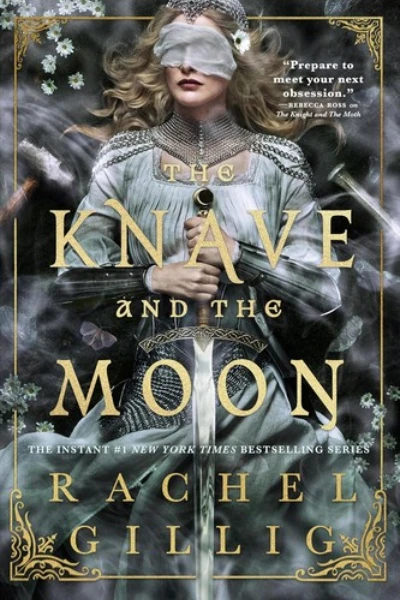
The Knave and the Moon
The Knave and the Moon — Chapter no 6
CHAPTER SIX
THE ONLY GOD OF MEN IS COIN
When I looked up, the ceiling was rippling. There were sweeping arches, stone buttresses, and when the moonlight dared to show itself, it was only through rose windows and thousands of pieces of stained glass therein.
I lay on my back upon the chancel, staring up at the reaching, rippling
ceiling of Aisling Cathedral.
And I was not alone.
A figure paced above me, winking in and out of my periphery. She wore a long, pale dress. Gloves over her hands. A shroud as long as a veil.
The abbess.
“Wrap your fingers around their legs,” she said, her voice, hard and chill, echoing through the cathedral. “Hold them down. Do not mind the bubbles that flee from their mouths or the water that laps over the lip of the spring. I will press them until they drown. After, bring them out, and always softly, for that is when people will see how you handle them. Lay them gently upon the chancel and let them dream. When they wake, sick and afraid, hold them; pet them if they cry. If they are frightened of the folk in the courtyard or if anyone tries to look beneath their shrouds, be generous with your violence. They must know to fear you, and also rely upon you.”
The abbess’s voice sharpened. “Wear the guise of noble protector, and
even as you drown them, they will believe you are keeping them safe. Now, gather the Div—Godsdamnit, are you even listening?”
A second voice came from out in the cathedral. Low, craggy, a little contemptuous. “Not really.” When a creature ambled into view, it was a batlike gargoyle.
When I called out to him, my voice was a creaking hinge.
“Bartholomew.”
He made no indication of hearing me. He’d picked several gowan flowers from outside and was attempting to fashion a crown, but his stone fingers were too blunt. The flowers were in tatters. “Let the others listen to your odes, your time as old a tale,” he murmured, never gifting the abbess his gaze. “I’ve heard it too often.”
The abbess banished him with a cold word, and the others, who must have been gargoyles too by the heavy toll of their footfalls, went with him.
She remained as she was, lingering in my periphery, haloed by the stained- glass windows. Slowly, she reached up. Caught the hem of her veil. Pulled it back. Her face, her eyes, were hewn entirely of stone.
She turned it to me.
The abbess bent over my body, getting on her hands and knees. Her nostrils flared and she sucked air into them, her lips parting in a long, desirous groan. Then she shut her eyes, opened her mouth— And bit me.
Blood pooled over my stomach, and the abbess lapped it up into her mouth with her hard stone tongue. I tried to stop her—tried to writhe and wiggle free—but I was immovable, too heavy to budge.
“Please,” I rasped. “Stop.”
Like Bartholomew, she did not hear. The abbess kept consuming me, rubbing her mouth and nose in the wellspring of my blood. Her breath came in quick pants; the throes of some sick ecstasy. Only when she was sated, her stomach bloated, did she raise her head. Her mouth was wet. There was no thick copper scent upon her, no red.
There was only water, and the sweet, fetid rot I knew so well in Aisling Cathedral.
Light flashed above my eyes. “Pith, she’s flailing again.”
“She’s lost too much blood, sire,” someone croaked. “The wound requires surgery. More ox-eye—quickly!”
My eyes snapped open. Aisling Cathedral and the abbess were gone. I was in the Artful Brigand’s room once more, looking up through my wedding veil, an aged man leaning over me. Benji was there, too, his face stricken.
I was on a cot, and they were trying to wrestle the spear out of me. I screamed. Thrashed. More ox-eye was thrust into my mouth, and I choked, making horrible sounds, every one of my muscles clenching, every limb quaking.
“If I could speak to her…” I heard the king say, his voice uneven.
Given his small, sharp tools, the old man was a surgeon. “Now’s not the time for conversation, sire. Your queen is dying.”
Benji drew in a breath. “Sprites,” he declared. “Sprites did this.” A moment later, he was gone.
Two women assisted the surgeon, and they put a strap of leather between my teeth. “Bite down,” one told me, trying to smile. “It’ll help.”
When they pulled the spear out of me, my teeth punctured the leather.
“Ready the linen,” the surgeon said, his tools clinking. “Sop up as much blood as you can.”
“It’s her womb,” the second woman murmured. “A fatal blow.”
“Linen,” the surgeon barked. “Now.”
I bit down and kept my eyes shut. There was another sharp pain—too many hands pressing into me—then the women let out a collective gasp.
The surgeon swore and dropped his tools.
“Inhuman,” the first woman whispered.
“How?” the other asked.
I opened my eyes, pain smearing black spots over my vision. “What is it?”
When the surgeon managed to speak, his voice was slow. Awestruck.
“Your organs, Diviner. They’re coated in limestone.”
Consciousness came and went. My wound was cauterized, the horrible scents of old blood and burning flesh sitting in my nostrils. The surgeon and
the two women were always there, startling whenever I’d jerk awake, as if they expected me to remain fixed in sleep. Poultices and bandages were applied, and more ox-eye was administered.
It gave me the strangest dreams. Of Aisling Cathedral. Of the tor.
Sometime later—days, perhaps—someone was poking my arm. “Hey.
You awake?”
When I opened my eyes, my veil was off. Candlelight—and a blue gaze behind it—bore down on me. I jolted up. My ankles, my wrists were tethered. Still I managed to knock the iron candlestick from my visitor’s hand.
It hit the king along his shoulder, snuffing its flames on his fine doublet, then clanged unceremoniously to the floor, casting us in darkness.
Benji hissed. “Pith, Sybil—stop trying to maim me.” He put a hand to his hip, sucking air between his teeth. “It’s not a pleasant sensation.”
“You’re drunk.”
He hiccupped. “Not at all.”
“You never call me Sybil.”
“Don’t I? Perhaps I feel I know Six better.” There were bruises on his face. A party of shallow cuts along his cheek. Besides that, the king seemed entirely untouched by my second attempt on his life. “The surgeon has been touting your miraculous recovery all over the castle. Praising the Omens for the stone in your body.” His eyes drifted over my abdomen, hidden beneath a pale flaxen shift. “You need spring water, I gather. Does it… hurt? Slowly
turning into stone?”
“Go to hell, Benji. I’m fine.”
“Yes, of course.” Moonlight caught his silhouette. The king looked around, as if the walls could hear him, then folded his hands in front of him and proceeded to stare at me. Slowly, a grin crept over his mouth.
How I longed to slap it off. “What?”
“Nothing. It’s just…” His grin widened. “Gods, Six. What a performance.”
He began to laugh, waving his arms emphatically and pitching his voice in a low, static rasp. “‘Take heed: History may be hewn of stone, but the future grows in its cracks. Not all that are lost are gone. A heretic can defend faith. The lowest creature can still reach the highest peak, and even death bears its flowers. A martyr might yet defeat a tyrant, but none shall
overthrow a god without becoming one themselves.’”
He put an emphatic hand on his chest. “I said that! Just the other night.
Well, I told you you’d conquered coin and knowledge and love and all that bullshit, and that it would make a god of you, remember? Well, of course you do.” His laughter made him wobble. “And here I thought you’d be such a beast to deal with. But with one portent, one rogue spear to the gut—and let me reiterate, a truly outstanding performance—not a single person will be talking about that creaky old cathedral. They’ll be talking about you.”
The king raised an invisible glass to toast me. “Great show. How did you come up with all that tripe?”
“I didn’t come up with it, you witless wonder. I didn’t even say it.”
“Of course you didn’t.” Benji winked. “The Omens did.”
There was an empty cup on a chair near my cot. I threw it, agony ripping through the jagged line of my wound. It hit Benji’s chin, making him howl.
“You’re not listening,” I snapped. “That voice, those words… It wasn’t me.”
Benji went still but for his eyes, which darted over the four corners of my face. “You’re saying someone spoke through you?”
“You don’t believe me?”
“You hate me,” he said plainly. “Wouldn’t be prudent to trust you, would it?”
“Choke on prudence, boy-king. I’m not a liar.”
Benji remained frozen, his breath uneven. Then, like a book slammed shut, he banished his unease and chuckled. “I don’t know what kind of trick you’re trying to play, Six, making me look for gods and signs that aren’t there. Old habits die hard, I suppose. I assure you, it won’t work.”
“The performer, assuming everything is a performance.” My spit was thick. “What about the rest of the ceremony? Why did the sprites—”
“Attack?” The king was wearing a toying smile, like it tickled him, watching me try to keep up. “Another outstanding spectacle, wasn’t it?”
And I remembered. The open page of his grandfather’s notebook. The tree sprite, most often seen in the glens near Coulson Faire, is thought to be the smallest variety of sprite in the land of Traum, with a diet consisting almost entirely of beech leaves.
We were up all night stripping the glen of beech boughs, Regius Ormsby had said.
“It was your doing?” My voice lodged in my throat. “Why?”
“You know, it is impolite to treat me like the child when I am ever explaining to you how things work, Six. I’d like a little credit—I’ve been thinking long and hard about what needed to happen after Aisling fell. And now the cathedral has crumbled—you saw how folk took it at the wedding, gasping and wailing and whining. They need to be sated, and ever, they need something to believe in. So I give them a tourney, I give them stone objects, the last Diviner—and I give them a common enemy.”
“You cannot blame sprites for things we have done.”
“Why not? I can’t see who it hurts.”
“It hurts sprites, you unimaginable prick.”
He waved a hand in my face like I was a nagging mosquito. “I haven’t forgotten how readily the knighthood stoned a heretic like my grandfather.
It was just as easy for you and Maude and Rory to kill the Omens. Do not be so naive as to think that hatred isn’t as potent a flame as faith, and make no mistake: Everyone hates sprites. It may be the only thing the hamlets have in common.”
The king’s gaze went out of focus. “Would that Maude were here. The might behind her name, her axe, her great legacy…”
“Maude would never do what you’ve done.”
“Wouldn’t she?” Benji’s cheeks went red. “I could commit violence every day for the rest of my life and it would be nothing to the mountain of carnage the Bauer women have perpetrated. You realize it was Maude’s ancestors who started this conflict with the sprites in the first place, don’t you? They hunted down Der ewige Mond. Killed it. The sprites of Traum retaliated, and there has been bloodshed in the hamlets ever since. It was the Bauers who crafted a common enemy for us all. The Bauers who committed the strife the abbess sought to amend by creating the Omens, Diviners, the cathedral.” Blue eyes boring into me, voice hot and righteous, he said, “There is no such thing as an unmarred paragon, Six. All of us do the wrong thing for the right reason. Even you. Or have you already absolved yourself from the multiple attempts on my life?”
Torrid breaths raked in and out of my lungs, stoking an inferno. Benji’s brow unfurled, his own indignation slipping away. “No matter. I do not need Maude to rally folk behind me any longer. I’ve made my own assurances. I’m only sorry we never finished the ceremony. But you can’t
count on witless creatures like sprites to be punctual.”
It was the only thing he’d said so far that did not make me ill. “We’re not officially wed, then.”
“The illusion is enough for now.” He picked my crown, my veil, off the floor. “Now, come along. Regius Ormsby, that gossipmonger, has called a meeting. The fool is trying to cancel my event in Coulson Faire on account of your unfortunate incident.” His eyes fell once more to my abdomen. “I’d like you to show him you are alive and well, that we might move on with the extensive arrangements.”
When all I did was stare, Benji rolled his eyes, as if I’d affronted him with my lack of worldly knowledge. “I suppose the abbess didn’t let you out to attend any tourneys, did she?”
No. But I’d heard clamors on the wind from Coulson Faire every summer. After, champions would often stumble to the tor, toss their winnings at a gargoyle, and demand a Divination. What was a tournament to me? All I ever took from one was but another hand, pressing me down into water until I drowned.
“They take planning. Wares are sold, bets are made, ale is drunk, whores are paid—” He waved his hand in my face. “Not to mention a delightful show of violence. Only these events are different. I told you—I aim to give the people something to believe in with those damn stone objects. And with Dedrick with the inkwell, Hamelin with the oar, Samuel with the chime, and Tory with the loom stone, and me with the coin—” He grinned. “I will.”
My gaze jerked to his face. “All of you will be competing?”
“Of course. We’ll be the champions of our hamlets.” The king raised his brows. “Now, will you come with me willingly, or will I have to call Hamelin to—”
I struggled to my feet. Snatched my veil, my crown, from his hand and
put them on.
Benji stepped back, mouth open.
“I want to hear more about the tournament.”
He was looking at me like he had earlier, like he didn’t understand my aim—like it was me trying to put a shroud over his eyes—but his hunger for compliance outbid his hesitation. Benji reached into his doublet pocket and withdrew the Artful Brigand’s coin. “Best if we don’t elaborate on your
wound or the stone in your body,” he said. “While we’re at it, let’s not mention the tor or the spring water or, well, any of it. We don’t want people thinking there’s an easy way back from death. It might… you know. Lessen your impact.”
Life after death was a cruel fate—I wouldn’t wish it on anyone. But it was like breathing in smoke, agreeing with Benji. My entire body rejected
it.
I managed a curt nod.
“Lovely.” Benji reached out, took my elbow.
The coin flew.
A terrible rush caught me in the stomach, and the king and I catapulted through the Artful Brigand’s chamber, then its door. He caught the coin in the dark corridor beyond, then tossed it again, this time downward, and we fell through the floors of Castle Luricht like I’d once fallen through dreams.
When Benji caught the coin for the last time, it was upon a flight of stairs. A landing, fixed before a tall mahogany door I recognized—the same place I’d been dressed for the wedding, where the painting Der ewige Mond resided.
A guard stood before the door. When my feet slammed onto woolen carpet, pain shot through my stomach. I bent over, barked out a nauseous
cough.
And was sick on the landing.
“Oh.” Benji chuckled. “I should have seen that coming. Guard—fetch the Diviner a cup of ox-eye.” He tendered me an imploring glance. “Please don’t throw it at me this time.”
The guard, who was gaping down at my vomit and barely seemed to see me at all, left in a hurry. Benji offered no handkerchief for the bile on my chin. The king merely took a flask from his belt, swallowed what smelled like wine, then, with the affect of a naughty child, put his ear to the mahogany door.
Voices sounded in the room beyond. “An odd pairing, if you ask me,” someone said. “He, the grandson of a heretic, who incurred five bad portents in his Divination, suddenly earns favor from both the abbess and the last Diviner? Magical stone objects and a marriage contract?”
A man cleared his throat. Hamelin. “That’s not the issue at hand, Regius.
We’re discussing the tournament.”
“Or if there should be one at all,” Regius bit back. “Now that she’s mortally wounded.”
“We don’t know that. There’s been no confirmation.”
“I was planning on hosting the joust. Though in a way, I already have.”
There was a high, tea-kettle laugh. “She was struck with a lance, after all, was she not?”
“It was a spear, idiot,” said a woman—Tory.
Benji reached down for the latch. “Now’s a good time.”
He opened the door, revealing five figures around a table. Hamelin, Tory, Dedrick, Samuel—surrounding their stone objects—and Regius Ormsby, whose mouth had not yet caught up to his gaze. He was smiling, but his eyes were wide in unmitigated surprise.
Benji held out his hands in greeting. “Thank you for waiting, my friends.
Shall we discuss the tournament?”
No matter his crown or his coin, he was young among them. An adolescent, yearning to overcome those who childminded him. But then I stepped into the room, and when I stood behind him, Benedict Castor was more than a boy. I felt it in the air—the prominence I granted him. He squared his shoulders, his chest wider as he watched his knights study me.
Hamelin and Dedrick made no attempt to hide that they were searching for my injury, their gazes predatory as they scanned my body. Tory and Samuel were less easy to read, equally gripped by the sight of me, but unwilling to look for longer than a few seconds.
Regius was still arrested by surprise. “Forgive me, Diviner. I understood you’d been horribly incapacitated.”
“In the joust, yes, I heard.” It pained me, but I stood straighter. “Do I
look incapacitated to you?”
He blanched.
But then a jolt of agony cut into my abdomen and I faltered. Benji moved faster than I thought him capable to pull out a chair. He guided me into it. A moment later the guard was back, dropping a cup in front of me. I drained it in one bitter swallow, waiting for the ox-eye to dull the pain.
The king addressed the table once more.
“Now that we are all here, and you see with your own eyes that the Diviner is unharmed, I must impress upon you the importance of this tournament, and what I will require from each of you and your families in
the hamlets.”
Benji spoke and barely seemed to draw breath, running his fingers over his coin, looking past everyone at the table as if he were peering into his own promising future. Accommodations were named—feasts and fetes would be held, purple banners flown. A three-copper fee would be imposed upon all attendees, and ten gold coins for anyone who deigned to participate. Tournament winners would be given heralding sashes and named champions and granted an audience with me that they might peer into my eyes: a Divination. After, they would be afforded the opportunity to follow from hamlet to hamlet as an honorary guest of the knighthood. Five tourney events, five extravagant ceremonies in the king’s honor; it seemed Benji was meticulously rewriting the discomfiture he’d endured the last time he’d visited the hamlets.
It was going to cost a great deal of money.
Benji was nodding to himself and swaying, moved by the sounds of his own designs. “Firstly, of course, I will send your stone objects ahead of us, placing them in the firm hands of your noble families. Tokens of my good faith and an assurance that all is well with the Diviner.”
Hamelin made a noise of complaint, but the king levied a hand. “You will see. Let the objects remain out of sight for a time, then bring them out to full effect in the arena. Their scarcity shall make them more sacred, their distance shall keep them divine, for only the privileged can access them by attending my tournament, thusly making the master of the object the most potent of rulers, and the tournament itself the most prosperous of markets.”
My stomach twisted. It was exactly what his grandfather had written in his notebook about the abuses of Aisling Cathedral.
“You will harness your objects, win your events, become my champions,” Benji told his knights. “Faith, inspired in the arena. All the proceeds will return to your families, all the coin they spent in my honor handed back to them with interest and thanks, but first”—the king’s blue eyes darted across the table—“they will get on their knees as you did when I gave you those objects, and swear unmitigated fealty to me.”
The room went silent.
“Come now.” Benji peered around the table. “Did I not pay a great sum just a few weeks ago for your mother’s death ceremony after she was killed by a birke, Samuel? Did I not gift your mother that castle in the Peaks and
all the gold therein, Hamelin? How are all those newly acquired books in your uncle’s library?” he asked Dedrick. “Is your mother enjoying her new stores of gold, Tory?”
And there it was. Every Omen we’d encountered we’d stripped of power —and power was not simply magical stone objects. Power, especially to a man of Coulson Faire, began and ended with coin. It was a knightly vow to reject pecuniary reward. But every rule had its exceptions; the knights looked down at the stone objects they’d been gifted. One by one, they nodded.
Benji pressed the Artful Brigand’s coin to his chest like it was his own beating heart. “Good.” He turned to Regius. “We will continue with plans for the joust. Dedrick?”
The knight ran his fingers over the Harried Scribe’s inkwell. “The melee
for the Seacht.”
“Very good. Hamelin?”
“What else?” Hamelin flashed a grin. “Feats of strength for the Fervent Peaks.”
“We of the Chiming Wood shall host the hunt,” said Samuel.
Benji raised his brows at Tory. “And for the finale in the Cliffs of Bellidine?”
The lines in Tory’s face tightened. “My mother will not like a show of violence in her hamlet.”
“Your mother’s wants are superfluous.” Benji flopped his wrist at her.
“She shall host the duel. The tournament will commence, you and your stone objects will win, and your families will bow prostrate to me and the Diviner in front of the hamlets. Now, the first event will begin as planned,
on the third…”
I didn’t hear the rest.
The room was wobbling, remnants of ox-eye burning my tongue. When I shut my eyes, colors danced behind my eyelids. Gray. Violet. An incomparable shade of blue. I was looking up at the night sky again. At a full, pale moon.
But then shadows came—five of them, all blocking out the moon. First a merchant with gold rings on his fingers and a stone coin in his hand. Next was a scribe in a gray robe with no hair upon his head. He bore a stone inkwell full of black ink. The next was a tall man in leathers—an oarsman
with a stone oar, followed by a forester with an axe on her belt and long black hair. She bore a stone chime.
Finally, a woman in a dyed woolen knit stepped forward. Around her neck was a piece of twine, and attached to it—a loom stone. She joined the others, and they spread around my body like the five points of a star, peering down at me through pale limestone eyes.
The Omens.
They were covered in blood.
All five lowered themselves to their hands and knees, put their mouths to my body, and sank their teeth into my flesh.
A voice tore from my throat. “This,” it said, I said, “is Traum’s oldest tale. Folk of the hamlets gathered around my body, held together not by craftmanship, but by hunger for power. How grotesque history is, always repeating itself, the past itself a terrible portent.”
And then I was back, staring down at the dregs of ox-eye in my cup.
Around me, mouths had fallen agape, eyes had widened, and cheeks had gone pale. For a moment I couldn’t tell if I was seeing the Omens or the knights who sat with me at the table.
Regius Ormsby was the first to speak. He kept his hands knotted, but his ringing bracelets gave him away—he was trembling. “A Divination, Your
Majesty?”
No. Yes. I didn’t know.
Ox-eye. That vile draft. It addled my thoughts the way dreaming in Aisling’s spring once did. It was either ripping away my sanity— Or something, someone, was speaking to me through it. Wittingly toying with my mind the way the abbess once had, building upon the story that I’d lost everything to dismantle. Whoever it was, I’d root them out as I’d rooted out the Omens.
And if the king wanted a tournament? A second chance to impress his power upon the hamlets? To inspire faith with his stone objects in the arena? Let him have his spectacle and trade influence and affluence with knights like the abbess had once traded the blood of Diviners with the Omens—I’d get my second chance, too.
I looked out on the table and saw it—a way to end the story. Power couldn’t go anywhere if it shattered. I’d done it to the Omens, the cathedral, and I’d do it now to Aisling’s final vestiges; all five stone objects,
destroyed. It didn’t matter if the king touted their sacrality with scarcity and sent them away into the hamlets—they’d be in the hands of his precious knights during the tournament.
So into the tournament I would go, and face my adversaries one by one.
Coin, inkwell, oar, chime, loom stone— I blinked. No, not five. What had Hamelin said the night before the wedding?
The only way to reach the Omens now is to look into your stone eyes.
Benji had said the night Aisling fell that he’d make a god of me, but I was no god. I, reduced once more to a number, was but the king’s sixth magical object. Coin, inkwell, oar, chime, loom stone—and me.
I’d rid him of all of them.
Then, when Benji was bereft, I’d finish what I’d twice failed at: I’d kill the king of Traum and let the Stonewater Kingdom know what I knew— there was nothing to believe in. Not coin or inkwell, oar or chime, not loom stone, not knights or nobles, not Benedict Castor the Third—and not me.
Let it finally end.
The others at the table were still watching me. “A terrible thing,” I told them slowly, “the loss of Aisling Cathedral.”
They waited in the stillness of my pause, startled, as if accustomed to hearing a Diviner speak only after the grotesque sounds of her drowning had faded. “I would prove to the Stonewater Kingdom that though the cathedral lies in ruins, I, the last Diviner, still stand.”
The king folded his arms over his chest, suspicion thinning his voice.
“And how do you wish to demonstrate that, Six?”
“With armor and chainmail and a hammer.” I stood from my chair, shaking and slick with sweat, peering down my nose at everyone seated.
When my gaze reached Benji, apprehension flashed across his face. “Faith, after all,” I told him, “requires a display.”
Ox-eye festered on my tongue. I slicked my teeth with it and smiled, one by one, at the knights and their stone objects. “I’ll be joining each of you in the tournament.”
OceanofPDF.com