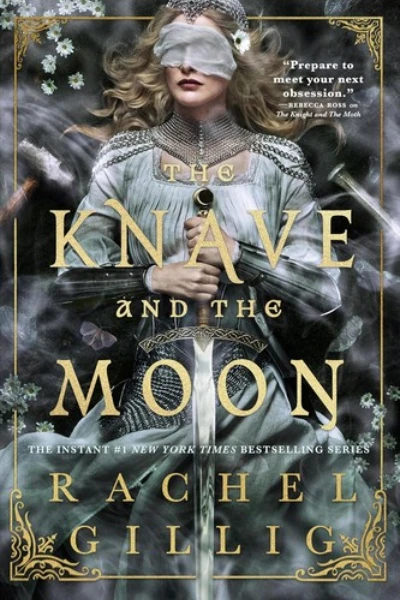
The Knave and the Moon
The Knave and the Moon — Chapter no 24
CHAPTER TWENTY-FOUR
I WILL SHOULDER ANY WEIGHT YOU
GIVE ME
No winner was named, no heralding sash given, no gold claimed; the hunt was forfeit, the tournament in the Chiming Wood without a champion. The fire spread, taking not just the sacred grove, but Eichel House as well.
Edora Eichel, the king, and his knights sought refuge in the village.
Victor brought Fig, and she carried a cart, and we placed the fractured body of the gargoyle in it and brought him back through the Wood. “Why are you crying?” he murmured as we took the winding road to Petula Hall.
Tears fell down my cheeks. “For you.”
The abbess had been right. The story doesn’t change. Terrible things happen again and again and we must bear them as a stone bears a chisel, allowing ourselves to be chipped away until we succumb to cracks.
We reached the house at midday. Maude’s mattress was stuffed with the finest wool, and the gargoyle was laid upon it as gently as Maude, Rory, Victor, and I could manage. And still, pieces of his body—now entire limestone chunks—dislodged in the process.
“Oh gods.” I wrapped him in linen, desperate to hold him together.
“Does it hurt?”
“Yes.” He shut his eyes and began to hum.
The fall in the sacred grove had shattered his other wing. And it, like a load-bearing pillar, had taken portions of stone from his back, his right arm.
I was merely bruised. He was irrecusably broken.
And I didn’t know how to stomach that. So I did what any desperate person might.
I shouted. “You should have stayed back like I asked! How could you be so careless?”
“Would I sit still while you burned, Bartholomew? I am your squire!”
I threw my hands up. “I don’t wish for a dead squire—I wish for you, and for you to remain.”
The gargoyle pouted and did not look at me. A minute later, he began to sniffle. Maude came to sit beside him, wiping soot from his face, and I, unable to bear the sight, retreated to the window and looked out.
The day had gone. It was night now, the sky a blackened haze fed by the flames and smoke that still rose from the sacred glen. The Chiming Wood was burning, the trees and leaves that had fallen in the earthquake perfect food for fire. “We killed Traum’s false gods, and this is what happens?” An ugly cloud of derision pressed over me. “What was any of it for?”
“Sybil,” Maude said gently.
“The hamlets break. Burn. And maybe they deserve to. People who put their faith in false gods and grasping kings should reap what they sow.” It sounded so ugly as I said it out loud. “Let the hamlets fall as Aisling did.
Maybe, when everything is gone, things will finally have a chance at
getting better.”
“Don’t fucking say that.”
Rory, who’d been slouching against the wall, straightened, his face marked by ash and a vicious scowl, the line of his shoulders taut. He looked like a soldier, my despair his foe. “You can’t think like that. There will be no change—no chance—unless we remain to pick up whatever bits of Traum are left to us. Please, Sybil.” Rory crossed the room like I was the painted center of his target. “It won’t always be like this.”
“Rich, from the man who wears pride and disdain and godlessness like armor.”
He kept coming. When Rory’s shadow fell upon me, my hand shot out, catching against his chest and stilling him in his tracks. “Don’t,” I
demanded.
His voice was rough. “Don’t what, Sybil?”
Don’t lecture or coddle me. Leave me to my scorn. It’s all I can bear.
Rory waited, his breath uneven. “Go,” I said, dropping my hand. “I want to be alone with Bartholomew.”
It took Maude calling his name, but eventually Rory did go, shutting the door behind the both of them.
“Oh my.” The gargoyle cleared his throat. “How embarrassing for you.”
“What?” I snapped.
“I seem to remember a young king who, in this very room, was cruel to his friends in the face of despair.”
I collapsed to a seat beside his bed. Put a singed hand to my ash-covered brow. “I’m no better than Benji, is that it?”
“You are better. And you’d do well to remember that.” He tapped my head too hard, no doubt trying to be comforting. “Perhaps if you endeavored to see the world clearly, you would not be so forlorn.”
“Seeing it clearly is what makes me forlorn.”
It was the wrong thing to say, because he put his hands over his face and sobbed, and it made me feel so terrible I’d have broken off a piece of my own body to make him stop. “Oh, Bartholomew,” I said. “I’m so wretched.
Everything is.”
That made him sob harder. “I blame myself.” He sniffled, tiny crumbs of limestone falling from his ears. “Before I was your squire I minded you upon the tor. Indeed, I am responsible for how stupid you’ve become.”
“Bartholomew!”
He put his hands down and stopped sobbing at once. “You think everything is horrible and hopeless and too heavy to bear? I cannot stop you from thinking that. But ask yourself what you believed before you told yourself that lie, and you might see there is more to the story. That life, wretched as you call it, has greater significance than your limited sight might ascribe.”
Shame scorched my cheeks. “I can’t remember a time when I did not think life burdensome in some way.”
The gargoyle rolled over in bed. “That, my sweet, stupid Bartholomew, is my entire point.”
A minute later he was snoring, as if our argument had been a glass of
warm milk. I stomped out of the room, down the corridor and stairwell. I found Maude in the kitchen, talking to Victor and Edora Eichel and a crowd of other foresters. “Ox-eye,” I blurted, like it was a kind of illness I’d contracted. “I’d like some.”
Maude didn’t ask why. She just raised her brows and said, “Benji’s grandfather kept a store of his concoctions somewhere. Check the larder.”
To the larder I went. Twenty minutes later I found a vial of brown liquid that, when I unstopped it, stank of ox-eye. The damn thing was likely long past its prime, but if sprites never decayed and gowans came from sprites and ox-eye came from gowans… whatever. I brought it out from its dusty shelf, stomped to the nearest solitary room, smacked the vial on a table, and paced in front of it.
He’s wrong, I thought, staring at the dark liquid. I’m not shortsighted. I am as I ever was—only now the Stonewater Kingdom has put its corrosive hand on me.
The ox-eye would show me just how damned the world was. All the visions had ever done was show me the terrible, violent things that had happened on the tor, and isn’t that where Traum’s story began—there, upon the tor? The longer I stared at the vial, the more certain I became that the gargoyle was wrong and I was the voice of reason between us. Life was a burden and hopelessness was its tax, just as a toughened palm was the cost of hard work. Hadn’t I earned my calluses?
But Bartholomew got to me, that sly creature. He always found a way to keep me wondering. I snatched the ox-eye off the table. Unstopped it.
Poured it into my mouth, made a retching sound.
And slipped into a vision.
I was Sybil Delling no more, but a great, unmoving creature, looking up at Aisling Cathedral’s reaching ceiling.
All was silent. Then, the sound of echoing footsteps, growing closer, and a softer, mournful knell. A child, crying.
“Enough, Bartholomew. The Divination will begin soon. Get in the
water.”
There were more sobs. Two figures came and stood above me. The abbess, tall and rigid and hidden beneath her veil.
And a little boy. He wore a silken robe, its sleeves too long for his arms.
There was blood on his mouth. His hair was the color of wheat, his skin a sickly gray. When he looked down at me, his bottom lip trembled.
I couldn’t see his eyes. They were covered in a tear-soaked shroud.
The abbess was speaking. Saying words I knew well. “For in the end, we are all supplicants. Whether craftsman or king, knight or foundling or Diviner—faith is the same. It, like Aisling Cathedral, holds up the hamlets.”
Slowly, the little boy lay over me, his weight a feather. “I don’t wish to do this anymore,” came his trembling whisper. “Would that things were different.”
“This is how they must be.” The abbess leaned over him. Pressed her hand onto his chest, offering no comfort, no kind word, but one resolute command. “Now dream.”
She pushed him into my blood. I felt his struggles, arms grasping at nothing, legs kicking, and though no one could hear me, I cried out, a long, mournful wail, as if the magnitude of my sorrow might save him.
The boy drowned.
The vision shifted—suddenly the boy was gone. There was a girl in his place, standing under the looming cathedral ceiling. She, too, was trembling, but she did not cry. The abbess told her to get in the water, and she waded into my body and was held down, struggling, bubbles fleeing her mouth. I cried out, weeping for her, forlorn that the only creatures who touched me were children in pain.
It went on like that. Girls, all different but each afraid, held down and drowned by the abbess’s hand, and for what felt like an eternity, I stared up at the cathedral ceiling in such abysmal despair I’d have paid my life just to be rid of it.
Then, long after all the drownings had begun to blend together, one was different. The girl in the silk robe was handed into the tub, held down, drowned, but this time it was not the abbess’s silk glove that brought her
out.
It was the stone hand of a gargoyle.
He brought the little girl out of my body and held her in his arms, his
wings flickering in my periphery.
“Settle yourself, Bartholomew,” he said softly. “Your dream is at an end.”
The little girl wept, and the gargoyle hummed an out-of-tune song.
“Would that things were different,” he told her softly.
It happened again. There would be a drowning, a Divination, a great show of power. After, the gargoyle would hand the girls—some were women now—out of the water and hold them, staying with them until they woke, his gentleness the grandest gesture that cold, unfeeling place had ever seen. “Would that things were different.”
It kept on that way. So many girls, then women, drowning, dreaming, the abbess harnessing my magic, my body, to procure portents and signs. I cared not for the falseness of her stories—how could she tell the truth of who or what I was if she did not know me? I lay still, as I always did, forlorn every time a Diviner drowned, heartened every time the batlike gargoyle pulled her from the water.
Another girl came. She had cropped silver hair that hung limply over her face. She was not yet in a silk robe. Not yet wearing a shroud.
I knew, just to look at her, that she was dying.
“I’m Sybil.” Tears fell down the girl’s cheeks, her voice echoing in the cathedral as if a hundred girls were crying. “Sybil Delling.”
“Would you like me to take care of you, Sybil Delling?” the abbess
asked.
“Yes.”
The abbess pushed the girl into my body with the hand of death. The girl cried out, sucked my waters into her lungs, and went still.
After, when the abbess had pulled her out and soothed her hair and called her names that so often abounded in the cathedral—strange, special, new—the girl reached up with both arms, wishing to be held.
The abbess stepped away. “Nobody’s going to carry you here, child.
You’ve got to hold yourself up; you’ve got to be a big strong girl.”
The abbess left her lying on the chancel. Coughing and sputtering for air.
“Settle yourself, Bartholomew,” the gargoyle told her. “Your dream is at an end.”
The girl shook her head, the anguish in her voice so heavy it might have
drowned her twice. “I don’t think I can do this.”
“That would be all right, Bartholomew.” The gargoyle hummed his usual tune, and the girl trembled. He wrapped his arm around her. “Would that things were different. But if it is too much to bear, take heart: I am made of stone. And if you do not feel you are strong enough”—I could hear the little smile in his voice—“I will shoulder any weight you give me.”
After that, the girl did not cough so loudly during her Divinations, and she did not flail in the water. She let the abbess press her down, as if desperate to prove there was no weight her own shoulders could not bear, as if she was already made of stone.
But then I heard her, speaking to the other girls with shrouds over their eyes. She was not stone-hard with them, but gentle as the gargoyle had been.
She told the Diviners stories. There were many, but some she favored most.
“We’ll go to the Cliffs of Bellidine and look out over the Sighing Sea.
We’ll shout, loud and so long, and our echoes will sound behind us. We’ll lie under the stars on beds of pink thrift flowers and stain our teeth with wine. We’ll sleep, but never dream.
“We’ll see the hamlets. Study their customs, their crafts—even their sprites. I’ve heard rumor of sprites as big as trees—as big as mountains.”
I liked that part.
“It’s a wild world out there, strange and magnificent, and we’re going to see it. Everything will be so entirely beautiful. We won’t always be here, trapped on the tor, drowning again and again. Things will change,” she’d whisper to whichever Diviner she spoke to. “They’ll get better. They just have to.”
They’ll get better, I murmured to myself. Strange that a creature as ancient as I might taste the words of a person so young and be fed. They just have to.
And suddenly Bartholomew and the Diviner were gone, taking their tales of hope with them. The cathedral was empty. I was alone, staring up at the stone ceiling, tragic and forlorn again.
But then—she returned. She could not see me, did not know me, but she came back, wearing neither silk nor gossamer, but armor. She bore a hammer and chisel, and with them she broke down my cruel wardens,
hitting the abbess and the cathedral again and again until they were dust.
I shouted, a long, beckoning call I had not uttered since before my own death. A sound long forgotten. The tor shook.
The cathedral began to fall.
The Diviner ran, taking Bartholomew and her companions with her, and the ceiling fell in on me, stone crashing into my body. I was in the dark again—buried beneath rubble, unable to see even the moon through the
cathedral’s stained-glass windows.
I lay still, alone and forlorn.
But lo—the rubble shifted. Through the cracks in the stone above, a light shone. The moon, peering through the cathedral’s rubble, such a tiny glimmer of light, and yet it filled me with a dizzying kind of longing.
Someone had heard my call.
They came in droves. In flocks. With slow, arduous precision, the cathedral’s rubble was hauled. The lid of Aisling’s tomb finally lifted, and I was surrounded by dozens, hundreds of sprites. Thin and panting and murmuring in that mournful language no human of Traum had ever
understood, they looked upon me.
After all this time, they knew me.
I saw the sky again after centuries in the dark—oh, to see the moon. To see her light! A beautiful shade of silver, the color of my savior’s hair.
I did not hum to the world—the sound was not a minor tune. When I cried out this time, the sound of my freedom was a deep, rolling call, full of fury and sorrow and gladness and hope so absolute it rattled the world.
Trees trembled, rivers shivered, and mountains bowed. A great quake shook Traum with an iron fist, rolling on and on until its tremors came back to me like an echo.
I stared up at the night sky and the moon it held, my oldest companion,
and wept.
There was light to touch, yet.
Things to dream of, yet.
OceanofPDF.com