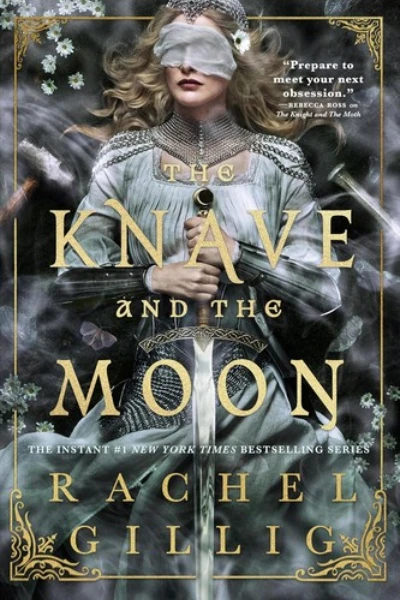
The Knave and the Moon
The Knave and the Moon — Chapter no 1
CHAPTER ONE
THE NIGHT AISLING FELL
Ihad no hammer, no chisel, just the bareness of my palms and the bloodstains upon them.
The knights put me on a horse and ripped me from the tor. We rode down the holloway road, that tunnel of trees and brambles, with a haste so thundering it sent owls screeching and darting from the branches above.
Vines lashed my armor. The road was a dark throat, swallowing our party down until it spat us back out among fields speckled with brightly dyed tents.
Coulson Faire’s pyres were not lit. Our horses clattered down the road, dirt and grass giving way to cobblestones, then the wooden slats of a
drawbridge.
Ahead, a castle loomed.
Purple banners caught the wind. We crossed the drawbridge and dismounted in the bailey, and two knights took me by the arms. They did not have an easy time of it getting me off the horse.
Guards straightened their backs as we approached the castle doors. They wore helmets and chainmail, and bore spears with leaf-shaped blades— small enough to throw, short enough for close combat. “Diviner,” they whispered as I approached.
“There’s blood upon her,” another said. “Should we call for the surgeon,
sire?”
“No.” The king pressed forward, stripping his gauntlets and throwing them on the bailey stones. “It’s not her blood.”
He was just about to step into the castle when I called after him. “Benji.”
He didn’t turn.
“Benedict.”
The king’s golden head lowered. Still, he kept his eyes forward except to mutter to one of his knights. “Put her where we discussed.”
Castle Luricht’s doors banged open.
It did not take me long to lose myself in the labyrinthian space. There were too many turns, too many stairs, too many suits of armor and faded purple rugs—and the knights at my side walked too quickly. I lost sight of Benji, and three guards took up my watch, leading me up one, two, three more staircases, then a ladder, then through a trapdoor, down a long hall and — My throat closed. We reached an iron door that stretched the entire height of the corridor. And I knew with raw assuredness, like I knew when I was going to vomit, where I was. “Here?”
“That’s what His Majesty said,” a guard answered. “Somewhere out of the way. Safe.”
They unlocked the door and ushered me in. “We’ll be outside, Diviner,” another said. “Should you need anything.”
I stared at him until he could no longer stand it. The door was shut.
Locked.
The room was long, hollow, the air thick within it. Situated on the top floor of the castle, where dampness from baths and laundry came from below and rain seeped in from above, the space was clammy, the wood planks beneath my feet supple. Fleshlike.
There were no furnishings, just mottled stains upon the floor. Without hearth or torches, the only light that touched the room came from the single barred window on the south wall. Behind it, a bare finger of silver gleamed, the moon’s aura smothered by clouds, its vibrancy choked.
I stared out the window. When the clouds thickened and the moon was
gone, I rolled my wrists. My shoulders.
And began to cough. “Guards.”
Footsteps rattled outside my door. I clambered forward, lowering my
hands to my knees as I peered like a thief through the door’s keyhole.
Beyond, three shadows moved.
I coughed louder. Wet, choking sounds. “Please. I’m—sick. Need water.”
Iron grated against iron, and a key slid into the lock. When the door opened, revealing the three guards with spears, I swayed on my feet. Took a tumbling step forward.
And hit the first guard on the chin with the heel of my palm, knocking his head back.
He gasped—tottered—tripped on his own feet and fell. The second guard began to shout. A knee to the groin, an elbow to the jaw, and he joined his companion on the floor, wheezing and groaning.
The third guard managed to raise his spear—but not before my hand was a shackle upon his wrist. I twisted it, and he cried out. “Please. Don’t hurt
me.”
“Drop your weapon.”
He did. When I asked the guard for his key, it didn’t matter that his spear was on the ground—he gave me what I asked for as if I’d held its tip to his throat.
“Go into the room,” I said. “Take your friends with you.”
By the arms, the ankles, the guard brought his groaning comrades into the room in turn, muttering what sounded like prayers to the Artful Brigand.
When I laughed, putting the key into the lock, he looked up, eyes full of fear. “Diviner?”
“This room was his haunt. The Artful Brigand’s.” My laugh edged away, lost in a chill that took hold of my entire body. “He can’t hear you now.”
I slammed the door shut. Locked it.
And ran.
Once, in Aisling Cathedral, I’d walked on tiptoe, afraid to make the barest echo upon the cold stone floors. Now my boots pounded and my armor rattled, the sound of me immense, the mightiness of my body my final companion.
On into darkness I went, treading the same floor that the Artful Brigand, that wretched beast—that Omen—had once walked. Now a new kind of false god walked the path, and, if tonight went to plan, a far worse beast.
Me.
I didn’t know where to go, only that it must be down.
I raised the trapdoor and climbed down the ladder beneath it, then two flights of stairs, and suddenly I was in the heart of the castle, where the air was colder, the torchlight stronger, the walls decorated and the carpets intricately woven. I was indifferent to it all, my sights swinging from wall to wall—not for their adornments, but for a sign of something.
Of someone.
One flight, then another, I descended. Below, voices echoed, the castle full of verve despite the hour. Then, four flights below the Artful Brigand’s room, I came upon a corridor. There the curtains were wider, thicker, finer: a richer shade of purple. Even the air smelled better—aromatic, like citrus paired with herbs and meat fat. Those things alone might have told me I
was in the right place.
That and the guards.
There were two of them, armed and pacing near the gilt door at the end of the corridor. Unfocused, slouched and playing with the straps of their leathers, they did not see me. Not at first. Then I came forward, my steps so heavy they rattled the walls, making the torches jump and the portraits quiver.
The guards snapped to attention, knuckles white on their spears. “Who is
it?” said the one on the left.
“Where is the king?” I asked back.
“Abed. He aims to rest—Oh. Diviner.”
Their eyes went wide, the first guard’s jaw so loose I glimpsed dark holes where he’d lost several teeth. The second guard, who seemed equally incapable of forming words, stared fervently into my eyes until his own
began to water.
“Open the door,” I told them.
“You should not be about,” said the second guard. “The king bade us to keep you secure atop the castle; it is not safe for you to wander unprotected.
Let us take you back—”
“Open. The. Door.”
The first of the two fumbled with the latch, his hands useless as hooves,
until the door opened as meekly as the lid to a music box. The guards cowered back into shadow, watching me as folk always watched Diviners in the Stonewater Kingdom: awestruck and afraid.
I slipped behind the door.
There was a wide hearth, a dark mantel, and dying embers—I could barely make out the shapes in the room. Carved furnishings. Walls with carefully crafted molding. There was a mirror, as tall and twice as wide as my body. When I passed it, my silver hair and armor looked like the moon had in the sky—a smudge of light in a despotic, infinite darkness.
No sound came but the beat of my heart. Then, in the center of the room, from a bed so huge it looked like a slumbering bear, I heard little snores.
Fitful breathing.
Benedict Castor the Third rested on the bed. His golden hair was dark, freshly washed, and his eyes tightly shut. He lay like I imagined he would, curled in on himself as if to protect his vital organs. Shirtless, his bare shoulder peeked from beneath several thick quilts, and his skin was covered in gooseflesh. For a moment I thought about pulling the quilts up and
covering him.
I ripped them away instead.
The king shuddered, holding tighter to himself, his eyes shooting open.
“Who’s there?”
I leaned over him like a serpent over a nest of delicate blue eggs. “Who do you think, Benji?”
For the briefest moment, Benji’s muscles eased. A second later they were taut. “You startled me. Your eyes. I thought you were—”
“An Omen?”
He sat up. Held the blankets close. “How did you get in here?”
“I walked.”
Slowly, Benji’s left hand slipped beneath his pillow. “Did you kill the
guards?”
“They cowed well enough.”
There was no more light in the room. The last ember in the king’s fire had died. “What do you—” Benji’s voice trembled. “What do you want, Diviner?”
“For you to look me in the eye. One last time.”
When he did, I saw a world in vivid blue waiting behind Benedict
Castor’s eyes. I had no hammer, no chisel, to put to that world, only my sorrow, my fury, and so with bloodstained hands, inevitable as the serpent
over the nest— I struck.
The king shouted, but I already had him by the throat. Benji grasped my wrist. Twisted it. When that did not work, he withdrew his hand and struck me over the arm. “Please don’t,” came his choked entreaty. His voice was desperate, a frayed piece of string. “Please.”
My grip on his neck tightened. But then—his eyes. Gods. Those eyes.
The king had begun to cry. He looked up at me, searching for pity, for more wrath—I didn’t know—but it was as if I was peering through time at the boy who’d come to Aisling Cathedral, small and afraid. Who’d sat me down and told me the truth of Traum, of the Omens. Who’d put power in my hands and harnessed it.
The king, the boy, who always seemed to look up to me, was looking up to me still.
But then he struck me again, his fist finding the crook of my arm. Benji hit me once, twice, thrice, until my conviction fell away. I let go of his throat, and for a moment neither of us did anything but struggle to breathe.
“You should have killed me, too.” Despair pressed itself upon me with bruising force. “You should have killed me.”
“You’re already dead, Six,” Benji whispered. “That’s what makes you so special.”
The king pulled a stone coin from beneath his pillow. Tossed it into the
air—
And vanished.
The door burst open.
The guards from my room and the two from outside shoved their way into the chambers. Behind them, armor glistening, stood a pair of knights. A woman with a pinched face and dark eyes, and a man with sand-colored hair and perfect teeth.
Tory Bassett and Hamelin Fischer took in the room, then turned their gazes on me. Tory’s dark eyes narrowed, and Hamelin held out his arm, the guards around him cowering. “Lost, Diviner?”
The two of them returned me to the top of the castle. Tory did not touch me, but Hamelin reached out every ten or so steps to softly graze my elbow.
A reminder that he was there. A threat.
They led me up the final stairs to the highest floor. “You were as docile as a lamb all the way here.” Hamelin’s laugh rumbled behind me. “A ruse, I see.”
I stepped into the Artful Brigand’s room, keeping my back to him.
Hamelin slammed the door shut, closing the three of us in together.
“That was foolish,” Tory said, clipped. “Waltzing around the castle.
You’re an important woman—what if something had happened to you?”
I gave them nothing but my rigid spine.
“Benedict gathered the knights and told them everything a few hours ago.” Hamelin’s voice was close to my ear. “He told us that sprites attacked the cathedral, killing its abbess, its gargoyles, its Diviners. He said, before she died, the abbess gifted him five magical objects, all different in variety; tokens of gods that he used to reduce the sprites to pieces.”
His voice went low. “He also said that with Aisling gone, the spring buried, the only way to reach the Omens now is to look into your stone eyes.”
My stillness must have aggravated him, because Hamelin’s tone turned goading. “A shame about your pet gargoyle. About Maude and Myndacious.
The lot of them, crushed by rubble.”
My entire body locked.
“Too easy a death for a prick like Rory if you ask me—”
I turned on my heel, shoving Hamelin so hard he hit the floor. “Get out.”
His armor groaned as he struggled to a stand. He stared at my stone eyes, fear wafting off him like smoke. Tory picked him off the ground and led him to the door. “Get some sleep, Diviner,” she said. “The ceremony
begins in the morning.”
“What ceremony?”
Hamelin closed the door. I heard the click of iron, and then… nothing.
I hauled myself to a dark corner of the room and lay with my arms wrapped around my knees as well as my armor allowed. So this would be Traum’s new story, then. Its new lie. That sprites had destroyed Aisling Cathedral. That the only magic that remained in the world was the stone objects the Omens had once held—coin, inkwell, oar, chime, loom stone.
And me.
Amazing how the boy-king could take everything from me and make me
holy in the same hour.
I lay on the floor of the Artful Brigand’s chamber, weighed down by certainty. All that I loved was gone, and all that I’d done ridding the kingdom of false gods had been for naught. The cathedral had fallen, but its shadow remained over Traum, and not even the tallest building or birch tree or mountain peak could pierce its darkness to reach the light.
I was a failed Diviner, and barely even a knight, but I knew well enough how to make a vow. There in the Artful Brigand’s chamber, tears journeying from my eyes, I swore that for what he’d done, Benedict Castor the Third would die. Tonight’s failure was a gift; death in the dark was too good for him. Whatever tomorrow promised, I’d kill the king of Traum the same way I’d Divined for him at Aisling Cathedral.
With a ceremony.
I shut my eyes. When I wept, the noise in my throat was the same as when I’d drowned in Aisling’s spring water, and when it finally faded, I spent the night listening for things I would never hear again. The rhythm of the other Diviners, breathing in their sleep. The gargoyle, humming out of
tune. Maude’s steady laugh.
Rory’s voice.
Tears dripped from my jaw, wetting the chain netting of my coif and then slipping into the cavern of my breastplate, where they pooled and chilled me until I began to shiver.
When sleep finally came, I was wondering at stories—at truths and falsities and how neither kept me company, but both kept me wondering.
What had become of Maude? Would the cracks in Bartholomew’s body spread until he was nothing but shattered stone?
Had Rory succumbed to his wound?
Was it a lie if I told myself that, before he slept the endless sleep, Rodrick Myndacious, the heretic, the beautiful rogue—the best knight I’d known—hadn’t bothered calling out to gods or men? Was it wrong to hope
that, just before he died… … He’d said my name instead?
The Artful Brigand’s chamber opened and gray morning light poured in.
Above me, four silhouettes loomed.
Hamelin Fischer from the Fervent Peaks, Tory Bassett from the Cliffs of Bellidine, Dedrick Lange from the Seacht, and a fourth knight with short, dark hair and copper skin and charcoal around his eyes. Samuel Eichel, I remembered. Son of Helena Eichel, the noblewoman from the Chiming Wood who had presided over the king’s ceremony. The one we’d stolen the Faithful Forester’s chime from. The one who’d been eaten by a birke.
“We’re to take off your armor,” Tory said to me.
They tried not to touch me as well as the task allowed, but their eyes were upon me, searching mine, as if they might see an Omen in the pallid nothingness of my gaze. When breastplate and cuisses and greaves and all the other pieces were off, all four led me away. The last thing I saw in the Artful Brigand’s chamber was my armor, crumpled and spineless upon the floor like it was my own dead body.
They took me to a washroom, where women scrubbed my skin until it was pink. And while they each searched my gaze, nothing in their own indicated they even saw me. They, like the rest, had undoubtedly been told they might glimpse an Omen if they peered long enough at my eyes.
My scalp was cleaned and my hair combed. Tory returned then. In her arms, long and white like a sallow eel, was a silk dress.
And I understood why the armor had been left behind. The ceremony that had been intimated. Today, I would not be a Diviner or a knight, but a martyr. If not the holiest, then surely the most tragic—the unwilling bride.
Today was my wedding day.
OceanofPDF.com