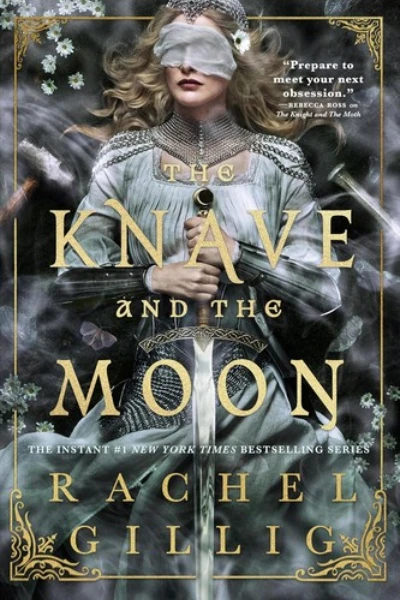
The Knave and the Moon
The Knave and the Moon — Chapter no 21
CHAPTER TWENTY-ONE
PLAYACTING
Avice Fischer stripped the Ardent Oarsman’s castle of purple banners and replaced them with black mourning cloths. She did not bid the kings or his knights goodbye, nor did she tend Sybil a single respect. The king and queen and knighthood—the tournament champions—were meant to stay another night under her hospitality, and yet she turned from the king like he was a gutted fish left too long in the sun.
Benji barely had time to present the gargoyle with his bowl of winnings.
When he asked Avice for the heralding sash she was meant to gift to the champion, she turned her nose up. She hadn’t shed a single tear, her strength spent staring the king down with unmarred revulsion. “The net he used to defeat my son is trophy enough.”
Benji was as gray as the shale he stood upon. “My aim was for his weapon.” Every time he said it, his back stooped more. “Hamelin would have struck my Diviner, after swearing loyalty to me and an oath to protect her. That is sacrilege. Heresy.”
Avice pressed her lips together, waiting for him to leave.
I worked the leather of Fig’s reins between my gauntlets, jaw aching. I’d been pressing my molars down for the past hour. The pretense of the knave was never going to be easy. But to pretend I felt nothing when Hamelin slammed his oar into Bartholomew’s back, when Sybil rushed forward and
tussled with him in the water, when he’d put his hand on her throat and raised that hammer above her head… I couldn’t do that.
Seems I was as bad a knave as I had been a knight.
The same powerlessness I’d felt as a boy, trapped by the Artful Brigand, had found me. Shaking, shouting, I’d pushed forward, aiming for the lip of the basin, for Sybil— The stone coin had flown, ending the feats of strength and staining the crystalline water red. Every soul in the Fervent Peaks had turned to stare at their king, and Benji, who, absorbing the severity of what he’d done, had bent over and coughed out vomit on the stones beneath his boots.
I might have respected the prat, killing Hamelin that way, if it hadn’t been an accident.
But then, just as the king got on his horse and the knights turned to lead us out of the Fervent Peaks, Benji turned a final time and said, “Where will you bury him that I might return in commemoration?” and all my fledgling respect festered. The little shit never came back to commemorate when he’d killed me.
“At the base of the Peaks,” Avice said. “The Fischer tomb is there. He will join his father and grandfather and all noble folk of vigor. Fear not: He will be remembered by more than just you, Benedict Castor the Third.”
Her message was clear enough. I will remember, too.
Once more, we took the untenable road down the mountains. I rode behind Maude, who drove the wagon where Sybil sat closely with the gargoyle, the sounds of their voices soothing in the jagged mountainscape.
And while the gargoyle was wagging a finger in Sybil’s face and lecturing her in his usual way, things were not as usual with Bartholomew.
He’d lost a considerable amount of limestone. Hamelin hitting him with the oar had done more damage than we’d initially thought—a chunk of stone the size of my fist had dislodged from his hip, and every time he tried to walk, cracks spread. Sybil had filled their cart with blankets, restored him in his robe as he’d once fit her with armor—tried to make him comfortable on the jostling journey to the next leg of the tournament. But she was biting her lip in a way that made my throat close. Ceaselessly watching him, even when he dozed.
Benji rode ahead with his knights, Samuel and Tory like iron wings at his side. I caught him looking back several times at Maude and Sybil.
Eventually, the road was not so rough, and when the caravan made its way back into the open moorland, a collective sigh of relief sounded, the journey south to the Chiming Wood straight and narrow.
The king stalled and bade his knights ride ahead. He waited along the road, his blue eyes never leaving Sybil in her cart. When he eased his horse back twenty paces behind them, he was in perfect step with me.
“Tell me, knave.” Benji drank from a flask on his belt with the same enthusiasm he used to, back when folk sometimes shouted at him, calling his grandfather a heretic. Gods, how I used to bloody my knuckles for this boy. “What have your fellow champions said about me?”
“Little,” I said, pressing my voice until it flattened like I did every time I lied. “They seem to be cradling what’s left of my mind. Strange how they take pains to care for me, knowing I’ve nothing to offer them in return.”
Benji chewed that over. “They knew you well.”
“How well did you know me, sire?”
The king looked up from his flask, startled. “Oh. I…” He swallowed.
“We were rather close, once. Friends.”
I was grateful for the iron cage of my helmet. He could not see the pain stamped over my face.
“You must think me reckless,” Benji hedged, “killing my own knight.
Did Maude tell you Hamelin wasn’t the first friend to die at my hand?”
Were I not a cynical man, I’d have guessed he felt guilty. But I knew better. Benedict Castor the Third was but a collector, his tokens of choice wealth, magical objects, and powerful friends.
And I had every intention to rob him of all three.
“I’m sure you had your reasons then as you did now,” I told him. “Like you said. You were protecting your Diviner.”
“Would that Avice Fischer and the other nobles saw it as clearly as that.”
Benji drank, then looked up at the sky, his gold crown dull in the gray light.
“Three events lost, three stone objects destroyed, two knights dead. None of this has gone to plan. But I think—”
He turned to me. “Suppose I might convince you to gift me your winnings, knave? Seven hundred gold coins is more than any one man needs—imagine how magnanimous I would be if I were to give your winnings back to Regius Ormsby and Otto Lange and Avice Fischer?”
“To help their hamlets recover from the earthquake, sire?”
“They can throw the gold into a vat and make new statues of their precious Omens for all I care, so long as it gets me back into their good graces. The only god of men,” he said plainly, “is coin.”
I could tell by the way he clutched the Artful Brigand’s coin, harder than his flask or even the reins of his horse, how desperately Benedict Castor the Third needed that to be true. “I could write to Otto when the tournament is over,” he offered, “that he might release your gold from the Seacht vault and send it to mine in Castle Luricht.”
I paused, making him wait. Then, sickly sweet, “Of course, sire. Write to
him now, if you like.”
Benji sighed. “Very good.”
A root sat in the road. When Maude drove over it, the cart jumped. The gargoyle, wrapped in blankets, hardly budged, but Sybil jostled against the side of the cart. She let out a sharp cry. Put her hand to her abdomen.
An anvil dropped from my chest into my stomach.
“It was my fault,” the king murmured, studying me. “I wanted to show everyone the vileness of sprites after the cathedral fell. She was grievously injured. Don’t let her posturing fool you, knave. The queen’s strength is like Traum after the earthquake. Breaking apart.”
He said, urgently, “That is why I cannot let this quake or the fucking nobles and their winnings derail my tournament. The more that goes wrong, the harder folk will look for signs that things might improve. Let them see her with me while she is fearsome and useful. Let them be inspired. Folk always need something to believe in.”
All I could think of in that moment was the abbess and how she spoke in the cathedral. Affected, virtuous—all the while pressing down on Sybil’s shoulders and drowning her. “And when she isn’t those things? What will become of the Diviner then?”
“People will not forget the cathedral just because it fell. I will find a way for her to still leave her mark on the Stonewater Kingdom.” Benji lifted his reins. “Oh—one more thing, knave. We’re entering the Chiming Wood.
Maude Bauer’s hamlet. There is a reason I asked you for your winnings and not hers or the gargoyle’s. I am quite certain your fellow champions do not have my best interests at heart. You will tell me, won’t you, if they try to undermine me?”
“What schemes would they have against their own king?”
He waved a hand. “History is a murky translation. So are right and wrong. Maude and I are of different minds regarding all three. No doubt she considers there to be unfinished business between us.”
She isn’t the only one.
“Thank you,” Benji said. “And not just for the gold. It is not easy, being a king. One never knows who to trust. Perhaps this is a second chance for
the both of us.”
“A second chance for what, sire?”
Benji did not note how tightly I held Fig’s reins. The king was looking at me like I was a blank page in a notebook, and he yearned to scribble his truth upon me. For some reason, it made his blue eyes narrow. “To be friends.”
It wasn’t a great distance between the Fervent Peaks and the Chiming Wood. Nary twenty miles. By late afternoon, we saw yellow trees on the horizon. By dusk, we traveled beneath them. And while there were no sinkholes in the road—no crumbling rock faces or cliffsides—the Wood was not the hamlet, the haven, we’d expected to find.
Birch trees had fallen on the road. Some bore the serrated markings of having snapped, others had been ripped up by the roots, the dirt and bramble and earthen floor around them ripped up, too. So many of the leaves—that brilliant canopy of yellow—were on the ground, as if something had taken the Chiming Wood in its fist and given it a brutal shake.
“That earthquake.” Samuel Eichel was fretting at the front of the caravan, gawking at his home hamlet. “A terrible portent.” He spurred his horse. “Come, sire. Let us see if Eichel House is unharmed.”
The caravan lumbered forward, the light in the wood fading. A shadow moved in my periphery. I turned to face it.
There was nothing there.
Night fell and the wind rushed, the sky clear, its hue the shade of bruises —black and purple and blue. Torches were lit, and we traveled among trees,
moving down the road at a hurried pace. No one spoke, the only sound among us the clatter of footsteps and the groan of wagon wheels and the wind, sounding through the trees in its usual chiming knell. But even that fell silent.
“Bad portents on the wind,” I heard Samuel tell Benji and Tory. “Very bad portents—”
“Here’s a portent,” Benji snapped. “Shut the hell up or you’ll find yourself at the back of the caravan with the horseshit.”
Samuel blanched and was quiet the rest of the way.
An hour later the trees began to grow farther apart, a glen opening up, the road no longer dirt but gravel, lined with flaming torches. A tall house came into view, the moon, like a great eye, sitting upon its turreted
shoulder.
Eichel House.
We rode into the drive. At the entrance, purple banners hung from the spandrel, four figures in yellow cloaks waiting. The eldest, a stooped woman, held the Faithful Forester’s chime. She was Samuel’s grandmother, Edora Eichel. I didn’t know how old she was—she’d seemed a thousand years old when I’d first come to the Wood as a boy. Besides Maude, she was the most respected noble of the hamlet.
I had it on good authority that whenever Benedict Castor the First mentioned heavy-pocketed nobs who go to Aisling for a Divination, he’d been referring specifically to Edora Eichel.
Samuel dismounted. “Grandmother.” He turned to the house and held his breath, like the damn thing might crumble any second. “Did you feel the earthquake?”
“Yes.” Edora held out a wrinkled hand, handed her grandson the chime, then gestured to the wood. “There have been rumbles, and the trees sway, the song among them different than before.”
Benji dismounted and stepped forward. But Edora looked past him. “Tell me—where is the Diviner?”
The gargoyle raised his hand, and Sybil stood in the wagon. “I am here.”
Edora nodded solemnly. “There have been rumors—talk of a Divination on your wedding day, when you predicted this. That the stacked stones of faith and accordance would crumble and the kingdom would end as it began, fractured and bloody. Tell us: Are the winds of change blowing?
Does the Faithful Forester warn of toil, of hardship? What do your stone eyes see?”
Everyone turned to Sybil. She stood higher than the rest of us, hand on her stomach and a crown on her head, peering down through gossamer, so pretty I was sick with longing. Her fingers lifted, ghosting toward her veil.
Edora, the nobles, even knights like Samuel and Tory leaned forward in anticipation.
Sybil’s hand went still. She did not raise her veil.
She stepped out of the cart instead. “I do not know from whence these earthquakes come,” she said plainly, “or why they come now. What I do know is what I’ve seen. Folk are displaced, sprites butchered. A pair of the king’s knights have died for spectacle. A distant memory, it seems, since I was a witness, pupil, visitor to Traum’s wonders. All my stone eyes see now”—her mouth went hard—“is a deeply flawed world.”
She might as well have slapped the old woman across the face. Edora Eichel gasped, and so did the other nobles. Even the wind seemed to quiet, hushed by the last Diviner’s flagrant faithlessness.
And still… they looked upon her, searching her veil. Were I to lift my visor, perhaps they would comb my stone eyes as well, hungry for signs and assurances.
Benji, on the other hand, looked up at Sybil like he was about to scream.
I dismounted and brought Fig close to the cart where Maude and the gargoyle sat, all three of us wearing our idiotic heralding sashes. “I can’t tell if she’s taking the piss out of Benji,” Maude murmured, “or if she means what she’s saying.”
“Bartholomew has never been a very gifted liar,” said the gargoyle.
“There is a dimness in her eyes that was not there before.”
I felt the same calamitous fear that had kicked my lungs in the Fervent Peaks when Sybil and I had sparred in the rain. If the stone objects go, and I go with them, then perhaps the lie might end.
“She still feels a part of Aisling’s system, like she’s another magical stone object.” I turned to Maude, hardly able to say it. “And you know what she intends to do with the stone objects.”
Understanding washed over Maude’s face. When her gaze lifted, it wore the same expression it had the night I’d woken on the tor: steadfast determination.
“Would that folk stopped treating her like one.” I exhaled hotly. “The fools cannot stop themselves from looking for signs that aren’t there.”
The gargoyle pondered that. “They never will.”
I glanced over my shoulder. “Not helpful.”
He lifted a fractured hand to a nearby birch, plucking away yellow leaves. “To be seen clearly is not a gift all of us are given. Some might look upon Bartholomew and see a stone object, and others look upon her”—he batted his eyelashes at me—“and see the whole world over. Some might glimpse her eyes and find a void, begging to be filled with cathedrals and systems and rules, and some might see a strange kind of freedom. Truth, and lies, can always be found when we search the unknown. But even a child learns by watching.”
He sighed, forlorn. “The story will never change unless, first, we observe it.”
Folk were still asking Sybil questions. About portents. About Omens.
About belief. Her answers were brief, curt, until the king, disturbed by a conversation he could not control, cleared his throat. “The unfortunate incidents that plagued the last events will find no foothold here, Edora. The Chiming Wood has ever been a hamlet of fine portents.”
He shot Sybil a glance, then held his hand out to the nobles, the knights, ushering them into Eichel House as if it belonged to him.
Still—it was Sybil whom Edora Eichel brought first over her threshold.
“Come, Diviner. I’ve prepared my home in your honor.” She looked back.
Waved at Maude. “You and the other champions have honored places, too, Bauer.” Finally, she acknowledged Benji. “You too, King Castor.”
Ten minutes later, the gargoyle was crying. “But I want to dance.”
Maude leaned over the wagon, speaking to him in a soothing voice. “I know. But those coins you won in the Peaks need a safe place, and you heard Sybil—you require rest. I’ll take you to Petula Hall. There are lots of blankets there.”
He stuck out his bottom lip and pouted. Maude took the reins. Gave me
a pointed look. “I’ll be back in a few hours. Don’t do anything stupid and get yourself killed.”
“Already dead.” I smacked the horse’s bottom, and they rode off into the darkened Wood.
Inside, the air was heavy with smoke. A suckling boar turned on a spit in the crackling fireplace. A grand table had been placed along the wall, covered in candles and dried fruits and herbs. Eichel House might not have been as old as Petula Hall, but its insides looked the same—rich and brown, nearly everything made of cherrywood or mahogany. Only here, instead of books and trinkets laid out on the house’s many shelves, there were bones.
Pelts. Trophies of animals slain.
I walked along the periphery of the great hall, combing the room for Sybil. She wasn’t with the king. He was over by the dead pig on the fire, onto his second or third goblet of wine, talking with Samuel, who was partially listening, partially showing the Faithful Forester’s chime to anyone who drew near.
A forester stepped in front of me. I was almost positive I’d picked his pocket at one time or another. “Where is your champion weapon, Myndacious?” he asked. “Did you use an axe from the Wood to win the
melee? A sword?”
“A hammer,” Benji called, too loud.
He crossed the room. When he reached me, head barely clearing my chin, he grinned. Without so much as asking, Benji lifted my visor, showing folk of the Wood my eyes. “Stone,” he said against the tide of gasps.
“Spectacular, isn’t he?”
The crowd pushed, vying to get closer, peering at me as I’d once looked upon Aisling Cathedral—in wonderment and fear.
They asked me questions. Touched and tugged at me.
“What will you do when the tourney ends?” the same noble asked.
“I’ll return to Castle Luricht.” An ugly part of me liked it, telling Benji what he’d always wanted to hear, knowing he’d never get it. “That I might be useful to King Castor in all his endeavors.”
The king’s cheeks flushed. Folk of the Wood, who had never bothered to acknowledge me when I was Maude’s squire or Benji’s knight, came up in droves, asking about the melee, about my eyes and my winnings, running their gazes and hands over the heralding sash I wore over my breastplate.
Bartholomew might have been right—it was good for folk to look at me, to break preconceived notions or form new ones—but by gods, if these idiots didn’t take ten honest steps back I was going to retrieve that hammer and break something. “Excuse me.”
I found an alcove behind a velvet curtain, a casement window beyond it.
Another forester was there, fumbling to light a twig of petrified idleweed with a candle. I yanked off my helmet, ripped the idleweed from his hand, and lit it.
“Hey,” he complained, then looked into my stone eyes, blanched, and walked away.
I took a deep inhale, held it in my lungs, let it out, remembering what Bartholomew had said about not needing to breathe, and how that would likely be me one day. What a damn shame.
Five seconds later the point was rendered moot—my lungs weren’t working. Beyond the velvet curtain, I could see the grand stairwell—and Sybil Delling upon it.
She walked behind Edora Eichel, no longer clad in the plain woolen clothes they’d given her in the Peaks, but wearing the Chiming Wood’s ceremonial garb. A long silk dress the color of birch leaves, the yellow fabric fitted along the bodice and upper arms, then loose and free around her wrists, her waist, her legs. The sleeves hugged the impressive muscles along her arms and the bodice held tightly to the curves of her breasts—the contours along her abdomen and shoulders and back. Lovely and formidable, she was the beauty who lay in the shade of the tree, then rose to snap off a bough with her bare hands.
I watched through a cloud of smoke, hot in the chest, unable to look away.
Sybil spoke to Edora and several other prominent folk of the Wood at the bottom of the stairs. It was hard to see where her eyes were behind her veil, but I knew what it felt like when she looked at me, and I knew it the second she spotted me across the room.
Sybil lifted her chin. Nodded twice to Edora, excused herself, and walked to the edge of the great hall, trailing its perimeter until she stood at the brink of my alcove.
I caught her arm. Pulled her toward me and slid the curtain over the mouth of the alcove, plunging us into darkness but for the yellow light that
came from the tip of my idleweed and the silver glow of moonlight from the casement window.
Sybil wrenched up her veil. Cupped my chin in her palm and brought my mouth to hers. When I exhaled, smoke slid from between my lips, and Sybil breathed it in. “Where’d you get the idleweed, knave?”
“Stole it.” I held it out to her, my voice full of gravel. “Have more. It’ll help with the discomfort. With the pain.”
Sybil’s mouth twitched in a way that made my heart stumble. “Aren’t
you in pain, too?”
“Near you? Always—”
She kissed me. I dropped the idleweed, thoughtless.
“You will be.” Sybil’s hand was on her abdomen again, just above her wound. “Soon, without spring water, you’ll feel what it’s like, slowly turning to stone.”
“No doubt. But until then—” I bit the inside of my lip. Hard. Tasted blood. “Permit me.”
Sybil’s nostrils flared. She leaned in again, and I took her by the nape of the neck, pulling her recklessly toward me. Our mouths collided. Sybil let out a low sound of pleasure that vibrated up her throat and into my mouth, rooting itself in every part of my body. She ran her tongue along my bottom lip—pulled it into her mouth and pressed her teeth around it, earning herself more blood and me another delicious sound from her throat.
A violent, magnificent ache took hold of my chest. My blood smeared over her mouth, and we kissed with abandon, the moonlight in the alcove growing hazy as our torrid breaths put fog over the casement window.
The sounds in the hall grew louder, voices pressing against the curtain.
“They’ll look for me,” Sybil whispered over my lips. “The spectacle never ceases, does it, Myndacious?”
“Two more events.” It was getting harder and harder to put that veil back over her face. “And we won’t be strangers, Sybil Delling.”
When her veil fell, a tiny spot of blood stained the gossamer that sat over her lips.
Sybil squeezed my hand and exited the alcove first. I followed a minute later. The crowd was beginning to disperse, pushing itself against the walls, the floor taken over by a quartet of strangely dressed folk. One carried a lute, and the three others wore face paint. Actors—and the same minstrel
who’d performed in the other hamlets.
Benji was still standing near the fire, Sybil and Tory and Samuel at his wings. When he saw me, he waved me over. “Come, knave.”
I made my way through the crowd, enduring awestruck stares and reaching for my visor—only to realize I’d left my helmet on the alcove floor.
By the fire, Samuel was explaining to the king the history of the playacting society in the Chiming Wood. Caught between an eye roll and a yawn, Benji coughed. His gaze snagged on Sybil. “I hope you weren’t too uncomfortable on the journey from the Peaks.”
He peered at her yellow dress. At her veil. “I must say you look well.”
Sybil kept her gaze on the performers in the center of the room and ignored him.
“Wine,” Benji told Samuel, and the knight disappeared into the crowd.
Tory, scowling, glanced at me, then Sybil. “Edora Eichel wants a word with you, Diviner.” She grasped Sybil by the elbow. “It won’t take long.”
I knew better than to watch her go. Still, I dropped my hand as Sybil passed, heartbeat pounding as she dragged her knuckles over my gauntlets.
Warmth touched the corner of my lips. My bottom lip was still bleeding.
I brought it into my mouth, slicking blood away with my tongue. When I looked at Benji, he was already watching me. “What do you think of Eichel House? Not as grand as Petula Hall, is it?”
“I’ve no memory of Petula Hall, sire.”
“Oh, yes.” He sipped his wine and nodded at the actors. “Apparently they will be reimagining the tournament. Are you familiar with playacting,
knave?”
I shook my head.
The king’s smile was thin. “This should be a treat for you, then.”
“Here.” Samuel Eichel was back, squeezing his unwelcome ass next to me and holding out a silver goblet. “There’s to be a toast at the end.”
The minstrel lifted his lute and began to play, and the actors spun around him. The performance had started.
“A colorful dream,” he sang, “the bright land of Traum, where the wind on the moors hums a tune. Where the holloways lead you awry and along, and the gowans are always in bloom. But mind the streets when the water is high, and look out for mountainous shale. The earth does tremble from time
to time, and the trees in the Wood have turned frail.”
Folk shared glances, and the minstrel strummed on. “Still—wherever you ramble, from woodland to sea, pray find the young king on your way. I lent him my axe, and he counted my gold, and to his queen, the Diviner, did I pray.”
The audience clapped. Benji’s cheeks reddened, and he opened his arms, smiling and accepting the applause.
The actors moved about, pulling props from a wooden box. One spread rouge on his cheeks and nose and placed a paper crown over his head, no doubt meant to be Benji. In his hands was a bowl of grain. He stirred it greedily, smiling and cackling to himself. Then he donned a helmet and took up a stick, and so did a second actor, the two of them dancing in absurd leaps as if mounted on horseback.
“The joust did begin in the great Coulson Faire, where merchants and brigands do quip. Neither jouster nor horse was hurt by the lance, but the king’s precious gold got the tip!”
The actors volleyed toward each other, and the one playing Benji was struck with a stick. He threw himself backward, falling dramatically on the floor, knocking against the bowl of grain and spilling it.
The crowd chuckled.
“Next was the melee in the city, the Seacht—a battle of wits on display!”
The jousters threw down their sticks, ran for their box of props, and withdrew a wooden mace and a hammer. They swung wildly at each other while the actor playing Benji put on his crown once more and took up an overflowing glass of wine, laughing and pointing.
“A great pity then that no wits could be found—the king lost a knight for a knave.”
Next to me, Benji was smiling, only now his mouth seemed frozen that way.
The actor with the mace fell to the ground and flopped, and the king in the paper crown spilled his wine down his tunic. Folk in the great hall were laughing now, some even applauding.
One of the actors threw off his helmet and donned a gray cape, crouching and waddling, grunting and groaning, pretending to be a gargoyle as he and the other actor threw paper rocks.
The minstrel sang louder. “And lo, what next? The great feats of strength, held high where the Tenor is fed. Muscle and vigor are qualities fine—”
The actor playing Benji threw a rock. It struck an actor, who fell to the ground and writhed. The play king looked at the audience and shrugged.
“What a shame I took off his head.”
Folk guarded their laughter behind their hands. And Benji—he wasn’t smiling now.
The tune slowed, the actors joining the minstrel in a line. “And so, dear folk, we come to the hunt, where ne’er was an axe that was beaten. Look out for the sprites, and keep a sharp eye—lest one, maybe both, are eaten.”
Applause rang. The minstrels and actors were given goblets the same as the rest of us. They raised them high. “To the hunt!”
“To the hunt!” echoed the call. Everyone drank, even Benji. I threw my
head back, swallowed the wine.
And coughed.
A horrendous taste coated my tongue, bitter and rotten. I knew what it was the second I choked it down. Ox-eye.
Blood draining from my cheeks, I whirled on Samuel. “What is this?”
The knight’s hand was on the hilt of his sword. “King’s orders.”
My vision winked, my senses already dulling from that vile poison—my skull felt too large, too heavy, a pounding headache starting behind my eyes.
“Since we are in the spirit of playacting and revelry,” Benji called, his voice distorting in my ears, “let us have one more reenactment for your pleasure.” He turned to me, lips thin. “This one shall be of myself and the knave, when he graciously challenged me to spar.”
Three knights seized my arms, and Samuel ripped my sword from its sheath. But the amount of ox-eye they’d given me was far greater than what I’d had in the Peaks—I was swaying on my feet. Hardly able to walk. It took all three of them to move me forward.
The knights led me to the heart of the room. The actors scurried away, leaving the box of props. Benji rummaged through it. Found the wooden stick they’d used as a lance and threw it at my feet. “Come now, knave,” he said. “Show everyone what a talented fighter you are. Give them a proper show.”
My vision went dark. I blinked. Saw the king’s bleary shape.
Benji dropped his goblet, then drew his sword with a sudden zeal.
“You’ll have all seen by now,” he said, his voice echoing through the room.
“The knave’s peculiar eyes, hewn of stone, just like my queen’s. How strange, special, new you must think him, despite his ill looks and manners.
Perhaps you even wonder if he is holy.”
The king jerked his sword, leveling it against the side of my neck. He pressed and I felt the sharp pain of skin splitting. “But I assure you,” Benji said. “He’s just a man.” Blood trickled down my neck. “As fallible as the rest of us.”
The king barked at his knights. “Make a circle.”
The knights exchanged glances, grasped their weapons, and boxed Benji and me into the center of the room. I could hear murmurs. But for every second that passed, the ox-eye’s grip on me tightened. I was farther and farther away, a pallid nothingness stretching out around me.
“Fight me, knave,” came Benji’s voice, hot and excited.
I slouched forward, faintly pressing against the tip of the king’s sword.
When I said nothing, Benji threw his sword down, reached into his pocket, and withdrew the Artful Brigand’s coin. He tossed it, vanished, then reappeared behind me, knocking his gauntlets into the back of my head.
I hissed.
Then Benji did it again and again, using the coin to vanish and reappear, always hitting me from the side or behind, never head-on. “You almost had me fooled,” he said quietly. “Pith, Rory, I never knew what a good actor you could be, bowing like that, reverent, not a single sign of your usual grating disdain. You held so damn still when I kissed her.”
I tried to anticipate him—tried to move—but it was like wading through mud. I was hindered at every turn, my vision growing dimmer, the pounding in my head and the rolling of my stomach worsening.
“I’ve been lying to myself,” Benji said, “thinking you’d truly forgotten the prick you were and had come to me new, full of value and zeal. But then Hamelin was holding my Diviner down in the water, and I was fumbling for the coin to save her, and you called out. I don’t even think you heard yourself, but I did. You said the strangest thing. Something the knave would never know to say.”
Benji slapped me over the face. Came forward. Whispered in my ringing
ear. “Sybil.”
He clapped me over the ear and skirted away. “Six could barely walk in the Seacht until she took your blood for a Divination. You’ve given it to her since, haven’t you? The blood on her shroud just now—and on your lip.”
His voice cracked and he hit me again, this time on the jaw. “Clandestine meetings under moonlight, were they?”
I spat blood on the floor. “She’s not your Diviner, asshole. She’s never been yours.”
Benji appeared in front of me and, with surprising strength, shoved me. I fell, my head hitting the ground with a bang. I coughed. Blinked— And saw five figures. A merchant with gold rings on his fingers, a scribe in a gray robe, an oarsman in leathers, a forester with long black hair, and a
weaver in a dyed woolen knit.
All of them had stone eyes.
In front of them, leering over me, was a woman. She wore silken gloves and a veil, obscuring her face from view. The abbess.
In her hands were a hammer and chisel. “The water is magic,” she said, “and so is the stone it leaches from. Let us see what we can make of it. Or what it makes of us.” She pressed the chisel into my body, lifted the
hammer—
And slammed it down.
I let out a terrible sound.
Again, the abbess placed the chisel. Again, she struck it. Chunks of limestone fell, clouding my vision, pain cutting through my body. And I—I was rooted. So heavy I couldn’t move, helpless but to lie there and let her lay waste to me. From my body, she carved five objects.
Coin.
Inkwell.
Oar.
Chime.
Loom stone.
But then I blinked, and it wasn’t the abbess leaning over me but Benji, and the pain from the chisel was him hitting me over and over again with the wooden stick I’d refused to pick up.
My eyes rolled back, my vision going dark. I lurched up, throwing the king off my body, my jaw opening, a horrible rasp scraping free. “You look
upon me, but you do not know me.” There they were again, the craftsmen with the stone eyes: merchant, scribe, oarsman, forester, weaver. Each of them held a stone object. I called up to them, knowing they could not hear me. “I am older than the world, younger than time, permanent as the sky, and temporal as a dream. It is I who measures Traum’s portents. I who Divines what is to come, for naught but the past can foretell the future.”
“What are you doing?” Benji hit me again over the face. “Rory—Rory.
Stop.”
I couldn’t. I wasn’t Rory, but someone else entirely. “What happened before will happen again,” I said to the craftsmen, watching as they clutched their stone objects. “Tools will turn to weapons, and the stacked stones of faith and accordance shall crumble. The Stonewater Kingdom shall end as it began: Fractured. Bloody…
“But never godless.”
A mournful cry clawed over my tongue.
Everything went dark.
OceanofPDF.com