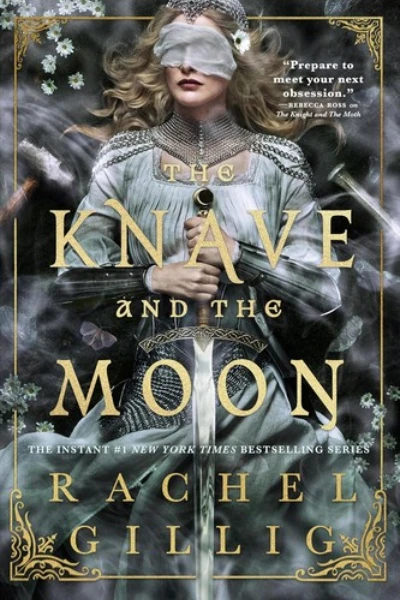
The Knave and the Moon
The Knave and the Moon — Chapter no 11
CHAPTER ELEVEN
THE DIFFERENCE BETWEEN HERESY
AND INGENUITY
Iwas still looking out the carriage window when a coin flew through the door. Benji appeared, smelling of wine.
“First that bitch ruins my joust and takes my winnings; now this,” he said, catching the coin and slamming into the velvet cushion bench across from me. “Oh, don’t bother hiding that face, Six. I’m sure it made your cold heart leap to see me fall from a horse. I just… can’t understand it.” He chewed his bottom lip. “What would sprites want with the spring?”
My head was buzzing, my pulse unsteady, the pain in my stomach searing. The farther we rode from the tor, the worse it got. “I don’t know.”
He took a flask from his belt and drank. “Gods, I hate the tor. Every time I go there I’m reminded of that first time.”
“When you came and ruined my life?”
“When my grandfather was stoned to death.”
I looked out the window.
“Of course, it’s rather in my favor that everyone should think that the creatures who destroyed the cathedral should treat its ruins like carrion.
Endlessly stupid, sprites. Still.” Benji scrubbed his hand over his face. “I should have brought my grandfather’s notebook. He kept a careful study of those beasts.”
“For which you thank him by slaughtering them.”
He’d toughened his skin on my quips. I could barely reach him now.
“Did the abbess ever tell you why sprites might want spring water?”
How dark the world looked out my window. “She never told me anything that was not, in some part, a lie.”
The king drank deeply from the flask. “What if someone should try to chop off a piece of that limestone and fashion another magical object? What if they drank the water or, gods forbid, brought someone back to life?” He shivered. “No. It must remain buried. My grandfather never got his second chance, and neither should that fucking spring.”
I kept my gaze on the window. Abruptly, the carriage quivered, then shook, a rolling rumble throwing Benji and me out of our seats. Outside, I could hear horses whickering.
As suddenly as it began, the rumblings stopped.
Benji’s crown was crooked. “What the hell was that?”
“Don’t know, sire,” came Tory’s muffled voice from outside. “A nearby
landslide, perhaps.”
“Felt like a bloody earthquake.”
Tory issued no reply, and soon we were rolling south again down the holloway road. Benji peered over my shoulder at the landscape. “Must have been difficult.” His tone was slower. Solemn. “You, too, have specters
among those ruins.”
More than he realized.
Rain pelted the roof. I could feel the king’s eyes on my shoulders and the hairs along the back of my neck. “I know what you’re thinking, Six,” he said. “Why you want to fight in the tournament.”
I said nothing.
“To you, I have become the abbess. You cannot forgive me for hurting your friends and entrapping you, and so you’d defeat my knights like you once defeated the Omens. The tournament is your mantle, and you take it up with vengeance. The same story, told again.”
He sighed. “But it will be for naught. The tournament is not a holy, righteous endeavor. It’s but a game of appearances; a display. And you…”
Those blue eyes measured me. “Maude and Rory may have dressed you up in armor—you may have a fondness for a hammer and chisel—but no one looks at a Diviner and sees a knight heralding a noble cause. All they see,
all they ever saw, is a girl who drowns.”
My gaze snapped up, cheeks scorched by fury.
Benji drained his flask, threw it onto the carriage floor, and leaned back, satisfied. “Though I must say, your rumored attendance in the joust brought in an astronomical amount of money to Coulson Faire. I have full confidence it will do the same in the Seacht. Funny, isn’t it?”
He levied the Artful Brigand’s coin, a grin toying at the corners of his lips. “The only thing folk are more keen to pay for than a Divination is the opportunity to hit you across the face in the arena.”
I turned on him, but he’d already anticipated me, tossed the coin, and disappeared from the carriage.
An hour later, the holloway road opened, and we reached the Tenor River, that body of water that split Traum. Reaching across it was a bridge, and beyond— The city-heart of the Stonewater Kingdom. Its buildings were tall, its roofs and turrets distinct against the night sky. Smoke rose from chimneys, the hamlet’s scribes likely hard at work despite the hour, writing and binding books, forging instruments of knowledge and innovation and war.
Not so long ago this had been the Harried Scribe’s haunt. Here, it was ink and knowledge, not coin, that guided men.
Here would be the second event—the melee.
We’d reached the Seacht.
Wheels groaning as they rolled from mud to hardened stones, we crossed the bridge. Dawn was a hint of gray in the sky when I was afforded a proper glance at the Tenor River. How it rushed, louder than I remembered, dawn’s early light painting it gray.
Creatures sat in the water, bobbing in the current. They had bluish bodies and milky eyes, slit nostrils, long snouts. When they peeled back their purple lips, bleating as we passed, their teeth were blunted.
Water sprites.
The knights saw them, too. Weapons were drawn—shortbows fitted with
arrows. Dedrick Lange rode his horse to the edge of bridge. He lifted his bow, aimed it at the water. Then, loathing coloring his dull, middling face, he shot.
The arrow hit the Tenor River, piercing a sprite’s shoulder. The creature bleated, crying out in pain. More arrows flew, hitting more sprites in the shoulders, the necks. I began to scream. “Stop.” I banged on the walls of the carriage, the pain in my abdomen white-hot. “Stop.”
No one heard me, and the arrows did not stop flying until nothing moved in the Tenor River save the water itself.
The bridge ended, and city streets began. We snaked our way through the Seacht—past buildings of brick and mortar and over cobbled lanes that grew more and more narrow. There were gray banners depicting the inkwell, but also the king’s purple sashes. It was early yet for folk to be about, and yet men and women and children with drawn faces and dirty clothes lingered along the edges of streets. When our caravan rolled past, they came with open, begging hands.
The knights pushed them away. Those who did not move fast enough were struck with the broad side of a sword. They cried out, scattering as fearfully and desperately as the water sprites had.
Ten minutes later, we’d reached a familiar wooden gate—the same place Bartholomew and I had wandered from and come back to the last time we’d trespassed upon the Seacht. The place Benji had told me the truth of the Omens. Where he’d convinced me, in a way only a boy with a chip on each shoulder could, to help him take up the mantle and kill the Omens. Where
Rory had measured me for armor.
The king’s barracks.
The carriage lock clicked and the door wrenched open. When Tory handed me out, shortbow slung on her back, all the arrows in her quiver had been spent.
I slammed my shoulder against hers, knocking her out of my way.
A scribe stood in front of the open gate, a dozen guards of the Seacht at his back. His brows were low and his gray robes long. In his hands, cupped with delicate care, was the Harried Scribe’s inkwell. “Majesties,” he called.
“You’re here sooner than we expected.”
Dedrick dismounted. Came forward and embraced the scribe, then took the inkwell from his hands. “Thank you for keeping it safe, Uncle.”
“Not for nothing. Folk are delirious to get a view of it in the arena.”
Benji dismounted and looked up at the barrack walls. “This is where you expect to host the tourney? It’s supposed to be a melee, Lange. Not a training session.”
The scribe rolled his eyes so vigorously they disappeared beneath the hairy shelf of his eyebrows. When he recovered, he turned to me. “I’m Otto Lange, Diviner. Dedrick’s uncle. Our family has called the Seacht home for many generations. It’s an honor to have you with us. If you will follow me inside—” He waved a hand, and two guards of the Seacht swung open the gate. “You will see that, despite limited time and a great number of tasks”— he eyed Benji—“considerable funds were spent; the training yard has been effectively transformed into an arena, with sizeable stands for viewing.”
“You’ll get your gold back, Lange,” Benji said, winking at Dedrick.
“Now—let’s take a look at this arena.”
The space hardly resembled itself. Wooden stands, raised by finely designed scaffolds, stood in a circle around the yard. “We’re currently fitting the king’s box,” Otto said. “Considering this is to be a melee, I assumed His Majesty and the queen would like to be kept safely out of range of the bedlam.” He nodded at me. “A Diviner of Aisling is no doubt used to being elevated above her subjects.”
“Just so.” My mouth felt incapable of even the thinnest smile. “But I’ll be fighting in the melee.”
“Really?” Otto Lange eyed his nephew. “How interesting.”
Benji, still surveying the scaffolding—the raised, elaborate seats—drew his sword. Pointed it to the west side of the stands. “There. Not a speck of spilled blood should go unnoticed from that vantage. Put the king’s box there.”
I moved with several knights onto the dirt floor that had once been the yard. It was larger now. A vast space to pass. For every step I took, the wound in my abdomen throbbed. I was sweating, laboring.
Ahead, mocking me with his vibrance, Benji skipped into the arena and twirled his sword. “What do you think, Dedrick?” he called. “Care to practice your victory bow?”
Hamelin drew his own sword and flashed his perfect smile at the king.
“How about we test out the arena instead?”
Benji answered his grin. “Why not?”
All five of them sparred, Dedrick with a mace, Tory with a spear, Samuel and Hamelin and Benji with swords. It was immediately clear this was a common affair for the quintet—they moved with precision, quick with their weapons, quicker with their feet, ever wary of the others in the arena. And Benji— He had been training. His hits were exact, his footfalls sure, the ring of steel a knell announcing his improvement. He even managed to knock Samuel off his feet, surprising him with an elbow, then a shove, and he turned with verve through the yard.
“Save your strength for the qualifications tomorrow, Dedrick,” Otto Lange called.
“As if he’ll need to.” Hamelin patted Dedrick’s back, and the knight pulled away from their session, kicking up dirt with his heavy steps. The others continued to spar, Hamelin and Tory taking on Samuel and Benji.
Dedrick Lange came and stood beside me, close enough that I could feel the chill radiating off his rerebrace. He set his mace on the ground and reached into a small leather pouch on his belt and retrieved the Harried Scribe’s inkwell.
“These stone objects of his are quite the marvel,” he said. “Limestone, I think. The kind Aisling Cathedral was built on—what the gargoyles are made of, what the spring leaches from. Not so different from your eyes, is it, Diviner?”
I peered over my shoulder and found him watching me. “Why is that?” he asked. “What is it about the limestone on the tor that gives it magic while the rest of Traum has none? What makes that spring and all the girls who drown in it so special?”
I told him what the Harried Scribe had once told me and tried not to stare at the inkwell. “Knowledge is mine to bear and yours to beg.” I wondered how it would break. Would it surrender beneath my heel like the loom stone had, or would I need that hammer I’d asked Tory for?
“I’d be careful if I were you, knight,” I said to Dedrick. “The king does not like probing questions about the spring. Not so long ago, questions like that were taken as heresy.”
“The only difference between heresy and ingenuity is timing. Benedict has chosen his well. This tournament, giving folk their spectacle while quietly raising his banner above the flags of Omens, is not something his
grandfather could have dreamed of achieving. There is no danger in questioning the cathedral’s practices now that its warden and her guard-dog gargoyles aren’t there to throw stones.”
His tone was conversational. His gaze was not. “All that is true, and yet you are right. The king does not like questions about the spring. Why is that?”
In the yard, Benji had faltered, his rapid steps churning dirt, his blade ringing as he blocked Hamelin’s downward cut.
Dedrick kept his gaze on me. “What exactly is it about the spring water that turns your eyes to stone? Does it alter you in other ways? Are you stronger for it? More fortified? Is that what you wish to prove in the arena?”
He sucked his teeth. “You certainly seem to feel pain like the rest of us. And I know you bleed.”
I said nothing, watching the inkwell as he looked me up and down, his gaze lingering over my abdomen. “It’s a game of strategy, the melee. War tactics in the arena. Far beyond your scope, I’m afraid. Or did you and your fellow Diviners practice tactical stratagems against the gargoyles up there on the tor?”
His bluntness was a slap to the cheek. “No,” I replied. “I simply hit my hammer upon granite, over and over again. I imagine a human head is far softer a target. Even one as swollen as yours.”
“Whatever it was the spring water did to you, I will know it. We of the Seacht like our knowledge on the page, and our chess pieces on the board— or back in the box where they belong.” Dedrick smiled for the first time.
His teeth were long. A little gray. “Stay out of the melee, Diviner.” He turned, following his uncle and several scribes out of the arena. “For your own good.”
I had three days until the melee, and not one of them would be spent on qualifications. There were more important things to do—a city full of books to take advantage of that I might learn something about ox-eye. Tory was my shadow, the two of us wandering cobblestone streets with the rest of the
folk who’d come to watch the melee. Chimneys bloomed with smoke, blacksmith forges roaring. Scribes sold and bound books, their windows and factory doors flung wide for visitors. Children ran through the streets, playing with toy weapons, stopping like everyone else to stare at me as I passed. The city was full of verve and excitement.
I couldn’t stomach it.
I didn’t wear my veil. No one had tied the damn thing around my head with an irrefutable knot—why keep it there? But the longer I trod the streets of the Seacht, gazing up at its impressive buildings and water wheels and mechanisms of innovation, the more folk gathered around me, emboldened in a way my shroud or veil had not previously allowed. Now, they came upon me quickly. Searched my eyes.
“What does the Harried Scribe say?” asked a woman wearing thick spectacles.
“I cannot see,” others complained, pushing one another to get to me.
“Please, Diviner, hold still—I’d like a glimpse—”
Tory was not a harsh bodyguard, but she was firm. She did not let anyone touch me, but she didn’t stop them from crowding, either.
I managed twenty minutes without them before I returned to the barracks for my veil and crown, slamming both over my head. “You see it, don’t you?” I said to Tory. “They look at me like I’m not a person.”
That seemed to surprise her. “But you aren’t. You’re a Diviner.”
My eyes weren’t the only things of interest in the city. Talk of the melee abounded, and folk had lined up outside the king’s barracks, hoping to catch an early glimpse of the arena. Tory and I pushed through them. An hour later, in the south part of the city, I found a scribe selling pamphlets.
“Where might I find something on ox-eye?” I asked him.
“Ox-eye?”
“It’s a sedative. It’s given me the strangest dreams. I’d like to know more.”
“Sounds like a question for a physician,” he answered.
I found a physician on the first floor of a large brick house. “What’s its proper name?” she asked, riffling through her books.
“Is ox-eye not a proper name?”
She peered over her spectacles. “We deal in exact terms here, Diviner, not hokum.”
By now Tory had grown accustomed to handing me ox-eye for pain and carried it in a flask on her belt. I snatched it and held it out to the surgeon.
“This is it.”
The woman wrinkled her nose, unstopped the flask, took a whiff, and coughed. “Smells rotten.”
“All I know is that it’s called ox-eye. The king’s surgeon administered it frequently.”
“Then you should’ve asked him what it was.” She snapped another book shut. “Try Josephine. She’s off the square.”
“Wonderful. Where’s that?”
Josephine, to my surprise, I already knew. She was the house mother of Pupil House II—a shelter for foundlings. I’d met her the last time I’d come to the Seacht. Back when I still thought I might find my Diviners.
“Aisling’s water,” she said, hand on her chest, when she saw me at her threshold. “You gave me a fright, Diviner.” She blinked up at my face.
“Didn’t you come here the other day asking me something? You and that mean-looking dog?”
My throat clogged. “He was a gargoyle, and that was over a month ago.”
I could hear the giggle of children in the house behind her. “Tell me, what
do you know about ox-eye?”
“Who’s that?”
“No—it’s a sedative. It reduces pain and brings on visions and terrible dreams.” I held out the flask.
“Not heard of anything like that.” Josephine sniffed the flask and made a gagging sound. “Nasty stuff.” A loud bang echoed through the house.
Josephine pinched her nose. “’Course, nasty tonics and bad dreams sound a right picnic compared to what I’ve got here—”
A low rumbling took hold of the Seacht, street signs swaying, windows rattling. Josephine braced the trembling doorframe and I gripped the door.
A moment later it stopped.
“What in Aisling’s waters?” Josephine’s mouth hung open. “Felt like an earthquake.”
“Not the first of late,” Tory murmured, scanning the city.
“You all right, love?” The house mother was watching me. “Got your moon’s blood?”
I hadn’t realized I’d been cradling my abdomen. “I’m fine.”
“Listen, I’ve got things for pain. Idleweed, if that’s your pleasure.”
I was already walking away.
There were books. Hundreds, maybe thousands. I didn’t know where to look for a draft whose name no one recognized. And even if I did manage to find information on ox-eye, I was growing more and more skeptical scribes of the Seacht would have condescended to chronicle its odd aftereffects— its visions and other such hokum. I found nothing.
“Keep back,” called the guards of the Seacht. “It’s the last round of qualifications. No one in or out.”
We’d returned to the barracks. Tory began to push, forcing her way through the crowd to the gates. I followed, broken pieces of conversations buzzing around me like wasps. “Never takes off his helmet and knocked down three men in as many minutes!”
“I wonder how the Diviner will fare against such ruthless—”
“Twenty coppers on the black team—Oi, what’s his name?”
“Goes by knave, I think.”
My gaze jerked back. A second later three children pushed by, the tallest elbowing me directly in my wound.
Tory found me gasping and wheezing and yanked me through the crowd.
“Move,” she said, shoving her way through the masses and into the narrow opening the guards had propped for us.
Men and women, knights and common folk, flung instruments in the arena. I barely saw them. I was staggering, desperate to shut myself away.
“Bring me that hammer,” I shouted back at Tory.
I fell onto the bed in my room. When I woke, a day and a half had passed. It was the night before the melee. I had not trained, not touched a hammer or put on my armor, and I was no closer to learning about ox-eye, its visions, or who spoke to me through them.
And the pain in my abdomen was getting worse.
I sat up shakily. My crown and veil were askew, and my shift was no longer white but a rust brown, stained along the middle where my wound had wept through its wrappings in my sleep. Someone had come and left water, bread, fresh bandages. I knocked over the food and water, hauled up my shift, and replaced the bandage, hissing as the old one peeled away.
Knock. Knock.
Someone was at my door. I swore. Hunched over. Stumbled to the
threshold and yanked it open.
Hamelin stood in the hallway. In his hands were a tray and a large silver goblet, brimming with ox-eye. “Your spirits, milady.”
I yanked it free. “Where’s Tory? She was supposed to bring me weapons and armor.”
“Melee is tomorrow, not this bloody minute.” His gaze dropped to my stained shift. “You’re, um, you’re bleeding.”
I pinched my nose. Put the goblet to my lips and downed its vile contents. “Ugck.” A moment later, the pain in my abdomen went from a booming shout to an ordinary yell. “What’s in it?” I managed. “Ox-eye, I
mean?”
“Do I look like an apothecary?”
He looked like a man asking to be rid of a few teeth.
“Sorry.” Hamelin put his hands up in a mock surrender. “All I know is that it’s an old recipe. It’s got herbs, spirits—absolutely nothing worth throwing a fit over.”
“Unhelpful as always.” I slammed the goblet down so hard that the tray, and Hamelin, wobbled. “Tell Tory I’m waiting for her.”
I went to shut the door, but Hamelin’s hand was there, blocking it. “You look pale. Trouble sleeping alone?”
I said nothing. “I can’t help but notice that you and Benedict haven’t spent the night together.” The timbre of his voice was sweeter than usual— bait at the end of a hook. “Strange behavior for a king and his bride, don’t you think?”
I glared at his hand, blocking the door.
“I think about that time at the end of summer,” he murmured. “When the knighthood escorted the Diviners to Coulson Faire. I know you remember.
You and I—”
“Go away, Hamelin.”
He grinned. “There I go again, opening my dumb mouth.” He took his hand off the door. “If you find yourself feeling lonely, Diviner, I’m just three rooms down. We can go for another evening stroll. Maybe even finish what we started in the glen by Coulson Faire. Benedict need not know.”
I slammed the door. Locked it. Collapsed on my cot, pain and nausea and revulsion curdling in my stomach. Slowly, the ox-eye did its work, the discomfort in my abdomen dulling, a leaden kind of heaviness weighing
upon my consciousness.
Blood pumped in my ears, behind my eyes, my senses thrown asunder.
White light flickered and flashed. Above me, rippling as it always did in the visions, was Aisling Cathedral’s ceiling.
Neither the abbess nor the Diviners nor the Omens were there.
But then—oh gods—the world began to shake. A catastrophic rumbling began above my head, a crawling fissure cutting into the cathedral ceiling.
Ten more joined, stone breaking open and raining down upon me. The entire cathedral ceiling was breaking apart.
I cried out. When the stones fell upon me there was a rushing sound, like water splashing. Everything went black. I was alone, suppressed by the weight of the fallen-in cathedral, lost and utterly hopeless in the dark.
I gasped, and I was Sybil once more, back in my chamber in the Seacht, wondering what I’d seen and what it meant, my heart galloping and my
senses righting.
The latch of my door turned.
Dedrick Lange stepped into my chamber wearing full armor.
I forced myself to my feet. “What are you—”
He caught my shoulders. Shoved me onto the floor. Kicked me once, twice, thrice, the iron sabbatons over his boot colliding with the wound in my abdomen. “Forgive me, Diviner,” he said. “But strategy is only effective when chess pieces move as they’re supposed to. I can’t risk you dying in the melee—and I can’t risk you winning it, either. That gold belongs to my uncle.” He smiled, showing me those gray teeth. “Enjoy the view from the king’s box.”
And then he was gone, locking the door behind him.
I curled into a ball, sweating and shaking. My body railed against the pain and I was sick on the floor. There was blood in my spit, bile, with dozens upon dozens of tiny white flecks of limestone within.
OceanofPDF.com