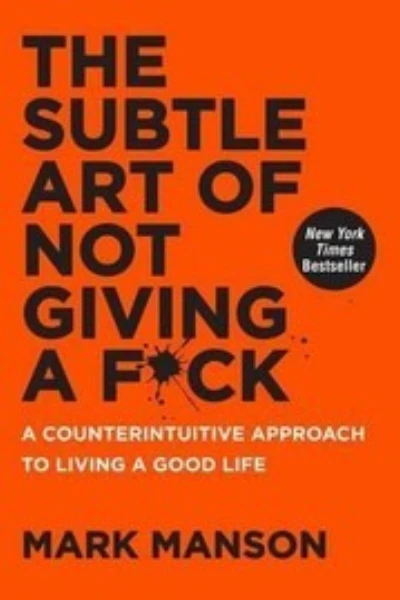
The Subtle Art of Not Giving a F*ck
The Subtle Art of Not Giving a F*ck — The Failure/Success Paradox
I grew up in a wealthy family. Money was never a problem. On the contrary, I grew up in a wealthy family where money was more often used to avoid problems than solve them. I was again fortunate, because this taught me at an early age that making money, by itself, was a lousy metric for myself.
You could make plenty of money and be miserable, just as you could be broke and be pretty happy. Therefore, why use money as a means to measure my self-worth?
Instead, my value was something else. It was freedom, autonomy. The idea of being an entrepreneur had always appealed to me because I hated being told what to do and preferred to do things my way. The idea of working on the Internet appealed to me because I could do it from anywhere and work whenever I wanted.
I asked myself a simple question: “Would I rather make decent money and work a job I hated, or play at Internet entrepreneur and be broke for a while?” The answer was immediate and clear for me: the latter. I then asked myself, “If I try this thing and fail in a few years and have to go get a job anyway, will I have really lost anything?” The answer was no. Instead of a broke and unemployed twenty-two-year-old with no experience, I’d be a broke and unemployed twenty-five-year-old with no experience. Who cares?
With this value, to not pursue my own projects became the failure—not a lack of money, not sleeping on friends’ and family’s couches (which I continued to do for most of the next two years), and not an empty résumé.
The Failure/Success Paradox When Pablo Picasso was an old man, he was sitting in a café in Spain, doodling on a used napkin. He was nonchalant about the whole thing, drawing whatever amused him in that moment—kind of the same way teenage boys draw penises on bathroom stalls—except this was Picasso, so his bathroom-stall penises were more like cubist/impressionist awesomeness laced on top of faint coffee stains.
Anyway, some woman sitting near him was looking on in awe. After a few moments, Picasso finished his coffee and crumpled up the napkin to throw away as he left.
The woman stopped him. “Wait,” she said. “Can I have that napkin you were just drawing on? I’ll pay you for it.”
“Sure,” Picasso replied. “Twenty thousand dollars.”
The woman’s head jolted back as if he had just flung a brick at her.
“What? It took you like two minutes to draw that.”
“No, ma’am,” Picasso said. “It took me over sixty years to draw this.”
He stuffed the napkin in his pocket and walked out of the café.
Improvement at anything is based on thousands of tiny failures, and the magnitude of your success is based on how many times you’ve failed at something. If someone is better than you at something, then it’s likely because she has failed at it more than you have. If someone is worse than you, it’s likely because he hasn’t been through all of the painful learning experiences you have.
If you think about a young child trying to learn to walk, that child will fall down and hurt itself hundreds of times. But at no point does that child ever stop and think, “Oh, I guess walking just isn’t for me. I’m not good at it.”
Avoiding failure is something we learn at some later point in life. I’m sure a lot of it comes from our education system, which judges rigorously based on performance and punishes those who don’t do well. Another large share of it comes from overbearing or critical parents who don’t let their kids screw up on their own often enough, and instead punish them for trying anything new or not preordained. And then we have all the mass media that constantly expose us to stellar success after success, while not showing us the thousands of hours of dull practice and tedium that were required to achieve that success.
At some point, most of us reach a place where we’re afraid to fail, where we instinctively avoid failure and stick only to what is placed in front of us or only what we’re already good at.
This confines us and stifles us. We can be truly successful only at something we’re willing to fail at. If we’re unwilling to fail, then we’re unwilling to succeed.
A lot of this fear of failure comes from having chosen shitty values. For instance, if I measure myself by the standard “Make everyone I meet like me,” I will be anxious, because failure is 100 percent defined by the actions of others, not by my own actions. I am not in control; thus my self-worth is at the mercy of judgments by others.
Whereas if I instead adopt the metric “Improve my social life,” I can live up to my value of “good relations with others” regardless of how other
people respond to me. My self-worth is based on my own behaviors and happiness.
Shitty values, as we saw in chapter 4, involve tangible external goals outside of our control. The pursuit of these goals causes great anxiety. And even if we manage to achieve them, they leave us feeling empty and lifeless, because once they’re achieved there are no more problems to solve.
Better values, as we saw, are process-oriented. Something like “Express myself honestly to others,” a metric for the value “honesty,” is never completely finished; it’s a problem that must continuously be reengaged.
Every new conversation, every new relationship, brings new challenges and opportunities for honest expression. The value is an ongoing, lifelong process that defies completion.
If your metric for the value “success by worldly standards” is “Buy a house and a nice car,” and you spend twenty years working your ass off to achieve it, once it’s achieved the metric has nothing left to give you. Then say hello to your midlife crisis, because the problem that drove you your entire adult life was just taken away from you. There are no other opportunities to keep growing and improving, and yet it’s growth that generates happiness, not a long list of arbitrary achievements.
In this sense, goals, as they are conventionally defined—graduate from college, buy a lake house, lose fifteen pounds—are limited in the amount of happiness they can produce in our lives. They may be helpful when pursuing quick, short-term benefits, but as guides for the overall trajectory of our life, they suck.
Picasso remained prolific his entire life. He lived into his nineties and continued to produce art up until his final years. Had his metric been “Become famous” or “Make a buttload of money in the art world” or “Paint one thousand pictures,” he would have stagnated at some point along the way.
He would have been overcome by anxiety or self-doubt. He likely wouldn’t have improved and innovated his craft in the ways he did decade after decade.
The reason for Picasso’s success is exactly the same reason why, as an old man, he was happy to scribble drawings on a napkin alone in a café. His underlying value was simple and humble. And it was endless. It was the value “honest expression.” And this is what made that napkin so valuable.