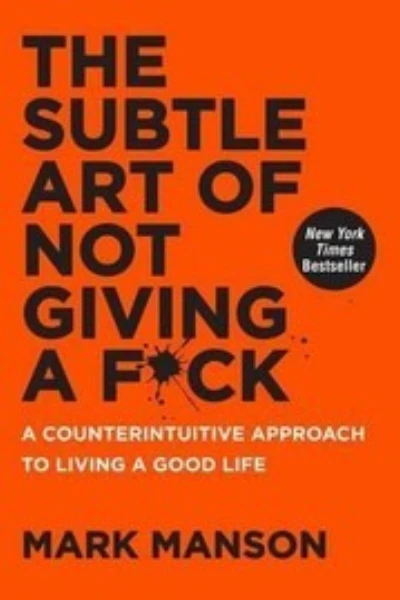
The Subtle Art of Not Giving a F*ck
The Subtle Art of Not Giving a F*ck — Rejection Makes Your Life Better
what seems obvious in your own life and to consider that perhaps it’s not necessarily the best way to live. In this case, Russia had me reexamining the bullshitty, fake-nice communication that is so common in Anglo culture, and asking myself if this wasn’t somehow making us more insecure around each other and worse at intimacy.
I remember discussing this dynamic with my Russian teacher one day, and he had an interesting theory. Having lived under communism for so many generations, with little to no economic opportunity and caged by a culture of fear, Russian society found the most valuable currency to be trust. And to build trust you have to be honest. That means when things suck, you say so openly and without apology. People’s displays of unpleasant honesty were rewarded for the simple fact that they were necessary for survival—you had to know whom you could rely on and whom you couldn’t, and you needed to know quickly.
But, in the “free” West, my Russian teacher continued, there existed an abundance of economic opportunity—so much economic opportunity that it became far more valuable to present yourself in a certain way, even if it was false, than to actually be that way. Trust lost its value. Appearances and salesmanship became more advantageous forms of expression. Knowing a lot of people superficially was more beneficial than knowing a few people closely.
This is why it became the norm in Western cultures to smile and say polite things even when you don’t feel like it, to tell little white lies and agree with someone whom you don’t actually agree with. This is why people learn to pretend to be friends with people they don’t actually like, to buy things they don’t actually want. The economic system promotes such deception.
The downside of this is that you never know, in the West, if you can completely trust the person you’re talking to. Sometimes this is the case even among good friends or family members. There is such pressure in the West to be likable that people often reconfigure their entire personality depending on the person they’re dealing with.
Rejection Makes Your Life Better
As an extension of our positivity/consumer culture, many of us have been “indoctrinated” with the belief that we should try to be as inherently accepting and affirmative as possible. This is a cornerstone of many of the so-called positive thinking books: open yourself up to opportunities, be accepting, say yes to everything and everyone, and so on.
But we need to reject something. Otherwise, we stand for nothing. If nothing is better or more desirable than anything else, then we are empty and our life is meaningless. We are without values and therefore live our life without any purpose.
The avoidance of rejection (both giving and receiving it) is often sold to us as a way to make ourselves feel better. But avoiding rejection gives us short-term pleasure by making us rudderless and directionless in the long term.
To truly appreciate something, you must confine yourself to it. There’s a certain level of joy and meaning that you reach in life only when you’ve spent decades investing in a single relationship, a single craft, a single career. And you cannot achieve those decades of investment without rejecting the alternatives.
The act of choosing a value for yourself requires rejecting alternative values. If I choose to make my marriage the most important part of my life, that means I’m (probably) choosing not to make cocaine-fueled hooker orgies an important part of my life. If I’m choosing to judge myself based on my ability to have open and accepting friendships, that means I’m rejecting trashing my friends behind their backs. These are all healthy decisions, yet they require rejection at every turn.
The point is this: we all must give a fuck about something, in order to value something. And to value something, we must reject what is not that something. To value X, we must reject non-X.
That rejection is an inherent and necessary part of maintaining our values, and therefore our identity. We are defined by what we choose to reject. And if we reject nothing (perhaps in fear of being rejected by something ourselves), we essentially have no identity at all.
The desire to avoid rejection at all costs, to avoid confrontation and conflict, the desire to attempt to accept everything equally and to make everything cohere and harmonize, is a deep and subtle form of entitlement.
Entitled people, because they feel as though they deserve to feel great all the