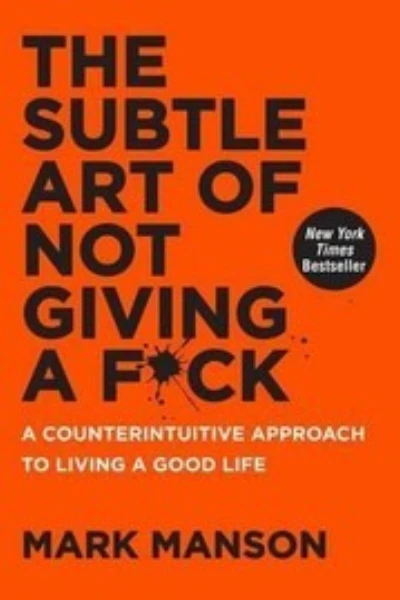
The Subtle Art of Not Giving a F*ck
The Subtle Art of Not Giving a F*ck — Kill Yourself
Years passed and he never did give up his “real job.” Why? Because despite dreaming about making a living through his art, the real potential of becoming An Artist Nobody Likes was far, far scarier than remaining An Artist Nobody’s Heard Of. At least he was comfortable with and used to being An Artist Nobody’s Heard Of.
I had another friend who was a party guy, always going out drinking and chasing girls. After years of living the “high life,” he found himself terribly lonely, depressed, and unhealthy. He wanted to give up his party lifestyle. He spoke with a fierce jealousy of those of us who were in relationships and more “settled down” than he was. Yet he never changed. For years he went on, empty night after empty night, bottle after bottle. Always some excuse.
Always some reason he couldn’t slow down.
Giving up that lifestyle threatened his identity too much. The Party Guy was all he knew how to be. To give that up would be like committing psychological hara-kiri.
We all have values for ourselves. We protect these values. We try to live up to them and we justify them and maintain them. Even if we don’t mean to, that’s how our brain is wired. As noted before, we’re unfairly biased toward what we already know, what we believe to be certain. If I believe I’m a nice guy, I’ll avoid situations that could potentially contradict that belief. If I believe I’m an awesome cook, I’ll seek out opportunities to prove that to myself over and over again. The belief always takes precedence. Until we change how we view ourselves, what we believe we are and are not, we cannot overcome our avoidance and anxiety. We cannot change.
In this way, “knowing yourself” or “finding yourself” can be dangerous. It can cement you into a strict role and saddle you with unnecessary expectations. It can close you off to inner potential and outer opportunities.
I say don’t find yourself. I say never know who you are. Because that’s what keeps you striving and discovering. And it forces you to remain humble in your judgments and accepting of the differences in others.
Kill Yourself Buddhism argues that your idea of who “you” are is an arbitrary mental construction and that you should let go of the idea that “you” exist at all; that the arbitrary metrics by which you define yourself actually trap you, and thus
you’re better off letting go of everything. In a sense, you could say that Buddhism encourages you to not give a fuck.
It sounds wonky, but there are some psychological benefits to this approach to life. When we let go of the stories we tell about ourselves, to ourselves, we free ourselves up to actually act (and fail) and grow.
When someone admits to herself, “You know, maybe I’m not good at relationships,” then she is suddenly free to act and end her bad marriage. She has no identity to protect by staying in a miserable, crappy marriage just to prove something to herself.
When the student admits to himself, “You know, maybe I’m not a rebel; maybe I’m just scared,” then he’s free to be ambitious again. He has no reason to feel threatened by pursuing his academic dreams and maybe failing.
When the insurance adjuster admits to himself, “You know, maybe there’s nothing unique or special about my dreams or my job,” then he’s free to give that screenplay an honest go and see what happens.
I have both some good news and some bad news for you: there is little that is unique or special about your problems. That’s why letting go is so liberating.
There’s a kind of self-absorption that comes with fear based on an irrational certainty. When you assume that your plane is the one that’s going to crash, or that your project idea is the stupid one everyone is going to laugh at, or that you’re the one everyone is going to choose to mock or ignore, you’re implicitly telling yourself, “I’m the exception; I’m unlike everybody else; I’m different and special.”
This is narcissism, pure and simple. You feel as though your problems deserve to be treated differently, that your problems have some unique math to them that doesn’t obey the laws of the physical universe.
My recommendation: don’t be special; don’t be unique. Redefine your metrics in mundane and broad ways. Choose to measure yourself not as a rising star or an undiscovered genius. Choose to measure yourself not as some horrible victim or dismal failure. Instead, measure yourself by more mundane identities: a student, a partner, a friend, a creator.
The narrower and rarer the identity you choose for yourself, the more everything will seem to threaten you. For that reason, define yourself in the simplest and most ordinary ways possible.