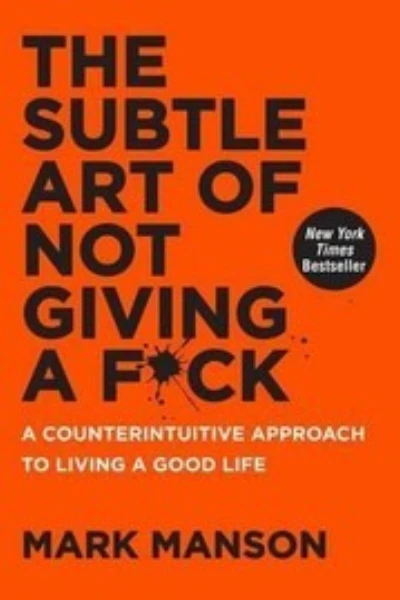
The Subtle Art of Not Giving a F*ck
The Subtle Art of Not Giving a F*ck — Manson’s Law of Avoidance
It’s the backwards law again: the more you try to be certain about something, the more uncertain and insecure you will feel.
But the converse is true as well: the more you embrace being uncertain and not knowing, the more comfortable you will feel in knowing what you don’t know.
Uncertainty removes our judgments of others; it preempts the unnecessary stereotyping and biases that we otherwise feel when we see somebody on TV, in the office, or on the street. Uncertainty also relieves us of our judgment of ourselves. We don’t know if we’re lovable or not; we don’t know how attractive we are; we don’t know how successful we could potentially become. The only way to achieve these things is to remain uncertain of them and be open to finding them out through experience.
Uncertainty is the root of all progress and all growth. As the old adage goes, the man who believes he knows everything learns nothing. We cannot learn anything without first not knowing something. The more we admit we do not know, the more opportunities we gain to learn.
Our values are imperfect and incomplete, and to assume that they are perfect and complete is to put us in a dangerously dogmatic mindset that breeds entitlement and avoids responsibility. The only way to solve our problems is to first admit that our actions and beliefs up to this point have been wrong and are not working.
This openness to being wrong must exist for any real change or growth to take place.
Before we can look at our values and prioritizations and change them into better, healthier ones, we must first become uncertain of our current values.
We must intellectually strip them away, see their faults and biases, see how they don’t fit in with much of the rest of the world, to stare our own ignorance in the face and concede, because our own ignorance is greater than us all.
Manson’s Law of Avoidance Chances are you’ve heard some form of Parkinson’s law: “Work expands so as to fill up the time available for its completion.”
You’ve also undoubtedly heard of Murphy’s law: “Whatever can go wrong will go wrong.”
Well, next time you’re at a swanky cocktail party and you want to impress somebody, try dropping Manson’s law of avoidance on them:
The more something threatens your identity, the more you will avoid it.
That means the more something threatens to change how you view yourself, how successful/unsuccessful you believe yourself to be, how well you see yourself living up to your values, the more you will avoid ever getting around to doing it.
There’s a certain comfort that comes with knowing how you fit in the world. Anything that shakes up that comfort—even if it could potentially make your life better—is inherently scary.
Manson’s law applies to both good and bad things in life. Making a million dollars could threaten your identity just as much as losing all your money; becoming a famous rock star could threaten your identity just as much as losing your job. This is why people are often so afraid of success—for the exact same reason they’re afraid of failure: it threatens who they believe themselves to be.
You avoid writing that screenplay you’ve always dreamed of because doing so would call into question your identity as a practical insurance adjuster. You avoid talking to your husband about being more adventurous in the bedroom because that conversation would challenge your identity as a good, moral woman. You avoid telling your friend that you don’t want to see him anymore because ending the friendship would conflict with your identity as a nice, forgiving person.
These are good, important opportunities that we consistently pass up because they threaten to change how we view and feel about ourselves. They threaten the values that we’ve chosen and have learned to live up to.
I had a friend who, for the longest time, talked about putting his artwork online and trying to make a go of it as a professional (or at least semiprofessional) artist. He talked about it for years; he saved up money; he even built a few different websites and uploaded his portfolio.
But he never launched. There was always some reason: the resolution on his work wasn’t good enough, or he had just painted something better, or he wasn’t in a position to dedicate enough time to it yet.