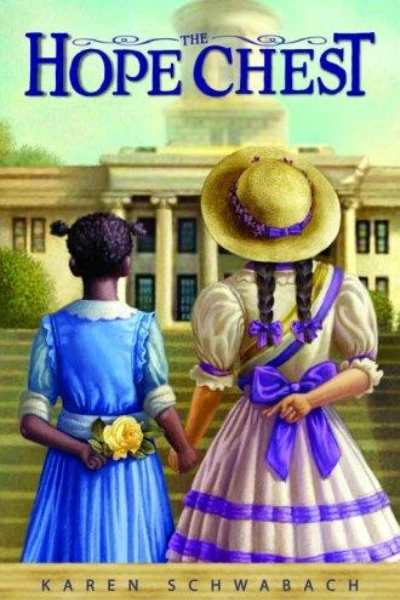
The Hope Chest
The Hope Chest — Chapter 8 - In the Jim Crow Car
In the Jim Crow Car
MYRTLE HAD HER BUNDLE TUCKED UNDER one arm—the extra cut-down dress and a toothbrush and a comb that Miss Burns had bought for her. The only possession she really cared about she always carried in her pocket, like a talisman. It was a tiny tin-framed snapshot that Mama and Daddy had had taken the day they were married. Mama had come through clearly, looking just like Mama only not as tired as Myrtle remembered her. Daddy was mostly hidden. The ash powder had left a blurred spot in the middle of Daddy's face, so that she could only see the edges of it. She wished whoever had taken the picture had known this was going to be the only time William Davies's daughter would ever see him and had tried again.
Daddy had gone down to Panama to work on Mr. Roosevelt's canal just before Myrtle was born. Then he had died, either of yellow fever or in a cave-in; the boss who wrote to Mama wasn't sure. So many American colored men died digging the Panama Canal, according to Mama, that the bosses couldn't keep track of them. Myrtle imagined that Daddy might have looked a bit like Mr.
Martin, only much handsomer, and colored, of course. She liked Mr.
Martin. He reminded her of Daddy somehow, which was dumb, considering Myrtle had never actually met her father.
The conductor followed Myrtle down the length of the train car to the vestibule between the cars, then said, “The colored car's all the
way at the back,” and left her. Myrtle struggled to open the door into the next car, the one behind the one that Mr. Martin and the other white people were in. The door wouldn't budge. She braced one foot against the side of the train car and hauled as hard as she could at the handle. The door opened and she stumbled backward but managed to recover and get through the door before it closed.
The next car was full of white people, and Myrtle hurried through it. Some of them gave her cold stares over their newspapers. One woman smiled at Myrtle and said to the man next to her, “They're so cute when they're little.”
The train started and Myrtle fell down. Somebody laughed. Myrtle got to her feet, angry but schooling her face to perfect passive indierence. She made her way backward as the train sped forward.
A conductor grabbed her arm.
“You're in the wrong car, girl,” he said.
Myrtle gave him a vacant look. “I'm going to the colored car, mister.”
“The Jim Crow car is in the back,” the conductor said. He opened the door at the rear of the car and shoved Myrtle through it. “Keep walking.”
The oor of the vestibule shifted and creaked under Myrtle's feet.
The doors to the cars were even harder to open now that the train was moving. Myrtle found she couldn't open the next one at all, and against her will, tears of frustration started in her eyes. Then a white man came through going in the other direction and Myrtle was able to pass through. He didn't even see her. Colored people were completely invisible to some white people, Myrtle had noticed. If she worked at it, she could make herself even more invisible. It was the only kind of magic she knew how to do.
Finally she got to the colored car. It was older than the other cars, with an open platform at the end instead of a vestibule. That made the door the hardest of all to open, but a young woman sitting at the front of the car saw Myrtle through the window and came and opened the door for her.
This car was made all of wood, and the seats were covered with woven rattan instead of mohair. The people in the seats were all colored. Myrtle felt relieved, knowing that nobody in the car was going to give her evil looks over their newspapers. But there was a conductor at the end of the car, coming toward her. He was white, of course; all conductors were. He was taking tickets, reading them carefully, and snapping them neatly with his hole puncher. Myrtle felt for the ticket she had in her pocket and hoped that other stupid conductor hadn't made any mistakes on it.
Myrtle looked around for an empty seat. The car was very full.
She saw a space next to an old woman— remarkably old. The woman looked almost too old to be human. She looked more like a very ancient tree that Myrtle knew of that grew in Anacostia, Washington. The woman was wearing the full, long skirts that had gone out of fashion before Myrtle was born.
The old woman saw her looking and patted the rattan seat beside her. “No one sitting here, child.”
“Thank you, ma'am,” Myrtle said. The rattan seat creaked as Myrtle sat down in the space between the woman's full skirts and the wooden wall of the train car. The seat had no springs, and Myrtle jolted with each clank of the wheels rattling against the rails.
Myrtle had heard someone say that trains ran on paper-cored wheels, but she didn't see how a train could run on paper, and the wheels sounded like metal to her.
The conductor stopped in front of the old woman and held out his hand for her ticket.
“Where are we headed to today, Auntie?” he said.
The old woman murmured something in reply. Her voice was so weak Myrtle couldn't make it out.
“Change trains in Lexington, Auntie,” said the conductor. He punched her ticket and reached for Myrtle's.
“Change in Chattanooga for Nashville,” he said to Myrtle. She guessed her ticket was all right.
“Mrs. Merganser is my name,” said the old woman, speaking quite clearly once the conductor had moved on.
“Pleased to meet you, ma'am,” said Myrtle politely. “I'm Myrtle
Davies.”
They rode on in silence for a while.
“You have people in Tennessee?” Mrs. Merganser asked eventually.
“Yes, ma'am.” Myrtle had never heard that she had people there, but there were people in Tennessee, no doubt, so it was possible that some of them were Myrtle's.
Mrs. Merganser seemed to accept this as reason enough for Myrtle's traveling. People sometimes sent their children on trains alone, because who could aord an extra adult's fare just to escort a child who presumably had brains enough to change trains by herself?
“How old do you think I am, child?” Mrs. Merganser asked.
“I don't know, ma'am,” said Myrtle, thinking that the woman must be at least a hundred.
“I don't know either. I was born in Alabama a long time before freedom came. When I was no bigger than you, I was sold away from my mother into Georgia, and I never saw her again.”
Myrtle kept her eyes cast down and listened respectfully. She had met old people who had been slaves before. None of them had been as old as Mrs. Merganser, though.
“My rst baby was sold away from me when he was one year old.
The second as well. Then my master died and left me to his brother in his will, along with some cows and a horse.” Myrtle heard the sarcasm in the old woman's voice. “But my husband he left to another brother. So I lost him too. Do you want an apple?”
Myrtle felt derailed by the sudden change of subject. “Yes, ma'am.”
Mrs. Merganser dug an apple out of her handbag, polished it against her skirt, and gave it to Myrtle. Myrtle was struck by how
bright and smooth the apple looked against Mrs. Merganser's wrinkled old skin.
Myrtle savored the rst bite of apple, crushing it between her teeth and letting the cider run over her tongue. Mrs. Merganser went on.
“After freedom, I searched for my rst two children, but I never found them. I didn't look for my rst husband, because by that time I was married again.”
Mrs. Merganser looked at Myrtle sharply, as though daring her to
say anything.
Myrtle said, “Yes, ma'am.”
“Nowadays they'd call that bigamy.” She shook her nger at Myrtle. “You can't marry another husband unless you divorce the rst one or he dies. But back then it didn't matter. Colored folk marrying didn't matter any more than dogs or cattle marrying, in the eyes of the law.”
Myrtle wiped apple juice from her chin with her sleeve. Mrs.
Merganser shook her head disapprovingly and handed her a handkerchief.
“I had eight children before freedom and four after,” she went on.
“And only three are alive today, not counting the two I don't know about.”
Myrtle tried to think of something comforting to say and came up with, “Pretty soon, though, ma'am, they're going to let women vote.”
Mrs. Merganser shook her head in disbelief. “You think they're going to let us vote? Even if they do pass this amendment and let white women vote, you think they're going to let colored women vote? You haven't been listening to a word I've said, child.”
“Yes, ma'am,” Myrtle contradicted.
“You don't know much, child. I've just been telling you how I was sold and willed and bartered about like so much livestock, and
you've got it into your head that white folks are going to let me vote?”
Myrtle said nothing. To say “yes, ma'am” again would, she felt, be pushing her luck.
“I guess you don't know,” said Mrs. Merganser, “that these white people talked about amending this amendment of theirs. They talked about xing it to say that white women could vote and colored women couldn't. They said that would make it easier to get the amendment passed. And I'll tell you something.”
“Ma'am?”
“These white people were right. If they could've xed that amendment to leave out colored women, it would've passed a long time ago.”
“Yes, ma'am,” said Myrtle. She didn't know if what Mrs.
Merganser said about the amendment was true. She hadn't paid very close attention to the news stories about it. But she did know one thing. “I'm going to vote, ma'am, when I grow up.”
Mrs. Merganser hued derisively. “We're sitting here in this Jim Crow car because white people don't want to have to look at us when they ride on a train. And you think these same white people are going to let you pick their president for them.”
Myrtle looked at the oorboards. Put that way, it did sound foolish.
“And if you live in Washington, D.C.,” Mrs. Merganser added, “you can't vote anyway, man, woman, or child; white or colored.”
“Then I won't live in Washington,” said Myrtle.
“I think you must be the most stubborn child ever born,” said Mrs.
Merganser.
“Yes, ma'am,” said Myrtle, glad they'd gotten that straight.