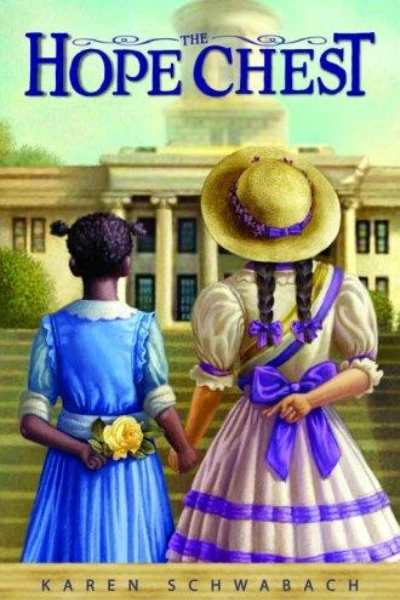
The Hope Chest
The Hope Chest — Chapter 15 - The Ferocious Mrs. Catt
The Ferocious Mrs. Catt
WITH HER WHITE DRESS AND PURPLE SATIN sash, Violet was suitably dressed to eat in the dining room at the Hermitage Hotel, and that was where she was on the evening of Saturday, August 14. The Antis must've had plenty of money, all right, because there were at least a dozen of them sitting around the dinner table. None of them seemed to make anything of the fact that Violet was there too, or to be worried about the expense.
They had had rack of lamb, tomato consommé, scalloped potatoes, creamed cauliower, and hot slaw, and now they were waiting for dessert. The orchestra was playing, and waiters in white uniforms with white gloves were zipping to and fro carrying platters with silver covers.
Violet was being seen and not heard, just like at home, although she had long since realized that what this really meant was not being seen either. The Antis were talking about the Senate vote, which they had lost, and the House vote, which they expected to win.
“There's no way we can lose in the House,” Miss Josephine Anderson Pearson said. “A week ago the Sus had two-thirds of the House members on their side, and now, thanks to us, they haven't even got a simple majority.”
“But we lost the Senate, didn't we?” said Miss Escuadrille, looking confused.
“We always expected to lose the Senate,” said Miss Pearson dismissively.
“Did we expect to lose it twenty-ve to four?” Miss Escuadrille asked.
“Never you mind, Annasette. Everything's under the control of wiser minds than yours,” said Miss Pearson as a white-gloved waiter set a dish of caramel custard in front of her.
A week ago, Violet thought, she had telegraphed her parents from Washington. Nine days ago she had still been at home. It seemed much longer.
Mrs. James S. Pinckard looked after the waiter, who had gone to get more custard. “Nothing but white servants are visible at this hotel. They guarantee it.”
“There are colored waiters downstairs in the Grill Room,” said the man sitting to Violet's left, who Violet thought was named Mr.
Garlick. “In fact, they're all colored.”
“Oh, well, waiters.” The man to Violet's right spoke, to her considerable surprise. He was dressed in a Confederate army uniform, which he had dribbled some tomato consommé down the front of. He had a bushy white mustache and long white hair combed over a bald spot on top. He had spent most of the meal staring o into space, although occasionally he stared at the other people at the table as if he was trying to gure out who they were.
“People expect waiters to be colored.”
Having spoken, he stared straight ahead of him again and dropped his spoon on the oor. Violet got down under the table to retrieve it for him.
“Speaking of dark colors, isn't this paneling beautiful?” said Mrs.
Pinckard. “It's Circassian walnut. Made in Russia by the same factory that did the woodwork for the Titanic.”
“Ha, you didn't hear anything about equal rights on the Titanic, did you?” said Mr. Garlick. “Now what are we going to do about the Bolshevik?”
“Which Bolshevik?” said Mrs. Pinckard. “They're pretty much all Bolsheviks.”
Violet had seen the spoon next to Mrs. Pinckard's high-heeled
pump, but she froze and listened.
“That foreign Jew,” said Mr. Garlick.
“Oh, the Jew,” said Miss Pearson.
There was something about the way they both said “Jew” that made Violet's skin crawl.
“He can be made to disappear,” said Mr. Garlick.
“Mr. Garlick, I really don't think we need to go as far as murder,”
Mrs. Pinckard whispered, and gave a nervous laugh.
Something glopped coldly down on Violet's arm. She looked. It was caramel custard. Someone must have given the Confederate veteran another spoon.
“I'm not talking about murder,” said Mr. Garlick, sounding both aronted and amused. “All we need is for the Jew to disappear for a week or so. That'll throw the Sus into at least as big a tizzy as they were in when they lost Seth Walker.”
“Can't they lose the Jew the same way?” said Miss Escuadrille, sounding like she was desperately trying to keep up with the conversation.
“He's not for sale,” said Miss Pearson dismissively. “Do you know he actually claims to have no interest in politics? Ran for the legislature for this special session merely so he could vote for the Susan B. Anthony Amendment. No hope of making him disappear till it's over.”
“Sure there is,” said Mr. Garlick. “How about if he wakes up Monday morning with a big bump on his bald head, locked in the hold of a tramp steamer headed south out of New Orleans?”
Violet had heard enough. She crawled out from under the table, squeezing carefully between the Confederate veteran's gray-clad legs and Mr. Garlick's spats without touching either of them. She slid along the Circassian walnut–paneled wall and hurried through the busy lobby and out the women's entrance. She had to tell Chloe what she'd heard right away.
Chloe had been assigned to squire around a fella named Harry T.
Burn, a legislator from McMinn County. He was no older than Chloe was and had had a question mark next to his name on yesterday's list. She had taken him to the burlesque and then to supper, but she must be done with him now. Violet ran down Union Street to Polk Avenue, then turned the corner and went downhill to the Tulane Hotel.
The Hope Chest was parked out front. But Chloe wasn't in her room.
“She's gone dancing with Harry T. Burn,” said Miss Lewis.
“They're over at the Hermitage Hotel, up on the tenth oor. I'm headed over there myself, if you'll just wait for a minute—”
“Sorry, can't,” said Violet, turning and running back down the stairs again.
It was really too hot for all this running, not to mention nearly impossible in Mary Janes, which had slippery soles and narrow straps that cut into your ankle. At least the hotels were only two blocks apart. Violet walked fast, back to the ladies' entrance of the Hermitage and into the elevator, where she told the white- uniformed boy, “Top oor, please.”
It took them a long time to get there, and as they rode up, Violet's panic lessened. Whoever they were talking about kidnapping—and it was clearly one of the Su legislators—it didn't sound like a really solid plan. It was just Mr. Garlick talking, and he might be the sort of man who just liked to say things to shock people. Still, whoever they'd been talking about needed to know he might be in danger.
The elevator stopped for a long time on the eighth oor, where the Antis' hospitality suite had apparently been fully restocked.
There was loud singing going on, of several anti-surage songs at once. None of the Antis' songs were anywhere near as stirring as the Sus' songs, Violet thought, even when the singers weren't drunk.
The top oor of the Hermitage was a big ballroom, with a wide wooden dance oor and an orchestra. It was full of men and women —mostly women—wearing evening dress and red or yellow roses.
Violet was momentarily grateful to Miss Escuadrille for dressing her in clothes that wouldn't get her thrown out of the ballroom. She looked around for her sister.
There she was—wearing a long white gown and a yellow rose and dancing with a young man with slicked-back blond hair, who was wearing a red rose.
“Miss Mayhew's certainly kept Harry T. Burn busy,” said a lady standing near Violet. “If we have the woman power, we need to keep the Antis away from him. He just might be persuadable.”
Persuadable or not, Mr. Burn seemed to be having a good time.
Clearly Chloe was doing her work well, Violet thought. In fact, all of the men, whether they wore yellow or red roses, seemed to be enjoying the extra attention they were getting.
“I don't know, Mrs. Dudley,” said another woman, whom Violet recognized as Miss Pollitzer. “He said something to me about ‘my vote will never hurt you,’ but he was batting his eyes when he said it. I think he's just irting with us.”
“He can irt all he wants as long as he votes aye,” said Mrs.
Dudley. “Let's go get some punch.”
Violet looked up to see Mr. Martin enter the ballroom. He had somehow gotten hold of a necktie and a celluloid collar, which he had buttoned over his Bolshevik soft collar, but other than that, he hadn't made any concessions to the sort of clothing you were supposed to wear in a ballroom. What was the matter with the fella, Violet thought, irritated. Why did he have to keep showing his wanted face in public?
He marched over to where Chloe was dancing with Mr. Burn. He tapped Mr. Burn on the shoulder.
“May I cut in?” Violet heard him say.
Violet knew from dancing school that there was only one way a gentleman could react to such a challenge, and that was to leave as gracefully as possible. Chloe and Mr. Martin started waltzing as Mr.
Burn backed away, looking disgruntled. He headed for the sidelines, and Violet saw an Anti eyeing him eagerly. Miss Pollitzer and Mrs.
Dudley were nowhere to be seen.
Violet quickly stepped into his path. “Mr. Burn, please, may I have the honor of this dance?” She held out her hand, wondering if she should bow. The boys had been taught to do this in dancing school, but girls, of course, didn't ask people to dance. They waited to be asked. But Chloe wouldn't want Mr. Burn to fall into the hands of an Anti.
Mr. Burn looked amused. “Why not?” he said, which was not what the girls in dancing school were taught to say. He took her outstretched hand, and Violet stepped gracefully into the dance with him.
One good thing about dancing school was that even though there were about a hundred better ways to spend an afternoon, it did teach you to dance. Violet had no trouble following Mr. Burn's steps and felt only a little self-conscious waltzing across the oor among all these adults.
“I'm Violet, Miss Mayhew's sister,” Violet said, introducing herself belatedly.
“And yet you seem to be on the other side,” said Mr. Burn cheerfully.
“Oh, well … yes …” Violet had forgotten about the stupid red rose she was wearing.
“Your sister seems to have run into an old friend,” said Mr. Burn with a sour smile.
Violet looked over at Chloe. She and Mr. Martin were standing with one arm around each other and the other hand clasped, in a waltz position, but they were no longer dancing. They were just
standing there, staring at each other. No, not staring, Violet thought.
Gazing. Nothing in Violet's dancing school experience had suggested that this was at all acceptable ballroom behavior. But Chloe and Mr.
Martin looked as if they had forgotten that there was anyone else in the room.
“It's just someone she knew from New York,” Violet said, then instantly bit her tongue. Mr. Martin was a fugitive, and giving any information about him was dangerous, even just the information that he lived in New York.
“Knew pretty well, I'd say,” said Mr. Burn, and Violet was relieved that he sounded amused now instead of sour. Mr. Burn seemed like a nice man, really, Violet thought, except for being an Anti.
The waltz was coming to an end, and Violet could sense that Mr.
Burn was already looking around for an older lady than Violet to dance with. And if there was one thing there was no shortage of in this ballroom, it was ladies. Violet looked around desperately. The sidelines seemed to bristle with red roses. Ah, there was a yellow rose—Miss Pollitzer! And she was nearly as pretty as Chloe, Violet thought. Behind Mr. Burn's back she gestured desperately to Miss Pollitzer, who fortunately came over to rescue Mr. Burn just as the dance ended. Miss Pollitzer was a member of the National Woman's Party, like Chloe and Alice Paul, and she knew about Violet being a spy.
“May I have the honor of this dance, Mr. Burn?” Violet heard Miss Pollitzer say.
“Delighted, I'm sure, Miss Pollitzer,” said Mr. Burn, beaming.
There was no question that Mr. Burn was enjoying the Susan B.
Anthony Amendment very much.
Violet looked around for Chloe and Mr. Martin but couldn't see them anywhere. Well, that wouldn't do. She needed to tell Chloe about Mr. Garlick's kidnapping plan right away.
She wondered if there was anybody else she could tell. The problem was that except for Miss Pollitzer, everyone else thought she was an Anti. Mrs. Anne Dallas Dudley, the lady who'd been
talking to Miss Pollitzer, was an important Nashville Su, but if Violet spoke to her, Mrs. Dudley would assume Violet was just part of an Anti trap.
She walked over to the elevator and pushed the button. Then she lost patience and headed down the stairs.
Mr. Martin had gotten away again. He had told Myrtle to stay at home, but Myrtle, who was sick of Dead Horse Alley and of Mrs.
Ready's hints that Myrtle ought to be in some sort of institute instead of traveling around with a suspicious-looking white man, followed him. They went back down Sixth Avenue toward Capitol Hill, then around the hill and along Union Street toward the Hermitage. It was Saturday night and the streets were crowded.
There were white people everywhere, some with yellow or red roses and some without. Some were driving in open automobiles, stopping in the middle of the street to talk to passersby and holding up trac. Horns honked. The music of a player piano came from an open doorway, a song that had been popular as long as Myrtle could remember:
I didn't raise my boy to be a soldier, I brought him up to be my pride and joy.
Who dares to place a musket on his shoul-oul-der To shoot some other mother's darling boy?
Myrtle would have liked to sing along, but she had to keep silent because she was busy turning invisible. She wove through the crowds, and no one saw her.
Then Mr. Martin went into the Hermitage. Colored people weren't allowed inside, and it was much more dicult to be invisible in places you weren't allowed to be. There was a doorman with a double row of gold buttons on his coat. Myrtle retreated. There was another entrance around the side. There was a doorman here too, but a group of suragists with yellow ribbons on their hats went in, and Myrtle slipped silently in with them.
The desk clerk at the Hermitage was much too harassed to see Myrtle. The lobby was full of white people all talking loudly. Myrtle slid in among them, concentrating as hard as she could on being invisible. They were busy talking to each other and talking about each other. Myrtle could feel their gazes slide around her. She was doing a good job.
There was a quiet area with some potted ferns and cut-velvet sofas. It looked like a good place for Mr. Martin to be hiding. A man and a woman were sitting on one of the sofas talking, but they weren't Miss Chloe and Mr. Martin.
“I've just come from the train station, Mr. Hanover,” the woman was saying. “We had to let some of the legislators leave town. After all, it's the weekend. But we're afraid that those that won't accept a bribe to change their vote might accept a bribe to just go home and stay there.”
A tall, bony man with tufts of gray hair in his ears came over to them. “Joe! Evening, Miss White.” He nodded vaguely at the lady.
“Joe, I gotta tell you, you know that leak in my barn roof?”
Mr. Hanover looked wary and put a hand over his stomach, as though it hurt. “You have a leak in your barn roof?”
“Yeah. Well, them Antis oered me three hundred dollars to vote against ratication. You know I'm with the Sus, Joe, I been with the Sus since way back, but three hundred dollars … and with that leak in the roof …” He trailed o and looked at Joe hopefully.
“Three hundred dollars?” Mr. Hanover sounded outraged. “That's all they oered you? Everyone else who votes with the Antis is getting a thousand.”
“A thousand?” The legislator stared. “A thousand, and they oered me a measly three hundred for my vote? Those lousy no- good Antis—what do they take me for? Forget them!”
The man stalked o, and Miss White and Mr. Hanover laughed.
Myrtle would have liked to laugh too, but you couldn't do that when you were invisible. Mr. Hanover suddenly grabbed his stomach again and winced.
“Can't wait to tell Mrs. Catt about that,” he said. “That was funny.”
Myrtle edged carefully out into the lobby again. Mr. Martin was nowhere to be seen. He would be looking for Miss Chloe, of course.
Myrtle was afraid that if she didn't manage things right, Miss Chloe was going to be Mr. Martin's downfall.
Myrtle slid along invisibly to a room that she could tell from the sounds and from the gravy smells must be the dining room. She couldn't go inside, since she didn't trust her invisibility walking right past that white-suited white headwaiter. She peered in the door as best she could. She didn't see Mr. Martin.
She slid back into the lobby. She climbed up the stone staircase to the balcony.
She had gone up there to get a better view, but the balcony was full of people wearing red roses. One woman looked directly at Myrtle. Thinking fast, Myrtle whipped out her handkerchief, dropped to her knees, and began dusting the balcony railing. At the Girls' Training Institute, they had always been sticklers for dusting railings and that sort of detail. At least that's what Myrtle remembered from the few classes she'd bothered to attend. Anyway, it worked. As soon as she started dusting, she became invisible again.
Down below, Myrtle saw Mr. Martin crossing the lobby with Miss Chloe on his arm. They went up a little staircase to a veranda at the front of the lobby. Myrtle hurriedly pocketed her handkerchief and went back downstairs to follow them.
The veranda was made of stone, with a vaulted stone ceiling. It stretched the length of the hotel along Sixth Avenue. Down below, Myrtle could hear automobiles and a few horses passing and the voices of people in the street. There was nobody on the veranda but Mr. Martin and Miss Chloe and a very old white lady wearing an enormous hat. The old lady was approaching Miss Chloe. Myrtle moved toward them cautiously.
Just then Violet came onto the veranda and ruined everything by
saying, “Hi, Myrtle!”
Everyone turned to look at Myrtle.
“Hi,” said Myrtle, very annoyed.
“What is this?” the old lady demanded.
“Mrs. Catt, this is my friend Theo Martin,” said Miss Chloe, looking tired. “And my sister, Violet, and her little friend Myrtle.”
“Your sister seems to be an Anti,” said Mrs. Catt.
“I'm not an Anti, Mrs. Catt,” said Violet, covering her red rose with her hand. “I'm just wearing this. In fact, I wanted to tell Chloe —”
“Preposterous!” said Mrs. Catt. “Just wearing the anti-surage rose? Do you have any idea how many women have lived their whole lives—yes, and died too!—for your right to vote? And you're just wearing an anti-surage rose?”
Mr. Martin looked at the old lady with interest. “You must be Carrie Chapman Catt. I would be honored to shake your hand.”
He grabbed her hand and shook it, which Myrtle thought was brave of him, considering the way Mrs. Catt was glaring at him.
“You're a Bolshevik, aren't you?” said Mrs. Catt. She turned to Miss Chloe. “We do not need this, Miss Mayhew!” Mrs. Catt said.
“We do not need anarchists and— and Negroes!”
“I'm not an anarchist,” said Mr. Martin. “I'm a socialist.”
“I don't know about you, Mrs. Catt,” said Miss Chloe coldly. “But I'm ghting for the right to vote for Negroes too.”
Myrtle felt a sudden rush of aection for Miss Chloe.
“Fine,” Mrs. Catt said. “But that doesn't mean you have to parade your little colored friend around now and scare these old Confederates in the legislature out of voting for surage. Do you know what a legislator from Mississippi told me?”
There was silence.
“He told me,” Mrs. Catt went on, “that the reason he was opposed to woman surage was that the white men in Mississippi beat up any Negro man who tries to vote and that he didn't really like the idea of having to beat up a woman. ‘Not even a black one,’ he said.”
Myrtle stared at Mrs. Catt. She couldn't tell if Mrs. Catt thought this was a bad thing, or a good thing, or just a thing that was.
“So keep your little colored friends and Bolsheviks hidden, please, until after the vote. Do you know how long we've fought to reach this moment? Seventy-two years!” Mrs. Catt said. “Seventy-two years, do you hear me? And now, at the scene of the nal battle, you play games, you wear the enemy's colors, you treat the culmination of our years of sacrice as if it were nothing more than a game of, a game of …”
She seemed at a loss to say what kind of game it was, and Myrtle wasn't about to suggest one. Mrs. Catt was a frightening old lady.
“Chloe, I really need to tell you something,” said Violet. “I beg your pardon,” she added as an afterthought. Myrtle had noticed that Violet's well-bred manners had been steadily deteriorating ever since they'd met. Personally, Myrtle thought this was a great improvement in Violet. What Myrtle knew about white people with well-bred manners was that they required servants to wait on them, and Myrtle was against that.
Violet looked at Mrs. Catt as if trying to decide whether she could be trusted and then apparently decided she could, on what grounds Myrtle couldn't imagine. Violet hurriedly gabbled out something about a plot to kidnap one of the Su legislators, although she wasn't sure which one.
“Mr. Hanover,” said Mrs. Catt promptly. “Our oor leader in the House. He needs a bodyguard. I've been saying that all along. I'll have Mrs. Dudley talk to Governor Roberts about it immediately.”
“Is he really a foreign Bolshevik?” said Violet, interested.
“No, he's a lawyer from Memphis,” said Mrs. Catt. “But I believe he came from Poland as a child.”
“Who was this fella you said you heard talking about it?” said Miss Chloe.
“Someone named Mr. Garlick,” said Violet. “I hadn't seen him before tonight.”
“A mystery man,” said Mrs. Catt grimly. “We've run into the mystery men in every single state. They always show up when the legislature is debating the Susan B. Anthony Amendment. Nobody ever knows where they come from.”
A hotel bellhop came out on the veranda. “Excuse me, ladies,” he said, then his eyes rested on Myrtle. “I beg your pardon, but we don't allow colored people in the hotel.”
“Come along, Myrtle,” said Mr. Martin. “Excuse us, ladies.”
“I'll go talk to Mrs. Dudley now about that bodyguard,” said Chloe.
“After you do that, let's all go out for ice cream,” Mr. Martin suggested.
“In the alley,” Myrtle muttered as she followed Violet and him o the veranda.