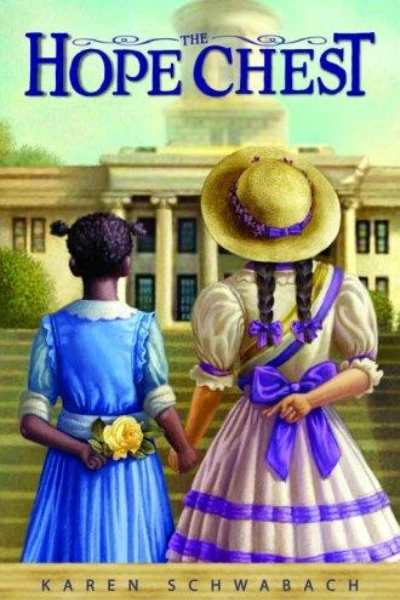
The Hope Chest
The Hope Chest — Chapter 16 - Politics and Gunplay
Politics and Gunplay
IN VIOLET'S OPINION, SUNDAY WAS AN ALMOST normal day. They packed a picnic lunch of sliced chicken sandwiches, pickles, and Chero-Cola and rode in the Hope Chest out to a quiet eld beside a river where there was nobody around to worry about what any of them looked like. They didn't wear any roses either. Violet and Myrtle rode in the wooden truck bed on the back of the Hope Chest. It was a bumpy, dusty ride, but Violet didn't care because she was wearing her horrible plaid dress and she was hoping to ruin it.
She did, too. Chloe insisted that the rst thing you had to learn about cars was how to take care of them, so she brought out a grease gun and an oilcan and showed Myrtle and Violet how to lubricate the spindle bolt and the steering ball socket and the universal joint and about a hundred other things Violet couldn't remember the names of. While the three of them climbed over and under the Hope Chest, getting gloriously dirty, Mr. Martin sat under a tree and read the Sunday paper.
Then Chloe showed them how to start the thing. Violet doubted she'd ever be able to start a car by herself. It seemed to require two people: one to turn the crank at the front (which was tricky, because if the car backred, the crank could break your arm, said Chloe) and one to work the throttle and the spark, two levers on the steering wheel. And you had to really listen, said Chloe. Violet didn't know
what Chloe was really listening for, because when the thing started, it sounded like a barrel of tin cans being eaten by a steam engine.
To drive the car, you had to use your feet to work the reverse pedal and the highand low-speed clutch and your hand to work the throttle. It was too much to think of all at once, and Violet was glad that they had this whole big open eld so that she didn't have to worry too much about steering. Instead, she concentrated on using the foot pedals and hand levers to keep the car running as it jolted and jumped over the hummocky eld.
When it was Myrtle's turn to drive, Violet went to sit with Mr.
Martin and look at the newspaper. Mr. Martin had prudently moved a little farther into the trees, out of the way of the Hope Chest.
“Is the whole Sunday paper about nothing but baseball?” Violet
asked, ipping through the pages.
“Pretty much. Isn't it grand?”
“Why is there nothing in here about what's going on with the amendment?” Violet asked.
“They're probably trying to pretend it isn't happening,” said Mr.
Martin. “Good heavens, I can't believe the Yankees lost to the Tigers.
They should never have taken on Babe Ruth.”
Violet noticed a story at the top of the page. “They caught him!”
Mr. Martin started. “Caught who?” he said warily.
“ ‘Veteran hobo at twelve is in hands of police,’” Violet read aloud. “Hobie. The fella who helped us get to Washington.”
“Poor lad,” said Mr. Martin. “But he'll be o on his travels again soon, I'm sure.”
Violet read the article. The reporter seemed very amused by the whole story and recounted that Hobie claimed he'd be o again in no time.
“Looks like the White Sox are getting stomped,” Mr. Martin observed. “They deserve it after last year.”
Violet looked up at Myrtle and Chloe bumping over the eld in the Hope Chest (Myrtle, who was shorter than Violet, seemed to be having considerable diculty seeing over the hood while working both the hand and foot controls) and then at Mr. Martin reading baseball scores. They all had something hanging over them, Violet thought. Myrtle had nowhere to go except back to the Girls' Training Institute. Poor Mr. Martin seemed to have nowhere to go but jail. And what about Chloe? Violet wasn't sure if Chloe saw anything after the Tennessee vote at all.
Later she and Myrtle took o their shoes and stockings and waded in a creek at the bottom of the eld. The water was pleasantly cool on their feet, and little minnows came up and nibbled on their legs as they stood in the current. Violet told Myrtle about Hobie being caught and sent home to his stepmother.
“He'll take o again,” said Myrtle. “Probably already has.”
“Do you ever think about what you're going to do with the rest of
your life, Myrtle?” said Violet.
“Yes,” said Myrtle.
“Well, what?” said Violet.
“I don't know. But it's going to be important,” said Myrtle.
They walked farther downstream and tried to catch some frogs.
When Violet nally did catch one, she held it for a moment, enjoying the cool feel of its soft clammy skin in her hands, and then it pushed o with its mighty hind legs and plopped into the water.
Violet asked Myrtle if it wasn't time they headed back, and Myrtle said it wasn't, so they walked even farther downstream and talked about the things they'd seen and done and heard in Nashville.
Violet wanted to know more about where Myrtle and Mr. Martin were staying, but Myrtle was curiously reluctant to talk about it.
“It's called Dead Horse Alley,” said Myrtle. “We're staying with a lady in her house.”
“Is it like the alleys in Washington?” said Violet, remembering the tumbledown shacks and heaps of trash and rats.
“Sort of dierent,” said Myrtle with a shrug. “Look, there's some kind of animal hole over here.”
So they went over to the bank and looked at a burrow under the roots of a willow tree and tried to decide what might live there.
Myrtle was fun to explore with, Violet thought, a lot more fun than the Antis. But the world seemed to have been set up so that Myrtle and Violet would always be on dierent sides of an invisible line.
By Monday, August 16, nobody could tell which side anybody was on anymore. Nobody knew when the House was going to vote. The Antis and the Sus were both polling the legislators every few hours, and it seemed like every few hours the list of who was an Anti and who was a Su had changed. Chloe told Violet at their noon meeting that she didn't think the polls were good at all anymore.
They had met at the lunchroom in Union Station because Violet was supposed to have been spending the morning watching the train station telegraph oces for the Antis. She hadn't really been doing this, of course, but she had gone down to the train station for verisimilitude.
Chloe had been assigned to spend some more time with Harry T.
Burn, but he had gone up to the capitol. The Sus' strategy required that only Tennessee women lobby legislators at the capitol.
Northerners were known to irritate Southerners, and the Sus didn't want the Tennessee legislators to be irritated.
“I don't think we have a chance with Burn anyway,” said Chloe.
“He's just enjoying the attention. He's so young.” Violet had heard that Burn was twenty-four, which was a year older than Chloe. “He's still wearing a red rose.”
“Let's go up to the capitol,” said Chloe when they nished their chicken salad sandwiches.
“But we're not supposed to,” said Violet.
“Oh, we won't lobby anybody,” said Chloe. “I just want to see what's going on. Besides, you've never seen inside it, have you? It's nice.”
Chloe drove the Hope Chest carefully along Broadway and then up Sixth Avenue, braking to let people pass. The city seemed to be getting more crowded every minute. Not everyone had yellow or red symbols to show that they were Sus or Antis—there were a lot of tourists who had just come to watch the battle. Chloe stopped to let a woman pushing a high-backed wicker wheelchair cross the street.
In the wheelchair was a young man whose legs ended at the knee, who Violet guessed from his age might've been a soldier. The woman looked like she might be his mother.
“I wish you hadn't left Stephen alone like that,” Chloe said.
“You wish I hadn't!” Violet was stung by the unfairness of this. “I didn't leave him alone; I left him with Mother and Father.”
“Yes, but being with Mother and Father can be a bit like being alone, you know.”
“Yes, I do know, as a matter of fact,” Violet said, folding her arms.
“Violet, you don't think I abandoned you, do you? Father threw me out.”
“No, he didn't,” Violet argued. “He told you never to darken his door again when you bought the Hope Chest, but you'd already moved out by then.”
“Yes.” Chloe stopped again; a yellow dog was wandering across the road ahead of them. “I had to leave, Violet.”
“So did I,” said Violet. “Anyway, it's not like Stephen really
notices who's around him.”
“I think he does,” said Chloe.
Then Violet remembered that Chloe had studied to be a nurse since leaving home. “Do people with shell shock ever get better?”
“Some do,” said Chloe. “It takes time. And it may be that they all do—it's a fairly new disease; we don't know much about it. Damn!”
The engine gave a loud pow and stopped running. “Now we're stalled. Violet, could you crank?”
Violet got out, went to the front of the car, and inserted the metal crank that turned the starter. She cranked until the car coughed,
spat smoke, and started. Then she got back in the passenger seat
next to Chloe. They chugged on.
“So what causes it, then?” Violet said.
“Well, some doctors believe it's caused by low air pressure in areas where a lot of shells have been red.”
“Not by …” Violet searched for a word.
“Cowardice?” said Chloe bluntly. “No, why should it be? After all, shell shock is a new disease, and cowardice is as old as humanity.”
Violet thought about this. It made sense. That was one of the nice things about Chloe: she was always so sensible.
Then Chloe ruined it by saying, “Violet, even if Stephen was frightened, why shouldn't he be? Surrounded by bombs and bullets and enemy soldiers?”
Violet made no reply. She liked the low-air-pressure explanation better.
The street in front of the capitol was full of Model Ts, parked diagonally on both sides. Chloe slid the Hope Chest into an empty space and they got out.
Violet remembered her red rose and pulled it o, sticking it inside her hat in case she needed it later. “Doesn't it matter, us going into the capitol together when I'm pretending to be an Anti?” she asked.
“I don't think anyone's paying any attention at this point,” said Chloe with a tired smile. “Both sides are panicking, just trying to gure out which side the legislators are on and when the vote is going to happen.
“There are some Tennessee Sus up here guarding the special House committee that's supposed to meet on the amendment tonight.” Chloe nodded up at the capitol.
“What's the committee meeting supposed to do?” Violet asked as they climbed up the seventy-two stone steps toward the capitol.
Violet had heard that a Model T Ford had climbed these steps a few years ago to prove the superiority of automobiles to horse-drawn carriages. Violet wondered if Chloe would be willing to try driving
the Hope Chest up these steps. She looked at Chloe's exhausted face and decided now was not the time to suggest it.
“A committee's job is to look at a bill and decide whether or not to send it to the oor to be voted on by the legislature,” Chloe said, sounding weary. “In this case, it's a bill saying that Tennessee raties the Susan B. Anthony Amendment.” She stopped to rest, leaning against the pedestal of a statue. “A week ago we had a clear majority; nearly two-thirds of the House members said they favored the bill. But thanks to the Antis and their businessmen and mystery men, it now looks like the committee might not even vote to send the bill to the oor.”
“And if it does get sent to the oor,” said Violet, moving around to see if there was any shade anywhere, “then it needs a three- fourths vote to pass?”
“Three-fourths? No, no. Only a majority. More than half of the House, that's all it needs.”
“In school we learned …” Violet frowned, trying to remember. It hadn't seemed nearly as important when they'd learned it in school as it did now. “A constitutional amendment requires a two-thirds vote of Congress and three-fourths of the state legislatures.”
“That means the legislatures of three-fourths of the states,” said Chloe. “In other words, thirty-six of the forty-eight states. And we've got thirty-ve and a half now. But we don't need the Tennessee House itself to vote three-fourths in favor. All we need is a simple majority. And we're so close.” She looked up at the old cannons that surrounded the capitol, left over from the Civil War.
“Capitols are built on hills so they can be protected if the people revolt,” said Chloe, looking up at the cannons and smiling.
Violet guessed from the smile that Chloe had probably heard this from Mr. Martin.
“Why are the women Antis even bothering?” Violet asked. This had been on her mind for the last several days. “If they're that much against voting, why don't they just not vote when they get the right?”
“Some people are never satised unless they're making choices for other people,” said Chloe. “And of course a lot of the Antis are funded by big business and by the political machines. Politics in this country is very corrupt, you know, Violet. Most elections are bought and sold. People sell their votes, and political machines in each city and state organize the purchase of votes.”
Violet nodded, too out of breath from the heat and the climbing to bother replying.
“The corrupt bosses don't want women to mess things up,” Chloe went on. “They've spent over a century building up the vote-buying system they've got now, and everything is so ne-tuned. If twenty- seven million voters are suddenly added to the rolls for the November election, it will destroy all their calculations.”
Violet moved around the statue again, still trying to nd a spot of shade. “Who was this fella?”
Chloe squinted up at the statue. “Edward Ward Carmack. He was a newspaper editor who was gunned down in the streets of Nashville a few years ago. His murderers were pardoned by the governor—not the governor they have now.”
“Pardoned by the governor?” Violet tried to look up at the statue silhouetted against the blazing white sun but couldn't. “They shot him down in the street in cold blood and they were pardoned by the governor?”
“Well, I don't know if it was cold blood,” said Chloe, patting the pedestal. “Mr. Carmack might have drawn rst. But in his newspaper he'd criticized the men who shot him, and he'd also criticized Governor Patterson. He was against the liquor interests, Mr. Carmack was, and Patterson was for them. Governor Patterson pardoned the killers before they'd spent a day in jail.”
“So the governor of a state can just have people he doesn't like killed?” Violet said. Nothing she had learned about government in school had suggested this.
“Oh, I doubt it was quite like that,” Chloe said. “Come on.”
As they climbed on, Violet looked back at the statue, suddenly struck with the idea that messing around in politics could be a deadly business. The liquor interests hadn't liked Mr. Carmack, and they didn't like suragists either. In spite of the midday heat, Violet shivered.
Inside the capitol the low, vaulted stone ceilings gave you the feeling you were underground. It was dark and felt cooler than outside. They climbed a wide stone staircase. Violet ran her hand over the cool stone handrail. There was a huge, jagged-looking gouge out of it. But when Violet touched it, she found that it too was smooth, as if hands had worn it down for many years.
Chloe noticed Violet looking at it. “That's from a bullet,” she said.
“When the Tennessee legislature met after the Civil War, some of the legislators tried to escape because they didn't want to vote for Tennessee to rejoin the Union. But there were soldiers guarding them, and they opened re.”
Violet stared at the gouge in the stair rail. “No wonder Father thinks politics isn't safe for women!”
Chloe laughed. “Well, I like to think once we're in, there'll be a little less gunplay involved. Anyway, you can see why the Tennessee legislators might still be a little persnickety about having Yankees in here telling them what to do.”
“Yes,” said Violet. She followed Chloe up the stairs.
The second story was lighter, with a high stone ceiling. The hallway was shaped like a cross. At one end was the House of Representatives, and at the other were the Senate and the library.
It all seemed oddly quiet after all the fuss and noise in the Hermitage and in the streets and in the train station during the last week.
“Thank goodness you're here, Miss Mayhew!” Miss Pollitzer burst through a doorway. “We need to work on two of the Su committee members, quick. We've lost them.”
“I thought only Southern women were allowed to lobby with legislators here in the capitol,” Chloe said.
“They're not in the capitol. I mean we've lost them,” said Miss Pollitzer. “Blotz and Credwell. They've own the coop. Do you know
what they look like?”
“I think so,” said Chloe.
“Then go, please. Look for them. We've got search parties out.
Mrs. Anne Dallas Dudley has gone to the Hermitage and Miss Sue Shelton White is searching the moving picture shows and Skalowski's Ice Cream Parlor. We have guards covering the train station, and I'm going down to check the Interurban station on Broadway, but Credwell might have an automobile. We need someone to drive out the highway looking for them. Is the Hope Chest nearby?”
Myrtle and Mr. Martin were trying a variation on their diet of sardines, Uneeda biscuits, and peaches. Myrtle had gotten a can of tuna sh instead. Myrtle was setting the Uneeda biscuits neatly out on a napkin on Mrs. Ready's oilcloth tabletop and Mr. Martin was just slicing through the lid of the tuna sh can with his pocketknife when the door burst open. It hit the wall with a loud crack, and a board fell o it and clattered to the oor.
Two men pounced into the room. They both had guns out, pointed at Mr. Martin. Myrtle dove into a corner.
“Don't move, Arpad,” one of the men barked.
Mr. Martin raised his hands over his head. “I'm not Arpad.”
“Of course you are. Who else would be able to pronounce it? Drop the knife. And that device you're holding in your game hand.”
Mr. Martin dropped the knife and the tuna sh on the oor. The knife stuck in the wooden oor. The can rolled lopsidedly, a smell of tuna sh rising from the oil dribbling out.
The men peered at the can intently. “Not a bomb. Just a can of tuna sh,” one of them announced. “Cover him, Hank. I'm gonna put the cus on him.”
The man who had spoken moved over behind Mr. Martin, grabbed his hands, and jerked them down behind Mr. Martin's back.
Myrtle winced in sympathy. It was what that evil brakeman had done to her on the freight train.
“Don't try nothing funny,” said Hank. “Nobody cares if we shoot dangerous alien radicals.”
“I'm not an alien,” said Mr. Martin. “I'm a U.S. citizen.”
“Uh-huh. And just when did you become a U.S. citizen, Arpad?”
“My name is Theodore Martin, and I was born in the United States.”
“Let's drop the Martin bushwa, okay? You're Sandor Arpad, you were born in some European hellhole or other—”
“Hungary,” the other agent put in.
“Hungary, then, around 1892, and you came to the United States in 1897. You lost three ngers in an industrial accident in 1898 and your left eye in a knife ght in 1916.” The man who was holding Mr. Martin's arms—he had handcus hanging at his belt, Myrtle noticed, but he made no move to get them—traced the scar from Mr. Martin's eye downward with his nger. It must be a glass eye, Myrtle realized. Mr. Martin jerked his head away.
“Resisting arrest,” the agent commented, twisting Mr. Martin's arms more tightly behind his back.
“It wasn't a ‘knife ght,’” said Mr. Martin through clenched teeth.
“The other man had a knife. I did not. And I am a U.S. citizen.”
“Right, you became a citizen in 1913,” said the agent. “In other words, after you'd already become a radical. A radical can't become a U.S. citizen. I think the courts will nd that your citizenship oath is null and void.”
“That's insane!” Mr. Martin protested. Drops of sweat stood out on his forehead. Having his arms twisted must have hurt a lot, but he was trying not to show it. That was being brave, Myrtle supposed, but she wished he would cry out in pain so that his captors would be satised and stop hurting him.
“In your position, I wouldn't go calling the laws of the United States of America insane,” the agent suggested.
“I don't believe that is the law,” Mr. Martin panted. “And if it is the law, then it is insane.”
“Did you hear that, Hank?” the agent asked.
“Sure did, Christopher,” said Hank. “Anything else you want to tell us about the laws of the United States, Arpad?”
Mr. Martin glared at both of them and would have liked to say a lot of things, Myrtle could tell. “Only that I'm as much a citizen of the USA as you are, and I know my rights.”
“You're a member of a radical organization and you don't have no rights,” said Hank smugly.
“I'm a member of a labor union,” said Mr. Martin. “It's my”—he gasped in pain and Myrtle winced again— “First Amendment right.”
“The International Workers of the World is a labor union the way the Boston Tea Party was a tea party,” Christopher said. “Quit arguing with us or we might notice you pulled a knife on us. You see how he had that knife out when we came in, Hank?”
He kicked at the open pocketknife where it had fallen on the oor. Myrtle would have liked to grab it and put it away, but then they'd probably say she'd pulled it on them.
“Sure did,” said Hank. “You gonna come along quietly, Arpad, or should we report you pulled a knife on us?”
Mr. Martin looked deated, the same way he had on the train when he'd argued with the conductor, Myrtle thought. “What choice do I have? I am coming along quietly.”
He looked at Myrtle as if he was about to say something. Myrtle shook her head and put a nger to her lips to silence him. It was better for both of them if Myrtle remained invisible.
In spite of the fact that Mr. Martin was coming along quietly, the agents seemed to nd it necessary to do quite a bit of kicking and shoving to get him out the door. Myrtle turned away. She picked up the knife Mr. Martin or Arpad or whatever his name was had
dropped, folded it, and stuck it in the pocket of her blue dress next to her picture of Mama and Daddy. She went to the cot where she slept and grabbed her toothbrush. She was just heading out the door when she bumped into Mrs. Ready coming in.
“Got him, did they?” said Mrs. Ready. “Thank the good Lord.
Child, now that you're free of that horrible man, I'm taking you to Mrs. Frankie Pierce. She's a colored suragist leader who's done wonders in nding institutions that will take in wayward colored girls, and I'm sure she'll nd—”
Mrs. Ready was packing up Myrtle's bundle as she said all this, and Myrtle didn't wait around to hear the rest of it. She didn't know if Mrs. Ready had turned in Mr. Martin—lots of people could have done it, he'd been so careless about staying hidden—and she wasn't about to ask her. If Mrs. Ready had done it, then she'd have to hate Mrs. Ready, and she really didn't have time for that. She ran out the door.