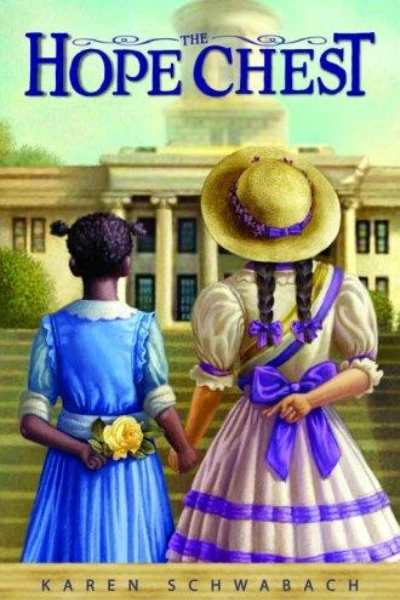
The Hope Chest
The Hope Chest — Chapter 19 - Freedom
Freedom
THEY TOOK THE STREETCAR OUT TO THE autocamp. The seats were all full and they had to stand. They didn't care. It seemed like nothing in the world could ever make them unhappy again.
The city had built the campground to accommodate the new sport of autocamping, which had become so popular these last few years.
Motorists could pitch their tents in the camps for free and stay as long as they wanted. Everyone was traveling all over America—at least, everyone who could aord an automobile and some gasoline — and people said it was just like the old covered-wagon days, only faster. But not much faster, because the roads were so bad.
Chloe and Violet walked to a tent at the back that had been turned around so that its door faced away from the rest of the campground—to keep Mr. Martin better hidden, Violet guessed. But Mr. Martin was kneeling on the ground outside the tent, tending a re. Myrtle stood beside him, clutching his shoulder possessively.
“There you are!” He jumped up and hugged Chloe, then reddened and stepped back. “I heard already. We won!”
“Theo, what have you done to your face?” Chloe demanded.
Violet thought his face looked rather bruised and battered, and he had a black eye. He had also been given a terrible haircut, it looked
like with a pocketknife. But Mr. Martin touched his scar. “I'm not wearing that stu.”
“You washed it o!” Chloe accused. “Theo, you have to wear it.
And stop washing it o. I paid fty cents for the bottle.” Chloe ducked into the tent and emerged a minute later holding a small glass bottle.
“I am not wearing Lady Janis Liquid Face Powder,” Mr. Martin said rmly.
“You have to wear it,” said Myrtle. “Miss Chloe sold her car to get you out of jail. So paint your scar and stay out of jail.” She took the bottle from Chloe and handed it to Mr. Martin.
“You sold your car?” said Mr. Martin. Chloe nodded. “You shouldn't have done that.”
“To get you out of twenty years in Fort Leavenworth? Sure, I should have.”
Mr. Martin silently sat down on a log and let Chloe dab Lady Janis Liquid Face Powder over his scar, his bruises, and his black eye. Myrtle and Violet watched with interest. The stu was a little bit lighter than Mr. Martin's face but darker than the scar. Once Chloe put on several coats, you couldn't see the scar if you looked at him from a distance. Or you probably wouldn't if you didn't already know the scar was there, Violet thought. And on a darker day, maybe.
“Now we'll celebrate!” Mr. Martin said. “You ladies are about to taste the nest of Hungarian dishes: rakott krumpli and zigeunerspeck.
Nothing else is good enough to celebrate the Nineteenth Amendment to the U.S. Constitution. At least, nothing that is legal in these abstemious times.”
He reached into the tent and brought out a paper sack, from which he began pulling out potatoes, onions, eggs, a cut of bacon, and a paper twist of spices.
“Theo, you went grocery shopping?” Chloe said in dismay.
“Anyone could have seen you.”
“I only went to the camp store,” said Mr. Martin with a shrug. He pulled out his pocketknife, which Myrtle had returned to him, and began peeling potatoes.
“You're hopeless,” said Chloe, sitting down beside him and taking a knife from her handbag. “We have to get you out of the country quickly.”
Although it was still sunny, a shadow seemed to have fallen over the campsite. They all drew closer to the re as if for warmth, although it was a hot day. There was silence for a moment.
“I was thinking about Argentina,” said Mr. Martin dismally, slicing into a potato. “They say it's very nice there.”
“Do you speak Spanish?” Violet asked.
“No,” said Theo. He set a naked potato on the toe of his boot and sliced it in half. “I've been meaning to learn.”
“What about Alaska?” said Chloe.
Mr. Martin looked at her in surprise. “Why would I go to Alaska?”
“Because Alaska gave women the vote as its very rst territorial act,” said Chloe. “And because it is a territory, not a state, and they hardly have any laws there. And it's about ve thousand miles away from Attorney General Palmer and his friend J. Edgar Hoover and their agents. And there are plenty of people there who have found it convenient to change their names.”
“You seem to know a lot about Alaska,” said Mr. Martin with a depressed-looking smile.
“She's wanted to go there all her life,” Violet put in. She remembered the picture Chloe had drawn for her of an Eskimo driving a dogsled.
Mr. Martin picked up another potato and studied it thoughtfully.
He looked at Chloe quickly and then back at the potato. “Do you want to go there, you know, I mean …” He stopped, at a loss for words, and stared at the potato.
“Do you want to go there with him, Miss Chloe?” Myrtle nished rmly. “Say yes.”
“Excuse me,” said Violet, jumping up. “I have to use the …” She stumbled blindly away from the campsite. She didn't have to use anything. She wandered between an autotent set up against the side of a Pan touring car and a red-and-white-striped tent that smelled strongly of mildew. She accidentally walked into the midst of a family sitting on the ground eating liverwurst sandwiches and pickles.
She knew it was dumb of her, but she'd just assumed Chloe would be going back to New York. She had gone on thinking that Chloe would let Violet live with her, even though Chloe had changed the subject every time she'd brought it up. She hadn't thought that Chloe— independent Chloe, who had spent her hope chest money on a car and called it her freedom—would ever get married. Well, lots of people said they never wanted to get married and then they went and got married just the same.
But they didn't go to Alaska when they did it.
Violet wandered over to the bathroom. It had real toilets and running water. She wandered on and found a kitchen house, with real stoves in it. All this for free, Violet thought. They shouldn't have wasted their money in the hotel. But she supposed it had been the National Woman's Party's money.
Chloe, Violet realized, had just come to the end of a long battle.
Violet had cared about women winning the vote for the last week or so—ever since she met the woman waiting for her son's con in Chattanooga. And these last few days it had meant a great deal to her. But she hadn't fought for it like Chloe had. That Chloe would want to move on to something else now was normal, she supposed.
That Mr. Martin should be the something else she wanted to move on to was … well, probably also normal. Only to be expected, really.
Mother and Father would be absolutely furious. Violet smiled.
That was some consolation. Furious wasn't even the word for it.
They had wanted Chloe to marry a Mr. R., not a one-eyed, seven- ngered Bolshevik who was on the run from the law and kept changing his name.
By the time she got back to the campsite, Chloe and Mr. Martin were standing side by side with their arms around each other, and Chloe's spare arm was around Myrtle.
“I've always wanted to go to Alaska too,” Myrtle was saying.
Violet decided to ignore all this. “There's a kitchen over there, with stoves,” she said. “You don't need to use the campre.”
“But we have to have a campre or we're not really camping!”
Mr. Martin said enthusiastically. He disentangled himself from Chloe long enough to ip the bacon in the frying pan resting in the ames. “In Alaska we'll cook like this all the time! No stoves in Alaska.”
“It's very cold there,” Violet reminded him. “Most of the year it's all snow and ice.”
“And dogsleds!” Chloe said. “And mountains!” She patted Myrtle on the head. “We'll have to wrap Myrtle up in a caribou parka to
keep her warm.”
Violet burned with jealousy.
She knew that she had a home to go back to—she didn't want to go back to it, but she could—and Myrtle didn't. She knew that Mr.
Martin had to leave the country or go to jail. But it wasn't fair. She had brought all of them together, found Chloe for Mr. Martin. And for Myrtle. And Myrtle and Mr. Martin for Chloe. That the three of them should all go o to Alaska and leave her was completely unfair.
“I want to go to Alaska too,” Violet said.
The three of them looked at her. Their faces were all sad, as if they all knew she wasn't going to Alaska.
“Let's eat,” said Mr. Martin.
They ate o tin plates, which, like the tent, Chloe had because she'd done a lot of autocamping during her travels from state to state over the last year. Violet had to admit that the stu Mr. Martin had cooked was good, whatever it was called. It certainly didn't look like any of the things he'd put into it.
“How did you two meet each other?” Myrtle asked.
Chloe looked at Mr. Martin adoringly. “He hit me on the head with a shovel,” she said.
“I did not!” Mr. Martin dropped his fork and tried to look annoyed but ruined it by looking adoring at the same time. “You walked into me. I was just carrying a shovel at the time.”
“Why were you carrying a shovel?” Myrtle asked.
Mr. Martin and Chloe both looked suddenly solemn.
“I know,” said Violet. “It was during the Inuenza. She was coming home from seeing inuenza patients, and he was coming home from … from digging graves for them.”
Suddenly Violet felt that she couldn't wait to be grown up and allowed to work, all day and into the night if she wanted, on something that mattered. Not taking care of sick people, necessarily, and denitely not digging graves, but some important work that needed doing. She wanted to feel again the way she'd felt this last week in Nashville: that what she was doing was going to make a dierence to somebody. The way she'd felt when her class knitted blankets for French orphans.
She thought about what Chloe had said, that college armed you to ght the great battles. She thought she knew what battle she needed to be armed for. She wanted to ght against the laws that put Myrtle in a separate train car and kept her out of hotels and away from drugstore lunch counters. Remembering the at expressions on the faces of the desk clerks and the conductor, she realized that was a battle that could last a lifetime.
And she knew, just as well as Chloe and Myrtle and Mr. Martin knew, that she wasn't going to Alaska.
A week later Violet sat alone on a fence in front of the autocamp.
She was waiting for some of the National Woman's Party ladies from New York, who had driven a big Packard motorcar to Tennessee.
Violet was going to ride back with them, autocamping the whole way. Auto-camping was America's most popular new sport, but
Mother and Father had always said that it was unsuitable for ladies and that one met entirely the Wrong Sort of People while autocamping. Violet hoped this was true. She expected she might like the Wrong Sort of People just ne. It would be an exciting trip, and Violet would be in charge of taking notes on the condition of the roads, which the ladies could then report to their automobile club and to the newspapers back home. The only bad thing about the trip was that there was a serious risk Violet might get back to Susquehanna in time to start school.
Mr. Martin/Hanover/Arpad and Chloe had gotten married under the name of Hanover, which Violet was a little worried about because she wasn't sure it counted. They had gotten a justice of the peace in another county to marry them, a county where Mr. Martin had not been in jail and wouldn't be recognized. Getting married seemed to be the one occasion in Tennessee when it was all right to have white and colored people in a room at the same time, and nobody tried to chase Myrtle out.
It had been a very brief ceremony, because when the judge asked Chloe if she promised to love, honor, and obey Mr. Martin, Chloe had said, “Obey him? What is that doing in there? I certainly don't.”
“Yes, really, that's a bit archaic,” Mr. Martin had said. “She's not my dog, you know. Don't you have a more modern marriage ceremony in there that you could do?” He reached politely for the book the judge was holding.
“Do you two want to get married or not?” the judge demanded.
“Yes, of course,” said Chloe, and Mr. Martin said, “That's what we're here for.”
“Fine. I now pronounce you man and wife,” said the judge, slamming his book shut.
“Why not woman and husband?” said Chloe.
“I was already a man when I came in here,” said Mr. Martin.
But the judge was through with them.
The Antis had tried for several days to get the Tennessee House to overturn their ratication of the Nineteenth Amendment, but instead the House voted and passed the amendment again. Then Governor Roberts signed the ratication and sent it by express to Secretary of State Colby in Washington, while the Antis kept sputtering and objecting and ling lawsuits.
Meanwhile, Chloe and Mr. Martin—Hanover—found someone who could give them and Myrtle a ride to Chicago. From there they would gure out a way to get to Seattle with Myrtle. Seattle was where ships for Alaska sailed from.
“But isn't that jumping bail?” Violet asked “Doesn't Mr. Mart— Hanover have a court date or something?”
“Please call me Theo,” said Mr.—well, all right, Theo, Violet decided. “According to what my wife tells me, I'm not out on bail.”
“He's not?” said Violet to Chloe.
“Uh-uh,” said Chloe happily. “Myrtle introduced me to a gentleman named Mr. Ezekiel, who she said knew a lot about bribes.
Well, not a gentleman, exactly, but a Su legislator. He knew exactly how to go about it. But I had to sell the Hope Chest to pay the bribe, which means I did use the money Granny Mayhew left me to get married after all,” Chloe said with a sigh. “Just like Granny meant me to.”
“I doubt your granny meant for you to spend it on a bribe to get your fella out of jail,” said Theo comfortingly.
Chloe brightened. “That's true. And I did make a lot of miles in the Hope Chest.”
“You have an education to get, Violet,” Chloe had told her before they'd left for Chicago. “You need high school— but don't take the domestic science program. Take sciences or academic, whichever you prefer. And then college. Remember what I said. College arms you to ght the great battles.”
“And how am I supposed to get Father and Mother to agree to all that?” Violet said.
“Insist,” said Chloe. “It won't cost them anything. There's your hope chest money.”
Two weeks ago Violet would have replied that it was no good insisting with Father, who seldom even spoke to her, or with Mother, who had no opinions except Father's. She would have said that the hope chest money might be hers in theory, but in reality it was tied up to a future she dreaded.
But now she knew what it was like to stand your ground. She knew what it was like to keep on when things seemed hopeless. And she knew that with patience and hard work, a radical, ridiculed idea —like women voting— could become as acceptable and ordinary as oatmeal.
Historical Notes
Real People
ALTHOUGH VIOLET, MYRTLE, CHLOE, AND MR. Martin are ctional, most of the characters who
appear in The Hope Chest are real, including Alice Paul, Lucy Burns, Harry T. Burn, Joe
Hanover, Hobie the Hobo, and Carrie Chapman Catt. The arguments used for and against
women voting are all real too. In 1920 many Americans believed they were living at the
dawn of a golden age, when war, alcohol, and poverty were about to vanish from the
earth. Others believed that the United States was on the verge of a communist revolution.
A few characters, including Mr. Ezekiel, Mr. Blotz, and Mr. Credwell, are made-up people
whose stories really happened. History has been too polite to record the real people's
names. You can read about them, and much more about the nal showdown in Nashville,
in The Perfect 36: Tennessee Delivers Woman Surage, by Carol Lynn Yellin and Janann
Sherman.
Miss Dexter is invented, but her attitude is not. Some suragists were racists. Some of
them would have liked to get the vote only for white women, but most realized that this
was unreasonable.
Woman Surage—Lost and Gained
AMERICAN WOMEN REGAINED THE RIGHT TO VOTE in 1920, 113 years after they lost it. Women
could and did vote in several states in the early years of our nation. The last state to revoke
the vote for women was New Jersey, in 1807.
Forty-one years later, in 1848, women began ghting to regain the vote at the Women's
Rights Convention in Seneca Falls, New York. Among the speakers at the convention were
three antislavery leaders: Elizabeth Cady Stanton, Lucretia Mott, and Frederick Douglass.
During these early years, the woman surage movement and the abolitionist movement
worked closely together. Freeing both women and African Americans seemed to be two
parts of the same goal.
Alice Paul sewing a surage ag
After the Civil War, the states ratied the Thirteenth, Fourteenth, and Fifteenth
amendments to the Constitution, ending slavery and giving African American men full citizenship and the right to vote. Some suragists reacted with resentment. The Fourteenth
Amendment put the word male into the U.S. Constitution for the rst time—before that, it had been the individual states, not the federal government, that denied women the right to
vote.
Suragist leader Susan B. Anthony wrote the amendment that eventually became the Nineteenth Amendment. It was rst introduced into Congress in 1878 but was voted down.
At the time of Anthony's death in 1906, only a handful of Western states and territories allowed women to vote.
Starting in the West and spreading to the Northeast, from Wyoming in 1869 to New York in 1917, the men in various states gradually agreed to let their sisters vote. No Southern
state gave women full voting rights. The state-by-state ght for woman surage seemed slow and wasteful to Alice Paul, a Quaker suragist from Pennsylvania. In 1916 Paul
founded the National Woman's Party, with the goal of getting Congress and the states to
pass the Susan B. Anthony Amendment. In this way, states where women were already
voting could help bring the vote to states that might otherwise never let women vote.
Congress passed the Susan B. Anthony Amendment in 1919. When it became part of the
Constitution in 1920, only one woman who had attended the 1848 Women's Rights Convention in Seneca Falls was still alive—Charlotte Woodward Pierce.
People believed that woman surage would bring about great changes, such as an end to war, child labor, alcoholism, and corruption. It was expected that women would all vote
the same way. They didn't. Some people say that women ended up voting “whichever way their husbands did,” but with the secret ballot, that's impossible to know.
As soon as the Nineteenth Amendment was ratied, Alice Paul began working on an
equal rights amendment. She continued working on this until her death in 1977. Thirty- ve states ratied it. It never became law.
Miss Maude Younger, legislative secretary of the National Woman's Party, working on her
Ford with her dog, Sandy
Despite his good deed on the morning of August 18, Governor Cox lost to Warren G.
Harding in the 1920 election. (By the summer of 1920, both Harding and Cox were Sus,
just in case.) Harding's administration was plagued by scandal, but he did pardon the “Bolsheviks” who were still in prison for having spoken out against the War.
The Inuenza
THE GLOBAL INFLUENZA PANDEMIC WAS A FORM OF bird u. It started out as a fairly mild disease
in the U.S. in the spring of 1918. By autumn it had traveled through Europe and Asia and back to the U.S., and had mutated into a deadly disease which killed an estimated 20 to 50
million people worldwide. At the time, it was called the Spanish Inuenza because Spain, a neutral country in World War I, reported a high death toll. The warring countries also had high death tolls but didn't report them because they didn't want to reveal any weakness to
their enemies.
Demonstration at the Red Cross Emergency Ambulance Station in Washington, D.C., during the inuenza pandemic of 1918
World War I
WORLD WAR I BEGAN IN 1914 WHEN THE GERMAN army overran Belgium and invaded France. It
ocially ended on November 11, 1918, although sporadic ghting continued for many years. It was ultimately one of the root causes of World War II in 1939.
The United States entered the War in 1917 and began sending large numbers of drafted and volunteer American soldiers (many carrying inuenza) overseas in 1918. The arrival of the strong American reinforcements, combined with a revolution in Germany, led to a German surrender.
Poster urging women to help the war eort, 1918
Jim Crow Laws
THE THIRTEENTH, FOURTEENTH, AND FIFTEENTH amendments to the U.S. Constitution ended
slavery and made African Americans full citizens, but some states passed laws to keep blacks out of sight and out of public life. Public facilities were segregated throughout the South, and some states required “literacy tests” for voting. The tests were so complicated
that nobody, black or white, could pass them, so the laws also contained a “grandfather clause.” The clause stated that you did not have to pass the test if your grandfather voted— that is, if you had a white grandfather. These laws were repealed in the 1960s as a result of the civil rights movement.
Civil rights march on Washington, D.C., 1963
Voting in America:
A Time Line
EIGHTEENTH CENTURY: MOST OF THE COLONIES have some form of elected government. Only
property owners can vote. In some colonies voting is restricted based on race, sex, and
religion, but the most important qualication is wealth.
1776: The Declaration of Independence, written by slave owner Thomas Jeerson, states
that “all men are created equal.”
1777: Women lose the right to vote in New York.
1780: Women lose the right to vote in Massachusetts.
1784: Women lose the right to vote in New Hampshire.
1787: The U.S. Constitution is ratied. It gives each state the right to determine the
qualications for voting. Most states restrict voting to male property holders over age
twenty-one; some states bar free African Americans from voting.
1801: Residents of Washington, D.C., lose the right to vote.
1807: Women lose the right to vote in New Jersey, the last state to allow women to vote.
1848: The Women's Rights Convention takes place in Seneca Falls, New York.
1856: North Carolina gets rid of the wealth requirement for voting—the last state to do so.
1867: The Fourteenth Amendment makes African Americans citizens but denes voters as
“male.”
1870: The Fifteenth Amendment gives African American males the right to vote.
1878: Congress rejects the Susan B. Anthony Amendment.
1880s: A series of laws known as the Chinese Exclusion Act deny Chinese Americans
citizenship.
1887: The Dawes General Allotment Act states that Native Americans can vote only if they
resign from their tribes.
1898: U.S. Supreme Court rules that U.S.-born children of immigrants are citizens.
1920: The Nineteenth Amendment gives women the right to vote.
1924: The Indian Citizenship Act makes Native Americans citizens, with the right to vote.
1943: The Chinese Exclusion Act is repealed; Chinese Americans gain the right to vote.
1946: Filipinos gain the right to become U.S. citizens and to vote.
Three suragists casting votes in New York City, 1917
1952: The McCarran-Walter Act gives rst-generation Japanese Americans the right to
become U.S. citizens and to vote.
1961: The Twenty-third Amendment gives residents of Washington, D.C., the right to vote
in presidential elections only.
1964: The Twenty-fourth Amendment eliminates poll taxes, which had been used to
restrict voting in the South.
1965: The Voting Rights Act eliminates so-called literacy tests, which had been used to
keep African Americans from voting in some Southern states, and gives the federal government power to oversee voter registration and fair elections in some areas.
1971: The Twenty-sixth Amendment lowers the voting age from twenty-one to eighteen nationwide.
1973: The Home Rule Act gives residents of Washington, D.C., the right to elect a mayor and city council.
1974: The Supreme Court rules that states may deny felons the right to vote.
1978: Congress passes the D.C. Voting Rights Amendment, which would have given Washington, D.C., residents representation in Congress. Only sixteen states ratied it.
End of book
You finished The Hope Chest
by Karen Schwabach