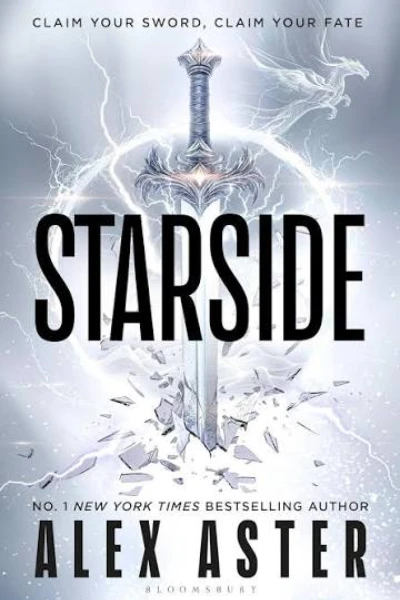
Starside
Starside — Chapter 2
2
I was ten years old when a goddess burned down my village like it was nothing more than kindling. Every night since, I’ve seen her eyes in my sleep, glowing silver with power. I’ve seen her metal-colored hair, and gem- encrusted skin, glittering in the light of the flames. I’ve seen the curl of her cape as she turned on her heel and left us all to burn.
I’m going to kill her, and the rest of the gods who have forgotten this side of the gates. Even if it kills me too.
Which means I have to survive the Culling. I have to become one of the Fifty. For them, I will survive anything. Even the haunted look in Stellan’s eyes as he watches me jump off the platform.
I can’t deal with his disappointment. Not yet. So, I use all the excitement and celebration as a cover to slip away.
The roads are crawling with the king’s guard. Their presence isn’t unusual, given how close we are to their training grounds. Still, seeing them never fails to fill me with rage.
Four years ago, in the worst of the drought, I turned a corner with a bucket of water I had carried for three hours from one of the remaining working wells, only to see a guard leaned against the wall, high on hemdrake. He took one look at my dry, dirt-crusted face and straining white knuckles and said, “Here. Let me help you with that.”
“No, I—”
I tried to turn, but he lunged forward, ripped the bucket from my hands, and poured the water out, little by little, right in front of my face, onto the broken cobblestones. He smiled the entire time, my horrified expression reflected in his marred silver armor.
He threw the bucket to the ground and passed me by.
I learned to take better roads. This one is usually clear.
The group I encounter now steps in front of me, and my bones clench.
Fury alights in my stomach.
When they see the ash arc on my brow, though, they back away. They must have been instructed not to mess with the king’s Questral challengers.
“Good luck,” one says, his voice full of whispered mirth. I hear something else, a murmur about how many challengers Raker will kill within the first hour, but I scurry away before I can hear anything more.
Choking on hot air, throat rough with thirst, I weave through the lines of caravans and carts that have been hauled from distant villages. I don’t stop until I reach the familiar patch of light brown soil at the base of the hill I visit almost daily, and then I begin to climb the weathered stone stairs.
Panic still bleeds through my chest like my body doesn’t know it’s not in danger anymore. My heart stutters. I stumble, before catching myself, blinded by flashes of the bloodshed—metal shattering, bodies going limp, blood turning the soil crimson, skin melting from bone in the flames. I grit my teeth, forcing the images into the dark corners of my mind as I focus on not twisting my ankle. I didn’t survive all of this to be taken down by some half-crumbled steps.
As a distraction, I start undoing my pins, slipping them into my pockets.
My hair gets in the way in the forge, so I always part it down the middle, then make two braids against my scalp at either side that merge into a big one at the back of my head. It usually hangs loose down my spine, but today I curved it into the gap between braids, like threading a needle, around and around until I could pin it all against my scalp. Now, I unravel it, releasing some tension as my braid hangs down again.
When I finally reach the ruins at the top of the hill, the full weight of what I’ve just done crashes into me. My knees buckle, and I collapse onto what’s left of the white marble floor, heaving, hands trembling. Only when I can breathe normally again do I fully press myself against the floor, then turn onto my back to squint up at the storm-gray sky, what’s left of the ceiling in pieces around me. My pulse drowns out all my senses, beating
loudly, as if declaring, I’m alive.
I did it. I can’t believe I did it.
I made it past the first step. I’m … going to the Culling.
I sit up. A breeze hisses through the columns of the ruins, prickling the ash arc on my brow.
This place is too broken to know what it once was, but a temple makes the most sense. Other than the Great Houses, the only structures built from materials this valuable are to honor the gods.
I found it years ago, while scavenging. At first, I wanted to try my best to finish the process of turning it to dust, because fuck them. But when the stone proved too hard to even make a dent, I tried to loot it. Everything of value was taken long ago … but there was one flash of color behind a massive rock. The border of what looked like a painting.
The idea of art, in a world of ruins … it seemed ludicrous. But it reminded me of finding wildflowers with my sister, years ago—a rare bloom in a wasteland. A spot of hope in a dark place.
So I came back every day for weeks, moving the stone blocking the color just inches at a time, until finally it was out of the way, revealing a landscape.
I instantly recognized the jagged horizon, formed by a mountain range like a serrated blade. I’d seen it multiple times.
Here.
I craned my neck past the wall and saw the same outline. This … was an ancient painting of this same view. But it might as well have been of another place entirely.
Because whereas this illustration was full of greens and blues, of forests
and rivers and flower-brushed valleys— Now I look out at endless dirt and ash.
“Why does the other side have all the magic?” I asked my mom when I was eight years old, while she combed through my hair, our nightly routine.
“We have our own magic,” she said, as she gently worked through a knot.
“We do?” I asked, eyes wide as I looked at her through the mirror.
She nodded. “We have the magic of warm socks, and nights playing cards by the hearth, and laughter, and love.”
I scowled at her. “That’s not magic.” I would have much rather had a dragon or magical sword from the stories she told before bedtime. The same ones her mother had told her.
“It’s the only magic that matters,” she said.
I didn’t believe her then. I do now, when it’s far too late.
With a grunt, I get to my feet, boots sliding in the rubble. I walk farther into the ruins, then crawl between two crumbled walls, reaching my hand deep, until my fingers brush against fabric.
I carefully withdraw my dust-covered pack.
It took years to save enough extra money from scavenging to get this simple bag and everything in it—a canteen for water, a bar of soap, some wrappings as bandages, a needle and thread, scraps of fabric, and a single gold coin that I traded everything of value for. It’s all I could manage, and my best guess of what I might need during the journey.
Guesses are all I have. Preparation for anyone but Great House heirs is almost futile. When the gates went up, all our books about the other side were magically stripped of their ink. All the poems went blank. All the paintings were drained of color, leaving only blank canvases.
Only stories, orally told, remained, and I don’t doubt the truth was twisted over time. All that’s left is myths and legends. Even our knowledge of the gods is limited.
But the heirs whose ancestors have gone on the Questral … they have the most recent information.
If I can somehow convince Stellan to tell me what he knows, then I’ll have it too.
I stare out at Nightfell, counting caravans, studying the crowds. Even if Stellan doesn’t tell me what he faced, soon enough … I’ll know.
I will survive the Culling.
I will cross those gates.
I have to.
And then, I will see for myself all that was meant to be hidden. I will see Starside, the world that birthed a thousand legends.
“I did it,” I repeat, this time aloud, eyes on the direction of where my home once stood. I feel that relentless pull toward it, the pain and loss a gaping wound in my soul, as if part of me is still there, kneeling in those ashes. “I did it for you.”
I take one last look at the mural, at the world that once was, and start the long trek down.
The streets are full now, packed with travelers already drunk on cheap ale. I take the long way around, through the ancient graveyard, along a row of abandoned houses, roofs caved in, paneling discolored, windows long
broken. Each neighbor packed up and left in the middle of the drought, in search of more food and water.
I still remember finding their caravans on the road, years later, their carts looted. Their skeletons. The children … I slip through the back, hoping Stellan is in the forge and won’t hear me —only to find him waiting right at the back door, like he knew I would be too much of a coward to go through the front.
Stellan’s eyes find my pack immediately. Then they find mine. I see the hurt there as he realizes this is something I’ve been planning for a while.
I lift my chin. “Save your breath. I’m not changing my mind.” I try to walk past him, but he steps to the side, blocking me.
Then I proceed to stand there and listen to every possible reason not to go with the Watchman tomorrow morning. Every way I could die. He maps it all out for me, as if my death is inevitable, careful not to tell me anything that could actually be useful. He has a list of dozens of ways I’m woefully unprepared, and shoots down every counter I make.
But hours of arguing are nothing when compared with ten years of hatred. It’s like lesser metal clashing against Starside steel and shattering into a thousand pointed pieces.
Finally, I throw up my hands. “Look. I’m going. You can’t stop me.
There’s no use spending our last moments together fighting about it.”
Last moments. I meant last hours, before the Watchman is at our door, loading me onto a cart that will take me east to the king’s castle, but I watch Stellan’s eyes flare with concern again and regret my choice of words.
We’ve never been good with them. We’ve gone days without saying anything to each other at all. Our language has always been that of smelting and shaping metal. He’d barely said anything during those first few weeks when he brought me here and all I could do was cry. I thought he didn’t care. I thought he was a giant oaf, all beard, thick eyebrows, and grunts. I thought he would forget me in the closet of a room he had piled blankets in.
I thought he might throw me back onto the streets.
One day he knocked on my door and came in to find me still crying. This is the end of warm blankets and soup left at my door, I thought. Tears were hot on my cheeks. This is good. If he leaves me to die, maybe I will. Maybe that would be better than all this pain.
But he didn’t kick me out of his house. All he did was slowly kneel before me, so our eyes were close to level. All he did was hand me a
figurine of a little girl holding a blade, in a fighting stance. It was painstakingly made of metal, so detailed, so expertly crafted that it could only be one person.
Through sniffling, I said, “But—but I don’t have a sword.”
He shook his head. Pointed his massive finger at the tiny figurine. “This here’s a dagger. Not a sword. And you will, if you get up and stop your crying.”
That was when he pulled a blade from his pocket. Something in me thought perhaps I should fear this towering man, with his hard eyes and weathered skin and long beard. He had a weapon. He could kill me. But I was so stunned by the sparkling metal, I stopped crying for the first time in
weeks.
He quickly sheathed it.
“It’s yours, when you’re ready for it. You can even design the hilt if you want. But only if you get up. It’s your choice.”
He stood. Then he offered me his hand. I knew what it meant, even then.
Either burn or rise from the ashes once and for all.
I took it.
And from then on, he spent his days teaching me to make swords and his nights teaching me to use them.
In the last decade, I never once saw his brow furrow. I never saw him display any type of emotion.
But now his face is all twisting lines. It’s easy to see the time that has passed.
I take a step forward, pushing off the wall. My tone softens. “If—if you want to help me live … then tell me something. Anything that will keep me alive.”
Stories about Starside are full of creatures and magic that are nearly too far-fetched to believe. But he knows the truth. He was one of the few survivors of the last Questral. He can tell me how he did it.
Stellan’s face hardens again. I ready myself, believing he might finally tell me something about the other side, after all these years.
“You want to live?” he says.
I nod. Of course. I need to survive until the very end to get to the gods. “I do.”
He leans in closer, as if about to tell me one of the world’s great secrets. I don’t dare breathe, in anticipation. It’s so quiet, I can hear the simmering of
the forge, and I remember all the work still left to do for the night. His mouth is almost to my ear.
“Don’t go, then,” he says, and then he passes by me on the way to the forge. I stay frozen in front of the hearth, hoping he might return, might actually tell me something useful, until I hear the familiar sound of pounding metal. It’s only when I feel around in my pockets that I realize he’s taken his dagger with him without my noticing.
Shit.
I don’t know what else I was expecting. He’s never said a word about Starside. Why would he help me now, when he’s still hoping I’ll stay?
In my foolish mind, I envisioned us sitting in front of these weak flames.
Him—telling me everything I need to know. Me—planning my survival.
Now I take a lesser blade from its hidden place on a high shelf, cursing Stellan and his ever-present concern for my well-being, and duck out into the night.
It’s suffocatingly hot, as always. A very convenient place for someone who must wear so many layers to live. Sweat already slips down the center of my chest, but I dutifully check the fabric at my throat, the way I have most of my life, just in case the collar has slipped.
Cursed markings.
As I approach the village square and see women wearing just bits of material, I wonder what that must be like. Feeling the wind against my bare skin. Having people look at me. Not hiding.
A curl of laughter spills out from inside a bar that is normally empty, considering few here have scraps of metal to spare. Through the open window, a teetering man spots the arc across my brow and tries to shove a chipped goblet into my hand.
I decline and cross to the other side of the road, making my way through a sea of strangers. I brush against fabrics worlds softer than the scratchy ones made by the local weaver, a woman with long, dirty nails who buys clothes I steal off corpses. Some weeks, she’s the reason we have enough to eat. She’s also the reason I have clothes that cover me, when usually so much fabric would be seen either as wasteful or dangerous in heat like this.
I turn another corner—then stumble back as a group of travelers pours out of the local inn. An inn I was sure was abandoned, given the fact that I have not, in the past decade, seen a single person inside of it. Now, its second floor is visibly sagging because of the crowd.
Stellan warned me of the throngs months ago. I thought he was exaggerating. Who would travel for days, or weeks, to see people die fighting to get onto a stone? It’s not like they actually get to see the events
of the mysterious Culling … Thousands of people, apparently.
Merchant carts have been wheeled in from miles away. Their lines make mazes through the normally empty streets. I weave through them, eyeing foaming mugs, whipped sugar, and spice-encrusted pastries. Some travelers will stay for as long as their coins last, just to await news of anyone making it back through the gates.
My empty stomach grumbles. I introduce it to my empty pockets.
I might not have scraps of metal to spare, but there are some mushrooms still left from my foraging.
My stomach twists—and not just from hunger this time. Stellan and I should be making soup instead of fighting.
Regret sinks through me. He sounded so upset. So disappointed. I should go back home, but I don’t. I turn again, toward the stone I barely made it onto. The crowds begin to thin, most people headed toward the carts. I see a
wisp of smoke.
“There she is. The hands thief.”
I jump, then whirl in the direction of the alley I just passed, blade clutched tightly. It’s copper, barely worth anything at all. One of the first daggers Stellan let me make.
A man is leaning against the brick, swirling a drink in a rusted goblet. He has brown skin, dark hair, and is so tall I have to lift my chin to look at his face. I recognize him from the platform. He tilts his head at me. “Aren’t you
sweating rivers in all that clothing?”
Yes. Literal rivers, it feels like.
I ignore his question and raise my brow. “Tell me you aren’t really going to drink that.” It’s one of the chipped goblets from the bar.
He cracks a smile. “Not even a drop. I’d like to make it to the gates. It would be a shame to have survived the platform only to be bested by bad ale.”
“Poisoned ale, more likely,” Kira says as she comes walking up to us from the other side of the street. Her red hair is now clean and combed, blood washed out of it. She’s frowning at her own cup. “This even looks disgusting.”
Poison wouldn’t surprise me. Some of the Great Houses would do whatever it takes to ensure their heirs make it to the Fifty. We’re all under the king’s protection for now, but poison is difficult to prove.
Kira dumps the liquid into a half-dead bush next to her. It will likely be full-dead by morning.
A shame. There’s such little green on this side to begin with.
“So,” Kira says, turning to the man. She stays at the mouth of the alley, in a pool of moonlight. “You are?”
“Zane,” he says. “From the Bladelands. Helmspeak, specifically.”
Kira stumbles forward, her suspicion instantly melting into excitement.
“Really?” The Bladelands are a stretch of mountainous territory to the west.
Stellan says people lucky enough to be born there die there. The top of the mountains remain lush. Every year, hundreds migrate to Helmspeak during the spring, when the conditions are less harsh. Few survive the climb.
Kira’s eyes are wide with a thousand questions. I just have one—if people die trying to reach his mountain’s peak, why leave?
Why risk almost certain death?
“Tell me. Are the Helmhawks real?” Kira is in the shadows now, halfway down the alley. I remain at its mouth, hand still gripped around my blade. I should move on. The frustration curling around my bones has already softened. I should go back and help Stellan finish the last of his orders. It’s the least I can do.
These are strangers. No—now they’re challengers. We’re all fighting for fifty placements. They’re rivals.
But I don’t move an inch. I’m curious to hear Zane’s answer, I realize. I
haven’t been west at all.
“They were,” he finally says.
The town weaver likes to talk while she makes my clothing. Listening gets me a discount. She claims she was once the personal tailor to a Great House heir, who wanted fabrics from all corners of Stormside. So she traveled to almost every one, collecting fabrics for her boss as she went.
And for herself … she collected buttons. She has a drawer of them, locked with a key. Each button has a story. Over the years, she’s told me almost all of them. I go to the drawer sometimes and pick one out. Tell me this one again, I’ll say. That’s how I know about Helmspeak and the hawks that once lived there.
Helmhawks are said to be larger than people and congregate on the highest peak they can find, which on this side is Helmspeak. Rumor is that hundreds of years ago they allowed themselves to be ridden.
“They’re gone?” Kira says, so loudly a few passersby turn toward the alley.
Zane nods. “About a century ago, they left. Only a few giant feathers remain. The only proof they were ever there to begin with.”
It’s the story of this entire side. After the war, and the gates, all magic on this side faded. Nature withered. We rely on the magic that is brought back.
These few years right before the next Questral are the hardest.
Maybe I should feel guilty for not having any intention of returning.
Maybe I should be fueled by something more honorable than revenge.
The gods are the reason for our suffering, though. When they die, the gates will fall. Magic will not be hoarded on one side any longer.
Kira grips my elbow, and I nearly stab her through the chest on instinct.
I’m glad I hesitate, though, because all she does is laugh and say, “Look at those fools. They’re going to be retching off their carts tomorrow.”
She’s staring at the group of ash-crowned challengers sitting on the dark platform, in front of a newly started fire. They’re drinking wine they must have brought themselves, because nothing that nice is sold anywhere close to here, even at the carts. Discarded bottles have gathered at their feet, over the blood-stained ground. The glass itself is worth something. I bury the urge to collect it. To make it into something I can sell.
Some challengers sit with women in their laps. Some are already passed out in the mud. Some aren’t challengers at all.
Half the king’s guard is here, standing and celebrating as if they each managed to gain a spot on the platform when it counted. My fists lock when I see them. My skin prickles with long-held fury.
Their leader sits in front of them, his massive sword dug into the dirt beside him. It’s standing on its own.
It’s the most valuable weapon on this side of the gates. I instinctually contemplate how much it would go for in the desert markets … Useless, really. For even if it wasn’t protected by knights, and Harlan Raker himself, I couldn’t claim it.
I would have to be more powerful than Raker. An ancient sword isn’t chosen; it’s claimed by both sides. Earned.
As if sensing my notice of his weapon, Harlan Raker’s head snaps up.
For a moment, the air seems to still. A chill licks down my spine. Fear. A creature encountering its species’ greatest predator. A ruthless killer. His hood casts his entire face in shadow, even the mask doesn’t glimmer. He would slay me where I stand if it wasn’t against the rules. If it was worth his time at all.
My mind says to look away. To step back into the shadows of the alley.
But I remember that day in the rain. The day I begged him for mercy. I
begged him to let me go.
He didn’t.
I don’t drop my gaze, even if I can’t see his eyes. Mine narrow as if they could convey even a fraction of my hatred for him.
The bastard doesn’t even look fazed. He doesn’t look anything. Of course he doesn’t. I can’t see his face, but his unbothered posture shows enough.
Someone taps him on the shoulder, and finally he turns, as if I’ve already been forgotten. As if he doesn’t remember me in the first place.
“Chances are he kills one of us,” Zane says, almost casually, motioning
toward Raker. He’s by my side now.
Kira gives him an incredulous look.
Zane only lifts a shoulder. “It’s true. No use in pretending it isn’t.”
He’s right. Harlan Raker once slayed an entire uprising himself. A hundred people against him, and he is said to have emerged without even a drop of blood on his armor. His movements were so precise, his blade so sharp, that it looked like he hadn’t been to battle at all, according to the few merchants who passed through town, leaving behind gossip.
But he’s not the only one with Starside steel going into the Culling. I’ll convince Stellan to let me bring his dagger. He’s angry … but he always promised that one day it would be mine.
Stellan likes lists. He makes one every morning of all our tasks and orders. On my way home, I make one of all the reasons he should help me.
Revelers stumble through the streets. The ash arc earns me a few bowing heads, and compliments, and—mostly—bets on how long I’ll last in the Culling. Not long at all, apparently. No one tries to steal my dagger, though, which is a marked improvement from my typical walk home.
I don’t hear Stellan in his forge, even though he locks himself in there all night whenever we get in an argument. Maybe he’s decided to forgive me, I think, hope flaring in my chest. Maybe he’s going to offer me the dagger.
Maybe I won’t need the list, which would be good, because it wasn’t all that convincing to begin with.
I don’t want to part on bad terms. I don’t want him to sit here in this house alone, hating me.
“Stellan?” I say, floorboards creaking as I inch through the house. The hearth has gone dark. I use the poker to brush a layer of cinder away, uncovering the few glowing embers. I add some kindling and blow softly, gritting my teeth like I always do whenever I’m near fire. The logs flame.
I turn around, thinking he must have already gone to bed, and gasp.
Stellan is lying in the center of the room in a pool of blood.
Roaring fills the world. I’m on my knees beside him, feeling around for where he’s hurt, my fingers finding gaping skin like screaming mouths. My hands slip in the blood. There’s so much of it. I need help, I—
His hand comes over mine. It’s cold.
“I—”
“Let me speak, child,” he says. His words are labored, as if he’s fought to stay conscious. How long has he been on this cold floor, in the dark? How long has he waited for me to come home?
Regret pierces me deeper than any blade could. I shouldn’t have left. I should have joined him in the forge. This never would have happened— His arm shakes with effort as he reaches to tap my pocket, and the copper blade inside of it. It’s weak, nothing like his.
His. I look at his scabbard, only to find it empty.
No.
This is my fault. One of the challengers must have seen me use the dagger, seen how easily the glimmering steel cut through bone, and shattered steel. They knew it would be invaluable during the Culling. They came here to get it.
He hands me my own blade. I know what he means.
He wants me to kill him. He wants me to claim his dagger. If I don’t, the
person who did this will.
But I can’t.
I shake my head. A sob rips from my chest, echoing through the room.
He takes my hand. It’s trembling. “Listen to me. Listen. Find Vander Evren.” His voice is so faint, I barely understand him.
“What?”
He doesn’t answer. All he does is curl my fingers around my dagger. All he does is drag both of our hands toward his heart. His eyes are pleading.
“Kill me,” he says, choking on the words.
I remember the figurine, still sitting on my bedside. I remember the day he let me accompany him to a Great House to hand-deliver a sword. I remember the village just outside the estate, and how he opened the tattered bag of metal scraps he kept in his front pocket and used one of his only copper ones to buy me a sugar-encrusted piece of fried bread. How I looked up at him and smiled wide after the first bite. How I stuffed half of it into his mouth, and he pretended not to like it, but I knew he did. How he taught himself to sew to make me long-sleeved shirts that covered my marks up to my throat—that kept me alive—when I was too young to make them myself, and before the weaver set up her shop. How, whenever I failed at something, he would tell me to rise from the ashes and call me a phoenix.
“I can’t,” I say, tears blurring my vision.
“Fool,” he says, and then he dies.
I stay with his body until dawn turns the floorboards scarlet. Until the sun sparkles in his lifeless eyes.
Until there is a single knock on the door, and a high-pitched screech.
Carts creak outside. There’s the murmuring of voices.
My tears have all been used up. They’re dried against my heated cheeks.
The dark pit in my stomach, the one where all my worst memories and emotions live, is churning. I push it down. I push it all down, because if I don’t, I will never get up again. I will lie beside Stellan and finally let the rage and agony extinguish me.
The only thing that keeps me from doing just that is the fact that Stellan would have hated it.
My voice is pure conviction. “I will find who did this, and I will kill them. I will use everything you taught me, everything you made me, and I will kill them all.” I press my lips to his cold forehead.
Then I take my things, get in a cart, and watch as my village becomes nothing more than a smudge of ash.